Gochugaru Sausage Rose Fusilli
Pasta Easy

Gochugaru Sausage Rose Fusilli

Quick answer

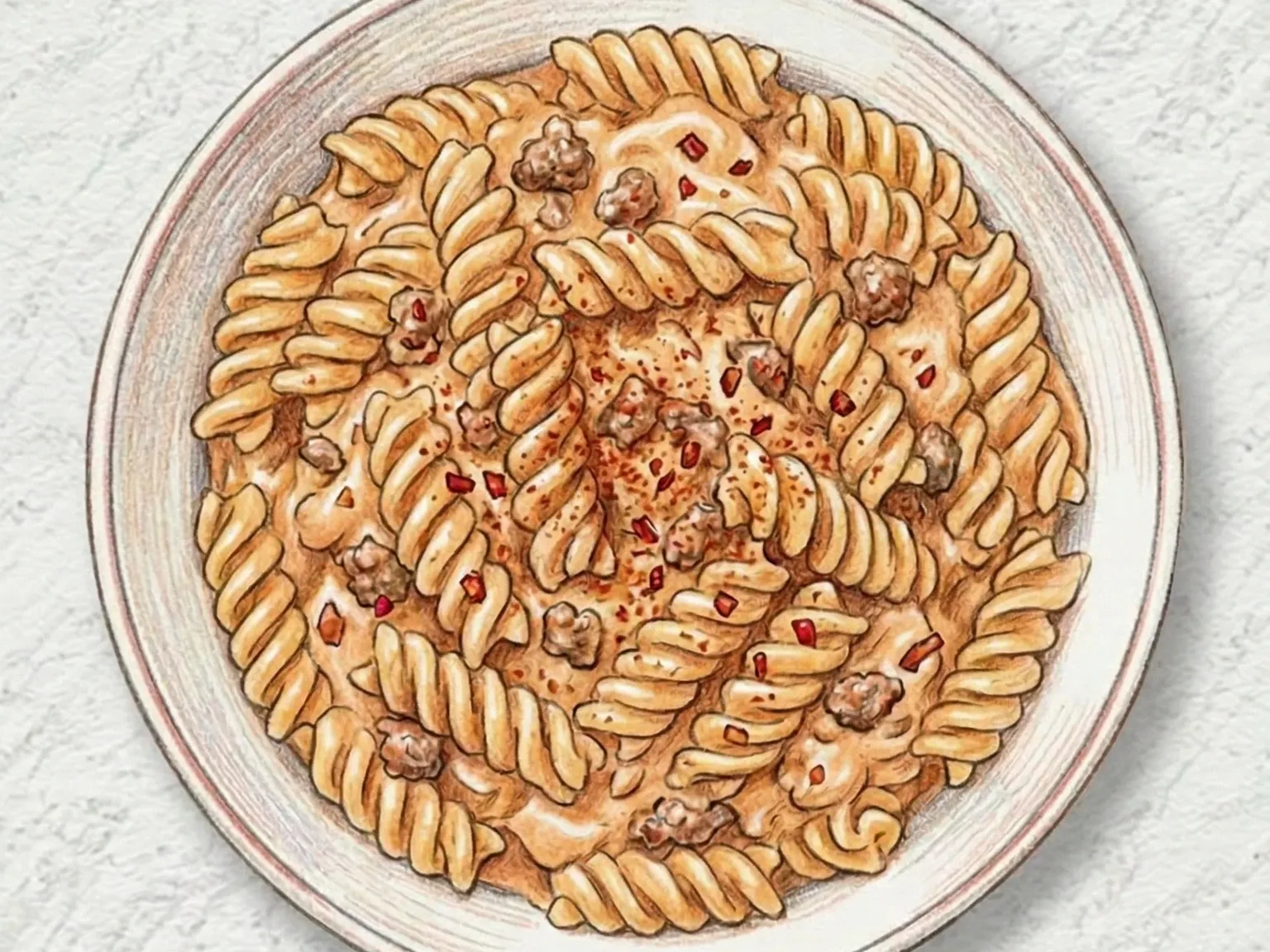
Gochugaru sausage rose fusilli starts by removing the casing from Italian sausages and breaking the meat into irregular pieces before browning it in a pan over high heat.

What makes this special

  • Crumbled Italian sausage and spicy gochugaru flakes flavor this creamy rose fusilli pasta.
  • Casings removed and crumbled for more surface area and intense browning
  • Onion and garlic sweated in sausage drippings before tomato and cream
Total time
30 min
Level
Easy
Servings
2 servings
Ingredients
9
Calories
860 kcal
Protein
29 g

Key ingredients

fusilliItalian sausageoniongarlictomato sauce

Core cooking flow

  1. 1 Finely dice 80g onion and 3 garlic cloves.
  2. 2 Cook 180g fusilli in salted boiling water for 1 minute less than the package time.
  3. 3 Heat 1 tablespoon olive oil over medium heat.

Gochugaru sausage rose fusilli starts by removing the casing from Italian sausages and breaking the meat into irregular pieces before browning it in a pan over high heat. Irregular pieces create more surface area than a smooth patty, which means more of the meat comes into contact with the hot pan and browns more thoroughly, producing a deeper meaty base for the sauce. Onion and garlic are added to the rendered sausage fat and cooked for three minutes to build sweetness underneath the savory elements. Korean red pepper flakes are stirred into the fat next and fried for just twenty seconds so their aromatic compounds bloom without burning, giving the sauce a warm, rounded heat rather than sharp spiciness. Tomato sauce goes in immediately and simmers for three minutes to concentrate and shed its raw acidity against the fat. Heavy cream and a ladle of pasta cooking water are added together and the sauce is reduced until it turns the characteristic pink of a rose sauce. Fusilli is tossed directly in the pan so the thick sauce can work its way into every spiral groove, ensuring each fork-load is well coated from surface to center. Finishing with grated Parmesan adds saltiness and helps the sauce emulsify slightly, while fresh basil leaves torn over the top provide a clean aromatic note.

Prep 10min Cook 20min 2 servings

Instructions

Read the steps as a cooking flow: prep, heat, seasoning, doneness control, and finish.

6 steps
  1. 1
    Step

    Finely dice 80g onion and 3 garlic cloves.

    Remove the casing from 180g Italian sausage and break the meat into crumbles with your hands.

  2. 2
    Finish

    Cook 180g fusilli in salted boiling water for 1 minute less than the package time.

    Reserve 80ml pasta water.

  3. 3
    Control

    Heat 1 tablespoon olive oil over medium heat.

    Cook the sausage crumbles for 3 minutes until browned, then add the onion and garlic and saute for another 3 minutes.

  4. 4
    Control

    Add 1 teaspoon gochugaru and stir-fry for 20 seconds to bloom the spice.

    Pour in 180ml tomato sauce and simmer over medium heat for 3 minutes.

  5. 5
    Control

    Add 120ml heavy cream and 50ml pasta water and simmer for 2 minutes.

    Add the cooked fusilli and toss until the rose sauce coats every spiral.

  6. 6
    Finish

    Turn off the heat, stir in 20g grated Grana Padano to adjust consistency, then plate and serve.

After the steps

Pick a recipe that fits this dish.

Continue with shared ingredients, meal pairings, or a similar method.

Recipes That Go Well With This

More Pasta →

Based on shared ingredients and meal pairing

Mala Chicken Alfredo Fusilli
Shared ingredient: fusilli Pasta

Mala Chicken Alfredo Fusilli

Mala chicken Alfredo fusilli is a fusion pasta that brings Sichuan mala sauce -- built on the numbing tingle of Sichuan peppercorn and the heat of dried chili -- into a cream-and-Parmesan Alfredo base. Chicken thigh is cut into bite-sized pieces and pan-seared to build a browned crust, then garlic and onion are sautéed in the residual fat to form the aromatic foundation. The Alfredo sauce is assembled from heavy cream, milk, and Parmigiano-Reggiano, with mala sauce stirred in to layer the peppercorn numbness against the dairy's richness. The amount of mala sauce added can be adjusted freely, making it straightforward to dial the level of tingling heat to preference. Fusilli's spiral ridges trap the thick sauce deep into their grooves so each piece delivers an even coating of flavor, and butter acts as a bridge between the cream base and the assertive spice, pulling both into a cohesive, glossy whole.

Heukimja Cream Bacon Rigatoni (Black Sesame Cream Pasta)
Shared ingredient: onion Pasta

Heukimja Cream Bacon Rigatoni (Black Sesame Cream Pasta)

Black sesame cream bacon rigatoni is a fusion pasta that earns its crossover status through ingredient logic rather than novelty. Roasted black sesame ground to a fine powder and blended into heavy cream and milk produces a sauce with a deep, slightly bitter nuttiness - closer to a nut butter than a standard cream - with a grey-toned color that signals immediately this is not a conventional cream pasta. Bacon fried until crisp adds salt, smoke, and crunch at regular intervals throughout the dish, which is important because the sauce, however rich, stays uniform in texture without it. Rigatoni is the right format here: the tube shape traps sauce both inside each piece and on the outer ridges, so every forkful delivers the full flavor load. Finishing with grated Parmigiano or Pecorino deepens the salt and umami content, and a final dusting of black sesame powder over the plated dish reinforces the Korean ingredient that anchors the whole concept. The combination works because black sesame and cream are both fat-forward and round - they do not fight each other.

Zucchini Noodle Salad
Serve together Salads

Zucchini Noodle Salad

Zucchini noodle salad spiralizes or peels zucchini into long noodle strands and tosses them with halved cherry tomatoes and minced garlic in a lemon juice and olive oil dressing, finished with shaved Parmesan and fresh basil. Zucchini has a high water content that releases quickly once dressed, so the salad must be tossed immediately before serving to prevent the dressing from becoming diluted. Finely minced garlic dispersed through the olive oil distributes a sharp, pungent flavor evenly across every strand, and lemon juice gives the mild zucchini a defined, bright direction. The cherry tomatoes burst with juice that acts as a secondary dressing, and the Parmesan contributes salt and umami that pair with basil's herbaceous aroma to produce depth without any cooking.

Gochugaru Anchovy Broccolini Orecchiette
Similar recipe Pasta

Gochugaru Anchovy Broccolini Orecchiette

Gochugaru anchovy broccolini orecchiette uses anchovy fillets dissolved in olive oil as the flavor foundation. The fillets go into the pan with garlic over low heat and are stirred continuously until they break apart and disappear into the oil, leaving behind deep salinity without any trace of fishiness. Korean red pepper flakes are added next and fried in the anchovy oil for twenty seconds so their aromatic compounds are released into the fat without scorching. The tomato sauce goes in immediately after and simmers for three minutes to cut its raw acidity against the rich oil base. Broccolini is blanched directly in the pasta cooking water during the final two minutes of boiling, which saves a separate pot and keeps the florets just crisp with a slightly bitter edge intact. Breadcrumbs toasted separately in a dry pan until golden are scattered over the plated pasta for crunch, since orecchiette's small ear shape traps sauce inside but offers a soft bite throughout. A squeeze of lemon juice is added off the heat to cut through the oil and brighten the plate. Parmesan shaved over the top adds a final layer of sharp saltiness.

Serve with this

Affogato
Baking Easy

Affogato

Affogato means drowned. A scoop of vanilla gelato, one shot of espresso pulled fresh, and that is the recipe. Its origins are placed in Milan's coffee bars around the mid-20th century, though the logic behind it is older - hot poured over frozen, bitter cut with sweet. What makes it work is physics as much as flavor: near-boiling espresso hits frozen cream and immediately begins melting the contact layer, creating a rapidly shifting border where coffee and vanilla blend before the temperatures equalize. The window for that state - two things at once, neither fully dominant - lasts roughly two minutes. The espresso must be poured at the table while the crema is still intact and the heat at its peak; a shot left sitting a minute loses both. Dark chocolate shaved on top introduces a dry cocoa note. Toasted almond slices give a crunch that holds briefly before the melting ice cream claims them too. Once everything is warm and uniform, it has become a coffee drink. The dessert lives in the transition.

🧒 Kid-Friendly ⚡ Quick
Prep 5min Cook 2min 2 servings
Cream Pasta
Western Easy

Cream Pasta

Cream pasta begins with bacon rendered crisp in butter, building a fat base that carries the flavor of everything that follows. Diced onion and minced garlic cook in the rendered fat until soft and fragrant before the heavy cream and milk go in, which is the combination that gives the sauce body without making it too dense. Heavy cream alone would weigh the pasta down, so the milk lightens the mixture to a consistency that clings to each strand without pooling at the bottom of the bowl. The cooked pasta is transferred directly into the sauce pan while still hot, and two to three tablespoons of starchy pasta water are stirred in to help the sauce emulsify and adhere evenly to the noodles. Freshly grated Parmesan is added off the heat so it melts smoothly rather than clumping, contributing a salty edge and a fermented depth that rounds out the simple cream base. The finished dish layers the smoky, cured saltiness of bacon against the mild richness of cream and the aged sharpness of Parmesan for a well-balanced, satisfying bowl.

🏠 Everyday 🌙 Late Night
Prep 10min Cook 20min 2 servings
Tomato Basil Juice
Drinks Easy

Tomato Basil Juice

Tomato basil juice is a cold savory drink made by blending ripe tomatoes with fresh basil leaves and straining the result through a fine sieve to remove seeds and skins. The ripeness of the tomato determines much of the flavor: fully ripe tomatoes carry free glutamates that produce a natural umami depth, whereas underripe fruit tastes predominantly sour without the sweetness and savory body that makes the juice satisfying. Basil should be added to the blender immediately before blending rather than sitting cut or torn, because the volatile oils that produce its aroma begin oxidizing quickly once the leaves are damaged. After blending to a smooth consistency, passing the juice through a fine-mesh strainer or cheesecloth removes the solids and produces a texture smooth enough to drink without resistance. Salt and black pepper season the juice, and fresh lemon juice raises the acidity in a way that brightens the overall flavor rather than making it sour. A small addition of olive oil emulsifies into the juice and activates fat-soluble aromatic compounds in both the tomato and the basil, producing a fuller, rounder flavor than the unstrained version. The juice must be thoroughly chilled before serving, as warmth mutes the herbal freshness. It works well as a brunch drink, a light non-alcoholic aperitif, or a base for savory cocktails.

🍺 Bar Snacks ⚡ Quick
Prep 10min 2 servings

Similar recipes

Gochujang Cream Pasta (Spicy Fermented Chili Cream Sauce)
Noodles Medium

Gochujang Cream Pasta (Spicy Fermented Chili Cream Sauce)

Gochujang cream pasta is a fusion dish that incorporates the fermented heat of Korean red chili paste into an Italian-style cream sauce. Heavy cream forms the base and parmesan provides the sharp, aged umami, while gochujang contributes a slow-building spice and the complex fermented sweetness that sets it apart from using raw chili pepper. Bacon is rendered first to extract enough fat for sauteing the onion and garlic, and that combination of cured pork fat, aromatic vegetables, and fermented paste forms the flavor core of the sauce before any liquid is added. Gochujang should be added at a reduced heat and stirred in gradually rather than dropped in all at once, since the paste can scorch quickly when exposed to a high-temperature pan. A ladleful of starchy pasta water adjusts the consistency and acts as an emulsifier, helping the fat from the cream and bacon stay bound with the aqueous components rather than separating. The result is a glossy, clinging sauce that coats each strand of pasta evenly. The balance between the richness of the cream and the acidity and heat of the fermented paste is what has made this combination popular in Korean home kitchens and casual restaurants alike.

🏠 Everyday 🎉 Special Occasion
Prep 12min Cook 18min 2 servings
Chili Garlic Pork Belly Arrabbiata Penne
Pasta Medium

Chili Garlic Pork Belly Arrabbiata Penne

Chili garlic pork belly arrabbiata penne builds its flavor entirely from the fat rendered out of slowly crisped pork belly. Cooking the belly over medium-low heat until the surface is crackling and golden draws out the fat gradually, infusing it with a deep, savory richness that becomes the sauce's foundation. Minced garlic goes into the rendered fat next, followed by crushed tomatoes that reduce into a concentrated, spicy sauce. The tomato's natural acidity cuts through the fat's weight, preventing the sauce from turning heavy. A small ladle of starchy pasta water added before tossing emulsifies everything into a glossy coating. Penne's hollow tubes and ridged exterior capture the sauce both inside and out, so every bite delivers the smoky pork fat, tangy tomato, and chili heat simultaneously. Finishing with the reserved crispy pork pieces scattered on top adds a textural contrast between the sauce-soaked pasta and the crunchy meat.

🍺 Bar Snacks 🎉 Special Occasion
Prep 18min Cook 25min 4 servings
Spicy Seafood Tomato Pasta
Western Medium

Spicy Seafood Tomato Pasta

Spicy seafood tomato pasta starts by building a chili-infused oil base - garlic, onion, and red pepper flakes sauteed in olive oil until fragrant. Shrimp and squid are seared briefly until just opaque on the outside, then hand-crushed whole tomatoes are added and the sauce simmers for six to seven minutes, during which the tomato reduces and absorbs the juices released by the seafood. Cooking the seafood only until the surface turns white is critical, as the residual heat from the simmering sauce finishes them gently without making them rubbery. The spaghetti is boiled one minute short of al dente and tossed in the sauce pan with a splash of pasta water over high heat, which emulsifies the sauce and binds it to each strand. The chili heat cuts cleanly through the tomato's acidity and the seafood's brininess, and chopped parsley adds a final fresh herbal note.

🍺 Bar Snacks 🎉 Special Occasion
Prep 15min Cook 18min 2 servings

Tips

If sausage releases too much fat, blot some out to avoid greasiness.
If sauce is too thick, add pasta water one spoon at a time.

Nutrition (per serving)

Calories
860
kcal
Protein
29
g
Carbs
69
g
Fat
50
g