Hungarian Goulash
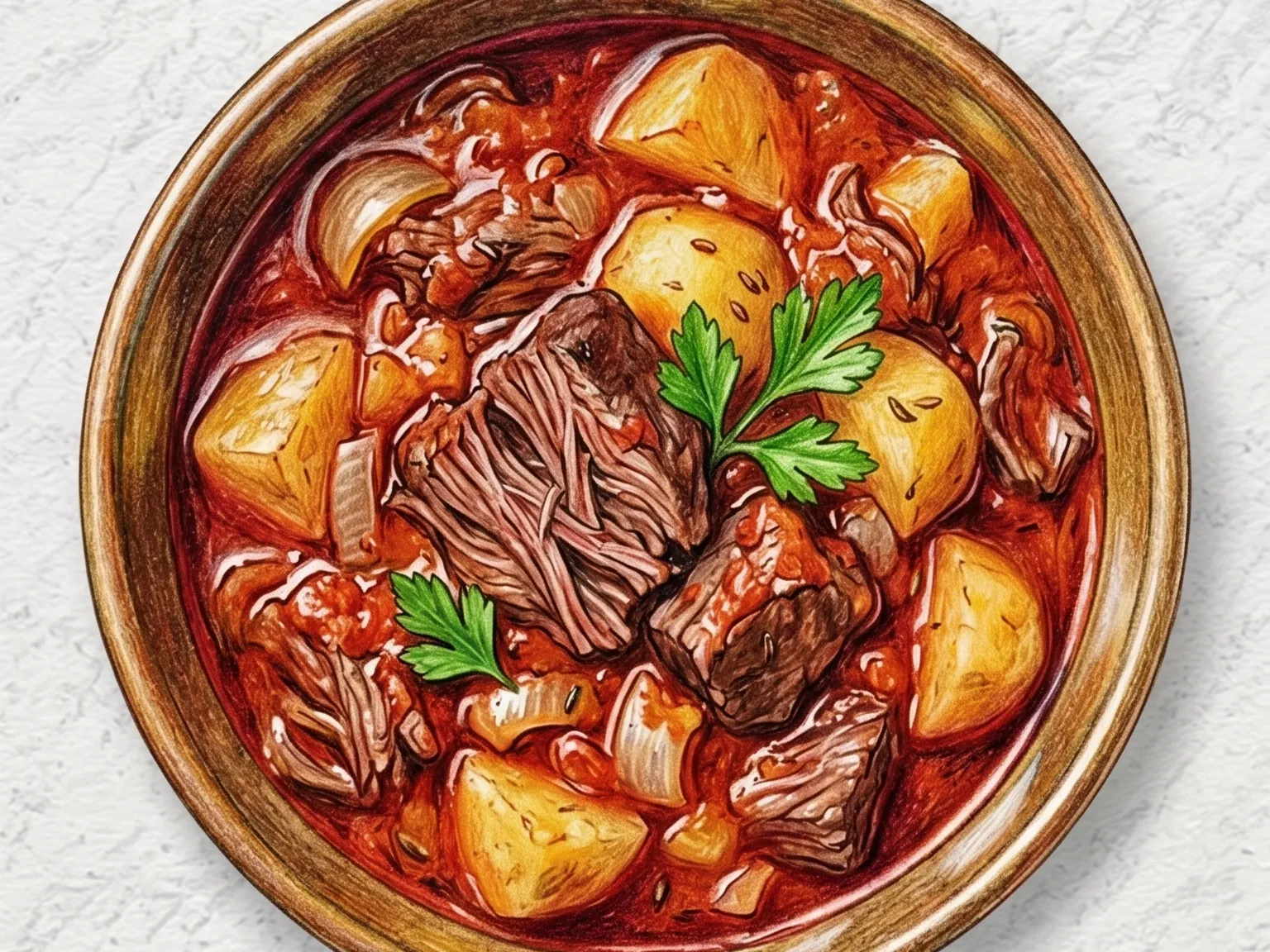
Goulash is a traditional Hungarian stew where beef chuck is slow-cooked with generous amounts of paprika until the meat falls apart at the touch of a fork. Onions are fried until golden, then paprika powder and garlic are toasted briefly in the fat - this step dissolves the paprika's red pigment and smoky flavor into the oil, defining the color and taste of the entire stew. After browning the beef, tomato paste, beef broth, and caraway seeds are added, and the pot simmers on low heat for over an hour until the connective tissue in the chuck breaks down completely. Potatoes go in for the final thirty minutes, absorbing the paprika-infused broth while their starch naturally thickens the liquid into a rich, cohesive sauce.
Adjust Servings
Instructions
- 1
Cut beef into 4cm cubes and season with salt and pepper.
- 2
Fry onions in oil until golden.
- 3
Add paprika and garlic, cook 1 minute.
- 4
Add beef and brown on all sides.
- 5
Add tomato paste, broth, caraway, cover and simmer on low for 1 hour.
- 6
Add potatoes and cook 30 more minutes.
As an Amazon Associate, we may earn from qualifying purchases.
Tips
Nutrition (per serving)
More Recipes

Chicken Paprikash (Hungarian Paprika Chicken Stew with Sour Cream)
Chicken paprikash is a Hungarian stew that browns chicken thighs, then simmers them with onion, sweet paprika, and tomato before finishing with sour cream. The onion is cooked slowly until sweet and soft, and the paprika is bloomed briefly over low heat to release its red color and smoky aroma without burning. Paprika forms the foundation of the sauce's flavor and hue, while tomato brings acidity that balances the richness of the dark meat over a 25-minute simmer. Sour cream must be stirred in at the very end over gentle heat to prevent it from splitting, adding a creamy body and subtle tang to the sauce. The traditional serving pairs it over wide egg noodles or spaetzle to catch the sauce.

Beef Tartare
Beef tartare is a French raw-beef preparation where premium tenderloin is hand-chopped with a knife - never ground - to preserve the texture of each small piece, then mixed with capers, anchovies, shallots, cornichons, egg yolk, and Dijon mustard. The knife cut keeps the meat granular and distinct on the tongue rather than pasty, and the yolk coats every morsel in a rich, silky film. Capers and anchovies drive the salty, briny umami that makes raw beef compelling, while Dijon adds a sharp mustard heat that wakes up the palate. Freshness is everything here - the quality of the tenderloin determines the entire experience, and there is nowhere for lesser cuts to hide.

Bouillabaisse (Provencal Saffron Seafood Stew)
Bouillabaisse is a Provencal seafood stew originating from Marseille fishermen cooking their unsold catch, distinguished by saffron's golden color and subtle floral aroma threaded through the broth. Fennel and tomatoes are first sauteed in olive oil to build an aromatic base, then saffron-infused fish stock is poured in and brought to a simmer. Firm-fleshed fish go in first, with shrimp and mussels added last to preserve their texture - overcooked shellfish turns rubbery and loses its snap. The broth derives its complexity from the layered contribution of multiple seafood varieties, each releasing a different aspect of ocean flavor into the pot. Traditionally, grilled baguette spread with garlicky rouille sauce is dipped into the broth alongside the stew.

Kare-Kare (Filipino Peanut Oxtail Stew)
Kare-kare is a Filipino celebration stew where beef shank is braised until fork-tender and served in a thick peanut-based sauce with vegetables. The shank requires at least sixty minutes of simmering so that its abundant connective tissue breaks down into gelatin, yielding meat that falls apart at the touch of a spoon. Glutinous rice flour is dry-toasted in a pan until lightly golden, adding a nutty fragrance before it is whisked into the broth as a thickener. Peanut butter dissolved in the strained broth forms the sauce's rich, creamy foundation, and the toasted rice flour gives it body without the slickness of cornstarch. Eggplant, yardlong beans, and bok choy are added in the final five to seven minutes so they soften without turning mushy. The traditional accompaniment is bagoong, a fermented shrimp paste whose intense saltiness and funk contrast sharply with the mild, nutty sauce.

Beef Rendang (Indonesian Dry Coconut Braised Beef Curry)
Rendang originated among the Minangkabau people of West Sumatra, where it was developed as a preservation method - cooking meat in coconut milk and spices until all moisture evaporates, allowing it to last for days in tropical heat without refrigeration. The process begins with a rempah paste of shallots, garlic, ginger, galangal, turmeric, and lemongrass pounded by mortar, then fried in coconut oil until the raw edge disappears. Beef chunks braise in coconut milk for two to three hours, during which the liquid reduces progressively - first a wet curry, then a thick sauce, and finally a dry coating where the coconut oil separates and fries the meat in its own spice crust. The finished pieces are dark brown, almost black at the edges, with a concentrated flavor that layers heat from chili, warmth from galangal, and a deep sweetness from the caramelized coconut. UNESCO recognized rendang as part of Minangkabau intangible heritage, and it consistently ranks among the world's most celebrated dishes.

Nikujaga (Japanese Beef Potato Onion Soy-Sweet Stew)
Nikujaga is the quintessential Japanese home-cooked stew, often described as the dish that defines a mother's cooking in Japan. Thinly sliced beef, potatoes, onion, carrot, and shirataki noodles are simmered in a broth of dashi, soy sauce, mirin, and sugar. The dish traces its origins to the Meiji era, when a Japanese naval officer attempted to recreate British beef stew using local ingredients - resulting in a clear, soy-based braise rather than a thick, flour-bound stew. The potatoes absorb the seasoned liquid until soft at the edges but still holding shape, while shirataki noodles soak up flavor and add a springy contrast.