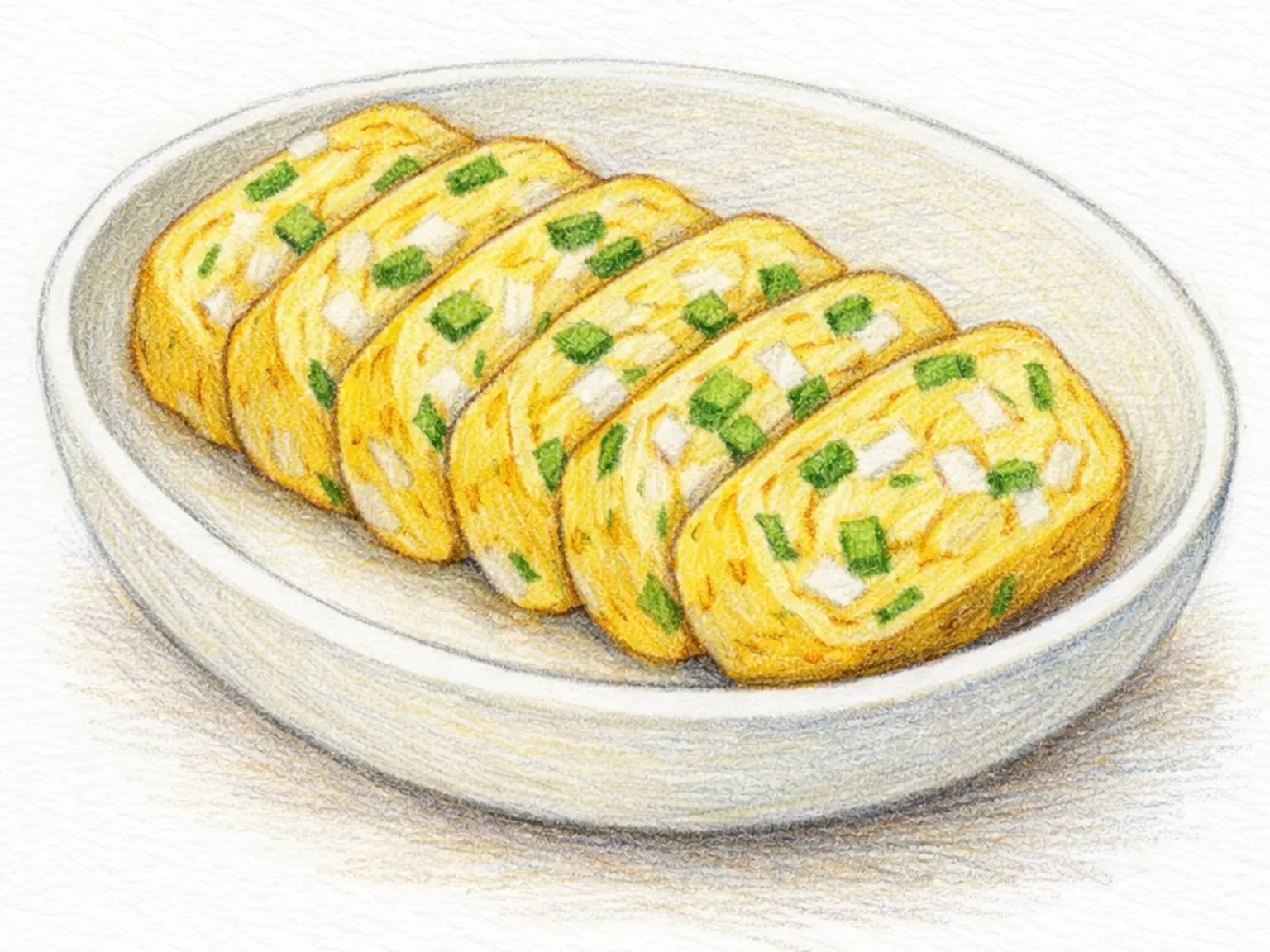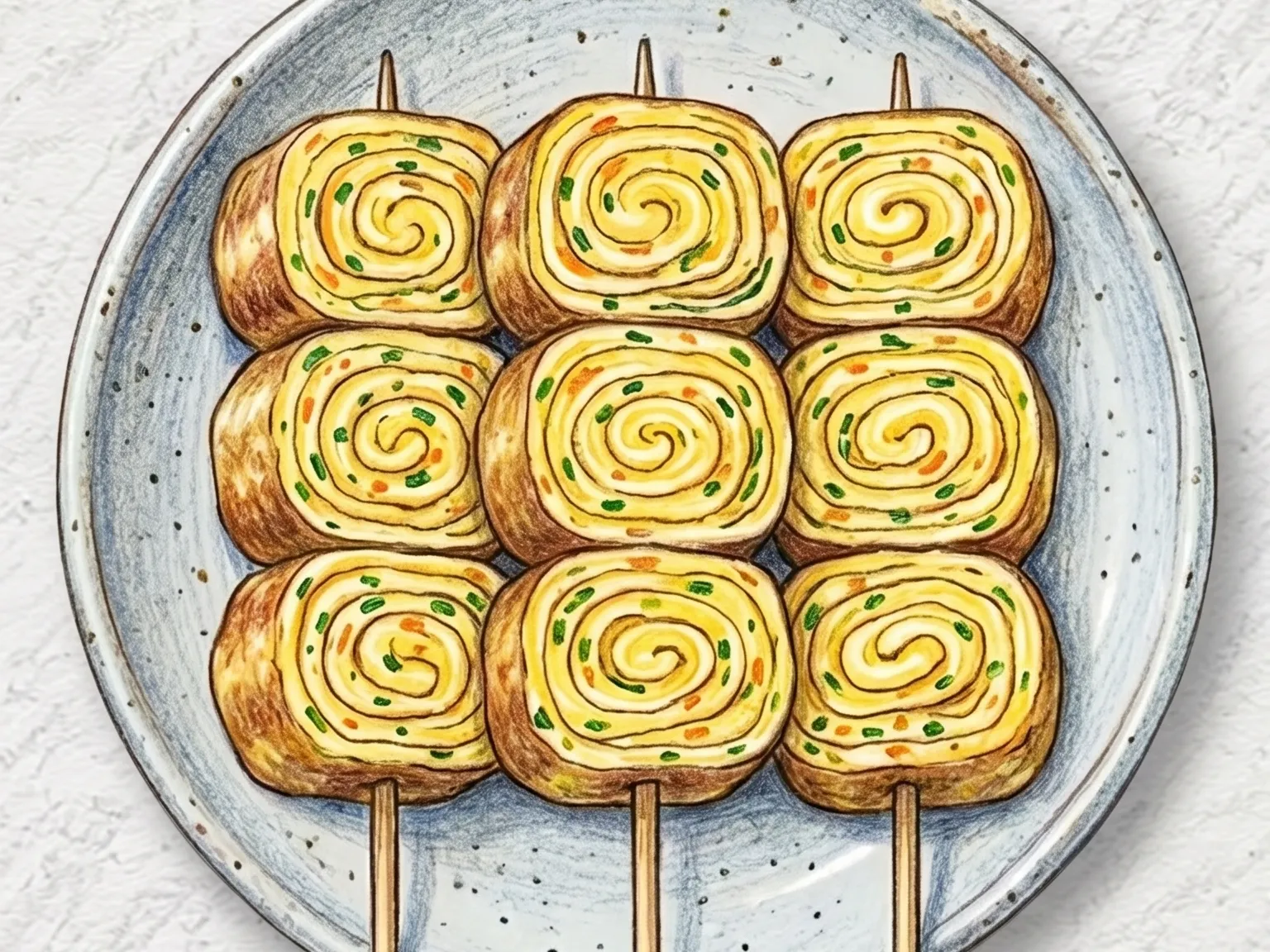
Korean Egg Roll Skewers (Layered Vegetable Egg Roll on Skewers)
Quick answer
Gyeran-mari kkochi is a Korean egg roll skewer made by folding finely diced carrot, garlic chives, and onion into beaten egg, then rolling the mixture in stages in a rect...
What makes this special
- Gyeran-mari kkochi layers finely diced vegetables into a tightly rolled, savory egg spiral.
- Three-pour rolling technique creates a visible spiral cross-section
- Milk at 10% of egg volume keeps the roll tender even when cold
Key ingredients
Core cooking flow
- 1 Mince carrot, chives, and onion as finely as possible, about 0.2cm.
- 2 Break 5 eggs into a bowl and add 0.5 tsp salt and 2 tbsp milk.
- 3 Coat a rectangular tamagoyaki pan with 1 tsp oil and wipe evenly with a paper towel.
Gyeran-mari kkochi is a Korean egg roll skewer made by folding finely diced carrot, garlic chives, and onion into beaten egg, then rolling the mixture in stages in a rectangular pan to create a tightly layered spiral. The beaten egg is poured into the pan in three separate additions, each addition rolled over and wrapped around the previous layer before the next is poured in - a technique that builds the internal spiral visible when the roll is sliced. Low heat from start to finish is not a preference but a requirement: if the heat climbs too high, the egg sets too quickly and tears during rolling rather than yielding to the spatula. Adding milk at roughly ten percent of the total egg volume relaxes the protein structure so the finished roll stays soft and moist even after cooling, rather than tightening into a rubbery cylinder. The natural sweetness of the chives and carrot folded inside complements the savory egg without requiring heavy seasoning - salt and a small amount of soy sauce are sufficient. Once the roll is formed, cooled briefly, and sliced into three-centimeter pieces, each piece is threaded onto a bamboo skewer and rolled once more in the pan to develop a light golden surface and lock the skewer in place.
Instructions
Read the steps as a cooking flow: prep, heat, seasoning, doneness control, and finish.
- 1Step
Mince carrot, chives, and onion as finely as possible, about 0.2cm.
Larger pieces cause the rolled egg to be uneven and difficult to shape when rolling.
- 2Season
Break 5 eggs into a bowl and add 0.5 tsp salt and 2 tbsp milk.
Beat with chopsticks until no white clumps remain, then mix in the minced vegetables.
- 3Control
Coat a rectangular tamagoyaki pan with 1 tsp oil and wipe evenly with a paper towel.
Preheat over low heat until you feel gentle warmth when holding your hand 5cm above the surface.
- 4Prep
Pour one-third of the egg mixture into the pan and spread thin.
When the edges turn translucent, roll tightly from one end like rolling gimbap. Push the roll to one side, pour more egg in portions of one-third twice more, and continue rolling each layer.
- 5Finish
Transfer the finished egg roll to a cutting board and slice into 3cm pieces before it cools.
Cutting while still warm produces clean, uniform cross-sections.
- 6Finish
Thread cut pieces onto skewers and pan-fry over low heat without oil for 1 minute per side until lightly golden on the outside.
Serve with teriyaki sauce or ketchup.
After the steps
Pick a recipe that fits this dish.
Continue with shared ingredients, meal pairings, or a similar method.
Recipes That Go Well With This
More Street food →Based on shared ingredients and meal pairing
Korean Street-Style Egg Bread
Preparing gyeran ppang involves pouring a sweet batter made from flour, milk, egg, and butter into individual molds and cracking a whole egg directly on top. The inclusion of baking powder helps the batter rise into a soft, airy bread structure during the baking process at 180 degrees Celsius. Within fifteen to eighteen minutes, the egg white sets firmly while the yolk reaches a state between soft and fully cooked, creating a moist center. The light sweetness of the buttered batter balances the naturally mild and savory profile of the egg, making the snack complete without any additional sauces. Where the batter makes contact with the mold, it develops a lightly crisped, golden exterior that provides a textural contrast to the pillowy interior. This snack reaches its peak quality immediately after removal from the mold while still warm, as cooling causes the bread to contract and lose its characteristic fluffiness. Its compact shape makes it easy to hold and eat while walking, which contributed to its status as a staple of Korean winter street food culture. Some versions include a light sprinkle of salt or dried herbs over the egg to introduce an aromatic element to the sweet and savory base.
Korean Street Ham & Egg Toast
Gilgeori ham egg toast is the foundational version of Korean street toast, the style found at early-morning carts across Seoul and other cities where vendors cook to order on flat griddles. The core is a pan-fried patty of beaten egg mixed with finely shredded cabbage and carrot, cooked flat and golden on both sides. Ham slices are seared on each side for about thirty seconds so the edges caramelize slightly and the surface color deepens without drying out. The bread is pressed onto a buttered pan until the exterior crisps while the crumb stays soft. Ketchup and sugar together form the sauce, and this combination is what separates the Korean street toast from any generic egg sandwich. Sugar in the sauce creates a sweet-salty pull that plays against the savory ham and egg, and omitting it produces something noticeably different in character. Without cheese, this version is lighter and less rich than variations that add a slice, making it more approachable as an early meal. The contrast between the crunchy toasted bread and the soft, yielding egg layer is the defining textural quality.
Korean Sweet Spicy Pollock Floss Stir-fry
Myeongyeopchae-bokkeum stir-fries finely shredded dried pollock floss in gochujang and oligosaccharide syrup until each fiber strand is evenly coated and moist. Myeongyeopchae is thinner and softer-fibered than hwangtaechae, the wider dried pollock strips, arriving in a dense cotton-like bundle that must be loosened strand by strand before cooking. Running your fingers along the grain separates the fibers cleanly, allowing the seasoning to penetrate evenly and preventing the finished banchan from clumping together in the mouth. A dry toast of thirty seconds in an oil-free pan drives off residual moisture and coaxes out a toasted fish aroma before gochujang, gochugaru, oligosaccharide syrup, soy sauce, and minced garlic go in over the lowest heat for a rapid coating. The fine fibers absorb the sauce almost immediately and turn pliant and glistening, but heat held too long draws the moisture back out, leaving them tough and stiff, so the entire stir-fry must be completed within two minutes. A finishing drizzle of sesame oil and a scatter of sesame seeds deepen the nutty aroma. The resulting banchan occupies a middle ground between the chewier, more aggressively seasoned hwangtaechae-muchim and the bolder jinmichae-bokkeum, its mild sweet-spicy profile approachable enough for children. The relatively dry finish means the seasoning does not bleed into adjacent items in a lunchbox, and stored in an airtight container in the refrigerator the flavor holds well for up to five days.
Korean Blood Sausage Skewers
Soondae-kkochi are Korean blood sausage skewers threaded alternately with onion and green onion pieces, pan-grilled and glazed with a sauce made from gochujang, ketchup, oligosaccharide syrup, and soy sauce. Applying the glaze in two separate rounds rather than all at once is critical: the first coat caramelizes and sets, then a second layer is brushed on over low heat to build a glossy, deeply lacquered finish without burning. The sundae must be cooked slowly over low heat, rolling it gently so the casing does not split while the interior stays chewy throughout. Onion and scallion segments release their moisture on the grill, concentrating into a natural sweetness that balances the bold, iron-rich flavor of the sausage and provides a textural shift between bites. A scatter of toasted sesame seeds over the finished skewers adds a final layer of nutty fragrance.
Serve with this
Korean Sweet Corn Latte (Butter Sauteed Corn Milk Drink)
Sweet corn latte begins by sauteing cooked corn kernels in butter until fragrant, then simmering them in milk to draw out the corn's natural sugars before blending everything smooth. The butter amplifies the starchy, roasted aroma during the initial saute, coating each kernel so that the fat-soluble flavor compounds dissolve fully into the milk during the five-minute simmer. Blending the mixture until completely smooth and then straining it through a fine sieve removes any remaining hull pieces, producing a texture as silky as a custard sauce. This straining step makes a noticeable difference in the final quality. Condensed milk adds a rounded sweetness, and a small amount of white pepper introduces a faint spiced warmth that gives the drink depth beneath the sweetness. It works equally well served hot in a ceramic mug or chilled and poured over ice; the corn aroma remains vivid in both versions.
Gotgam Cream Cheese Roll (Dried Persimmon Rolls)
Gotgam cream cheese roll is a no-cook Korean dessert that requires nothing more than a knife, a bowl, and a refrigerator. Dried persimmons are slit open and flattened into thin sheets, each one acting as the outer wrapper. The filling is cream cheese mixed with honey and fresh lemon juice to balance its natural richness with acidity, and finely chopped walnuts are folded in throughout to add a crunchy, nutty element to every bite. The filling is spread across the opened persimmon, which is then rolled tightly and wrapped in plastic wrap. Twenty minutes in the refrigerator firms the roll enough to slice cleanly. Dipping the knife in warm water and wiping it dry before each cut produces the smoothest cross-sections. The finished slices reveal clearly defined layers: the chewy, caramel-sweet dried persimmon on the outside, the tangy cream cheese in the middle, and flecks of walnut distributed throughout. The combination makes it a natural pairing with wine or a polished addition to a traditional holiday table.
Korean Spicy Mixed Wheat Noodles
Bibim guksu is a chilled Korean noodle dish in which boiled and cold-rinsed somyeon wheat noodles are tossed in a sauce of gochujang, chili flakes, plum syrup, vinegar, soy sauce, and sesame oil. The heat from the gochujang, the sweetness of plum syrup, and the brightness of vinegar stack into a multi-dimensional flavor in every bite. Rinsing the noodles thoroughly in cold water removes excess starch, giving them a bouncy texture and allowing the sauce to cling evenly. Torn lettuce and julienned cucumber folded in at the end add crunch and release moisture that loosens the thick sauce just enough. A tablespoon of noodle cooking water can thin the sauce if needed. For 100 g of somyeon, a starting ratio of 1 tablespoon gochujang, 1 tablespoon plum syrup, and 1 teaspoon vinegar provides a reliable base to adjust from.
Similar recipes
Korean Egg Dumpling Pancakes
Gyeran-mandu is a Korean market-style egg dumpling pancake made by mixing finely chopped cabbage, scallion, and soaked glass noodles into beaten egg, then pan-frying the mixture into flat, palm-sized rounds. Rather than using a traditional flour wrapper, the egg itself forms the outer shell that binds and seals the filling. The patties cook slowly over medium-low heat, giving the surface time to turn lightly golden while the interior stays moist and tender. Squeezing the excess moisture from the vegetables before mixing is the most critical step - too much water and the patties spread and lose their shape before the egg can set. Glass noodles must be cut into short lengths so the rounds hold together and flip without falling apart. A thin layer of oil in the pan and a lid placed on top help the egg cook evenly without burning. Dipping the finished patties into a sauce of soy sauce, vinegar, and a pinch of gochugaru brings a salty-tangy contrast that complements the mild richness of the egg.
Korean Street Egg Bread (Sweet Batter Muffin with Whole Egg)
Winter streets in Seoul feature this warm handheld snack prepared by baking a whole egg atop a sweet batter. The base consists of cake flour, baking powder, milk, and melted butter poured into muffin molds. Adding a layer of finely diced ham beneath the egg creates a salty contrast against the sweetness of the dough. When baked at 180 degrees Celsius, sixteen minutes results in a soft and runny yolk, while eighteen minutes produces a firm center. Vanilla extract mixed into the batter helps neutralize the natural scent of the egg for a clean finish. A light dusting of dried parsley on the domed surface adds a subtle herbal scent as the bread turns golden in the oven. Small amounts of shredded cheese can be added to the batter to balance the sweetness. Serving the bread while it remains warm ensures the interior stays moist. This egg bread functions well as a quick breakfast option and can be made in paper muffin cups if metal molds are unavailable.
Korean Tteok Kkochi Yangnyeom Gui (Grilled Rice Cake Skewers)
Cylinder rice cakes are threaded onto skewers, lightly brushed with oil, and rolled on a grill pan over medium heat for six to seven minutes until the exterior turns golden. A sauce of gochujang, ketchup, oligosaccharide syrup, soy sauce, and minced garlic is applied in two rounds, building a glossy red glaze that clings to the surface. The outer layer develops a slight crispness while the inside remains stretchy and dense - that textural duality is the hallmark of this dish. A light dusting of cheese powder turns it into a kid-friendly snack, and it stands as one of the most iconic items in Korean street-food culture.