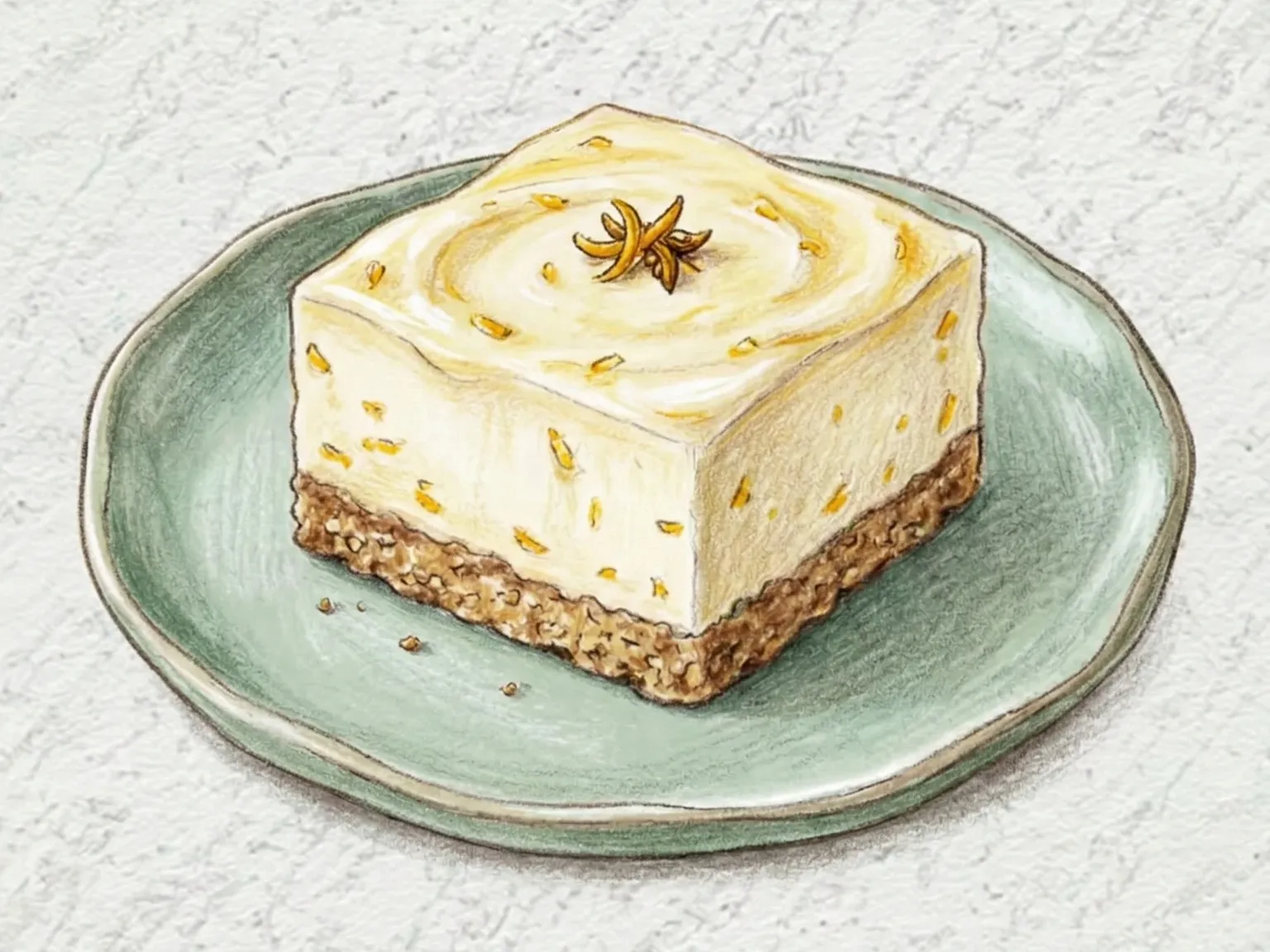
Hallabong Cheesecake Bars Recipe (Jeju Mandarin Cream Cheese Dessert)
Quick answer
Bright, floral Jeju hallabong citrus (a hybrid of mandarin and orange) lifts these cream cheese cheesecake bars with a honeyed aroma that lemon cannot match.
What makes this special
- Hallabong cheesecake bars made with Jeju citrus for a bright, floral mandarin aroma.
- Hallabong zest oil spreads through the filling during baking, sustaining citrus aroma to the last bite
- Sour cream lightens the cream cheese density with a gentle acidity
Key ingredients
Core cooking flow
- 1 Preheat the oven to 170C and line a square pan with parchment.
- 2 Mix 120 g cracker crumbs with 50 g melted butter until evenly moistened.
- 3 Beat 300 g cream cheese with 90 g sugar until smooth and free of visible lumps.
Bright, floral Jeju hallabong citrus (a hybrid of mandarin and orange) lifts these cream cheese cheesecake bars with a honeyed aroma that lemon cannot match. Sour cream in the filling adds gentle acidity to balance the richness of the cheese, and the essential oils from the zest spread through the batter during baking so the fragrance stays consistent through the last bite. A buttered cracker crumb base provides crisp contrast to the creamy layer above. The flavor reads brightest when served cold, and chilling the dessert thoroughly yields clean rectangular slices for sharing. Fresh fruit from the winter to early spring peak season delivers the most aromatic results, and preparing the bars a day in advance lets the filling settle for cleaner cuts and deeper citrus perfume.
Instructions
Read the steps as a cooking flow: prep, heat, seasoning, doneness control, and finish.
- 1Step
Preheat the oven to 170C and line a square pan with parchment.
Keep the cream cheese, eggs, and sour cream at room temperature so the filling blends smoothly without small cold lumps.
- 2Heat
Mix 120 g cracker crumbs with 50 g melted butter until evenly moistened.
Press the mixture firmly into the pan base, pre-bake for 8 minutes, then let it cool slightly so it stays crisp.
- 3Season
Beat 300 g cream cheese with 90 g sugar until smooth and free of visible lumps.
Add the 2 eggs one at a time, mixing just until combined to avoid trapping excess air.
- 4Heat
Fold in 80 g sour cream, 1 tbsp hallabong zest, and 50 ml hallabong juice until the batter looks even.
Pour it over the baked crust and level the top gently.
- 5Heat
Bake at 170C for 30-35 minutes.
Remove it when the edges are set and the center still has a slight wobble, then let it rest for 10 minutes in the turned-off oven.
- 6Finish
Cool the pan completely, then chill for at least 2 hours so the filling firms enough for clean bars.
Warm a knife in hot water, wipe it between cuts, and serve the bars cold.
After the steps
Pick a recipe that fits this dish.
Continue with shared ingredients, meal pairings, or a similar method.
Recipes That Go Well With This
More Baking →Based on shared ingredients and meal pairing
New York Cheesecake
New York cheesecake is distinguished by its heavy reliance on cream cheese, which gives the filling a dense, almost clay-like consistency when chilled and a rich dairy flavor that coats the palate. The crust - crushed graham crackers pressed together with melted butter - provides a sandy, slightly salty foundation that offsets the sweetness above. Sour cream folded into the batter introduces a mild acidity that keeps the richness from becoming monotonous. Baking at a moderate temperature and cooling gradually inside the closed oven minimizes the surface cracking that plagues rushed versions. After refrigeration overnight, the texture firms enough to hold a clean knife line, and the flavors consolidate into a unified creaminess. Each slice stands tall on the plate, pale and smooth, requiring nothing more than a fork to enjoy - though a spoonful of fruit compote alongside never hurts.
Hallabong Lemon Bars (Jeju Citrus Curd on Shortbread)
Hallabong lemon bars combine the sweet citrus flavor of Jeju hallabong juice with the sharp acidity of fresh lemon juice over a buttery shortbread base. The crust is made by rubbing cold unsalted butter into flour and powdered sugar, then pressing it into a pan to bake until pale golden. A smooth citrus curd, made by gently mixing eggs, sugar, hallabong juice, lemon juice, and cornstarch, is strained and poured over the warm pre-baked crust. Baking the curd just until the edges are set keeps the texture silky. Once baked, the bars are chilled to firm up the curd layer, which can then be sliced cleanly with a hot knife. A light dusting of powdered sugar is added before serving, creating a nice contrast between the soft topping and the buttery crust.
Buffalo Wings
Buffalo wings coat chicken wings in baking powder and roast them at high heat for forty-five minutes, producing a crisp skin without deep-frying. The baking powder raises the skin's pH to accelerate the Maillard reaction and drives out moisture faster, yielding a crunch that rivals the fryer. Straight from the oven, the wings are tossed in a sauce of melted butter and hot sauce - the butter tempers the vinegar-based heat into something that coats the tongue rather than burning it, and a touch of white vinegar at the end sharpens the finish. Blue cheese dipping sauce and celery sticks served alongside provide a cooling, creamy contrast and a crisp palate cleanser between bites.
Yuja Cream Cheese Tart (Korean Citron Cream Cheese No-Bake Tart)
Yuja Cream Cheese Tart features a crunchy biscuit crust filled with a smooth, oven-baked cream cheese filling sweetened with yuja marmalade. The crust is made from crushed digestive biscuits and melted butter, pressed into a pan and baked until fragrant. For the filling, softened cream cheese is whipped with sugar, eggs, heavy cream, and Korean citron marmalade. A splash of lemon juice is added to elevate the acidity and brighten the citrus notes. This filling is poured over the pre-baked base and baked until the edges set while the center remains slightly soft. After cooling, the tart is chilled in the refrigerator for at least two hours to achieve a dense, mousse-like consistency. Resting the tart overnight allows the citrus peel to infuse the creamy filling, creating a balance of sweet and tangy flavors.
Serve with this
Real Pineapple Sherbet
This refreshing fruit dessert is prepared by scooping out the flesh of a mini pineapple and using its hollowed shell as a serving vessel. The fruit pulp is blended until smooth to prevent icy lumps, then mixed with sugar, lemon juice, and oligosaccharide syrup to achieve a sweet and tangy flavor. After pouring the mixture back into the shell and covering it with the top lid, it is frozen for at least four hours. Stirring the mixture occasionally during freezing breaks up ice crystals, resulting in a smoother texture. The active bromelain enzyme present in the fresh fruit provides a subtle tingly sensation on the tongue. Serving the sherbet directly inside the pineapple skin minimizes juice loss and keeps the dessert cold. Letting it stand for five minutes before scraping and topping with fresh apple mint leaves makes it ready to serve.
Seven Layer Salad
Seven layer salad stacks romaine lettuce, sliced cucumber, halved cherry tomatoes, cooked green peas, chopped boiled egg, and thinly sliced red onion in a clear glass bowl, then seals the top with a smooth layer of Greek yogurt mixed with lemon juice. The yogurt cap acts as a moisture barrier, preventing the lower layers from turning soggy and making the salad suitable for advance preparation. Boiled eggs contribute a mild richness and peas add a starchy sweetness that rounds out the crisp vegetable layers, while red onion's sharp bite creates a contrast against the creamy, tangy dressing. Serving requires scooping deep to the bottom so every portion captures all seven layers at once.
Citrus Espresso Tonic with Orange
Espresso tonic is a carbonated coffee drink built by slowly pouring espresso over chilled tonic water to form two distinct layers. The tonic must be thoroughly cold to maintain stable carbonation throughout; cooling the espresso for about thirty seconds before pouring it over a spoon produces a clean separation between the two liquids. The quinine bitterness in the tonic water meets the espresso's roast bitterness, creating a balanced interplay rather than one-note sharpness. Orange slices and lemon peel garnish the glass, releasing citrus oils that rise with the bubbles. Specialty espresso with pronounced fruit acidity works particularly well here, harmonizing with the tonic's effervescence and lending natural sweetness without added sugar. Pre-chilling the glass with ice before adding the tonic helps preserve carbonation. The drink gained popularity in Scandinavian coffee culture during the 2010s before spreading worldwide.
Similar recipes
Mugwort Cream Cheese Brownies
Mugwort cream cheese brownies are a fusion dessert that combines earthy, herbal mugwort powder with a tangy cream cheese layer. The chocolate batter starts by melting dark chocolate and unsalted butter over a double boiler, followed by mixing in sugar, eggs, flour, and dried mugwort powder. A separate mixture of softened cream cheese and heavy cream is spooned over the chocolate batter, and a skewer is dragged through to create a marble pattern. Baking at 175°C for twenty-five to twenty-eight minutes leaves the edges set while keeping the center slightly wobbly for a fudgy consistency. The grassy notes of the mugwort and the bitterness of the dark chocolate balance the cool acidity of the cream cheese swirl. Once cooled, chilling the brownie makes the green and white marble pattern distinct and enhances the density of the dessert.
Citrus Espresso Tonic with Orange
Espresso tonic is a carbonated coffee drink built by slowly pouring espresso over chilled tonic water to form two distinct layers. The tonic must be thoroughly cold to maintain stable carbonation throughout; cooling the espresso for about thirty seconds before pouring it over a spoon produces a clean separation between the two liquids. The quinine bitterness in the tonic water meets the espresso's roast bitterness, creating a balanced interplay rather than one-note sharpness. Orange slices and lemon peel garnish the glass, releasing citrus oils that rise with the bubbles. Specialty espresso with pronounced fruit acidity works particularly well here, harmonizing with the tonic's effervescence and lending natural sweetness without added sugar. Pre-chilling the glass with ice before adding the tonic helps preserve carbonation. The drink gained popularity in Scandinavian coffee culture during the 2010s before spreading worldwide.
Black Sesame Brownies
Black sesame brownies are built on a base of dark chocolate and butter melted together over a double boiler, with roasted black sesame powder sifted in before folding. The bitter edge of the chocolate meets the toasted, grain-like aroma of the sesame, adding a nutty depth that standard brownies lack. The cake flour ratio is kept low to produce a fudgy, dense center that stays slightly underdone-looking even after the full bake at 175 degrees Celsius for twenty to twenty-five minutes. Because black sesame powder is naturally oily and prone to clumping, it must be sifted together with the flour and salt before going into the batter - skipping this step leaves uneven pockets of undistributed sesame. Pull them from the oven with a faint wobble at the center, and the residual heat finishes the interior as the pan cools. Wait until fully cool before cutting for clean edges.