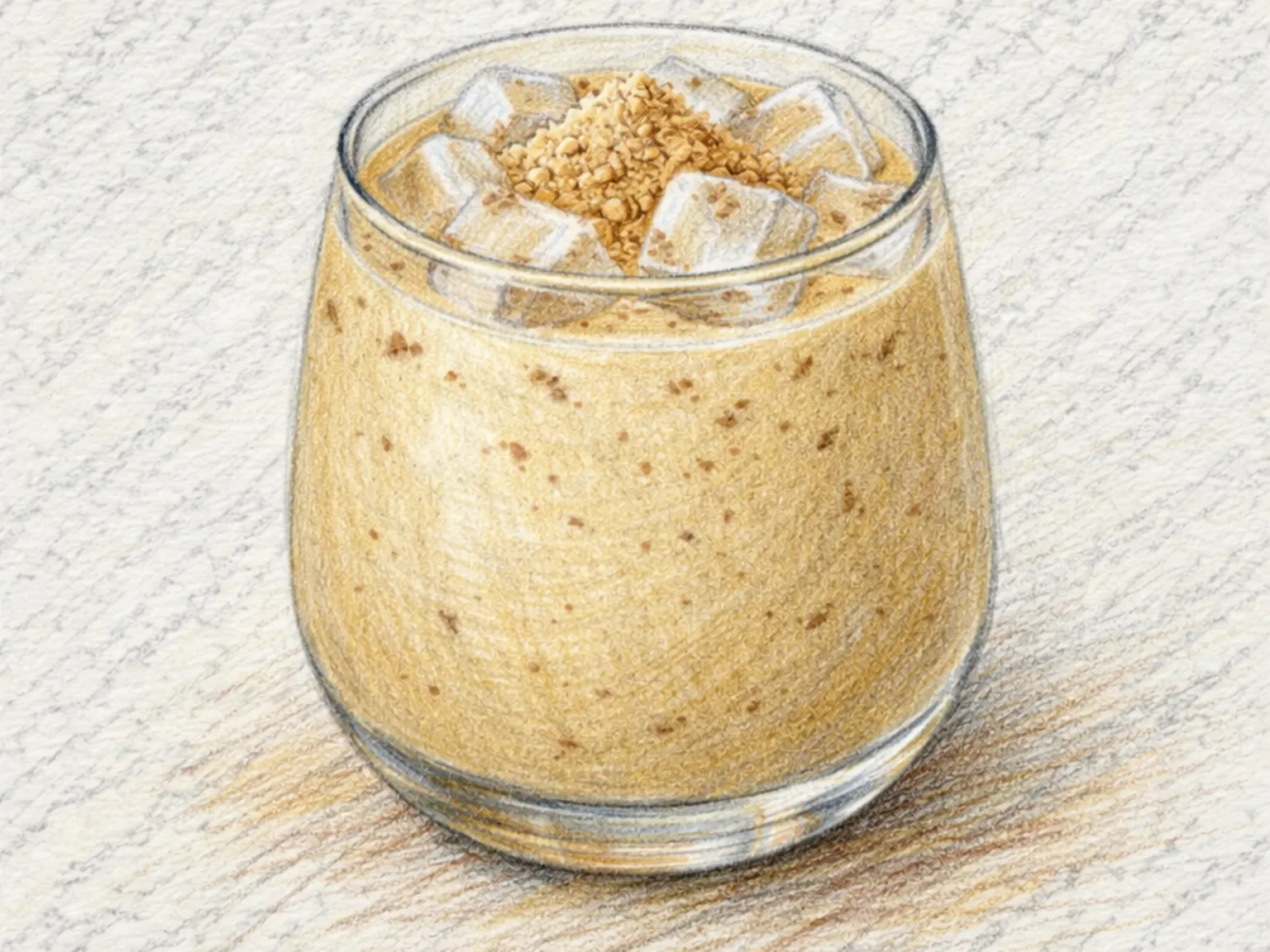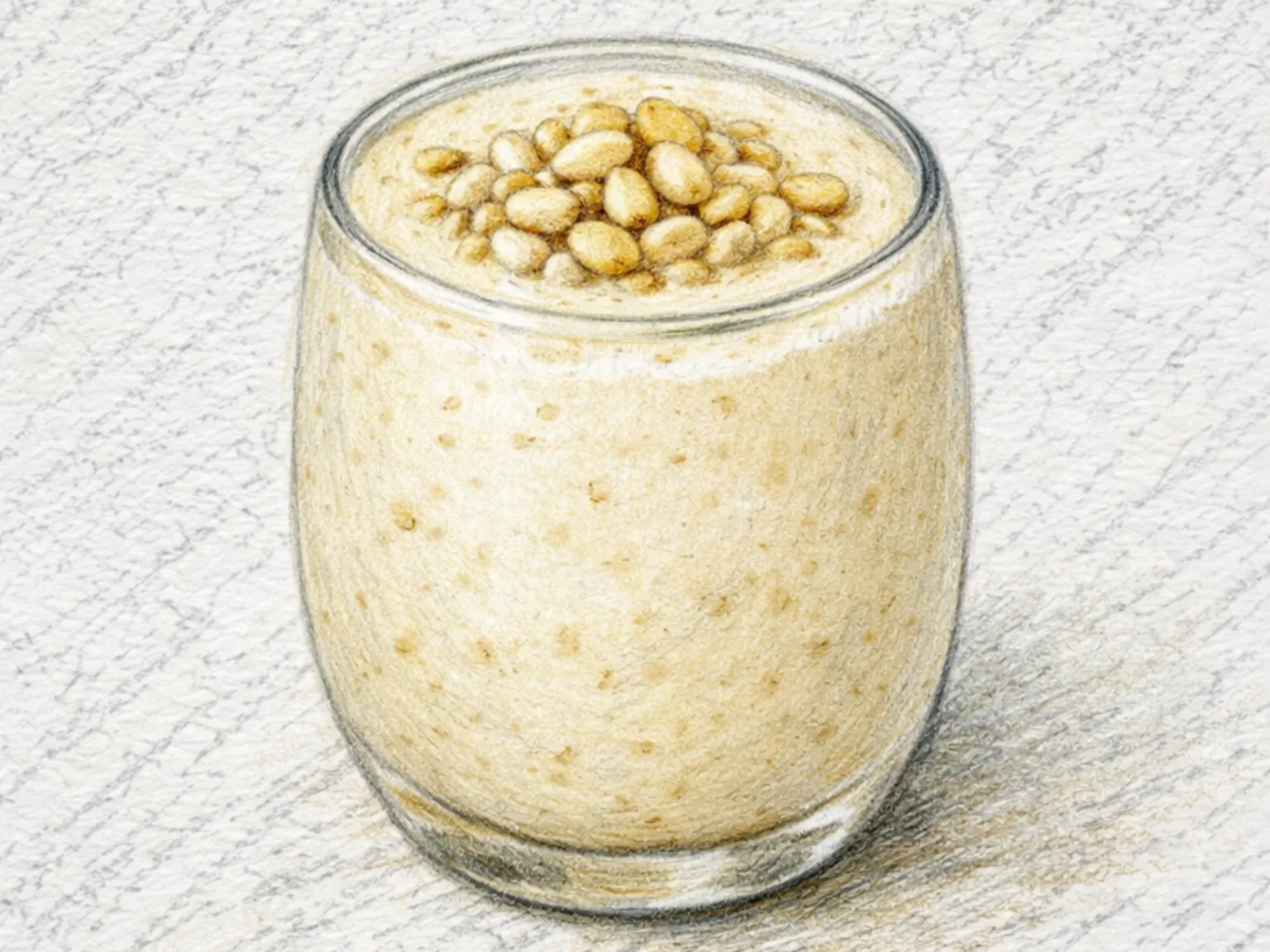
Korean Pine Nut Job's Tears Shake

Korean Pine Nut Job's Tears Shake

Quick answer

Jat-yulmu shake blends cooked job's tears (yulmu) and pine nuts with cold milk, honey, and ice into a thick, grain-based drink.

What makes this special

  • Fully boiled job's tears and pine nuts blend into a thick, grain-based Jat-yulmu shake.
  • Job's tears need two hours soaking and full cooking to blend without gritty bits
  • Pine nut's high fat content blends in naturally during processing for rich creaminess
Total time
20 min
Level
Easy
Servings
2 servings
Ingredients
7
Calories
290 kcal
Protein
9 g

Key ingredients

job's tearspine nutsmilkhoneysalt

Core cooking flow

  1. 1 Rinse 60g of job's tears several times until the water runs clear, then soak...
  2. 2 Put the soaked grains in a pot with 300ml of water and boil over medium heat for about 12 minutes.
  3. 3 Drain the cooked grains in a fine strainer and let the steam fade at room temperature.

Jat-yulmu shake blends cooked job's tears (yulmu) and pine nuts with cold milk, honey, and ice into a thick, grain-based drink. Job's tears must be boiled until they are genuinely soft all the way through before going into the blender: partially cooked grains leave behind a gritty, coarse texture that no amount of blending time will fully eliminate. Pine nuts are high in natural oils, and those oils emulsify during blending to give the shake a richly creamy body that separates this drink from lighter fruit-based smoothies. Honey provides a clear sweetness that sits lightly over the mild, slightly earthy character of the cooked grains, while a small amount of vanilla extract deepens the overall aroma without competing with the grain flavors. A single pinch of salt is not about seasoning in the conventional sense but about amplifying - it sharpens the nutty quality of the pine nuts and brings the toasty, wheaten aroma of the job's tears into clearer focus. Blending with ice cubes rather than adding milk alone results in a colder, thicker shake with more resistance when sipped through a straw.

Prep 8min Cook 12min 2 servings
Recipes by ingredient → milk honey

Instructions

Read the steps as a cooking flow: prep, heat, seasoning, doneness control, and finish.

6 steps
  1. 1
    Heat

    Rinse 60g of job's tears several times until the water runs clear, then soak them in fresh water for 2 hours.

    If they are not fully soaked, the centers can stay firm even after boiling.

  2. 2
    Control

    Put the soaked grains in a pot with 300ml of water and boil over medium heat for about 12 minutes.

    They are ready when a grain crushes easily between your fingers without a hard core.

  3. 3
    Heat

    Drain the cooked grains in a fine strainer and let the steam fade at room temperature.

    Do not blend them hot, because warm grains make the milk lukewarm and melt the ice too quickly.

  4. 4
    Control

    Place 25g of pine nuts in a dry pan and toast over low heat for about 1 minute, shaking or stirring often.

    Remove them as soon as they smell nutty and look glossy to prevent bitterness.

  5. 5
    Season

    Add the cooled grains, pine nuts, 400ml milk, 1.5tbsp honey, 0.1tsp salt, and 0.25tsp vanilla extract to the blender.

    Blend for about 40 seconds until the grains disappear and the mixture looks creamy.

  6. 6
    Step

    Add 120g of ice cubes and blend for another 20 seconds until the shake is cold and thick.

    Pour it into glasses as soon as the texture is right, since it thins and separates if left standing too long.

After the steps

Pick a recipe that fits this dish.

Continue with shared ingredients, meal pairings, or a similar method.

Recipes That Go Well With This

More Drinks →

Based on shared ingredients and meal pairing

Korean Job's Tears Walnut Latte
Shared ingredient: job's tears Drinks

Korean Job's Tears Walnut Latte

Yulmu-hodu latte is a traditional Korean grain-based beverage prepared by combining job's tears and walnuts with milk to create a thick and consistent texture. The preparation begins by soaking the job's tears in water for a minimum of two hours. This extended soaking period is necessary to soften the grains thoroughly, ensuring they pulverize completely during the blending process to avoid a gritty or sandy mouthfeel. Once softened, the job's tears are dry-toasted along with the walnuts in a pan. This heat application serves to caramelize the starches within the grains, which effectively removes the scent of raw grain and replaces it with a concentrated, roasted aroma. After the toasted ingredients are blended with milk, the liquid is passed through a fine strainer to achieve a smooth and silky finish. Sweetness is added using honey, accompanied by a small amount of salt to highlight the deep profile of the roasted nuts. A light sprinkle of ground cinnamon is applied to the surface to provide a subtle spice that balances the grounded flavor of the grain base. For cold servings, it is important to dissolve the honey while the liquid is still warm to ensure it distributes thoroughly throughout the drink instead of settling at the bottom of the container. The resulting beverage offers a depth of flavor and a rounded profile that is far more prominent than what is found in mass-produced, packaged versions of similar grain drinks.

Korean Misutgaru Latte (Roasted Multigrain Milk Drink)
Shared ingredient: milk Drinks

Korean Misutgaru Latte (Roasted Multigrain Milk Drink)

Misutgaru latte is a Korean multigrain drink made by whisking roasted grain powder into cold milk and sweetening with honey. The misutgaru powder -- roasted barley, rice, and other grains ground together -- brings a deep, toasty nuttiness that milk carries into a smooth, substantial beverage. A tiny pinch of salt sharpens the grain flavors, and a dusting of roasted soybean powder on top adds another aromatic layer. Substituting part of the milk with soy milk intensifies the nutty profile for a richer, more complex grain latte, and serving it over ice makes it a satisfying cool drink through summer.

Gotgam Cream Cheese Roll (Dried Persimmon Rolls)
Serve together Desserts

Gotgam Cream Cheese Roll (Dried Persimmon Rolls)

Gotgam cream cheese roll is a no-cook Korean dessert that requires nothing more than a knife, a bowl, and a refrigerator. Dried persimmons are slit open and flattened into thin sheets, each one acting as the outer wrapper. The filling is cream cheese mixed with honey and fresh lemon juice to balance its natural richness with acidity, and finely chopped walnuts are folded in throughout to add a crunchy, nutty element to every bite. The filling is spread across the opened persimmon, which is then rolled tightly and wrapped in plastic wrap. Twenty minutes in the refrigerator firms the roll enough to slice cleanly. Dipping the knife in warm water and wiping it dry before each cut produces the smoothest cross-sections. The finished slices reveal clearly defined layers: the chewy, caramel-sweet dried persimmon on the outside, the tangy cream cheese in the middle, and flecks of walnut distributed throughout. The combination makes it a natural pairing with wine or a polished addition to a traditional holiday table.

Korean Job's Tears Tea (Creamy Grain Porridge Drink)
Similar recipe Drinks

Korean Job's Tears Tea (Creamy Grain Porridge Drink)

Yulmu-cha is a Korean grain tea made from Job's tears powder and glutinous rice powder, first dissolved in cold water to prevent lumps, then cooked on low heat with constant stirring. Once the mixture begins to thicken, milk is added for a creamier body, and honey with a pinch of salt balances the sweetness. Job's tears give the drink a distinctly nutty, toasted grain aroma that pairs smoothly with the milk, producing a texture thicker than typical tea but lighter than porridge. The glutinous rice powder contributes a subtle stickiness that coats the palate, and reducing the water ratio yields an even denser, more filling version.

Serve with this

Korean Spicy Octopus Skewers
Street food Easy

Korean Spicy Octopus Skewers

Blanched octopus is cut into bite-sized pieces, threaded onto skewers, and grilled on a pan or open flame while being basted repeatedly with a spicy sauce of gochujang, soy sauce, sugar, minced garlic, and sesame oil. Octopus toughens dramatically with prolonged heat, so high-temperature, quick grilling is essential. Adding a slice of ginger to the blanching water removes any fishiness before the octopus hits the grill. The layered sauce builds up with each basting: gochujang contributes heat, sugar balances it with sweetness, soy sauce deepens the umami, and sesame oil finishes with a nutty fragrance. Keeping the heat at medium-high and turning the skewers frequently prevents the sugar in the glaze from burning while still achieving light char marks. The result has a caramelized, sticky crust over a chewy, springy center. Equally at home as street food or as bar snacks alongside cold beer or soju, these skewers are a reliable crowd-pleaser.

🍺 Bar Snacks ⚡ Quick
Prep 15min Cook 10min 2 servings
Korean Spicy Stir-Fried Anchovies
Side dishes Easy

Korean Spicy Stir-Fried Anchovies

Spicy stir-fried anchovies (maeun myeolchi-bokkeum) toss medium-sized dried anchovies in a gochujang-gochugaru glaze, occupying the opposite end of the flavor spectrum from the sweet jiri-myeolchi version and targeting adult palates. Medium anchovies are larger and thicker than the tiny variety, requiring individual head-and-gut removal to eliminate bitterness - a tedious prep step that nonetheless determines the dish's clean finish. After dry-toasting to drive off moisture, the anchovies simmer in a sauce of gochujang, gochugaru, soy sauce, oligosaccharide, and minced garlic until each piece is coated in a rust-colored glaze. The gochujang's fermented heat combines with gochugaru's vivid red to create both flavor depth and visual appeal. The larger anchovy size delivers a satisfying crunch that lingers alongside a lasting savory umami. Heat intensity is adjustable via gochugaru quantity - adding chopped cheongyang chili ratchets it up another notch. This banchan doubles as a soju drinking snack, appearing as frequently on bar tables as on dinner tables.

🍺 Bar Snacks 🏠 Everyday
Prep 5min Cook 10min 4 servings
Dasik (Korean Honey-Pressed Roasted Grain Confection)
Baking Easy

Dasik (Korean Honey-Pressed Roasted Grain Confection)

Dasik is a traditional Korean pressed confection made by kneading roasted grain or nut powders with honey and pressing the mixture into carved wooden molds. Unlike baked goods, dasik holds its shape entirely through the binding power of honey, with no heat applied during preparation. This technique produces a texture that is slightly resistant at first contact, then dissolves gently at body temperature in a way that releases the full aroma of the main ingredient. Roasted soybean powder yields a nutty version, black sesame produces a deeply aromatic one, and additions of pine nut powder or cinnamon develop the flavor in different directions. The wooden molds carve decorative patterns into the surface of each piece, giving dasik a visual refinement that matches its restrained sweetness. For centuries, dasik has been a standard offering at Korean tea gatherings, and its subtle flavor remains a natural match for the gentle bitterness of green tea.

🧒 Kid-Friendly ⚡ Quick
Prep 20min 4 servings

Similar recipes

Korean Black Sesame Latte
Drinks Easy

Korean Black Sesame Latte

Heugimja latte is a Korean roasted black sesame drink made by finely grinding toasted sesame seeds and warming them slowly with milk over low heat. Toasting the sesame beforehand draws the oils to the surface, intensifying the deep, nutty character that defines the drink. The finer the grind, the more evenly the sesame disperses through the liquid, creating a smooth, uniform texture rather than a gritty one. Adding sweet rice flour dissolved in a small amount of water gives the latte a natural thickness that sets it apart from commercial nut milks or grain beverages. A tiny amount of salt sharpens the sesame flavor without adding any perceptible saltiness, and sugar should be added with restraint since too much sweetness masks the roasted depth that makes this drink distinctive. Served warm, the toasted aroma rises steadily from the cup. Chilled versions retain the same nuttiness, making the drink work in both seasons. The drink draws on a long Korean tradition of using ground sesame as a nutrient-dense base for beverages and porridges.

🍺 Bar Snacks ⚡ Quick
Prep 8min Cook 7min 2 servings
Korean Milk Rice Porridge
Desserts Easy

Korean Milk Rice Porridge

Tarakjuk is a traditional Korean milk rice porridge made by coarsely grinding soaked rice, simmering it in water first to initiate gelatinization, then gradually incorporating milk over sustained stirring. Grinding the rice coarsely rather than to a fine paste preserves some texture in the finished porridge, preventing it from becoming uniformly smooth. Once the rice has been simmered in plain water and the starch begins to thicken the base, milk is added in two or three separate additions over ten minutes of constant stirring. Pouring all the milk in at once risks splitting due to the temperature differential between the cold dairy and the hot starch base. Each addition is stirred in fully before the next portion goes in, allowing the proteins and fats in the milk to incorporate evenly without curdling. A small pinch of salt and a measured amount of sugar are added to tie together the toasty, nutty character of the grain and the mild sweetness of the dairy -- neither should dominate. A final three minutes of simmering brings the porridge to a consistency that flows slowly off the back of a spoon. Pine nuts on top contribute a richly oily nuttiness, and a pinch of ground cinnamon adds a warm, aromatic finish. Historical records from the Joseon period note tarakjuk as a medicinal restorative prepared in the royal court.

🧒 Kid-Friendly
Prep 15min Cook 25min 2 servings
Korean Pine Nut Porridge (Creamy Nutty Nourishing Rice Porridge)
Rice Medium

Korean Pine Nut Porridge (Creamy Nutty Nourishing Rice Porridge)

Pine nuts are blended with water into a smooth milk, then stirred into soaked rice that has been sauteed in sesame oil to bring out its starch aroma. The pine nut milk is added after the rice has already simmered for ten minutes, because prolonged boiling diminishes the nuts' volatile fragrance. The finished porridge has a pale cream hue and leaves a lingering resinous pine-nut note on the palate. Thinly sliced jujube garnish adds a pop of red color and gentle natural sweetness that complements the nuttiness.

🎉 Special Occasion 🏠 Everyday
Prep 15min Cook 20min 2 servings

Tips

For a thicker texture, reduce milk by 50ml.
Overtoasted pine nuts can become bitter.

Nutrition (per serving)

Calories
290
kcal
Protein
9
g
Carbs
27
g
Fat
16
g