Jianbing (Chinese Savory Breakfast Crepe)
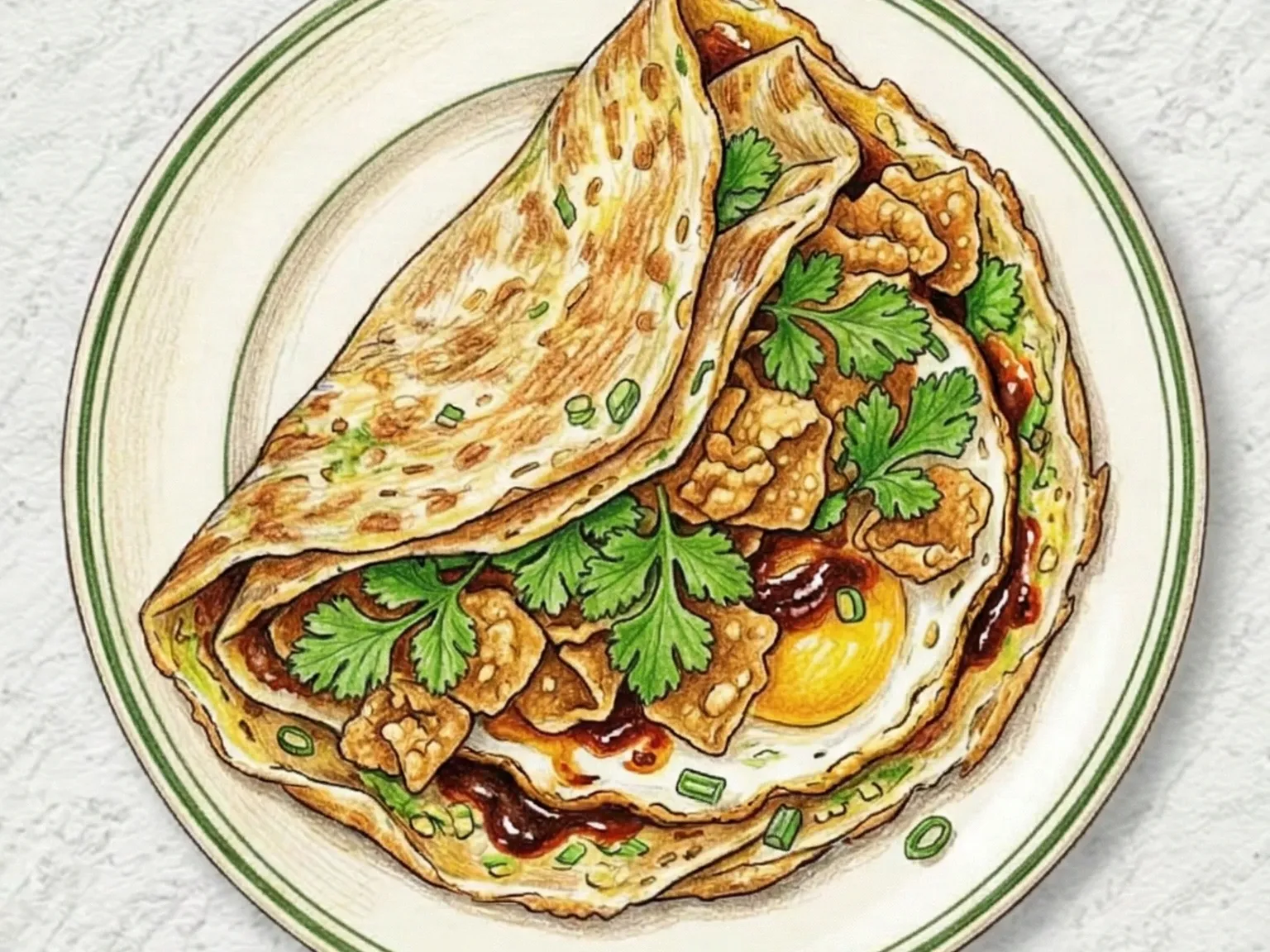
Jianbing is a northern Chinese street breakfast crepe assembled on a flat griddle within minutes. A thin batter of mung bean flour and wheat flour is spread into a wide circle, then an egg is cracked directly on top and smeared across the surface while still liquid. Chopped scallion is scattered over the egg before the crepe is flipped briefly to set the other side. Sweet bean sauce and chili sauce are brushed on, followed by fresh cilantro and a crispy fried wonton sheet that provides the signature crunch. The mung bean flour gives the batter a distinctive nutty flavor and slightly crisp edge that plain wheat flour cannot replicate. The whole assembly is folded into a neat rectangle meant to be eaten by hand. Timing is critical for the wonton cracker, which should be added last to prevent sogginess, creating a layered contrast of soft crepe, runny egg, sharp sauce, and shattering crunch.
Adjust Servings
Instructions
- 1
Whisk flour, mung bean flour, and water into a thin batter, then rest for 10 minutes.
- 2
Heat a nonstick pan over medium-low and spread half the batter into a thin round crepe.
- 3
Crack 1 egg on top, spread evenly, and sprinkle scallion.
- 4
Flip once set, cook for 20 seconds, then flip back.
- 5
Spread sweet bean and chili sauce, add cilantro and crispy wonton sheet, then fold into a rectangle.
As an Amazon Associate, we may earn from qualifying purchases.
Tips
Nutrition (per serving)
More Recipes

Zongzi (Chinese Bamboo-Wrapped Sticky Rice Dumplings)
Zongzi are traditional Chinese sticky rice dumplings wrapped in bamboo leaves and simmered for hours. Glutinous rice is soaked overnight, then bundled around a filling of soy-braised pork belly and rehydrated shiitake mushrooms seasoned with oyster sauce. The bamboo leaves are folded into a tight shape and secured with kitchen twine before being submerged in boiling water for two hours or more. During this cooking, the rice absorbs the rendered fat and seasoning from the pork, becoming dense, sticky, and deeply flavored. The bamboo leaves impart a subtle grassy fragrance that permeates every grain. While traditionally eaten during the Dragon Boat Festival, zongzi are available year-round across southern China.

Pork Baozi (Chinese Steamed Pork Cabbage Bun)
Baozi is a Chinese steamed bun made from yeast-leavened wheat dough filled with seasoned ground pork, cabbage, and scallion. The dough proofs for 40 minutes and puffs into a soft, pillowy shell in the steamer, while the filling is bound with soy sauce and sesame oil for a savory, aromatic center. Pleating the top seals in the juices during the 15-minute steam. Resting the buns for two minutes after turning off the heat prevents the delicate skin from collapsing due to sudden temperature change.

Osaka-Style Okonomiyaki (Japanese Savory Cabbage Pancake)
Osaka-style okonomiyaki is the signature griddle dish of Japan's Kansai region - a thick, cabbage-loaded savory pancake whose name means 'grilled as you like it.' Finely shredded cabbage is folded into a batter of flour, eggs, and dashi stock, then poured onto a hot griddle with strips of pork belly laid across the top. The pancake cooks slowly on medium heat, developing a golden crust on each side while the interior stays moist from the cabbage. Once done, it receives thick okonomiyaki sauce, zigzags of Japanese mayonnaise, a shower of bonito flakes that dance in the rising heat, and a dusting of aonori seaweed powder.

Cantonese Steamed Fish
Cantonese steamed fish - ching jing yu - embodies the Cantonese culinary philosophy of letting premium ingredients speak for themselves with minimal intervention. The technique demands the freshest possible whole fish - sea bass, grouper, or pomfret - because steaming hides nothing; any hint of staleness is immediately exposed. The fish is scored, placed on a plate with ginger slices tucked underneath and inside the cavity, then steamed over roiling water for exactly eight to ten minutes depending on thickness. Overcooking by even a minute turns the flesh from silky and translucent to dry and chalky. The moment the fish leaves the steamer, any accumulated liquid is drained - it carries a fishy taste that would spoil the dish. Julienned scallion and ginger are piled on top, then a ladle of smoking-hot oil is poured directly over them, sizzling the aromatics and releasing their fragrance into the fish. A final drizzle of seasoned soy sauce and a few drops of sesame oil complete the dish. In Cantonese banquet culture, the steamed fish course is often the most expensive item on the table, chosen live from a restaurant tank.

Century Egg and Pork Congee
Century egg and pork congee - pi dan shou rou zhou - is the quintessential Cantonese breakfast, served from dawn at congee shops across Hong Kong, Guangzhou, and the broader Pearl River Delta. The congee base requires a full hour of slow simmering, during which rice grains disintegrate entirely into a silky, porridge-like suspension - the Cantonese call this texture 'sang shui,' meaning the rice and water have become indistinguishable. Lean pork is sliced thin and dropped into the pot during the final minutes, cooking instantly in the hot porridge. Century egg - duck egg preserved in clay, ash, and salt for weeks until the white turns translucent amber and the yolk becomes a creamy dark-green gel - is cubed and stirred through. The egg's alkaline, sulfurous depth meets the clean blandness of the rice porridge, while the pork provides a savory anchor. White pepper, sesame oil, and sliced scallion finish the bowl. The congee must be eaten immediately - it thickens rapidly as it cools, and the textural window between perfectly flowing and pasty is narrow.

Pepper and Pork Stir-fry (Chinese-Style Julienned Bell Pepper and Pork)
Gochu-japchae is a Korean-Chinese stir-fry of julienned bell peppers and pork loin cooked fast over high heat in a soy-oyster sauce base. The pork is pre-marinated with starch and soy sauce to lock in moisture, ensuring each strip stays tender through rapid cooking. Keeping the stir-fry time short preserves the peppers' crunch and vibrant color. Served alongside steamed flower buns or wrapped in a tortilla, it makes a quick, flavorful meal. The dish captures the wok-seared character of Chinese-Korean cooking in under 30 minutes.