Kedgeree (British Smoked Fish Spiced Rice Dish)
Quick answer
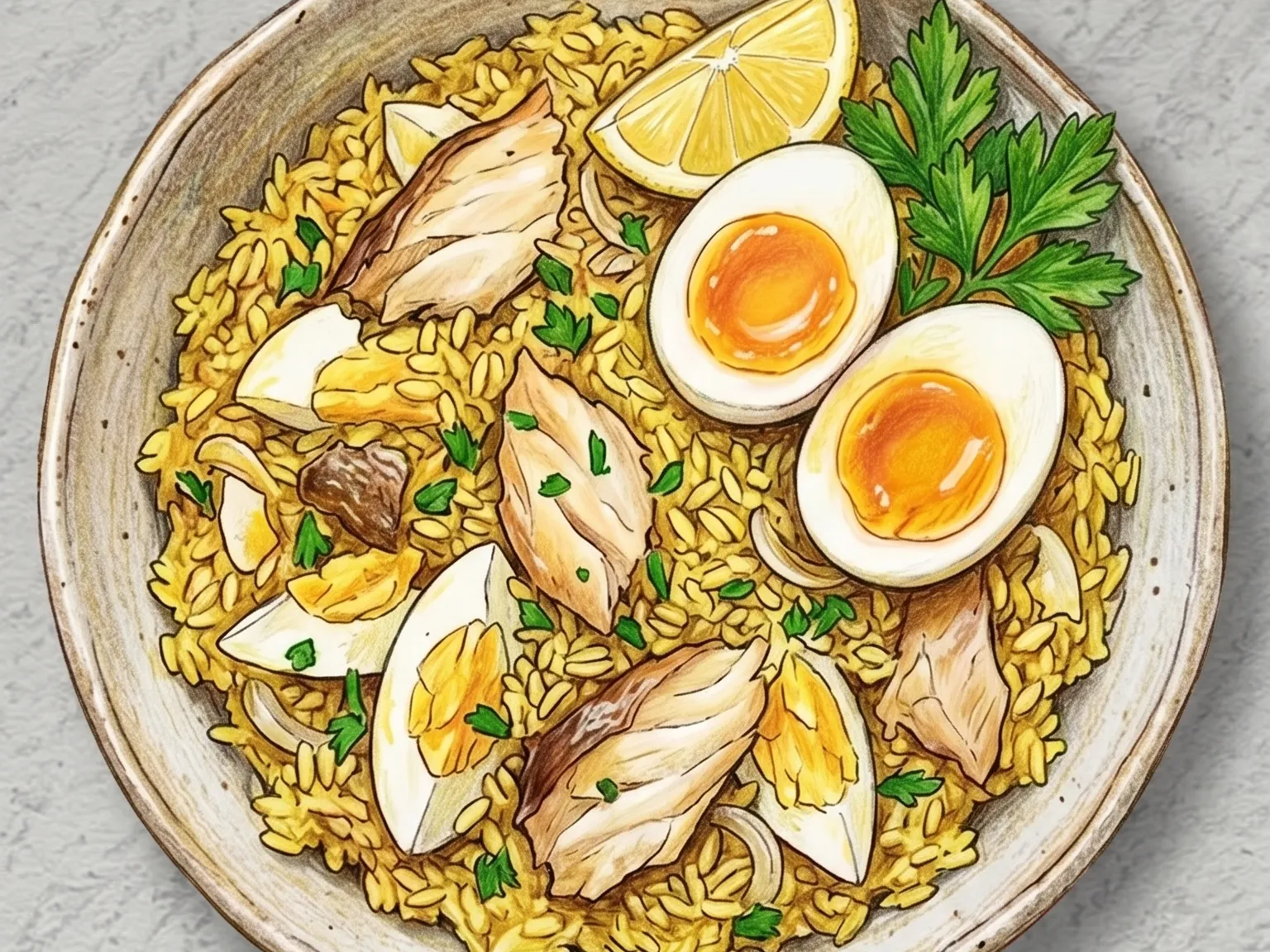
Kedgeree is a British brunch dish of smoked haddock flaked into spiced rice with boiled eggs, descended from the Indian colonial-era dish khichri.
What makes this special
- Curry-spiced rice folded with flaked smoked haddock defines this British brunch.
- Tearing the smoked haddock into large chunks spreads the smoke aroma through each bite
- Blooming curry powder in butter for 30 seconds infuses the fat with cumin and turmeric
Key ingredients
Core cooking flow
- 1 Hard-boil the 2 eggs, cool them in cold water, and peel them carefully.
- 2 Steam or gently warm the 220 g smoked haddock over low heat just until heated through.
- 3 Set a pan over medium heat, melt the 20 g butter, and add the 100 g onion.
Kedgeree is a British brunch dish of smoked haddock flaked into spiced rice with boiled eggs, descended from the Indian colonial-era dish khichri. The smoked fish is poached or steamed and broken into large pieces - keeping the flakes sizable preserves their texture and allows the smoky flavor to distribute through the rice in distinct pockets. Onion is sauteed in butter, then curry powder is bloomed for thirty seconds, releasing the warm aromas of cumin and turmeric into the fat, which tints and seasons every grain of rice. A squeeze of lemon juice at the end cuts through the richness of the butter and the heaviness of the spices with a bright acidity. Halved boiled eggs and chopped parsley finish the dish with contrasting texture and color.
Instructions
Read the steps as a cooking flow: prep, heat, seasoning, doneness control, and finish.
- 1Heat
Hard-boil the 2 eggs, cool them in cold water, and peel them carefully.
Cut them in halves and set them aside with the yolks facing up so they stay neat for serving.
- 2Control
Steam or gently warm the 220 g smoked haddock over low heat just until heated through.
Flake it along the grain into large pieces, keeping distinct chunks so the fish texture does not disappear in the rice.
- 3Control
Set a pan over medium heat, melt the 20 g butter, and add the 100 g onion.
Cook for about 3 minutes, stirring often, until the onion turns translucent without browning too hard.
- 4Heat
Add 1 teaspoon curry powder and stir for only 30 seconds to bloom the spice in the butter.
Keep the heat moderate, because cooking it too long or too hot can make the curry taste bitter.
- 5Heat
Add the 350 g cooked rice and break it up with a spatula as it fries.
Toss until the grains are hot, separate, and evenly tinted yellow by the curry butter.
- 6Finish
Fold in the haddock gently so the large flakes stay intact.
Finish with 1 tablespoon lemon juice and the parsley, taste for brightness, then top with the halved eggs and serve warm.
After the steps
Pick a recipe that fits this dish.
Continue with shared ingredients, meal pairings, or a similar method.
Recipes That Go Well With This
More Western →Based on shared ingredients and meal pairing
Fish Pie
Fish pie is a staple of British home cooking, particularly during the colder months. Chunks of cod, salmon, and smoked haddock are folded into a cream sauce made with milk, butter, parsley, and a touch of English mustard, then topped with a thick layer of mashed potatoes and baked until the surface turns golden and slightly crisp. The combination of fresh and smoked fish creates layers of flavor - the cod contributes clean, mild sweetness, the salmon adds richness, and the smoked haddock provides a saline, smoky depth that permeates the sauce. Peeled prawns and halved boiled eggs are common additions that make the filling more substantial. In the oven, the sauce bubbles up around the edges of the potato crust, and the first scoop through the golden top reveals the creamy seafood filling beneath. It is a complete meal requiring nothing more than a side of steamed greens.
Bubble and Squeak (Pan-Fried Mashed Potato and Cabbage Cake)
Bubble and squeak is a traditional British household dish made by combining mashed boiled potatoes with blanched, chopped cabbage, pressing the mixture flat in a well-oiled hot pan, and frying each side until a deep golden-brown crust forms across the entire surface. The name refers to the noise the dish makes during cooking - moisture from the cabbage hits the hot fat and sends up bubbles and a squeaking hiss. Frying diced onion in butter until soft and lightly caramelized before folding it into the potato-cabbage mixture adds a quiet sweetness that elevates the otherwise modest base ingredients considerably. Pressing the mixture firmly and evenly with a spatula throughout cooking is what creates the crust, and holding back the urge to move or flip it prematurely is the main technique. If the potatoes are particularly wet, a tablespoon or two of plain flour helps the mixture bind and hold its shape in the pan. The dish has been a fixture of British home cooking for generations, rooted in the tradition of using leftover Sunday roast vegetables the following day, and is commonly topped with a fried egg to make a complete one-plate meal.
Black Tea Milk Tea (British Condensed Milk Sweet Tea)
Milk tea is prepared by steeping black tea bags in boiling water for exactly four minutes to extract a strong, tannic base, then combining it with whole milk and condensed milk over low heat. Steeping shorter than four minutes leaves the tea pale and thin; longer than four minutes introduces bitterness and astringency that no amount of milk can fully mask. The milk rounds out the tea's sharpness and adds a creamy body, while condensed milk layers on a dense, caramel-like sweetness that sets this version apart from tea simply sweetened with sugar. Regular sugar dissolved early provides the baseline sweetness, and the condensed milk fine-tunes the richness and texture in the final moments. Warming the milk before combining it with the brewed tea helps both blend more smoothly. For an iced version, the mixture must be cooled completely before pouring over ice, since adding hot liquid directly to ice dilutes the drink and washes out the flavor.
Welsh Rarebit (British toast dish)
Welsh Rarebit is a British open-faced toasted sandwich topped with a savory, seasoned cheddar cheese sauce. The bread slices are toasted lightly beforehand to prevent the bread from absorbing the moisture of the sauce and becoming soggy. To prepare the sauce, butter and flour are cooked together for one minute to form a roux, and milk is whisked in gradually to avoid lumps. Grated cheddar cheese is then added by handfuls over very low heat to ensure it melts smoothly without separating. The sauce is seasoned with Dijon mustard, black pepper, and Worcestershire sauce, which adds a savory depth of flavor. The cheese sauce is spread thickly onto the toasted bread slices, reaching near the edges, and broiled in the oven for a few minutes until the top is bubbling and browned.
Serve with this
Chestnut Sweet Jelly (Korean Agar-Set Chestnut White Bean Confection)
Bam yanggaeng is built from three components: chestnut puree, white bean paste, and agar powder. Boiled chestnuts are mashed fine and combined with the bean paste, then dissolved agar, sugar, and honey are stirred into the mixture before it is brought to a brief boil. Poured into a mold and left to cool at room temperature, the agar sets the block into firm, clean-slicing slabs - a texture that comes from agar's sharp recrystallization as it cools, which produces a harder and more abrupt snap than gelatin-based confections. The starchy density of chestnuts gives the cross-section a smooth, fine-grained quality that plain bean paste lacks. A small amount of salt is critical: it draws the sweetness into focus rather than muting it. Skimming air bubbles before pouring ensures a flat, even surface. Prepared as a holiday gift in Korean households for generations, the finished block keeps in the refrigerator for about a week without losing texture.
Myeongran Lemon Cream Fettuccine
Myeongran lemon cream fettuccine wraps wide pasta ribbons in a sauce made from salted pollock roe, heavy cream, butter, and lemon zest. The small eggs of the roe are left intact and stirred into the sauce off the heat so they stay soft and burst with briny flavor when bitten rather than turning granular or hard. Garlic bloomed in butter forms the aromatic base, and a mixture of heavy cream with milk tempers the roe's saltiness into a smooth, balanced coating. Using lemon zest rather than juice adds a bright citrus fragrance without diluting the sauce or introducing acidity that would curdle the cream. Parmigiano-Reggiano deepens the savory foundation, and fettuccine's broad, flat surface holds the thick cream more effectively than thinner pasta shapes. The entire dish takes about twenty minutes from start to plate, making it a practical weeknight option that does not sacrifice depth of flavor for speed. The critical technique -- incorporating the roe off the heat -- keeps the texture creamy throughout and prevents the eggs from cooking into tough, unpleasant morsels.
Pork Bossam Apple Mustard Salad
Bossam apple mustard salad uses thinly sliced cold boiled pork belly as its main component, arranged over shredded cabbage, cucumber, and crisp apple slices, then finished with a sharp mustard-soy vinaigrette. Chilling the boiled pork completely before slicing is not optional: warm pork crumbles under the knife, while cold pork yields clean, even cuts that hold their shape on the plate. Cabbage and cucumber provide a firm, crunchy base whose texture directly contrasts with the soft, fatty pork, and the apple slices introduce a cool sweetness along with a welcome burst of moisture. Korean hot mustard, dissolved generously into a soy-vinegar dressing, releases a nasal, sinus-clearing heat with each bite that cuts through the richness of the pork fat without the acidity becoming the dominant note. Perilla leaves placed underneath the pork act as both a flavoring layer and a suppressor of any residual pork odor, their herbal intensity complementing the mustard without competing with it. The salad works equally well as a standalone meal and as a second-day use for leftover bossam from the previous night, which is one reason it appears in Korean home kitchens as often as it does.
Similar recipes
Fish and Chips
Fish and chips began in the seaside towns of England and grew into one of the most recognized British dishes worldwide. A fillet of cod or haddock is dipped in a batter made with beer or sparkling water, then fried at high heat until the coating turns golden, crisp, and shatteringly light. The carbonation in the batter creates tiny air pockets during frying, producing a shell that is crunchy without being heavy or greasy. Inside, the fish remains moist and flakes cleanly along its natural grain. The chips - thick-cut potatoes fried twice - develop a golden crust around a fluffy, starchy interior. Malt vinegar splashed over the hot fish cuts through the oil with sharp acidity, and traditional accompaniments include mushy peas and tartar sauce. Eating them wrapped in paper, standing at the harbor, remains the definitive experience.
English Muffin
English muffins are round, flat breads made from a yeasted dough that is cooked entirely on a griddle rather than in an oven. This stovetop method creates a firm, cornmeal-dusted exterior that browns directly against the hot surface while generating large, irregular air pockets throughout the interior. These nooks and crannies define the bread: they are produced by the high-hydration dough and preserved intact by splitting with a fork rather than slicing with a knife. Fork-splitting tears the crumb open along its natural fault lines, leaving a rough, cratered surface full of ridges and hollows. When placed in a toaster, the edges of those pockets crisp up quickly and unevenly, creating contrasting textures in every bite. Melted butter, jam, marmalade, or the broken yolk of a poached egg settles deep into every crevice, making each mouthful more saturated with flavor than a smooth cut surface ever would allow. English muffins are the structural foundation of Eggs Benedict and work equally well as a straightforward breakfast toast. Because the dough is wet and sticky, ring molds on the griddle keep the rounds uniform in thickness during cooking.
Eton Mess (Crushed Meringue, Cream & Strawberry Mix)
Eton mess is a British dessert originating from Eton College, made by roughly folding together broken meringue, whipped cream, and strawberries into a deliberate, unstudied jumble. The name comes from the method itself: there is no careful layering or presentation, just a generous combination of three components mixed loosely in a glass or wide bowl. The meringue is baked low and slow until the outside develops a firm, crisp shell while the inside stays soft and marshmallow-like, then cooled completely before being broken by hand into irregular shards of varying sizes. Strawberries are treated in two ways: some are crushed roughly with a fork so the juice bleeds in red streaks through the white cream, while others remain whole to provide fresh, firm bites of fruit. The heavy cream is whipped only to soft, billowy peaks so it folds around the meringue and fruit loosely rather than sitting in stiff mounds. Every spoonful delivers a different ratio of crunch, softness, tartness, and sweetness depending on which pieces land together, which is the pleasure of the dessert. Because the cream and fruit juices begin softening the meringue the moment they are combined, Eton mess must be assembled and eaten immediately to preserve the textural contrast between crisp and soft.