Korean Perilla Leaf Beef Stir-Fry

Korean Perilla Leaf Beef Stir-Fry

Quick answer

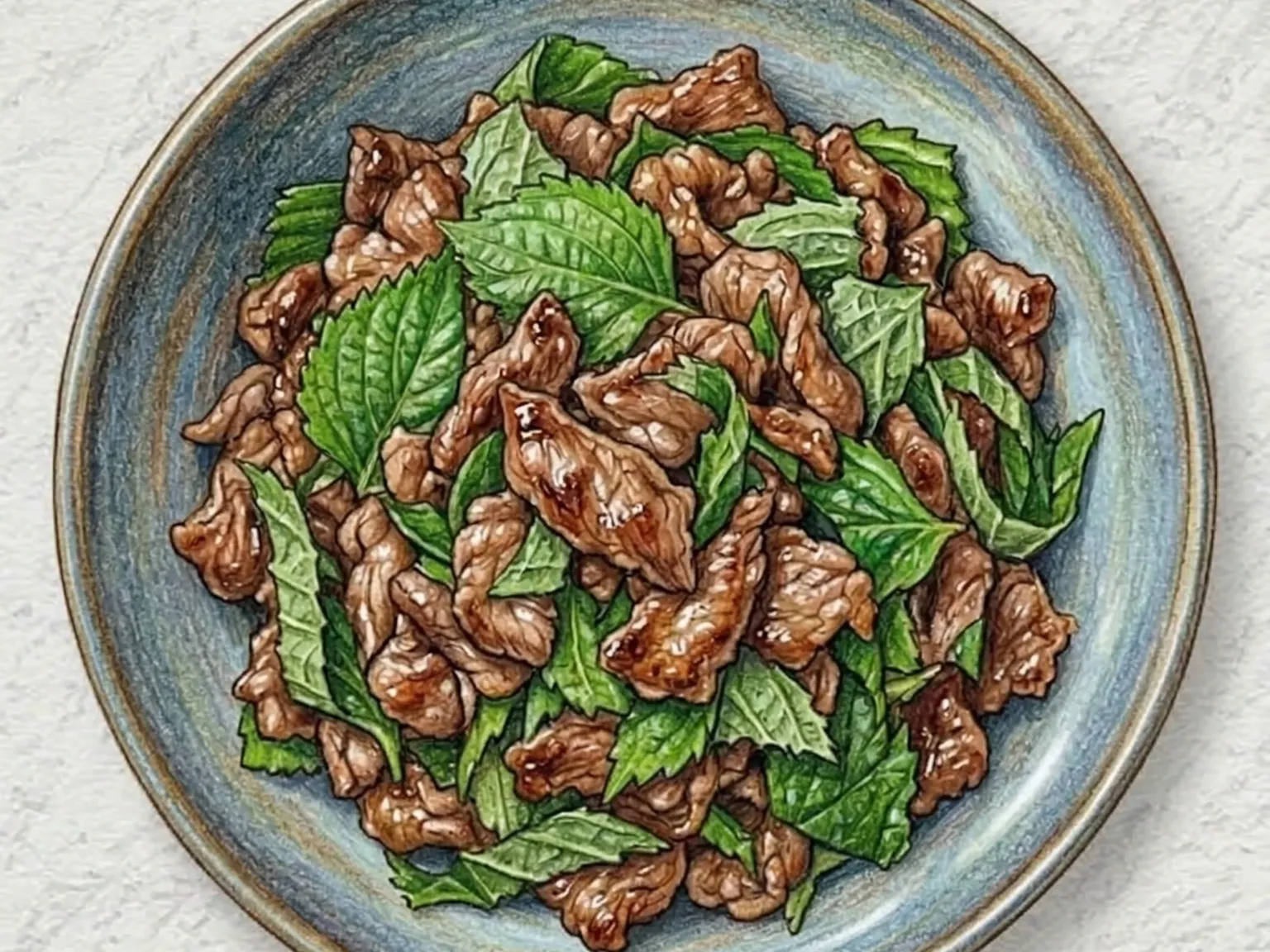
Kkaennip sogogi bokkeum is a stir-fry of thinly sliced beef marinated briefly in soy sauce, cooked with garlic over high heat, and finished with roughly chopped perilla l...

What makes this special

  • Kkaennip sogogi bokkeum highlights thin beef slices finished with a bold, herbal perilla aroma.
  • Perilla's strong herbal note over beef umami sets it apart from other beef stir-fries
  • Perilla wilted by residual heat only to prevent blackening
Total time
20 min
Level
Easy
Servings
2 servings
Ingredients
5
Calories
260 kcal
Protein
22 g

Key ingredients

Beef (thinly sliced)Perilla leavesSoy sauceSesame oilGarlic

Core cooking flow

  1. 1 Separate the 200 g thinly sliced beef into bite-size pieces, then coat it wi...
  2. 2 Shake excess water from the 20 perilla leaves, trim the tough stem ends, and...
  3. 3 Heat the pan over high heat for about 1 minute, then add the 2 garlic cloves and stir briefly.

Kkaennip sogogi bokkeum is a stir-fry of thinly sliced beef marinated briefly in soy sauce, cooked with garlic over high heat, and finished with roughly chopped perilla leaves added at the last moment. The perilla's bold herbal aroma sits on top of the beef's umami, giving this dish a flavor profile distinctly different from other beef stir-fries. The leaves darken and lose fragrance if overcooked, so they are wilted only by residual heat. Sesame oil rounds out the dish, which comes together in under twenty minutes with minimal ingredients.

Prep 10min Cook 10min 2 servings

Instructions

Read the steps as a cooking flow: prep, heat, seasoning, doneness control, and finish.

6 steps
  1. 1
    Season

    Separate the 200 g thinly sliced beef into bite-size pieces, then coat it with 2 tablespoons soy sauce for about 5 minutes.

    Loosen any clumps so the slices cook quickly and evenly in the pan.

  2. 2
    Season

    Shake excess water from the 20 perilla leaves, trim the tough stem ends, and cut the leaves into large pieces.

    If the leaves stay wet, they will steam the beef and dilute the seasoning.

  3. 3
    Control

    Heat the pan over high heat for about 1 minute, then add the 2 garlic cloves and stir briefly.

    Cook just until fragrant, stopping before the garlic browns because burnt garlic will make the beef taste bitter.

  4. 4
    Control

    Spread the seasoned beef widely across the hot pan and stir-fry over high heat for about 2 minutes.

    Turn the slices as they change color, cooking until most of the red color has disappeared.

  5. 5
    Control

    When the soy sauce on the bottom reduces and the beef looks glossy, turn off the heat and add the perilla leaves.

    Toss for only about 20 seconds with residual heat to keep their color and aroma.

  6. 6
    Finish

    Drizzle in 1 teaspoon sesame oil, toss once more, and transfer the stir-fry to a plate right away.

    Serve it warm before the perilla leaves darken and lose their fresh herbal fragrance.

After the steps

Pick a recipe that fits this dish.

Continue with shared ingredients, meal pairings, or a similar method.

Recipes That Go Well With This

More Stir-fry →

Based on shared ingredients and meal pairing

Korean Water Parsley Beef Stir-Fry
Shared ingredient: beef slices Stir-fry

Korean Water Parsley Beef Stir-Fry

Minari-sogogi-bokkeum pairs thinly sliced beef - briefly marinated in soy sauce - with water parsley, finishing the stir-fry with sesame oil. The beef provides a savory foundation, while minari's distinctive herbal sharpness cuts through the richness, leaving a clean aftertaste. Because water parsley wilts rapidly, it is added in the final moments and tossed for only a few seconds to preserve both its crunch and fragrance. The seasoning is deliberately minimal - just soy sauce, garlic, and sesame oil - letting the contrast between the two main ingredients speak for itself.

Korean Beef and Broccoli Stir-Fry
Shared ingredient: beef slices Stir-fry

Korean Beef and Broccoli Stir-Fry

Sogogi broccoli-bokkeum stir-fries thinly sliced beef with broccoli florets in a glaze of oyster sauce and soy sauce. The beef is seared first over high heat to lock in its juices, then the broccoli -- blanched just enough to keep its bite -- joins the pan. Oyster sauce binds the two main ingredients with concentrated savory depth, and garlic plus a final drizzle of sesame oil layer on fragrance. The sauce coats every surface with a glossy sheen, making this a complete main dish that needs nothing beyond steamed rice.

Korean Water Kimchi (Chilled Radish Broth Kimchi)
Serve together Side dishes

Korean Water Kimchi (Chilled Radish Broth Kimchi)

Nabak-kimchi is a Korean water kimchi made by submerging thinly sliced radish and napa cabbage in a clear, lightly reddened broth - fundamentally different from the dense, fermented intensity of baechu-kimchi. Here, the chilled broth is the centerpiece, meant to be sipped and spooned rather than merely eaten as a side. Radish and cabbage are cut into flat 2-to-3cm squares, salted briefly, then immersed in a liquid made by steeping gochugaru in water through cheesecloth - wrapping the powder prevents the particles from clouding the broth. Garlic, ginger, scallion, and fish sauce flavor the liquid. One day at room temperature initiates lactic fermentation, introducing a gentle tang, and refrigeration over two to three days deepens the complexity. A spoonful of nabak-kimchi broth alongside spicy food acts as a cooling palate cleanser. Served cold, this kimchi is particularly refreshing in summer - it is a drinking kimchi in the truest sense, closer in spirit to naengmyeon broth than to solid fermented kimchi.

Korean Beef and Paprika Stir-Fry
Similar recipe Stir-fry

Korean Beef and Paprika Stir-Fry

Sogogi paprika-bokkeum stir-fries soy-and-sesame-marinated beef strips with julienned bell peppers of mixed colors. The peppers lose just enough moisture over heat to concentrate their natural sweetness, which balances the salty soy marinade on the beef. Two cloves of garlic provide background aroma, but the seasoning is intentionally spare so the ingredients themselves lead the flavor. The dish's vivid reds, yellows, and greens make it as visually striking on the plate as it is straightforward to cook.

Serve with this

Korean Seasoned Seaweed Rice Bowl
Rice Easy

Korean Seasoned Seaweed Rice Bowl

This seasoned seaweed rice bowl stir-fries rehydrated wakame with garlic in sesame oil, seasons it with soy sauce, and spoons it over steamed rice for a quick and satisfying one-bowl meal. Soaking the dried seaweed until fully softened gives it a slippery yet pleasantly chewy texture that slides across the palate with each mouthful of rice. Cooking the garlic and seaweed together in sesame oil removes any raw oceanic sharpness and replaces it with a warm, nutty fragrance that layers over the natural sea-mineral character of the wakame. Soy sauce brings a savory edge that rounds out the seasoning and makes the bowl complete without any additional side dishes. With only five ingredients and a short cooking time from start to finish, this is one of the most efficient Korean rice bowls to prepare. The mineral richness of the seaweed gives the finished dish a depth that outpaces its simple ingredient list.

🥗 Light & Healthy 🏠 Everyday
Prep 20min Cook 10min 2 servings
Korean Radish and Salted Shrimp Stew
Stews Easy

Korean Radish and Salted Shrimp Stew

Musaengchae-jjigae simmers julienned radish in a broth built on salted shrimp (saeujeot) and gochugaru, drawing a surprising depth of flavor from minimal ingredients. Saeujeot is fermented shrimp paste that concentrates months of salt-curing and enzymatic breakdown into a potent seasoning -- it supplies umami on the level of fish sauce but with a more rounded, fermented character that forms the backbone of this broth without requiring any stock. Cutting the radish into thin julienne strips, rather than chunks, is deliberate: thin pieces cook through quickly and release just enough starch into the broth to give it a faint natural body. Gochugaru provides color and heat, and its fruity spice complements the sweet, mild flavor that radish develops as it softens. Tofu adds body and protein, and the green onion and garlic round out the aromatics. What makes this jjigae worth repeating despite its simplicity is the fermented complexity from the saeujeot -- a single tablespoon transforms plain water into something that tastes long-cooked. Lighter in texture than doenjang or kimchi jjigae, it works well as an everyday soup that pairs with rice without overwhelming the meal.

🏠 Everyday ⚡ Quick
Prep 10min Cook 20min 3 servings
Korean Boiled Seafood Broth
Soups Easy

Korean Boiled Seafood Broth

Haemul suyuk-tang is a clear Korean seafood soup where clams, shrimp, and squid are simmered together in lightly seasoned water with garlic and green onion. The defining quality of this dish is its restraint: no gochujang, no doenjang, no complex spice paste, just salt and the natural briny liquor each ingredient contributes to the pot. The clams open first and release their saline juice into the water, establishing the initial salinity of the broth. As the shrimp cook they turn pink and contribute a sweet current beneath the salt. The squid firms and curls into rings, adding a chewy textural counterpoint to the soft clam meat and the tender shrimp. Each of these three seafoods produces a different form of marine umami, and together they layer into a broth that reads as remarkably full despite being completely transparent. There is no competition from fermented paste or chili, so the ocean flavor comes through cleanly and directly. The visual effect of the finished bowl is also appealing: open clam shells scattered through the pot, curved pink shrimp, and white squid rings give the bowl a sense of abundance without heaviness. The soup works well as a light meal alongside rice, and it is the dish to reach for when the goal is to taste the seafood itself without interference from heavier seasonings.

🏠 Everyday 🍺 Bar Snacks
Prep 15min Cook 25min 3 servings

Similar recipes

Korean Cabbage Doenjang Stir-Fry
Stir-fry Easy

Korean Cabbage Doenjang Stir-Fry

Baechu doenjang bokkeum is a Korean home-style side dish where napa cabbage is stir-fried with doenjang (fermented soybean paste) in perilla oil. The cabbage goes into a hot pan first and is tossed until slightly wilted, then the doenjang is added and the heat lowered so the paste spreads evenly and coats every piece. Minced garlic goes in with the cabbage, its sharpness merging into the fermented depth of the doenjang as both cook together. The thicker stem sections go into the pan before the leaves to preserve their crunch, and the leafy parts follow later so they stay tender rather than limp. A final drizzle of perilla oil just before removing the pan from heat reinforces the nutty aroma, finished with a scatter of toasted sesame seeds. The seasoning is minimal, but the salty intensity of the doenjang and the natural sweetness of napa cabbage strike a balance that makes this side dish a reliable staple with steamed rice. No soup or stew is needed alongside it.

🏠 Everyday 🍱 Lunchbox
Prep 5min Cook 8min 2 servings
Korean Perilla Leaf Beef Stew
Stews Easy

Korean Perilla Leaf Beef Stew

Korean perilla leaf beef stew is a savory broth dish that combines thinly sliced beef with perilla leaves. The cooking process starts by marinating the beef with soup soy sauce and minced garlic, then stir-frying it briefly with sliced onions to extract its natural flavors. Anchovy stock is then poured into the pot and brought to a boil. Red pepper flakes, soup soy sauce, and garlic are added to build a spicy broth, followed by cubes of firm tofu that simmer for several minutes to absorb the seasoning. At the very end of cooking, twelve fresh perilla leaves are sliced and added to the pot for just a minute or two along with green onions. This late addition ensures the delicate, herbal aroma of the perilla leaves is preserved, infusing the entire stew. Seasoned primarily with soup soy sauce, the stew highlights the distinct taste of beef and perilla without heavy seasonings.

🏠 Everyday
Prep 15min Cook 20min 2 servings
Korean Perilla Seed Porridge
Rice Easy

Korean Perilla Seed Porridge

Deulkkae juk is a traditional Korean porridge made by blending toasted perilla seeds into a smooth liquid and simmering it with soaked rice. Toasting the seeds beforehand unlocks a deep, earthy nuttiness that defines every spoonful of the finished porridge. The rice is first stir-fried briefly in sesame oil, then the perilla liquid is poured in and the mixture is stirred over low heat until the starch from the rice and the natural oils from the seeds combine into a thick, creamy consistency. Salt is the only seasoning needed - the perilla carries enough flavor on its own to make the bowl complete. The porridge is easy to digest and coats the stomach gently, making it suitable as a morning meal or a restorative dish during illness. In Korean tradition, deulkkae juk has long served as a warming winter food, valued for its ability to nourish without burdening the body.

🥗 Light & Healthy 🏠 Everyday
Prep 10min Cook 30min 2 servings

Tips

Add perilla leaves at the end - they darken quickly and lose their aroma.

Nutrition (per serving)

Calories
260
kcal
Protein
22
g
Carbs
6
g
Fat
16
g