Charim

2686 Korean & World Recipes

2686+ Korean recipes, clean and organized. Ingredients to instructions, all at a glance.

Korean Steamed Shishito Pepper Banchan

Korean Steamed Shishito Pepper Banchan

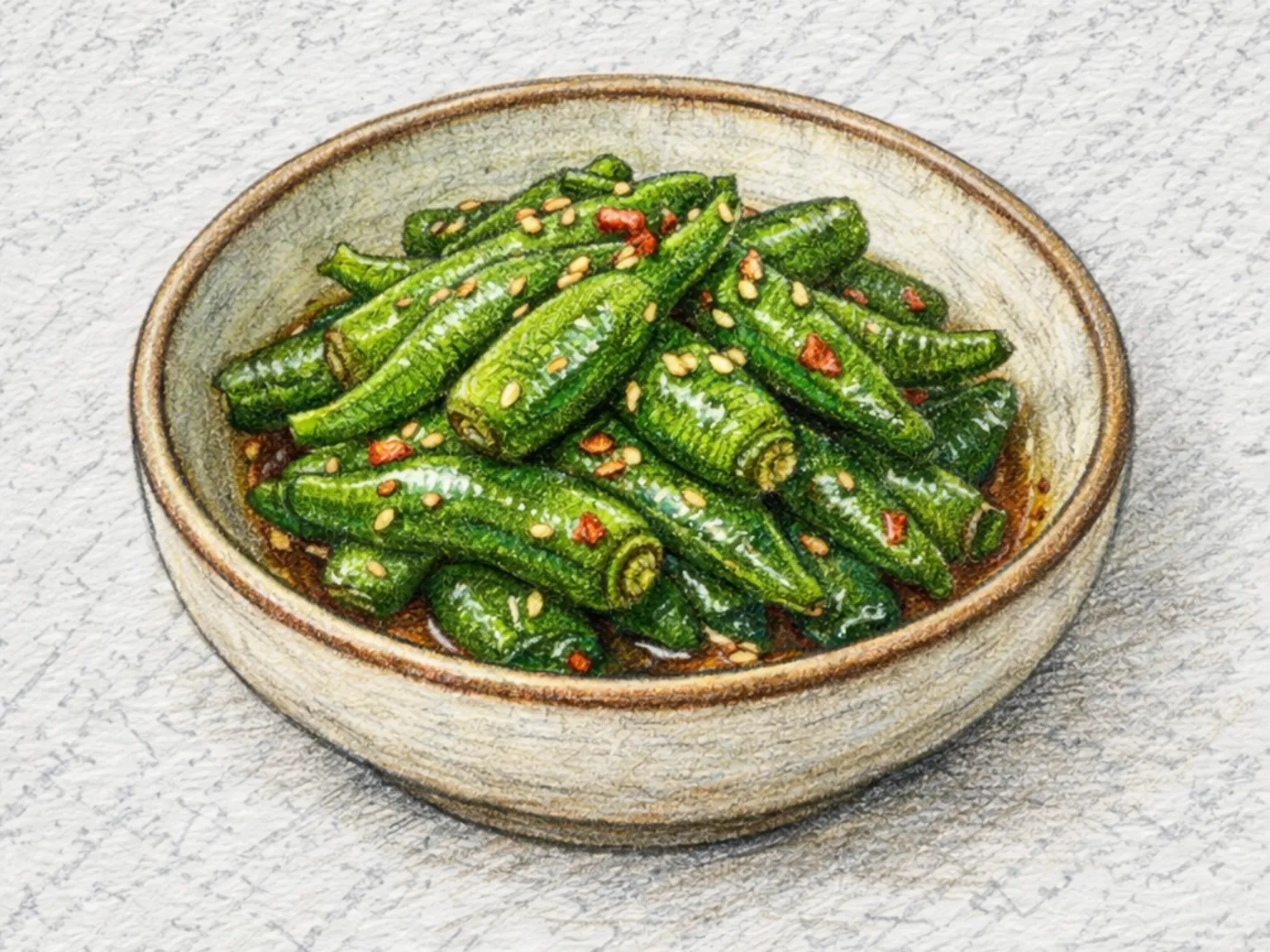
Kkwarigochu-jjim steams flour-dusted shishito peppers rather than frying them, yielding an oil-free banchan with a moist, tender bite. The wrinkled surface of shishito peppers catches flour naturally, and that thin coating traps steam during cooking to keep the flesh juicy - but too much flour causes the peppers to clump into a sticky mass, so the trick is to toss them in a sieve with a light dusting. Five to six minutes of steaming wilts the peppers and turns the flour coat translucent. A quick toss in soy sauce, gochugaru, garlic, and sesame oil layers savory-spicy seasoning over the pepper's own mild sweetness. Because no oil is used, the calorie count stays low, and the steaming method preserves more of the pepper's vitamin C compared to stir-frying. This is a go-to for anyone looking for a lighter approach to shishito pepper banchan.

Prep 12minCook 7min4 servings

Adjust Servings

2servings
servings

Instructions

  1. 1

    Trim stems, wash peppers, and pat dry.

  2. 2

    Coat peppers lightly with flour.

  3. 3

    Steam for 5-6 minutes.

  4. 4

    Mix soy sauce, gochugaru, garlic, and sesame oil.

  5. 5

    Toss steamed peppers in seasoning and finish with sesame seeds.

🛒Shop Ingredients on Amazon

As an Amazon Associate, we may earn from qualifying purchases.

Tips

Use only a thin flour coating to avoid clumping.

Nutrition (per serving)

Calories
72
kcal
Protein
2
g
Carbs
9
g
Fat
3
g

More Recipes

Korean Seasoned Shishito Pepper Banchan
Side dishesEasy

Korean Seasoned Shishito Pepper Banchan

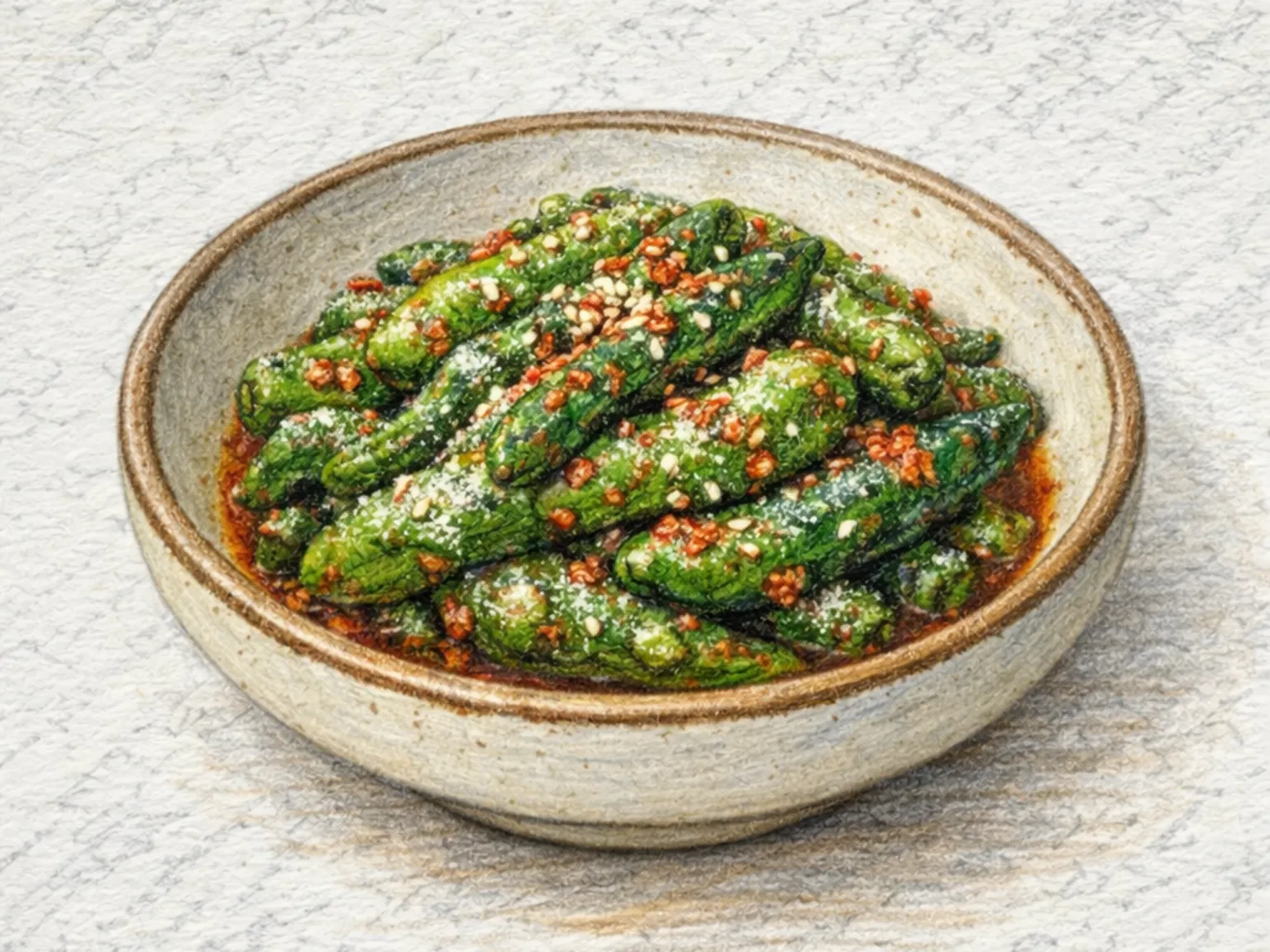
Kkwarigochu-muchim is a Korean banchan made by briefly blanching shishito peppers and dressing them in doenjang-based seasoning - distinct from the braised version (jjim) that simmers the peppers until soft. The key is keeping blanching under forty seconds so the peppers retain their snap. Those characteristic wrinkles on the pepper skin trap the doenjang-soy-sesame dressing, delivering concentrated flavor even with minimal sauce. Shocking the peppers in cold water after blanching locks in their vivid green color. Tearing one end slightly allows the seasoning to seep inside. Among Korean diners, part of the appeal is the occasional surprise - most shishito peppers are mild, but one in every handful packs unexpected heat. This banchan releases very little liquid, making it a practical choice for packed lunches.

🏠 Everyday🍱 Lunchbox
Prep 8minCook 3min4 servings
Korean Steamed Eggplant Namul
Side dishesEasy

Korean Steamed Eggplant Namul

Gaji namul strips eggplant down to its quietest expression - steamed until completely soft, then dressed with just soy sauce, garlic, and sesame oil. No chili, no vinegar, no fermented paste. The eggplant is halved and steamed for seven minutes until the flesh is uniformly tender, then torn into long shreds by hand along its natural fibers. This tearing technique creates rough surfaces that grip the minimal seasoning better than knife-cut pieces would. The dressed namul has a glossy, dark sheen from the sesame oil and soy sauce soaking into the porous flesh. Among Korean namul dishes, gaji namul stands out for its exceptionally soft, almost melting texture - it practically dissolves when mixed into warm rice. A traditional banchan in Korean Buddhist temple cuisine, where simplicity is a principle rather than a limitation.

🏠 Everyday🍱 Lunchbox
Prep 10minCook 8min4 servings
Korean Braised Tofu with Shishito Peppers
SteamedEasy

Korean Braised Tofu with Shishito Peppers

Kkwarigochu-dubu-jorim is a Korean braised dish of pan-fried tofu and shishito peppers in a soy sauce, gochugaru, and garlic seasoning. The tofu is seared first to create a firm, golden crust that contrasts with its soft interior once it finishes braising in the sauce. Shishito peppers absorb just enough liquid to carry the seasoning while adding their own fresh, vegetal note. Soy sauce and sesame oil pull the flavors together into a cohesive, savory whole, making this a satisfying plant-based banchan that holds its own on any table.

🏠 Everyday🍱 Lunchbox
Prep 10minCook 20min2 servings
Korean Pan-fried Radish Pancakes
Side dishesEasy

Korean Pan-fried Radish Pancakes

Mu-jeon is a Korean pan-fried radish pancake belonging to the same vegetable-jeon family as hobak-jeon and gaji-jeon, though daikon radish brings a textural character distinctly its own. Slicing to an even 3mm thickness is critical - the radish must cook through until soft and sweet inside while the egg coating crisps golden outside. Too thick and the raw center retains an acrid bite; too thin and the slices collapse. Five minutes of salting draws surface moisture so the flour adheres properly and the oil does not splatter during frying. Slow cooking over low heat is essential: the egg batter sets gradually into a golden shell while the heat converts the radish's starch into sugars, replacing the raw spiciness with a gentle sweetness completely unlike the uncooked root. Dipped in cho-ganjang (soy-vinegar sauce), the acidity cuts through the pan-fried richness. Mu-jeon appears on Korean holiday tables during Chuseok and Seollal alongside other vegetable jeon as part of the traditional jeon platter.

🏠 Everyday🍱 Lunchbox
Prep 15minCook 12min2 servings
Korean Stuffed Eggplant Seon
Side dishesMedium

Korean Stuffed Eggplant Seon

Gaji-seon is a Joseon-era royal court dish - one of the 'seon' preparations where vegetables are stuffed with seasoned fillings and steamed. The eggplant is scored deeply at intervals but not cut through, creating accordion-like pockets. A filling of minced pork or beef mixed with tofu, scallion, and sesame oil is pressed into each slit. The stuffed eggplant steams for fifteen minutes, during which the filling's juices meld with the collapsing eggplant flesh. A light soy-based sauce is drizzled over at serving. The dish requires more patience than most banchan - each eggplant is individually stuffed - and this labor-intensive nature is why it has historically been reserved for guests and celebrations. The combination of the nearly-dissolving eggplant shell and the savory, compact filling creates a textural refinement that sets seon apart from ordinary stir-fried or steamed banchan.

🏠 Everyday🎉 Special Occasion
Prep 25minCook 20min4 servings
Korean Steamed Zucchini with Salted Shrimp
SteamedEasy

Korean Steamed Zucchini with Salted Shrimp

This gentle braise belongs to a family of Korean jjim dishes where vegetables are steam-cooked in minimal liquid seasoned with fermented ingredients. Salted shrimp - saeujeot - is the sole seasoning base, minced and dissolved into water with garlic to create a light broth. Half-moon slices of zucchini cook covered on medium-low heat, absorbing the shrimp's briny umami as they turn translucent. The technique produces something between steaming and braising: the zucchini stays moist and intact, never waterlogged. A finish of perilla oil and sesame seeds off-heat adds a nutty fragrance. This banchan traces to Korean countryside kitchens where salted shrimp was the primary seasoning before soy sauce became widely available. It pairs naturally with steamed rice and a stronger-flavored main dish.

🏠 Everyday🍱 Lunchbox
Prep 12minCook 15min2 servings
More Side dishes