Steamed Komatsuna and Tofu

Steamed Komatsuna and Tofu

Quick answer

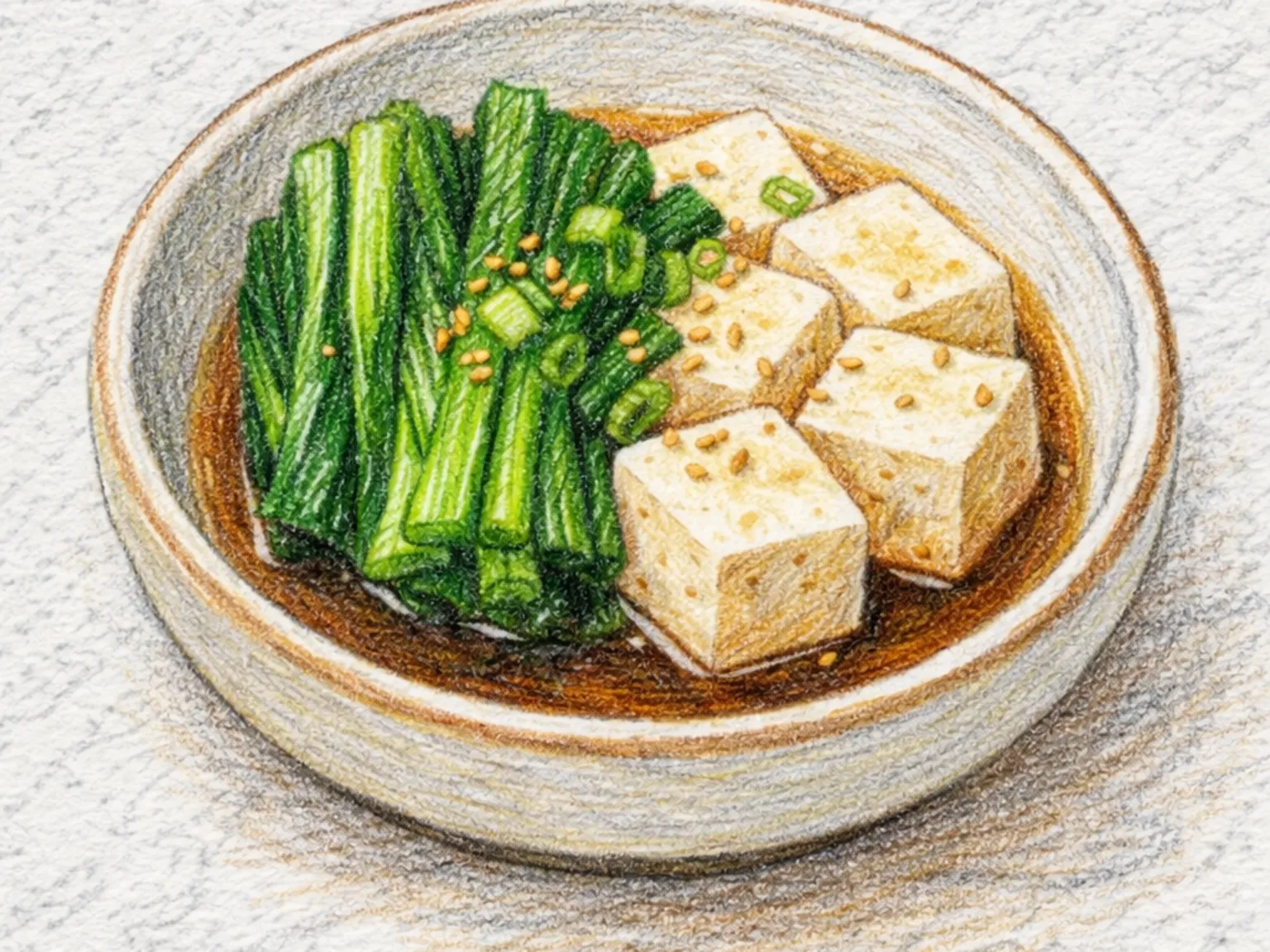
Komatsuna mushi is a Japanese steamed dish of mustard spinach and tofu, finished with a poured dashi-soy sauce.

What makes this special

  • Komatsuna-mushi maintains a firm vegetable bite against soft tofu in a light dashi-soy broth.
  • Komatsuna's firmer stem and milder bitterness than spinach survive steaming with texture intact
  • Dashi and soy-only sauce uses zero oil to let the ingredients speak for themselves
Total time
22 min
Level
Easy
Servings
2 servings
Ingredients
6
Calories
180 kcal
Protein
14 g

Key ingredients

komatsunasoft tofusoy saucedashi stocksesame oil

Core cooking flow

  1. 1 Rinse 180 g komatsuna, shake off excess water, and cut it into 5 cm lengths.
  2. 2 Cut 300 g soft tofu into roughly 2 cm cubes and set them briefly on paper towels.
  3. 3 Arrange the komatsuna stems on the steaming plate first, then the tofu, then the leaves.

Komatsuna mushi is a Japanese steamed dish of mustard spinach and tofu, finished with a poured dashi-soy sauce. Komatsuna has less bitterness than regular spinach and keeps a firm bite after steaming, which stands in textural contrast to the soft tofu beneath it. The sauce is made from kombu and katsuobushi dashi seasoned with soy sauce and salt alone, so there is nothing artificial in the flavor and each ingredient comes through cleanly. No oil is used anywhere in the preparation, making this one of the lighter dishes in a multi-course Japanese home meal, where it commonly appears alongside several other small plates. A small amount of bonito flakes laid over the tofu at the end adds fragrance and gives the dish a tidy, composed appearance.

Prep 10min Cook 12min 2 servings
Recipes by ingredient → soy sauce sesame oil

Instructions

Read the steps as a cooking flow: prep, heat, seasoning, doneness control, and finish.

6 steps
  1. 1
    Prep

    Rinse 180 g komatsuna, shake off excess water, and cut it into 5 cm lengths.

    Keep the stems and leaves slightly separated so the firmer stems can be placed where they receive more heat.

  2. 2
    Season

    Cut 300 g soft tofu into roughly 2 cm cubes and set them briefly on paper towels.

    Draining the surface moisture keeps the dashi soy sauce from tasting diluted after steaming.

  3. 3
    Finish

    Arrange the komatsuna stems on the steaming plate first, then the tofu, then the leaves.

    Leave small gaps instead of piling everything tightly so steam circulates and the tofu keeps its shape.

  4. 4
    Finish

    Once the steamer is boiling, add the plate and steam over medium heat for 7 to 8 minutes.

    Stop when the leaves look bright and wilted and the stems bend slightly but still hold some bite.

  5. 5
    Control

    In a small pan, warm 80 ml dashi with 1.5 tablespoons soy sauce over low heat.

    Do not boil it hard; turn off the heat as soon as steam rises and the aroma opens.

  6. 6
    Finish

    Pour off a little excess liquid from the steaming plate, then spoon the warm sauce evenly over the tofu and greens.

    Finish with 1 teaspoon sesame oil and 1 teaspoon sesame seeds, and serve while warm.

After the steps

Pick a recipe that fits this dish.

Continue with shared ingredients, meal pairings, or a similar method.

Recipes That Go Well With This

More Steamed →

Based on shared ingredients and meal pairing

Japanese Simmered Yellowtail and Daikon
Shared ingredient: dashi stock Steamed

Japanese Simmered Yellowtail and Daikon

Yellowtail and daikon are simmered in a dashi broth seasoned with soy sauce, mirin, and sake until the braising liquid concentrates around the fish. The daikon absorbs the rich stock as it cooks, turning tender and translucent with a deep savory flavor throughout. Sliced ginger added to the pot neutralizes the fishiness without masking the yellowtail's natural richness. Sugar tempers the salt in the soy, producing a glaze that coats the skin and clings to the daikon. The dish is best from December through January, when yellowtail carries its peak fat content and yields the most flavorful braising stock.

Japanese Braised Chicken and Root Vegetables
Shared ingredient: dashi stock Steamed

Japanese Braised Chicken and Root Vegetables

Chikuzenni is a Japanese-style braise of chicken thigh with lotus root, burdock, and carrot simmered in dashi seasoned with soy sauce and mirin. The thigh is seared first to render its fat, which coats each root vegetable piece as they braise together, building savory depth in the broth. Lotus root holds its firm bite through the cook, while burdock develops an earthy, nutty quality that intensifies with chewing. Mirin's restrained sweetness rounds out the soy, producing a side dish that stays satisfying across multiple meals of steamed rice.

Tea Rice Bowl (Japanese Green Tea Poured Rice with Salmon)
Serve together Rice

Tea Rice Bowl (Japanese Green Tea Poured Rice with Salmon)

Ochazuke is a Japanese dish of cooked rice topped with grilled salmon flakes, dried seaweed, green onion, and wasabi, over which hot green tea is poured just before eating. The astringent bitterness of the green tea works against the fatty richness of the salmon, cutting through the oil and keeping the palate clean throughout the bowl. Wasabi adds a sharp, nasal heat that punctuates each spoonful differently depending on how much dissolves into the surrounding liquid. A light drizzle of soy sauce provides a salty baseline that ties the ingredients together without overpowering the tea. The seaweed flakes soften and dissolve into the hot liquid, gradually releasing a subtle oceanic aroma that spreads through the broth. As the meal progresses, the rice releases some starch into the tea, thickening the broth slightly and shifting the flavor toward the end. Using dashi stock made from kombu and bonito instead of green tea produces a richer, more umami-forward version. Variations with pickled plum or mentaiko in place of salmon are equally common.

Japanese Savory Steamed Egg Custard
Similar recipe Steamed

Japanese Savory Steamed Egg Custard

Eggs beaten with dashi stock, soy sauce, and mirin are steamed into a silky custard. A high dashi-to-egg ratio produces an exceptionally smooth texture that holds its shape yet barely resists the spoon. Shrimp, shiitake mushroom, and ginkgo nuts placed inside the cup before steaming offer distinct pockets of flavor and chew within each serving. Controlling the steam temperature is critical - too much heat causes bubbles that roughen the surface, so a cloth tucked under the lid and a low flame keep the environment gentle throughout. Found in both Japanese home kitchens and izakaya menus, chawanmushi is served warm in individual cups as a starter.

Serve with this

Korean Mushroom Seaweed Soup
Soups Easy

Korean Mushroom Seaweed Soup

Rehydrated seaweed and two kinds of mushrooms - oyster and shiitake - are stir-fried in sesame oil first, before any water is added, so their flavors concentrate in the fat rather than leaching out into the broth. Water is added after that initial fry and the soup simmers for twenty minutes until the seaweed softens completely and releases a gentle oceanic character into the liquid. Without any meat-based stock, the umami comes entirely from the mushrooms and the natural glutamates in the seaweed, which is enough to give the broth genuine depth. The sesame oil blooms through the whole pot. Seasoned with soup soy sauce and salt at the end, the finished soup has a calm, layered flavor with soft seaweed and slightly chewy mushrooms providing contrasting textures in each bowl.

🏠 Everyday 🥗 Light & Healthy
Prep 15min Cook 30min 4 servings
Korean Seasoned Sea Grapes Salad
Side dishes Easy

Korean Seasoned Sea Grapes Salad

Kkosiraegi-muchim is a tangy, low-calorie banchan made from kkosiraegi, a red algae seaweed whose thin, noodle-like strands snap with a distinctive crunch that no other seaweed can replicate. Blanching must not exceed twenty seconds, as anything longer collapses the characteristic texture, so a timer is essential. The seaweed goes straight from the boiling water into cold water to stop the heat and lock in elasticity. The dressing brings together gochugaru, soup soy sauce, vinegar, maesil-cheong, garlic, and sesame oil; the green plum extract layering in a fruity acidity that lifts the dish beyond simple sour-spicy flavoring. Julienned cucumber threaded through the seaweed strands provides a crisp, garden counterpoint to the oceanic depth. At roughly 72 kilocalories per serving with high dietary fiber content, this banchan appears frequently in Korean diet meal plans because it satisfies without adding much to the calorie count. Eating it promptly after seasoning prevents the cucumber from releasing water and diluting the dressing. Served cold in summer, it doubles as a refreshing side that pairs well with grilled meat or plain rice.

🥗 Light & Healthy 🏠 Everyday
Prep 10min Cook 2min 4 servings
Korean Red Cabbage Kimchi
Kimchi Easy

Korean Red Cabbage Kimchi

Jeokchae kimchi is made by salting red cabbage leaves, then tossing them in a seasoning of gochugaru, sand lance fish sauce, minced garlic, and Korean pear juice before a short fermentation. Red cabbage has thicker, denser leaves than napa cabbage, so it holds its crunch well after brining rather than going soft. The anthocyanin pigment in the red cabbage reacts with the chili seasoning to produce a vivid purple color rather than the typical red associated with kimchi, making it visually striking on the table. Pear juice provides a gentle fruit sweetness underneath the heat and spice, while sand lance fish sauce builds enough savory depth that even a brief fermentation yields full flavor. Scallions add a fresh, aromatic finish that ties the seasoning together. The result is a kimchi that is crunchy, spicy, and umami-rich simultaneously, with a distinctive character that sets it apart from traditional napa kimchi.

🍱 Lunchbox 🏠 Everyday
Prep 30min 2 servings

Similar recipes

Agedashi Tofu (Japanese Crispy Fried Tofu in Dashi Broth)
Asian Easy

Agedashi Tofu (Japanese Crispy Fried Tofu in Dashi Broth)

The dish has been in Japanese izakaya cookbooks since the Edo period - essentially a method for turning a block of tofu into something worth drinking beside. Firm tofu is pressed under weight for at least half an hour to drive out moisture, then tapped lightly in potato starch. Any residual water causes violent spitting in the oil; too thick a starch coat turns gummy once the broth hits. Into oil held at 170C until a translucent golden shell forms, two to three minutes without touching it. From there, hot dashi-soy-mirin broth goes on immediately at the table. The edges of the crust absorb the liquid and turn to something between gel and noodle; the center stays dry and crisp for roughly thirty seconds. That window is the whole point. Eat past it and you have soft tofu in broth, which is fine but is a different dish entirely. Grated daikon on top cuts through any lingering oil.

🍺 Bar Snacks ⚡ Quick
Prep 15min Cook 12min 2 servings
Korean Steamed Flounder (Whole Flatfish with Soy Garlic Sauce)
Steamed Easy

Korean Steamed Flounder (Whole Flatfish with Soy Garlic Sauce)

Korean steamed flounder, called gajami-jjim, is a fish dish prepared by cooking whole flatfish over a bed of vegetables with a light soy garlic sauce. The process starts by layering sliced onions at the bottom of the steamer to prevent the delicate white flesh from sticking or breaking apart during cooking. A seasoning mixture of soy sauce, minced garlic, and rice wine is spooned over the cleaned fish. The rice wine and garlic neutralize fishy notes while keeping the flounder moist. Steaming takes about twelve minutes over medium-high heat, followed by an additional two minutes after scattering sliced green onions on top. The cooking time must be monitored closely to prevent the tender fish from drying out. The resulting dish features a clean, savory taste highlighting the natural flavor of the flounder. The light sauce left in the dish can be mixed with cooked rice.

🏠 Everyday 🍱 Lunchbox
Prep 15min Cook 20min 2 servings
Udon with Seasoned Fried Tofu
Noodles Easy

Udon with Seasoned Fried Tofu

Kitsune udon is a Japanese noodle soup defined by its topping of sweet-simmered fried tofu pouches floating on a clear, deeply savory dashi broth. The aburaage is blanched first in boiling water to remove the excess oil that would otherwise cloud the broth and repel the seasoning, then braised in a mixture of water, soy sauce, mirin, and sugar for about six minutes until the liquid has been absorbed and the sweetness has penetrated to the center of each pouch. The broth is built separately from a stock of katsuobushi and kombu, seasoned with soy sauce, mirin, and just enough salt to round out the flavor without making it salty. The quality of this broth is the single most important factor in the finished bowl. Frozen udon noodles are warmed in boiling water for about two minutes, just long enough to loosen and heat through without losing their elastic, springy texture, then transferred to the bowl with the broth ladled over. The simmered tofu pouch sits on top, and as you eat, it releases its sweetened liquid gradually into the surrounding broth, shifting the flavor of the soup with each bite. Sliced scallion and a pinch of shichimi togarashi finish the bowl with fresh aroma and gentle heat. The tofu benefits from being prepared a day in advance, as resting overnight deepens the braising flavor throughout.

🏠 Everyday ⚡ Quick
Prep 12min Cook 18min 2 servings

Tips

Drain tofu well for cleaner flavor.
Avoid oversteaming to keep bright color.

Nutrition (per serving)

Calories
180
kcal
Protein
14
g
Carbs
7
g
Fat
10
g