Braised Pork Belly with Preserved Mustard Greens
Quick answer
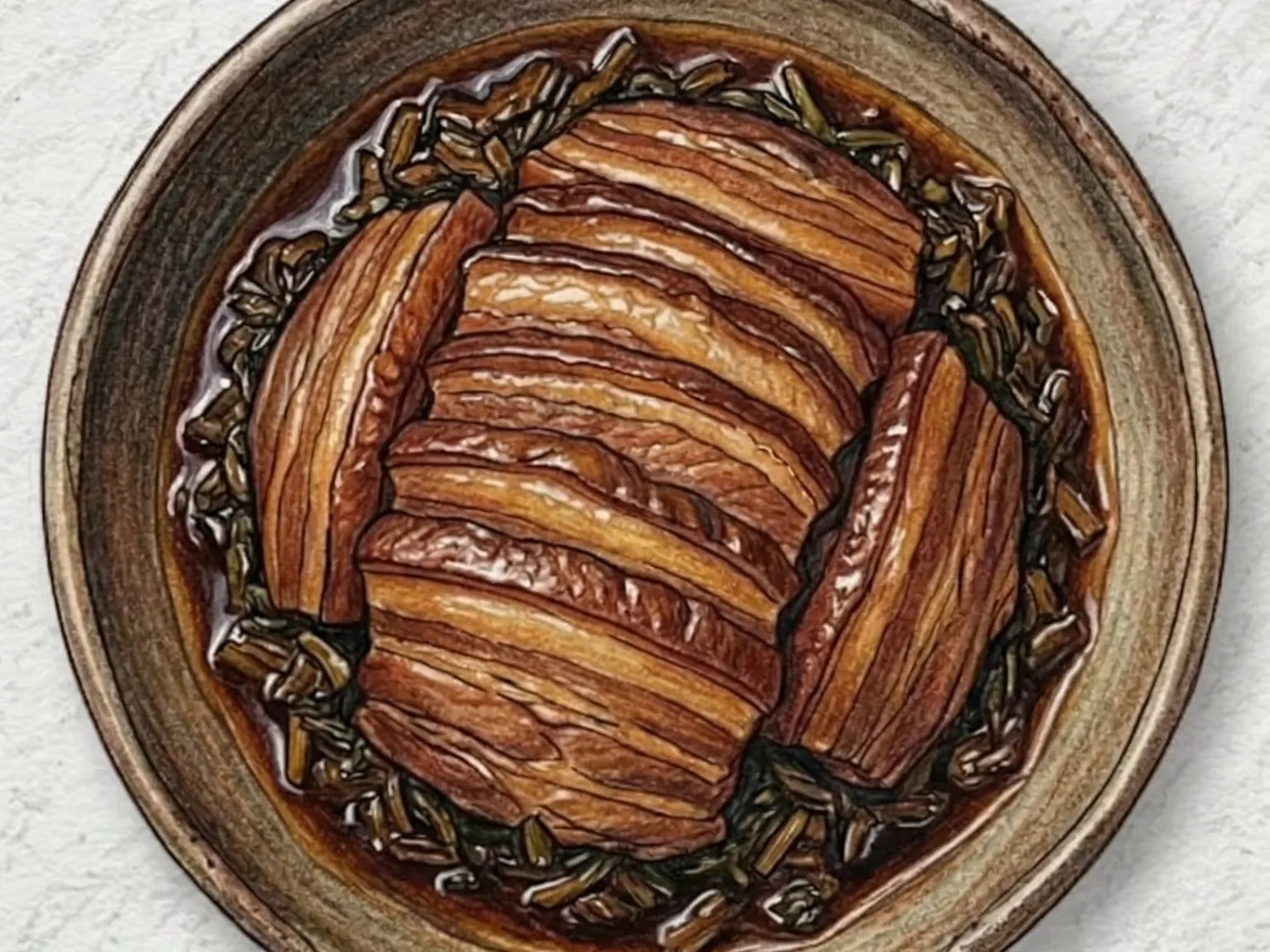
Meicai kourou is a Hakka Chinese dish of parboiled pork belly that is seared with soy sauce for color, then layered with preserved mustard greens and steamed for over an hour.
What makes this special
- Meicai-kourou renders pork belly fat translucent over preserved greens through prolonged steaming.
- Pork belly fat turns translucent in 60-minute steam and fully melds into the meat
- Preserved mustard greens' salty fermented aroma penetrates deep into the pork, Hakka-style
Key ingredients
Core cooking flow
- 1 Place the 700 g pork belly block in water and parboil over medium heat until the outside firms up.
- 2 Mix 3 tbsp soy sauce with 1 tbsp sugar and brush it evenly over the skin.
- 3 Slice the cooled pork belly thickly and arrange the pieces neatly in a steaming bowl.
Meicai kourou is a Hakka Chinese dish of parboiled pork belly that is seared with soy sauce for color, then layered with preserved mustard greens and steamed for over an hour. The prolonged steaming renders the fat translucent and meltingly soft, while the fermented, salty greens infuse the meat with their concentrated flavor. When inverted onto a plate, the neatly stacked slices glisten under the braising sauce. It is a centerpiece dish meant for sharing, with the sauce spooned over steamed rice to capture every layer of richness.
Instructions
Read the steps as a cooking flow: prep, heat, seasoning, doneness control, and finish.
- 1Control
Place the 700 g pork belly block in water and parboil over medium heat until the outside firms up.
Lift it out and cool it until it is easy to slice cleanly.
- 2Control
Mix 3 tbsp soy sauce with 1 tbsp sugar and brush it evenly over the skin.
Sear briefly in a pan over medium low heat, just until the outside darkens without burning the sugar.
- 3Prep
Slice the cooled pork belly thickly and arrange the pieces neatly in a steaming bowl.
Keep the fat layers aligned instead of piling them unevenly, so the slices invert cleanly later.
- 4Finish
Taste the 180 g preserved mustard greens, and reduce the soy seasoning slightly if they are very salty.
Spread the greens evenly over the pork so their flavor steams down into the meat.
- 5Control
Add 1 tbsp minced garlic, 20 g ginger, 2 tbsp rice wine, and 400 ml water.
Cover the bowl and steam it for 60 minutes in a steamer already producing steady steam over medium heat.
- 6Finish
Turn off the heat when a chopstick slides gently through the fat layer.
Invert the bowl carefully onto a serving plate, then spoon the sauce left in the bowl over the pork.
After the steps
Pick a recipe that fits this dish.
Continue with shared ingredients, meal pairings, or a similar method.
Recipes That Go Well With This
More Steamed →Based on shared ingredients and meal pairing
Chinese Red-braised Pork Belly
Hongshao rou is a traditional Chinese red-braised pork belly dish where thick-cut pork is slowly simmered in soy sauce, sugar, cooking wine, ginger, and scallion. The meat is first seared to render excess fat, then braised on low heat until the seasoning penetrates deeply. As it cooks, the pork becomes fork-tender and the sauce reduces into a thick, glossy glaze with a deep reddish hue. It is one of the most beloved home-cooked dishes across China, served simply over steamed rice. The benchmark for a well-made version is pork that yields at the slightest pressure from chopsticks.
Chinese Red-Braised Pork Belly
Hong shao rou, red-braised pork belly, originated in the Suzhou region before spreading across China to become one of the country's defining braised dishes. Cubed pork belly is briefly boiled to remove impurities, then the pot is dried and sugar is melted alone until it reaches a deep amber caramel. The pork returns to the pot to coat every surface before dark soy sauce, light soy sauce, Shaoxing rice wine, fresh ginger slices, and star anise are added. Covered and simmered over low heat for sixty to ninety minutes, the fat layers slowly dissolve into the braising liquid while the lean meat becomes tender enough to break apart with chopsticks without any pressure. The sauce reduces to a thick, mahogany-lacquered glaze that carries layers of sweetness, salt, and the faintly medicinal warmth of star anise. Served over plain steamed rice with a generous spoonful of the sauce poured over the bowl, the dish transforms the simplest grain into a complete and deeply satisfying meal.
Tomato Egg Rice Bowl (Stir-fried Tomatoes with Soft Scrambled Eggs)
Ripe tomatoes are cut into wedges and stir-fried over high heat until they release their juices and form a natural, tangy sauce. Beaten eggs are poured in and gently folded so they stay soft and barely set, mingling with the tomato pulp. A small amount of sugar and soy sauce brings the sweet-tart balance into focus. Spooned over hot rice, the sauce soaks into the grains and the whole bowl comes together in under ten minutes, drawing on the simplicity of Chinese home cooking. It can be served as a one-bowl meal, with simple accompaniments chosen to match the sauce, broth, or topping.
Dongpo Pork (Chinese Soy-Braised Melt-in-Mouth Pork Belly)
Dongpo rou is a Chinese-style pork belly braised slowly in soy sauce, rice wine, sugar, ginger, and green onion until the fat turns translucent and the lean sections absorb a deep mahogany glaze. The belly is cut into thick five-centimeter squares and tied with kitchen twine so the layers stay together over the long cook. Searing the pieces briefly in hot oil before moving them to the braising liquid is not decorative; the Maillard reaction at the surface builds color and aroma that carry into the finished dish. Long cooking over low heat renders the fat layers meltingly soft, while the lean portions turn a deep mahogany from the soy and sugar. Rice wine drives off any porkiness and ginger sharpens the finish, though the dominant impression is a sweet, deeply savory richness. Named after the Song dynasty poet Su Dongpo, the dish is appreciated for the luxurious texture of the rendered fat as much as for its flavor. Reducing the braising liquid separately and spooning it over the finished pieces produces a glossy coat that makes the plated result visually striking.
Serve with this
Galbitang (Clear Korean Beef Short Rib Soup)
Galbitang is a clear Korean soup built from long-simmered beef short ribs, extracting a deep, clean beef flavor without the milky opacity of seolleongtang or gomtang. Before cooking, the ribs are soaked in cold water for one to two hours to draw out blood, which is what allows the finished broth to stay clear and free of off-flavors. The radish goes in from the beginning, slowly releasing a gentle sweetness as it absorbs the surrounding broth and becomes fully saturated with beef flavor. The ribs need time - the measure of doneness is the meat sliding cleanly off the bone with minimal pressure from chopsticks. Unlike bone-based broths that turn white from emulsified collagen and fat, galbitang remains translucent because the fat from the rib meat dissolves more gently, leaving a subtle richness rather than heaviness. Seasoning is deliberately restrained, using only salt and white pepper at the table so nothing interferes with the honest taste of the beef. Garnishes of sliced egg crepe and green onion add color and a fresh note. The soup is served year-round in Korean restaurants, always arriving steaming hot alongside a bowl of plain rice.
Korean Seasoned Bracken Fern
Gosari, the Korean name for bracken fern, is one of the oldest foraged vegetables in Korean cooking, with consumption records tracing back to the Three Kingdoms period. It is a mandatory component of bibimbap and a required dish on jesa, the ancestral rite table set for ceremonies honoring the dead. Dried gosari must soak overnight in cold water and then boil until the tough, wiry fibers relax into a distinctively springy, almost elastic chew that no fresh vegetable can replicate. The rehydrated fern is stir-fried in perilla oil with minced garlic until fragrant, then a small amount of soup soy sauce and water goes in and the pan is covered to let the liquid absorb and the fern braise briefly. This short braising step is what rounds the flavor and ensures the seasoning penetrates the fibrous strands rather than sitting only on the surface. Perilla oil is the traditional fat of choice rather than sesame oil because its green, herbal quality pairs more naturally with the woodsy, forest-floor flavor of gosari, amplifying rather than competing with it. Large batches are typically made during Chuseok or Seollal and eaten over several days, as the flavor improves and deepens as the dish sits.
Korean Bitter Herb Kimchi
Sseumbagwi kimchi is a traditional spring fermented side dish made from sseumbagwi, a wild bitter herb that grows in Korea during early spring. The herb is soaked in cold water for at least twenty minutes to pull back its pronounced bitterness before being salted to soften the stalks. It is then dressed in a seasoning paste built from gochugaru, sand lance fish sauce, minced garlic, ginger, sweet rice paste, and plum syrup, mixed together with cut scallions. The rice paste adds body to the seasoning so it clings to the herb's thin stems and narrow leaves rather than sliding off. Plum syrup works on both the bitterness and the salt's edge at once, smoothing the overall profile without masking the herb's character. Sand lance fish sauce is preferred over anchovy sauce here because its gentler aroma does not compete with the plant's natural flavor. Five hours of room-temperature fermentation followed by refrigeration sets off lactic acid development, layering tangy depth over the bitter-green base. The flavor peaks around day three when bitterness, acidity, and umami reach the best balance. If the raw herb tastes too sharp, one additional soak in fresh cold water brings it within range before seasoning.
Similar recipes
Steamed Pork Ribs with Black Bean Sauce
Douchi paigu is a Chinese-style steamed pork rib dish where the ribs are marinated in fermented black beans, soy sauce, garlic, and Shaoxing wine, then coated with starch before going into the steamer. The fermented black beans carry a salty, complex savory depth that penetrates the meat throughout the marinating period. The starch coating forms a thin seal over the surface, locking in moisture so each piece stays tender rather than drying out under steam. Maintaining high heat throughout steaming is important - steady, vigorous steam circulates evenly and cooks the ribs through without drying them. Sesame oil is added just before serving to preserve its fragrance. Because the ribs are steamed rather than fried, the dish has a clean, light quality while still carrying the bold flavor of the fermented beans. Douchi paigu is one of the most recognized items on a dim sum menu.
Chinese Red-Braised Fish (Hong Shao Yu)
Hong shao yu is a Chinese braised fish dish made by pan-searing white fish until golden, then pouring over a sauce of soy sauce, sugar, ginger, green onion, and Shaoxing wine and simmering over medium heat until the liquid reduces to a glaze. Searing the fish first firms up the surface so the flesh holds together during braising, and the browning from the sear adds a savory depth to the final sauce that straight braising cannot achieve on its own. Sugar softens the saltiness of the soy sauce into a sweet-savory balance, while ginger neutralizes any fishiness and contributes a sharp, clean aroma throughout the braise. As the sauce reduces it coats each piece of fish in a glossy, dark glaze well suited to spooning over steamed rice. The dish comes together in under thirty minutes, and thicker white fish holds moisture better through the braise than thin fillets. Patting the fish thoroughly dry before placing it in the pan prevents oil splatter and ensures the surface browns evenly rather than steaming.
Lion's Head Meatballs (Chinese Braised Large Pork Meatballs with Cabbage)
Lion's head meatballs are a hallmark of Huaiyang cuisine from eastern China. Each meatball is shaped to the size of a fist from a loose mixture of ground pork, minced water chestnuts, and aromatics - the water chestnuts keeping the interior moist and giving it a subtle crunch even after long braising. The meatballs nestle into napa cabbage leaves in a clay pot, then simmer gently in a light soy and ginger broth until the cabbage wilts into silky ribbons and the pork turns spoon-tender. The name comes from how the cabbage wraps around each ball like a lion's mane. Served with steamed rice, the mild broth doubles as a soup course.