Nasi Lemak (Malaysian Coconut Pandan Rice with Anchovy Sambal)
Quick answer
Nasi lemak is Malaysia's definitive national dish, built on a foundation of rice cooked in coconut milk with pandan leaves.
What makes this special
- Nasi Lemak features rice steeped in coconut milk and pandan leaves for a rich, herbal fragrance.
- Pandan leaf infuses the rice with a vanilla-like fragrance alongside coconut milk
- Crispy fried anchovies and roasted peanuts contrast the soft coconut rice
Key ingredients
Core cooking flow
- 1 Rinse 2 cups of rice until the water runs mostly clear, then drain it in a sieve for about 10 minutes.
- 2 Put the rice in a pot with 200 ml coconut milk, 200 ml water, 2 pandan leaves, and 1/2 teaspoon salt.
- 3 Cover and cook for 12 to 15 minutes, until no liquid is visible on the surface.
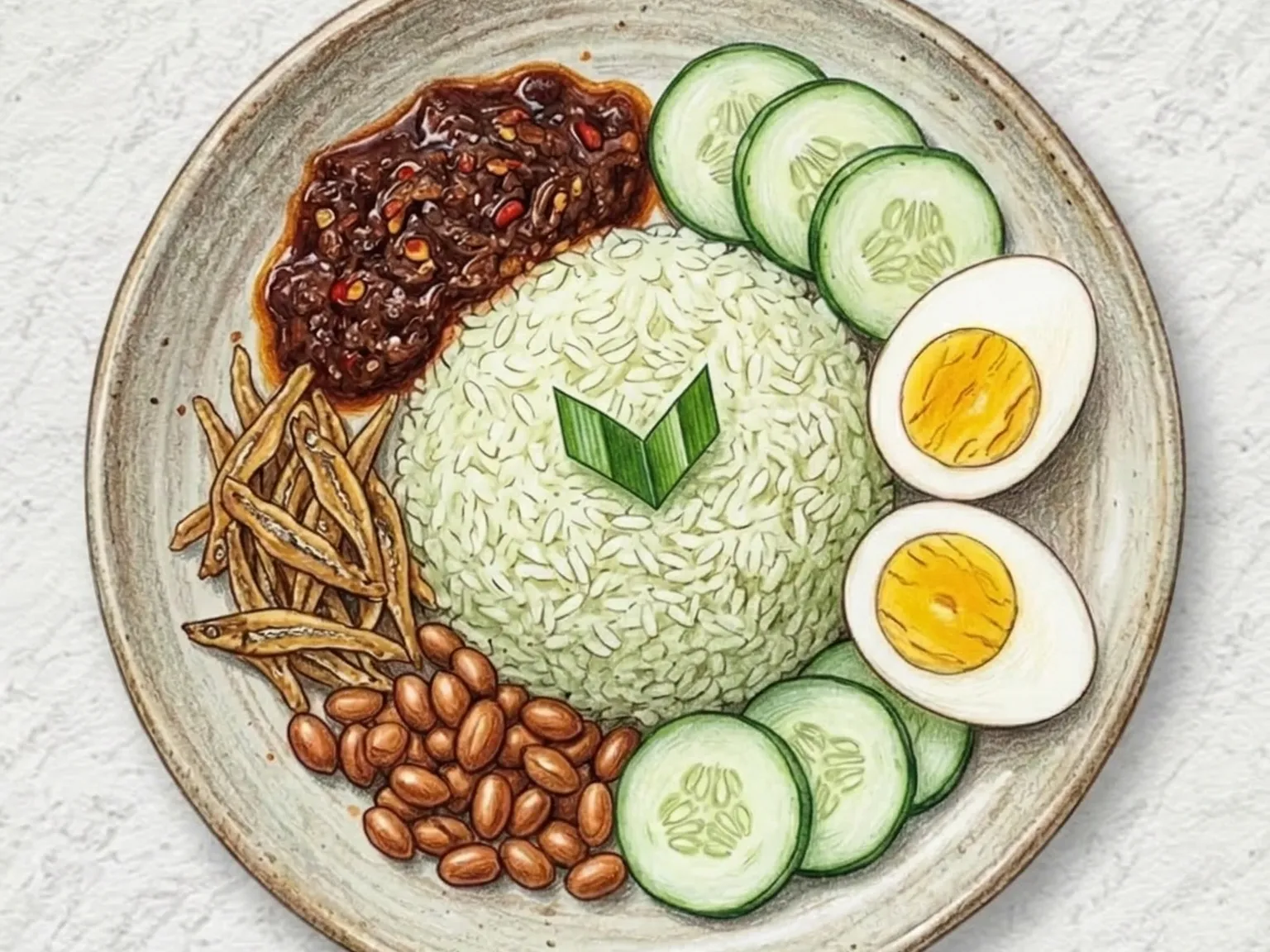
Nasi lemak is Malaysia's definitive national dish, built on a foundation of rice cooked in coconut milk with pandan leaves. The rice alone carries a subtle richness and a faint vanilla-like fragrance from the pandan, making it flavorful even before any accompaniment. The essential sambal is a cooked chili paste built on shrimp paste and tamarind, delivering sweetness and slow-building heat in equal measure. Crispy fried anchovies and roasted peanuts contribute crunch, while a halved boiled egg and fresh cucumber slices balance the richness. In its simplest form, nasi lemak is wrapped in a banana leaf for a quick breakfast.
Instructions
Read the steps as a cooking flow: prep, heat, seasoning, doneness control, and finish.
- 1Step
Rinse 2 cups of rice until the water runs mostly clear, then drain it in a sieve for about 10 minutes.
Removing excess surface water keeps the coconut flavor concentrated instead of thin.
- 2Control
Put the rice in a pot with 200 ml coconut milk, 200 ml water, 2 pandan leaves, and 1/2 teaspoon salt.
Bring it to a boil over medium heat, then lower the heat so it cooks gently.
- 3Control
Cover and cook for 12 to 15 minutes, until no liquid is visible on the surface.
Turn off the heat, let it rest for 10 minutes, remove the pandan leaves, and fluff the grains gently.
- 4Control
Heat 3 tablespoons oil in a pan over medium heat and shallow-fry 50 g dried anchovies for 3 to 4 minutes.
Remove them before they turn too dark so they stay crisp without tasting bitter.
- 5Control
Toast 50 g peanuts in a dry pan over medium heat for about 8 minutes, stirring often, until the skins crack and smell roasted.
Boil 4 eggs for 8 minutes, cool them, then peel them cleanly.
- 6Finish
Slice 1 cucumber thinly and halve the eggs.
Mound the coconut rice on plates, then arrange 4 teaspoons sambal sauce, the crispy anchovies, toasted peanuts, cucumber, and eggs around it, serving while the rice is warm.
After the steps
Pick a recipe that fits this dish.
Continue with shared ingredients, meal pairings, or a similar method.
Recipes That Go Well With This
More Asian →Based on shared ingredients and meal pairing
Nasi Kerabu (Malaysian Blue Herb Rice with Coconut and Vegetables)
Nasi kerabu is a traditional rice dish from Malaysia's east coast that commands attention with its striking blue-tinted rice. The color comes from butterfly pea flowers, which stain the grains a vivid indigo without altering the taste. Rice is cooked with coconut milk and lemongrass, then served alongside grilled fish, julienned cucumber, blanched bean sprouts, and finely chopped fresh herbs. Sambal provides a spicy counterpoint that ties the plate together. The proper way to eat it is to mix everything by hand, combining herbs, rice, protein, and chili paste in each bite so no two mouthfuls taste the same. Fresh mint and cilantro give the dish a bright, herbaceous character.
Nasi Kandar (Penang Indian-Muslim Rice with Mixed Curries)
Nasi kandar is a Penang-born rice dish rooted in the culinary traditions of Malaysia's Indian-Muslim community. A mound of steamed white rice is doused with multiple curry gravies and accompanied by a choice of protein and vegetable sides. The defining technique is kuah campur - the deliberate mixing of different curry sauces so they pool together and soak into the rice, creating a layered complexity no single curry could achieve alone. Coconut milk lends a gentle richness, curry powder supplies aromatic depth, and chili brings lingering warmth. Diners select their own combination from a counter full of dishes, making each plate unique.
Mee Rebus (Noodles in Sweet Potato Curry Gravy)
Mee rebus is a Malaysian noodle dish where springy yellow noodles are topped with a thick gravy built from mashed sweet potato, curry powder, peanut butter, and chicken stock. The sweet potato dissolves into the stock to form a naturally thick base, and the curry powder and peanut butter contribute layers of spice and nuttiness that make the sauce unlike any other noodle topping. Soy sauce adds fermented depth and ties the sweetness and spice together. If the gravy becomes too thick during cooking, extra stock loosens it without diluting the flavor. A halved boiled egg and a squeeze of fresh lime just before eating cut through the richness, bringing the bright acidity that is a hallmark of Southeast Asian noodle dishes.
Ayam Lemak Cili Padi (Malay Coconut Chicken with Bird's Eye Chili)
Ayam lemak cili padi is a kampung staple from Malaysia's east coast states, built on a simple formula of chicken simmered in thin coconut milk with bird's eye chilies, turmeric, lemongrass, and shallots. Unlike richer curries where coconut milk is reduced to a thick gravy, the broth here stays deliberately soupy and light, designed to be spooned over steamed rice. Bird's eye chilies hit with an immediate, sharp heat the moment they touch the tongue - a quality distinct from the slow-building burn of dried chili pastes - and the heat lingers well past the last spoonful. Turmeric turns the broth a pale gold and contributes an earthy bitterness that runs beneath the coconut sweetness, keeping the overall flavor from tipping too rich. The dish requires no elaborate technique: the same pot holds everything from raw chicken to finished broth, and the short ingredient list reflects the rural economy it came from.
Serve with this
Lotus Root Crab Yuja Salad
Thinly sliced lotus root, blanched until just crisp-tender, provides the structural crunch at the center of this salad, while gently separated crab meat drapes a delicate sweetness and umami over each bite. The yuja mayo dressing - yuja marmalade folded into mayonnaise with lemon juice - delivers citrus fragrance and creamy richness simultaneously. Half-moon cucumber slices and thin red onion add contrasting crunch, and a bed of mixed baby greens brings color and freshness to the plate. Keeping the blanching time under four minutes is critical; even a minute longer turns the lotus root soft and robs it of its signature snap.
Korean Fish Cake Soup (Clear Anchovy Radish Broth)
Eomuk-tang is a Korean fish cake soup in which skewered fish cakes and thick radish slices simmer in a clear broth built from dried anchovies and kelp. The kelp must be removed the moment the water begins to boil, otherwise it releases a slimy texture that clouds the broth. Cutting the radish thick allows it to slowly release natural sweetness over the long simmer. Rinsing the fish cakes in hot water before adding them washes away surface oil and keeps the broth clear and clean. Soup soy sauce adjusts the seasoning, and green onion and black pepper finish the pot. Adding the radish before the fish cakes ensures it has enough time to fully soften and sweeten the broth, since it takes longer than the eomuk to cook through.
Korean Sesame Oil Abalone Porridge
Both abalone flesh and innards are used together with a generous two tablespoons of sesame oil to maximize nuttiness in this porridge. The innards carry a concentrated brininess unique to abalone, and sauteing them with minced garlic in sesame oil infuses the fat with both marine and roasted flavors simultaneously, forming the aromatic foundation for the entire pot. Soaked rice is stirred into that same seasoned oil and cooked until each grain turns translucent, a step that coats the starch in fat and gives the porridge a fuller, rounder flavor. Water is then added and the mixture simmers for 25 minutes while the grains slowly dissolve their starch into a naturally thick consistency. Stirring regularly throughout this stage prevents the rice from settling and scorching on the pot floor. Soup soy sauce and salt are added at the finish, their saltiness anchoring the nuttiness of the sesame oil rather than competing with it. Chopped chives provide both color and a light onion fragrance. An extra drizzle of sesame oil just before serving deepens the aroma and gives the surface a subtle sheen.
Similar recipes
Mee Bandung (Malaysian Johor Shrimp Tomato Gravy Noodles)
Mee bandung is a traditional noodle dish from the Johor region of Malaysia, featuring yellow wheat noodles served in a thick, reddish-orange shrimp and tomato gravy. The base is prepared by stir-frying finely minced onions and garlic, followed by tomato paste and chili paste to create a concentrated aromatic paste. Shrimp stock and soy sauce are poured in and simmered before fresh shrimp are added and cooked briefly to maintain a tender texture. A starch slurry is stirred into the hot liquid to thicken it, producing a gravy that coats the noodles and sits between a soup and a stir-fry in consistency. The resulting sauce delivers a balanced profile of sweet, spicy, and savory flavors. The dish is finished by ladling the warm gravy over boiled noodles and topping them with shrimp and boiled eggs.
Paella Valenciana (Spanish Saffron Rice with Chicken and Rabbit)
Paella Valenciana is a traditional rice dish from the Valencia region of Spain, cooked in a wide, shallow steel pan with saffron-tinted short-grain rice, chicken, rabbit, and green beans. The chicken and rabbit are seared first to build a fond on the pan's surface, which the rice absorbs as it cooks in the broth. Saffron must be bloomed in hot stock beforehand to extract its color and aroma evenly across every grain. Once the rice goes in, it is never stirred - the undisturbed bottom layer forms the socarrat, a caramelized crust of toasted rice that defines an authentic paella. In the final three minutes, the heat is raised to drive off remaining moisture, leaving grains that are firm on the outside and moist within, sitting atop a crackling golden crust.