Schisandra Fruit Punch (Korean Cold-Brewed Berry Fruit Bowl)

Schisandra Fruit Punch (Korean Cold-Brewed Berry Fruit Bowl)

Quick answer

Omija hwachae is a traditional Korean fruit punch made by cold-infusing dried schisandra berries in water for at least two hours to extract a vivid red liquid, then sweet...

What makes this special

  • Omija hwachae fruit punch uses a two-hour cold steep to extract color without pulling bitter tannins.
  • Cold-water steeping for 2 hours is mandatory; hot water turns it astringent
  • Ball-cut pear and watermelon stay crisp in the tart schisandra base
Total time
20 min
Level
Easy
Servings
4 servings
Ingredients
7
Calories
132 kcal
Protein
1 g

Key ingredients

Dried omija berriesWaterHoneyKorean pearWatermelon

Core cooking flow

  1. 1 Rinse 25g dried omija berries briefly, just enough to remove dust without crushing them.
  2. 2 When the liquid turns a clear, vivid red, strain it through a fine sieve.
  3. 3 Transfer only 200ml of the omija liquid to a small pot and warm it over low heat until just lukewarm.

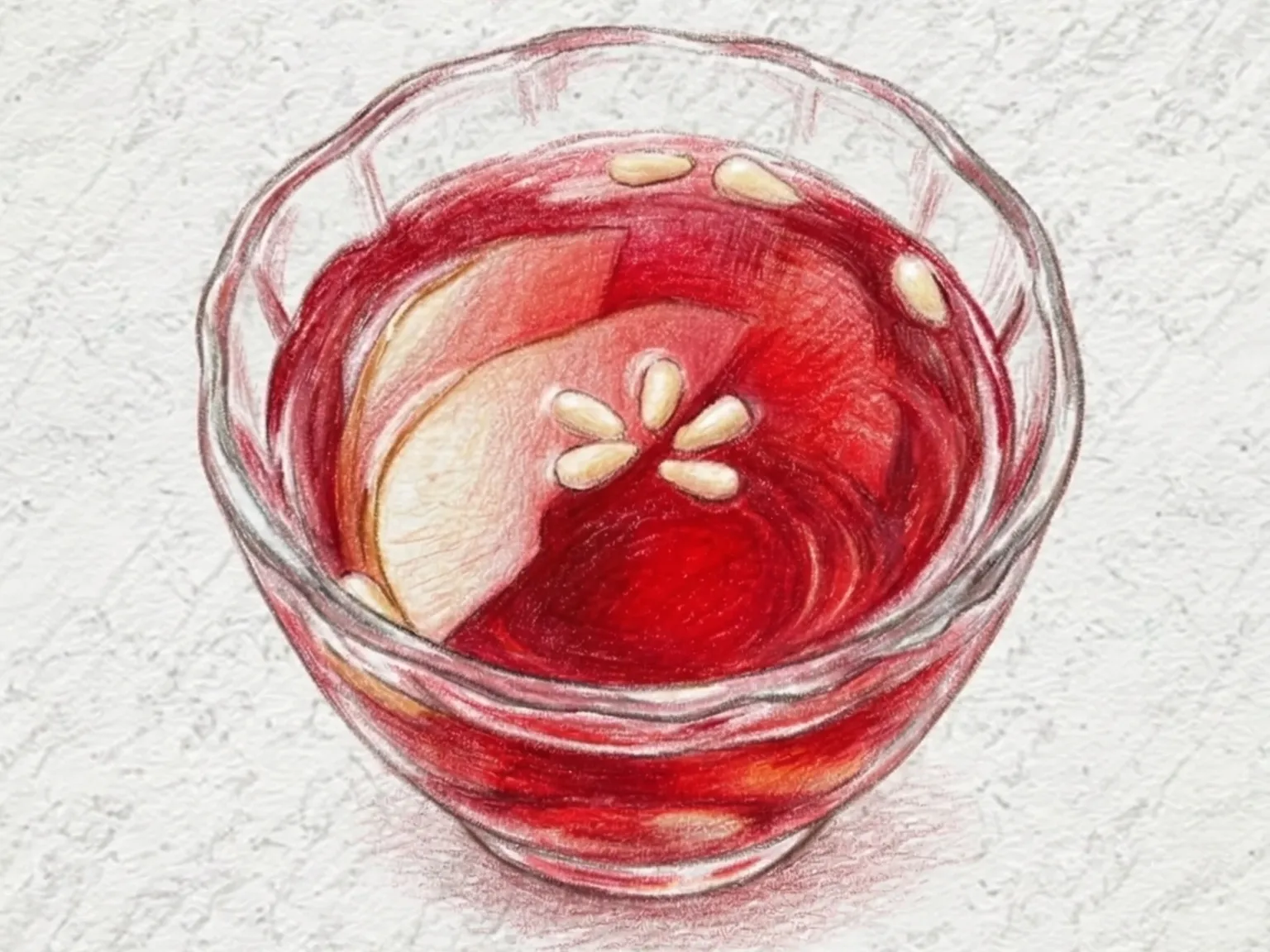
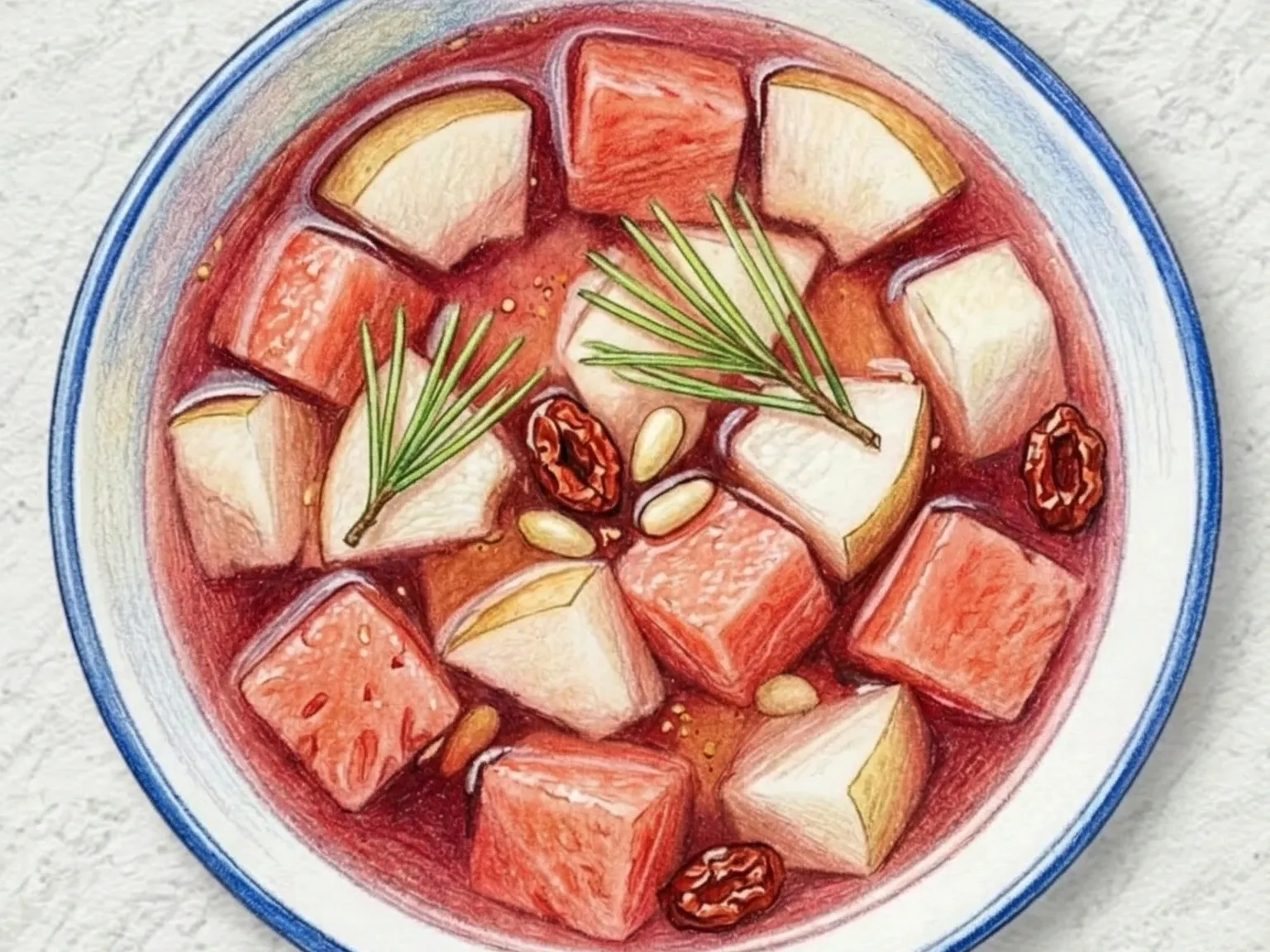
Omija hwachae is a traditional Korean fruit punch made by cold-infusing dried schisandra berries in water for at least two hours to extract a vivid red liquid, then sweetening with honey. Cold extraction is not optional: hot water pulls excess astringency from the berries and makes the liquid harsh rather than bright. Only a small portion of the infusion is gently warmed to dissolve the honey before the two are combined. Scooped balls of Korean pear and watermelon sit submerged in the chilled omija broth, so each spoonful delivers a crisp, juice-filled bite against the tart-sweet liquid. Pine nuts floated on the surface add a mild fatty richness that tempers the sharpness of the schisandra acid, and serving the hwachae over generous ice keeps every component at its most vivid.

Prep 15min Cook 5min 4 servings
Recipes by ingredient → honey

Instructions

Read the steps as a cooking flow: prep, heat, seasoning, doneness control, and finish.

6 steps
  1. 1
    Step

    Rinse 25g dried omija berries briefly, just enough to remove dust without crushing them.

    Add them to 900ml cold water and steep for at least 2 hours in the refrigerator or a cool spot.

  2. 2
    Step

    When the liquid turns a clear, vivid red, strain it through a fine sieve.

    Do not press the berries, because squeezing pulls out a harsher astringency; use only the liquid that drains naturally.

  3. 3
    Control

    Transfer only 200ml of the omija liquid to a small pot and warm it over low heat until just lukewarm.

    Add 45g honey and stir until fully dissolved, keeping it below a simmer.

  4. 4
    Prep

    Cool the sweetened portion, then combine it with the remaining omija liquid.

    Taste for sweetness and tartness, adjust only if needed, and refrigerate until thoroughly cold before adding fruit.

  5. 5
    Prep

    Pat 180g Korean pear and 220g watermelon dry, then scoop them into 2cm balls or cut them into bite-size pieces.

    Prepare them close to serving time so the fruit stays crisp and does not soften in the liquid.

  6. 6
    Finish

    Place the fruit and 200g ice in a wide serving bowl, then pour the cold omija liquid over them.

    Float 12g pine nuts on top and serve immediately before the ice melts and weakens the flavor.

After the steps

Pick a recipe that fits this dish.

Continue with shared ingredients, meal pairings, or a similar method.

Recipes That Go Well With This

More Desserts →

Based on shared ingredients and meal pairing

Korean Mixed Fruit Punch
Shared ingredient: honey Drinks

Korean Mixed Fruit Punch

Modum hwa-chae is a Korean fruit punch assembled by dicing several types of fruit into similar-sized cubes and submerging them in honey water and sparkling water. Apple and pear contribute a firm, satisfying crunch, while green grapes add a burst of sweet juice when the skin breaks between the teeth. Cutting everything to a consistent size matters because it ensures each spoonful carries a balanced mix of textures rather than any single fruit overwhelming the others. Honey dissolved in cold water merges with the natural juices released by the fruit, building a sweetness that feels integrated rather than applied. Sparkling water is added last, its bubbles threading up through the fruit pieces to give the punch its characteristic effervescence, so the drink is best served before the carbonation fades. Generous ice keeps the bowl thoroughly cold and prevents the fruit from softening, which preserves the sharpness of each variety's flavor. The combination of fruits shifts freely with the seasons, making this one of the most adaptable summer refreshments in Korean home cooking.

Watermelon Punch
Shared ingredient: ice cubes Desserts

Watermelon Punch

Subak hwachae is a Korean summer punch that uses half its watermelon blended and strained into a smooth juice base, with the other half scooped into balls as garnish. Mixing the watermelon juice with milk creates a pink, creamy foundation, and lemon-lime soda is stirred in just before serving to preserve its fizz. Adding strawberries and blueberries introduces an acidic brightness and color contrast that watermelon alone lacks, and generous ice keeps the drink cold enough for the fruit aromas to stay sharp. Chilling the watermelon juice thoroughly before combining it with milk is essential to prevent the two liquids from separating. The layered colors of red watermelon, deep blueberries, and vivid strawberries in a single bowl make it as visually striking as it is refreshing, turning a straightforward summer drink into something worth presenting at the table.

Korean Dalgona Coffee (Whipped Instant Coffee Foam Milk)
Serve together Drinks

Korean Dalgona Coffee (Whipped Instant Coffee Foam Milk)

Dalgona coffee is made by whipping equal parts instant coffee, sugar, and hot water with a hand mixer for three to five minutes until stiff, caramel-colored peaks form, then spooning the foam over iced milk. The whipped layer carries a concentrated, bittersweet coffee flavor that gradually blends into the cold, neutral milk below as you stir. A light dusting of cocoa powder on top introduces a faint chocolate note, and increasing the sugar slightly helps the whipped cream hold its stiff structure longer.

Sweet Rice Punch (Traditional Korean Malted Barley Grain Drink)
Similar recipe Desserts

Sweet Rice Punch (Traditional Korean Malted Barley Grain Drink)

Sikhye is a traditional Korean sweet rice punch made by steeping malted barley powder in lukewarm water, straining the liquid, adding cooked rice, and holding the mixture at around 60 degrees Celsius for one hour until the rice grains float to the surface. The amylase enzymes in the malt break down the rice starch, producing a distinctly malty, clear sweetness with grain depth that no sugar alone can replicate. Only the clear top liquid is used after settling -- discarding the sediment keeps the punch from turning cloudy. Simmering with sugar and sliced ginger for 20 minutes rounds the sweetness and adds a gentle, spiced warmth to the finish. Served well chilled with the reserved floating rice grains and pine nuts on top, the cold temperature sharpens the malty aroma and makes each sip crisp. Temperature control during the steeping stage is critical: if the mixture exceeds 70 degrees Celsius, the amylase denatures and the grains will not float, so keeping a steady 60-degree hold determines whether the preparation succeeds.

Serve with this

Kimchi Cheddar Savory Scone
Baking Easy

Kimchi Cheddar Savory Scone

Cold butter rubbed into flour creates the flaky, crumbly layers of a classic scone, but here the dough takes a savory turn with the addition of squeezed kimchi and sharp cheddar cheese. As the butter melts in the oven, it releases steam that puffs the layers apart, and between those layers the kimchi's spicy acidity and the cheddar's salty richness emerge in alternating waves. Removing moisture from the kimchi before mixing is critical; wet kimchi produces a dense, heavy dough instead of the light texture that defines a good scone. Overworking the dough develops gluten and sacrifices that crumbly snap, so the ingredients are combined just until they hold together. A brief bake at 200 degrees Celsius sets the crust golden while the interior stays tender. Eaten warm with a pat of butter, the scone delivers a pronounced sweet-salty-tangy interplay that works as well at breakfast as it does alongside a bowl of soup.

🧒 Kid-Friendly 🍱 Lunchbox
Prep 20min Cook 22min 4 servings
Korean Donkatsu Gimbap (Pork Cutlet Roll)
Street food Medium

Korean Donkatsu Gimbap (Pork Cutlet Roll)

Donkatsu gimbap rolls an entire crispy pork cutlet inside a seaweed rice roll. Sesame oil and salt-seasoned rice is spread thinly over a sheet of dried seaweed, tonkatsu sauce is drizzled generously over the rice, and the full cutlet along with shredded cabbage is placed at the near edge before rolling tightly. The structural goal of the roll is to keep the breadcrumb coating on the cutlet crispy between the layers of rice and seaweed rather than letting it soften against the moisture in the rice. To achieve this, the cutlet must be well-drained of oil and cooled to room temperature before rolling, and the roll should be cut and eaten promptly rather than held for long. When sliced, the cross-section reveals the full width of the pork cutlet occupying most of the interior, which is a visual cue for the substantial filling inside. The sweet, savory tonkatsu sauce melds with the sesame-scented rice and the salt of the dried seaweed wrapper, making each section of the roll satisfying enough to serve as a complete meal.

🧒 Kid-Friendly 🍱 Lunchbox
Prep 20min Cook 15min 2 servings
Cuban Sandwich
Western Easy

Cuban Sandwich

Cuban sandwich splits a baguette lengthwise and spreads Dijon mustard on both cut sides before layering roast pork, sliced ham, Swiss cheese, and thin pickle slices inside. Butter goes on the outer crust, and the assembled sandwich is pressed in a skillet or sandwich press over medium heat for four to five minutes per side. The sustained pressure flattens the bread into a crisp, golden shell while the Swiss cheese melts and binds the fillings into a cohesive unit. Pickles provide a tart acidity and mustard adds a sharp, pungent bite that cut through the salty richness of the two meats, keeping each mouthful balanced rather than heavy. A heavy cast-iron pan placed on top works as well as a dedicated press when equipment is limited. The traditional pork is lechon, a Cuban-style roast marinated in garlic, cumin, and sour orange juice, though tightly grained pork belly or chashu makes a serviceable substitute. This sandwich was developed by Cuban immigrants in Tampa and Miami, where it became a daily staple rather than an occasional indulgence. Deceptively simple in appearance, it is a study in balance: every ingredient serves a specific purpose and the whole is noticeably better than the sum of its parts.

🏠 Everyday 🍱 Lunchbox
Prep 15min Cook 12min 2 servings

Similar recipes

Sweet Pumpkin Rice Punch (Korean Kabocha Malt Drink)
Desserts Easy

Sweet Pumpkin Rice Punch (Korean Kabocha Malt Drink)

Danhobak sikhye is a Korean malt rice punch with steamed kabocha pumpkin puree stirred in to thicken the body and deepen the color beyond what plain sikhye offers. The base follows traditional method: cooked rice steeps in malt-strained water held at around 60 degrees Celsius, where the malt enzymes convert starches to maltose over several hours, creating a sweetness that needs no added sugar. Kabocha puree blended into the fermented liquid adds a dense, velvety weight and a warm golden-orange color. Sliced fresh ginger added during the fermentation hold leaves a faint spicy note in the finish, which prevents the pumpkin's natural sweetness from turning cloying as the drink warms. After the steeping is done, the liquid is brought to a full boil to stop the enzyme activity before cooling. Served cold with a few floating rice grains, it occupies the space between a refreshing beverage and a light dessert.

🎉 Special Occasion 🧒 Kid-Friendly
Prep 20min Cook 70min 4 servings
Korean Black Raspberry Jelly
Desserts Easy

Korean Black Raspberry Jelly

Bokbunja jelly cups are a chilled Korean dessert made by setting bokbunja, the Korean black raspberry, with gelatin sheets and a measured addition of lemon juice for acidity balance. The process requires dissolving the bloomed gelatin sheets into sugar syrup that has been removed from the heat; adding gelatin to boiling liquid breaks down its protein chains and compromises its setting ability. A single pass through a fine strainer removes air bubbles and sediment, producing a perfectly smooth surface that lets the deep purple of the bokbunja come through cleanly and without distortion. Topping each cup with fresh blueberries and a mint leaf reinforces the berry flavor while providing a sharp visual contrast against the dark jelly beneath. Bokbunja is well known in Korea as a traditional medicinal ingredient and as the base of the country's signature fruit wine; these jelly cups translate its tartness and intense pigmentation into a simple refrigerator dessert that can be prepared ahead and served straight from the cold. The result is a bright, clean finish that sits light on the palate.

🧒 Kid-Friendly 🌙 Late Night
Prep 15min Cook 10min 2 servings
Korean Five-Grain Sweet Rice Punch
Drinks Medium

Korean Five-Grain Sweet Rice Punch

Ogok-sikhye is a traditional Korean grain punch made by saccharifying a mix of cooked sweet rice, barley, millet, and foxtail millet in barley malt extract at 60 to 65 degrees Celsius for one hour. The malt powder is soaked in lukewarm water for 20 minutes, kneaded by hand, and strained through a cloth to yield a clear, enzyme-rich liquid -- this is the working ingredient that converts the grain starches into natural sugars during the slow saccharification. Temperature control is central to the process: below 60 degrees the enzymes slow down, and above 70 degrees they denature and die, so maintaining the right range throughout the hour-long rest determines whether the conversion succeeds. As saccharification progresses, the rice grains hollow out and float to the surface; these are skimmed off, rinsed separately, and later floated back into the finished punch to add a soft, chewable element to each cup. After sweetening with sugar and chilling completely in the refrigerator, the drink is served cold with pine nuts floating on top. The combination of multiple grains produces a more layered, complex sweetness than single-grain sikhye, and the overnight rest in the refrigerator smooths the flavor into something more cohesive.

🍺 Bar Snacks 🎉 Special Occasion
Prep 20min Cook 70min 2 servings

Tips

Using hot water can make omija taste more astringent.
Swap honey for rice syrup for a more traditional flavor.

Nutrition (per serving)

Calories
132
kcal
Protein
1
g
Carbs
32
g
Fat
1
g