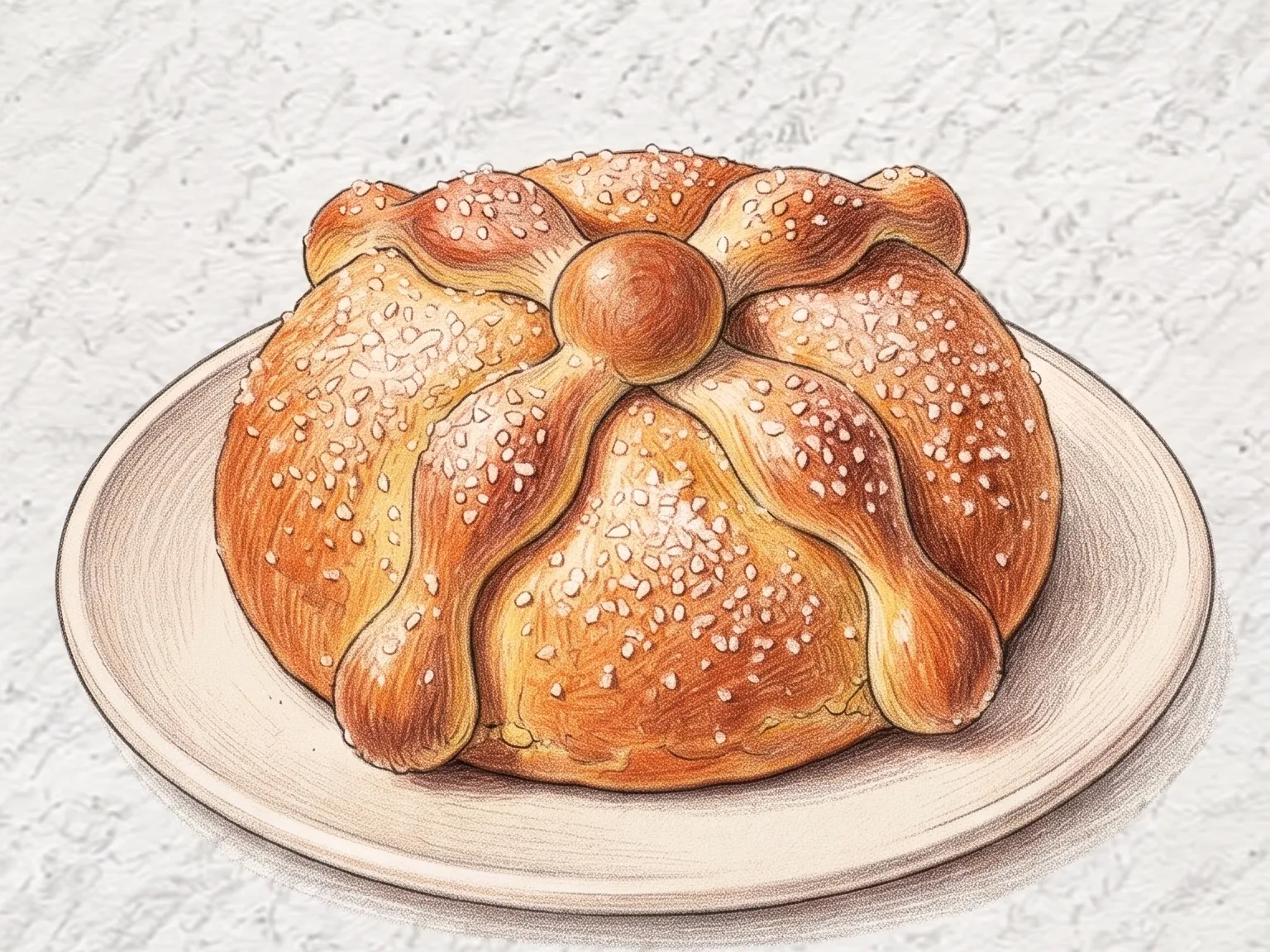
Pan de Muerto (Mexican Day of the Dead Bread)
Quick answer
- Total time
- At least 4 hr 35 min
- Level
- Medium
- Servings
- 12 servings
- Ingredients
- 18
About this dish
The bones and the ball on top are made from a third of the same dough, kneaded with a little extra flour until it is no longer sticky, so the finger-pressed knobs stay visible after the long second rise and baking.
Read more
That second rise takes about 2 hours once the breads are decorated, after a first rise of about an hour; from start to finish, plan on about four and a half hours.
Ingredients
Instructions
Stops the screen from turning off while you cook.
- 1
In a small saucepan over medium-low heat, warm 180 ml milk with 1 tablespoon (12 g) of the sugar until the sugar dissolves and the milk reaches 38 to 43°C (100 to 110°F). Off the heat, stir in 7 g yeast and let it stand until frothy, about 10 minutes.
- 2
Fit a stand mixer with the dough hook.
In the bowl, mix 600 g flour, 2 teaspoons cinnamon, 1/2 teaspoon salt, 1 tablespoon orange zest (from about 2 oranges), 2 teaspoons anise seeds and the remaining 100 g sugar on low speed. With the mixer running, add the yeast mixture a little at a time, then 1 tablespoon orange blossom water, 1 tablespoon vanilla and the 3 beaten eggs. Mix until a shaggy dough forms, about 5 minutes.
- 3
Cut the 170 g butter into tablespoon-size pieces.
Raise the speed to medium and add the butter one piece at a time, letting each piece disappear into the dough before adding the next. Raise the speed to medium-high and mix for 10 to 15 minutes, checking now and then, until the dough is elastic and only slightly sticky.
- 4
Turn the dough out onto a lightly floured surface and knead it by hand for 1 to 2 minutes, until it forms a ball and is no longer sticky. Put it in a large bowl lightly greased with the oil, cover with a damp towel or plastic wrap and leave it in a warm, draft-free spot until doubled, about 1 hour.
- 5
Line 2 baking sheets with parchment paper.
Set aside about a third of the dough for the decorations. Divide the rest into 12 pieces of about 60 g, shape each into a smooth round and place 6 on each sheet.
- 6
Knead about 2 tablespoons flour into the reserved dough by hand for 5 to 8 minutes, until it is no longer sticky, then divide it into 12 pieces of about 40 g. Cut each piece into 3. Roll two of them into ropes long enough to cross a bread and reach down its sides, then press three spread fingers into each rope to make the knobby bones.
- 7
Lay two bones across each round in an X.
Roll the third piece into a ball and set it where the bones cross. If a piece won't stay in place, dab a little water underneath it.
- 8
Cover the breads loosely with plastic wrap and let them rise until doubled, about 2 hours.
- 9
Set oven racks in the upper and lower thirds and heat the oven to 175°C (350°F).
Beat 1 egg with 1 tablespoon water and brush it over the breads, decorations included.
- 10
Bake for 20 to 25 minutes, swapping the sheets between the racks halfway through, until lightly golden brown.
Let the breads cool briefly on wire racks.
- 11
While the breads are still warm, brush the tops with the 2 tablespoons melted butter and sprinkle with the 50 g sanding sugar.
References checked
These references were consulted when this page was prepared or corrected. A source check does not mean the recipe was independently kitchen-tested.
- Pan de Muerto
Food Network Kitchen (Jacqueline Tris) · Checked: 2026-11-08
- Pan de Muerto (Mexican Day of the Dead Bread)
Taste of Home · Checked: 2026-11-08
Use-up ingredient planner
Turn these ingredients into two more meals
The overlap excludes basic seasonings. Open the next recipe and your selected dishes will stay with you.
Fluffy Pancakes
milk, all-purpose flour
Chocolate Gravy
milk, all-purpose flour
Dorayaki (Sweet Red Bean Pancake Sandwich)
milk, all-purpose flour