Pavlova
Quick answer
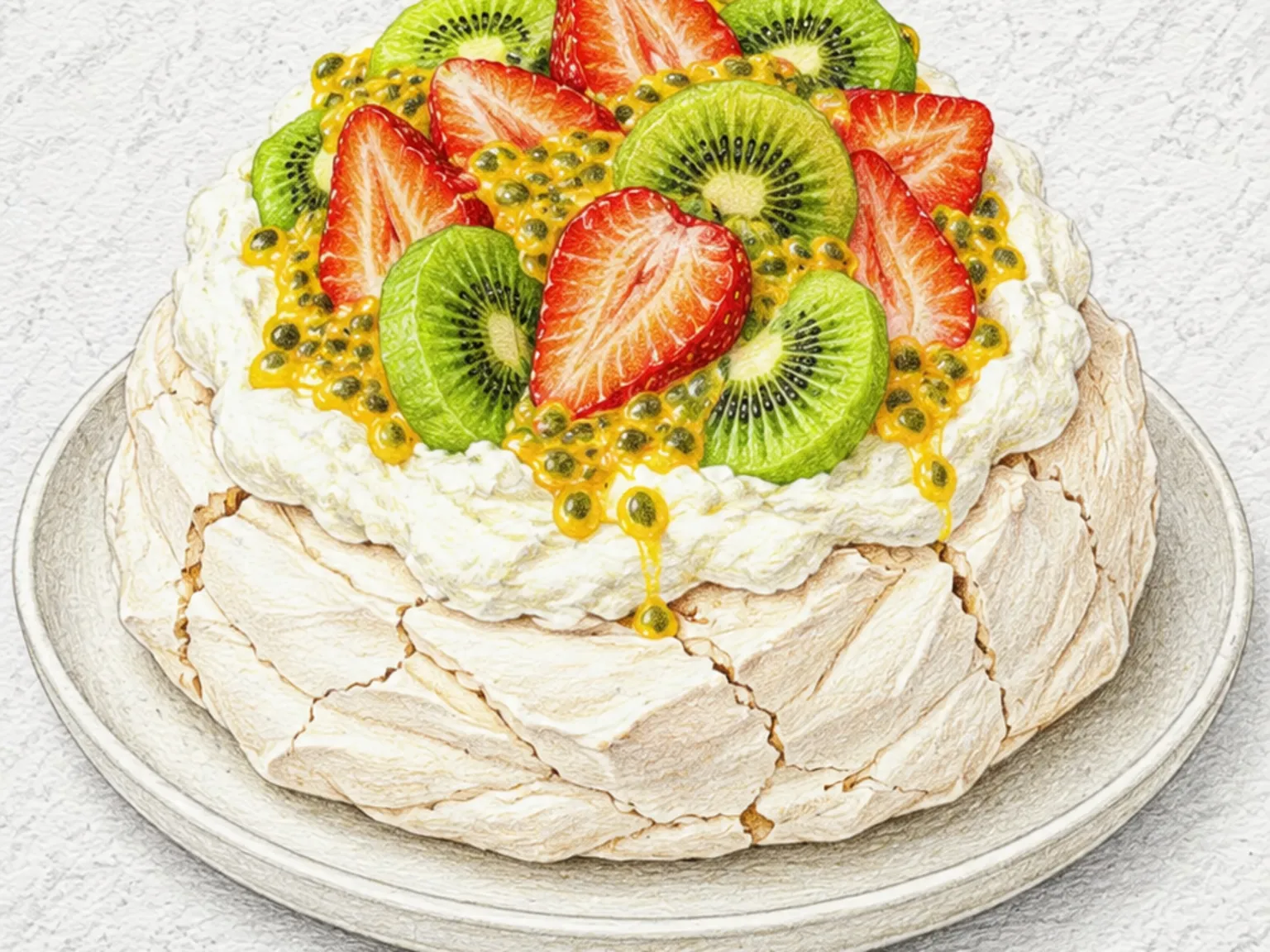
Egg whites are whipped to stiff, glossy peaks with sugar, then baked at low temperature for ninety minutes to create a meringue shell that is crisp on the outside and mar...
What makes this special
- Pavlova bakes into a crisp meringue shell with a soft marshmallow center and fresh fruit.
- Vinegar and cornstarch create a crisp shell with a marshmallow-soft interior
- 90 minutes at 100°C slowly drives off moisture while keeping the center tender
Key ingredients
Core cooking flow
- 1 Separate 4 egg whites into a clean, dry bowl, keeping out every trace of yolk, water, and grease.
- 2 Beat the whites on medium speed until foamy and white, then add 220 g sugar...
- 3 Add 1 teaspoon each of white vinegar, cornstarch, and vanilla extract.
Egg whites are whipped to stiff, glossy peaks with sugar, then baked at low temperature for ninety minutes to create a meringue shell that is crisp on the outside and marshmallow-soft within. Once cooled, the base is crowned with billowy whipped cream and an arrangement of fresh fruit, most commonly strawberries, kiwi, and passion fruit. The tartness of the fruit balances the sweetness of the meringue and the richness of the cream, keeping each bite from feeling heavy despite the sugar content. A small amount of vinegar and cornstarch folded into the meringue before baking stabilizes the structure and encourages the characteristic soft center. Any trace of yolk in the whites will prevent them from whipping properly, so careful separation is essential.
Instructions
Read the steps as a cooking flow: prep, heat, seasoning, doneness control, and finish.
- 1Step
Separate 4 egg whites into a clean, dry bowl, keeping out every trace of yolk, water, and grease.
Preheat the oven to 100C and line a baking tray with parchment before starting the meringue.
- 2Season
Beat the whites on medium speed until foamy and white, then add 220 g sugar gradually, a spoonful at a time.
Keep beating until the meringue is glossy, thick, and holds stiff peaks without collapsing.
- 3Step
Add 1 teaspoon each of white vinegar, cornstarch, and vanilla extract.
Fold with a spatula by lifting from the bottom in broad strokes, stopping as soon as no streaks remain so the foam stays airy.
- 4Heat
Spoon the meringue onto the tray in a round shape and make a shallow dip in the center for the cream.
Bake at 100C for 1 hour 30 minutes, keeping the shell pale and dry.
- 5Heat
Avoid opening the oven often while it bakes, because sudden temperature changes can crack or sink the shell.
When the time is up, turn off the oven and let the meringue cool completely inside.
- 6Prep
Whip 300 ml cold heavy cream only to soft peaks, so it spreads without weighing down the shell.
Just before serving, top the cooled meringue with the cream, 200 g strawberries, and 2 sliced kiwis.
After the steps
Pick a recipe that fits this dish.
Continue with shared ingredients, meal pairings, or a similar method.
Recipes That Go Well With This
More Baking →Based on shared ingredients and meal pairing
Baked Alaska
Baked Alaska is a dessert where sponge cake and ice cream are encased in Italian meringue without any gaps, then baked briefly at high heat. The meringue acts as an insulating shell, preventing the oven's intense heat from reaching the frozen core. For this to work reliably, the meringue must be applied thickly and cover every part of the surface. The ice cream needs at least four hours in the freezer before assembly so it stays solid through the brief bake, and the finished dome should go back into the freezer immediately after construction and stay there until just before browning. Egg whites whipped with sugar to stiff peaks form the meringue shell, which is then torched or placed in a 250-degree oven for two to three minutes until the surface turns golden brown. Adding vanilla extract to the meringue releases its aroma during browning. When sliced, three distinct layers become visible in cross-section: charred meringue, frozen ice cream, and moist sponge cake beneath. The contrast between the scorched, warm exterior and the frozen core is the defining quality of this dessert, and the visual reveal when the knife cuts through makes it as much a performance as a dish.
Crêpe Cake
A crepe cake is constructed by alternating dozens of paper-thin cooked crepes with thin layers of cream, building a tall multi-layered dessert that requires no baking and no oven. A batter of flour, eggs, milk, and butter gets poured by the ladleful into a lightly buttered pan and swirled into rounds that cook for under a minute per side, then cool completely before assembly. Each crepe receives an even, thin spread of lightly sweetened whipped cream or pastry cream before the next crepe goes on top, repeating until the stack reaches twenty to thirty layers. The precision of each spread matters: uneven layers create an inconsistent cross-section when the cake is sliced, whereas layers of uniform thickness produce the clean, intricate striped pattern the cake is known for. Unlike conventional sponge cake, the dominant flavors are egg, butter, and dairy fat rather than sugar and flour, and the texture is distinctly its own: soft and yielding, with each layer sliding gently against the next under the lightest pressure. Pan temperature during crepe-making must stay slightly below medium heat, as excess heat chars edges and makes the crepes brittle. After assembly, refrigerating the cake for at least two hours stabilizes the cream and allows the structure to set so each slice cuts cleanly without collapsing.
Roasted Pumpkin Feta Salad
Roasted pumpkin feta salad bakes pumpkin wedges at 200 degrees Celsius until the edges caramelize and the flesh turns soft, then layers them over baby spinach with crumbled feta and toasted pumpkin seeds. The pumpkin's starchy, chestnut-like sweetness plays against the salty, tangy bite of feta, and a simple dressing of lemon juice and honey bridges the two with a bright acidity that keeps the whole salad from feeling heavy. Pumpkin seeds add a nutty crunch that contrasts with the soft roasted flesh and tender spinach leaves, making each forkful varied in texture. Cutting the wedges thin, about seven to eight millimeters, ensures even roasting and prevents the interior from staying raw while the surface dries out. Dressing the salad while the pumpkin is still warm causes the spinach to wilt slightly, helping all the components come together rather than sitting separately on the plate.
Lamington Cake (Chocolate-Dipped Coconut Sponge Cubes)
Cubes of sponge cake are dipped in a chocolate coating and rolled in desiccated coconut to produce this iconic Australian treat. The sponge is baked in advance and left to dry slightly so it holds its shape during the dipping process; if it feels too fragile, a brief spell in the freezer firms it up. The coating is made from melted dark chocolate, butter, milk, and powdered sugar, mixed until smooth and fluid enough to coat each cube in a single quick dip. Rolling the chocolate-covered cube in coconut immediately, before the coating sets, ensures the flakes adhere evenly and create the characteristic white-speckled exterior. Each piece delivers three textures in one bite: the crisp snap of the thin chocolate shell, the dry chew of coconut shreds, and the soft, airy crumb of the sponge underneath. The flavor moves from the bittersweet intensity of dark chocolate to the mild tropical sweetness of coconut, finishing with the neutral lightness of the cake. They pair naturally with black tea or a flat white.
Serve with this
Sweet Chestnut Confection
Yulran is a traditional Korean chestnut confection that is prepared by boiling 300 grams of chestnuts in water for a duration of 20 minutes. Once the boiling process is complete, the chestnut flesh is removed from the shells and pressed through a fine sieve. This manual pressing continues until the texture becomes perfectly smooth. The purpose of using a sieve is to eliminate any grainy bits, which results in a chestnut paste with an even and velvety consistency. This puree is then kneaded together with a combination of honey and ground cinnamon. After the ingredients are thoroughly mixed, the paste is shaped into small, bite-sized rounds. The honey used in this recipe serves as both a source of moisture and a necessary adhesive. Its sticky property provides the strength required for the confection to hold its molded shape effectively without crumbling into pieces. Ground cinnamon is included to provide a warm spice note. This flavor is chosen because it complements the starchy and earthy sweetness of the chestnut rather than competing with the natural profile of the nut. Following the shaping process, each piece is rolled in ground pine nuts. This step coats the exterior in a mild nuttiness and introduces a subtle textural contrast against the smooth paste contained within. For a final visual touch, thin slices of jujube are placed on top as a garnish to provide a stroke of red color. The finished rounds are then placed in the refrigerator to chill for 15 minutes. This cooling period firms the surface of the paste just enough so that the confections can be picked up cleanly with the fingers without sticking to the skin. Historically, Yulran was a common fixture on the ceremonial and banquet tables of the Joseon court. It was valued for its clean and understated sweetness, which allows the natural flavor of the chestnut to remain the central focus.
Kasespatzle (German Alpine Cheese Dumpling Noodles)
Kasespatzle is an Alpine comfort dish from southern Germany and Austria, made by boiling a thick batter of flour, eggs, and milk into small dumplings, then tossing them with melted Emmental cheese and caramelized onions. The batter must maintain a thick consistency rather than being runny - this is what gives the spaetzle their characteristic chew when boiled and drained. Sliced onion is slowly cooked in butter over low heat until deeply browned, transforming the raw sharpness into a concentrated sweetness. The cooked spaetzle and grated cheese are combined in a hot pan so the cheese melts and coats every dumpling. Topped with the caramelized onions and black pepper, the dish is served immediately while the cheese is still molten and stretchy.
Korean Butter-Grilled Scallops
Garibi butter-gui sears fresh scallops in garlic butter until each side develops a deep golden-brown crust, then finishes with lemon juice and parsley to balance the richness. Removing every trace of surface moisture with paper towels before seasoning is the single most important step -- water on the surface of the scallop causes it to steam rather than sear, and no caramelized crust will form until that moisture has evaporated. Each side cooks for only one to two minutes at the highest heat the pan can sustain, leaving the center just barely opaque and the texture tender rather than rubbery. After flipping, butter and minced garlic are added directly to the hot pan and spooned continuously over the scallops so the aroma infuses the surface. A squeeze of lemon and a scatter of chopped parsley added just before removing from heat layers acidity and freshness over the butter richness. Simple to prepare and fast to cook, this dish appears regularly at home gatherings in Korea as a crowd-pleasing appetizer.
Similar recipes
Chocolate Souffle
Chocolate souffle folds stiffly beaten egg white meringue into a base of melted dark chocolate and egg yolks, then bakes it in a buttered ramekin at high heat until it rises dramatically above the rim. The intense oven heat expands the air trapped within the meringue, pushing the souffle upward while the exterior sets into a thin, delicate crust and the interior remains a molten, near-liquid chocolate cream. Breaking through the top with a spoon releases a rush of hot, intensely flavored chocolate from inside, and that moment of opening is the point of the entire dessert. The souffle begins to deflate within a minute or two of leaving the oven, so it must go directly to the table without delay. Coating the inside of the ramekin with butter followed by sugar is not optional: this surface preparation gives the batter traction to climb straight upward rather than sticking to the sides and collapsing unevenly. Using chocolate with a high cocoa content produces a deeper, more defined contrast between bitterness and sweetness. The most critical technical step is folding the meringue into the chocolate base using broad, circular motions with a spatula and a minimum number of strokes, because overmixing deflates the air bubbles that are responsible for the rise. Serve dusted with powdered sugar or alongside a scoop of vanilla ice cream.
Chocolate Lava Cake
Chocolate lava cake bakes a batter of melted dark chocolate, butter, whole eggs, egg yolks, sugar, and a small measure of flour in buttered ramekins at 220 degrees Celsius for ten to twelve minutes, producing a set crust and molten center from a single brief baking window. The high oven temperature firms the outside and top of the batter into cake while the core stays liquid, so breaking the surface with a spoon releases a slow pour of concentrated warm chocolate. High-cacao dark chocolate provides a complex, bittersweet depth that pairs with the richness of butter fat, and vanilla extract softens and rounds the overall aroma. Timing controls everything in this recipe: overbaking by even two minutes sets the center solid and destroys the signature flow. The edges of each ramekin should feel just firm when pressed lightly through a towel at the ten-minute mark. Ramekins can be filled ahead and refrigerated, but the baking time then needs an extra one to two minutes to account for the colder starting temperature. Serving with a scoop of vanilla ice cream or a spoonful of cold heavy cream creates a striking contrast between the hot, dense chocolate interior and the chilled, lighter dairy.
Bibingka (Filipino Coconut Rice Cake)
Bibingka is a Filipino baked rice cake that belongs almost entirely to the Christmas season, sold warm from clay-pot stalls outside churches after Simbang Gabi, the nine-day series of dawn masses leading up to Christmas Day. For Filipinos, the smell of bibingka cooking over charcoal at four in the morning is inseparable from the feeling of the holiday itself. The batter is made from ground rice flour mixed with coconut milk, eggs, and sugar, then poured into a clay pot lined with fresh banana leaves. The pot sits between two layers of live charcoal - one below and one held above on a metal lid - so both surfaces cook simultaneously. This top-and-bottom heat is what gives bibingka its characteristic crust: lightly charred and fragrant on the outside from the banana leaves, moist and tender within. As the batter cooks, the banana leaves release a vegetal green fragrance that infuses into the rice cake and leaves faint dark marks on the underside. Midway through cooking, slices of salted duck egg are pressed into the surface alongside fresh coconut shavings, then a brush of butter is applied and the cake returns to the heat. During this final pass the sugars in the butter and batter caramelize at the edges, producing a triple wave of banana leaf, coconut, and butter aromas. The finished texture sits somewhere between a glutinous rice cake and a sponge cake - slightly sticky and chewy yet airy and soft. The salted egg cuts through the sweetness and gives each bite a complexity that plain sweetness alone cannot provide. Bibingka vendors outside Philippine churches in December, tending glowing braziers in the pre-dawn darkness, are one of the country's most enduring Christmas images.