Pot-au-Feu (French Slow-Simmered Beef and Root Vegetable Broth)

Pot-au-Feu (French Slow-Simmered Beef and Root Vegetable Broth)

Quick answer

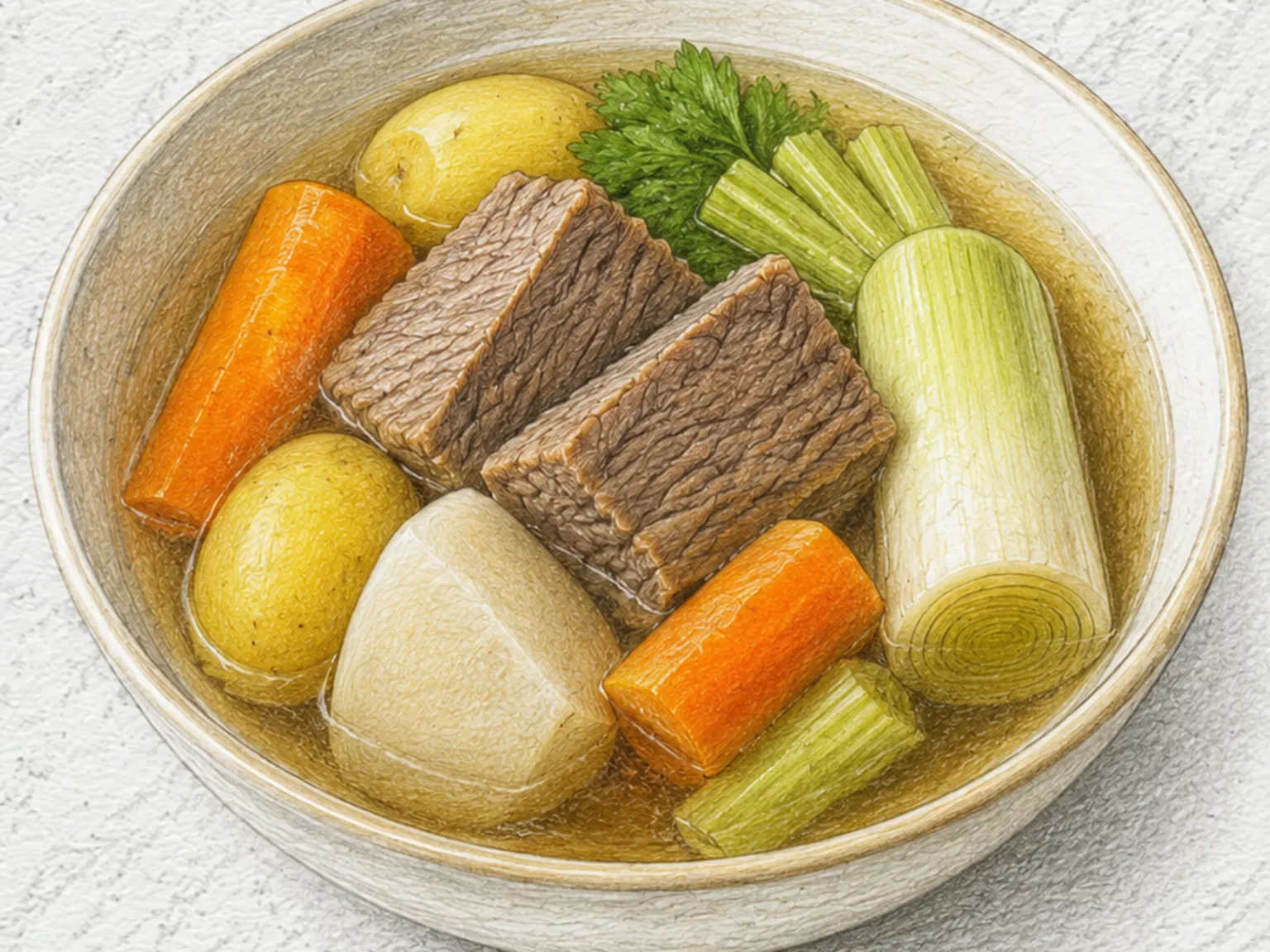
Pot-au-Feu is the archetypal French home-cooked meal - beef and root vegetables simmered slowly in a clear broth that prizes simplicity and patience.

What makes this special

  • Pot-au-Feu uses a cold water start to ensure the beef and vegetable broth remains golden and clear.
  • Starting in cold water and heating slowly keeps the broth clear and golden
  • Vegetables added late so each holds its own texture separately
Total time
200 min
Level
Hard
Servings
4 servings
Ingredients
9
Calories
520 kcal
Protein
43 g

Key ingredients

beef brisketpotatoescarrotsleekonion

Core cooking flow

  1. 1 Place 800 g beef brisket in cold water and heat it gradually over medium heat.
  2. 2 Rinse the pot, return the beef, and add enough fresh cold water to cover it well.
  3. 3 Add 1 onion, 2 celery stalks, 1 leek, the bay leaf, and the peppercorns.

Pot-au-Feu is the archetypal French home-cooked meal - beef and root vegetables simmered slowly in a clear broth that prizes simplicity and patience. Beef brisket is placed in cold water and brought up to temperature gradually; dropping meat into boiling water causes surface proteins to seize and cloud the broth. Skimming the impurities that rise to the surface throughout the cooking process keeps the liquid clear and clean, while bay leaf and whole peppercorns add depth without muddying the flavor. Vegetables - potatoes, carrots, leeks, and celery - are added only after the meat is nearly tender to preserve their individual textures. The traditional service presents sliced beef and whole vegetables on a platter with the broth served separately in bowls, accompanied by coarse salt, Dijon mustard, and cornichons.

Prep 20min Cook 180min 4 servings

Instructions

Read the steps as a cooking flow: prep, heat, seasoning, doneness control, and finish.

6 steps
  1. 1
    Control

    Place 800 g beef brisket in cold water and heat it gradually over medium heat.

    Once foam rises, blanch for only 2 to 3 minutes, then discard the first water to remove surface impurities.

  2. 2
    Control

    Rinse the pot, return the beef, and add enough fresh cold water to cover it well.

    Bring it up over medium low heat, skimming foam before a full boil clouds the broth.

  3. 3
    Control

    Add 1 onion, 2 celery stalks, 1 leek, the bay leaf, and the peppercorns.

    Keep the heat low enough that the broth only trembles gently, then simmer about 2 hours.

  4. 4
    Prep

    When the beef is tender enough to pierce with chopsticks or a skewer, add 300 g potatoes and 250 g carrots.

    Do not raise the heat hard, or the vegetables may break and cloud the broth.

  5. 5
    Control

    After adding the vegetables, simmer gently for another 30 to 40 minutes.

    The potatoes should keep their edges, and the carrots should feel tender when pressed without collapsing into the broth.

  6. 6
    Finish

    Season near the end with the 2 teaspoons salt, adding it gradually and tasting the broth.

    Slice the beef thickly, arrange it with the vegetables, and serve the clear broth separately in bowls.

After the steps

Pick a recipe that fits this dish.

Continue with shared ingredients, meal pairings, or a similar method.

Recipes That Go Well With This

More Western →

Based on shared ingredients and meal pairing

Blanquette de Veau (French Veal Stew in Creamy Egg-Lemon Sauce)
Shared ingredient: carrot Western

Blanquette de Veau (French Veal Stew in Creamy Egg-Lemon Sauce)

Blanquette de veau is a French white stew in which veal shoulder is first blanched in cold water to remove impurities and then gently simmered in fresh water with carrot, onion, and a bouquet garni for over an hour until the meat becomes completely tender. The name comes from blanc -- white -- and the defining rule of the dish is that the meat must never be browned at any stage; searing would change both the color and the delicate character of the final stew. The braising liquid is used to build the sauce: a butter-flour roux is whisked smooth, the warm broth is added gradually, and the finished veloute is enriched with a liaison of heavy cream and egg yolks to create a velvety coating. Once the yolks go in, the sauce must not boil -- even a brief simmer will cause the eggs to curdle, breaking the emulsion in a way that is difficult to repair. A small squeeze of lemon at the end brightens the richness of the cream, and button mushrooms sauteed separately in butter add an earthy note when folded in just before serving. The dish has been a staple of French bourgeois cooking since the 18th century, originally developed as a way to make the most of secondary cuts without the demanding technique required for braises like boeuf bourguignon.

Beef Bourguignon
Shared ingredient: carrot Western

Beef Bourguignon

Beef bourguignon is a Burgundian stew that slow-braises beef chuck in red wine for at least two hours, long enough for the tough connective tissue to dissolve into silky, fork-yielding meat and for the wine to condense into a glossy, concentrated sauce. Bacon is rendered first for its fat, which then sears the beef cubes into a deep, caramelized crust before the wine enters the pot, stacking smoky and browned notes into the base. As the wine reduces around the meat, it transitions from a thin liquid into a sauce that coats everything in the pot with an even, mahogany-colored gloss. Mushrooms and pearl onions absorb the sauce during the final stage of cooking, the mushrooms turning spongy and meaty, the onions sweet and yielding. Tomato paste and beef stock anchor the wine's natural acidity so the finished dish reads as deeply savory rather than sharp. The sauce should cling to the back of a spoon when done.

Beet and Goat Cheese Salad
Serve together Salads

Beet and Goat Cheese Salad

Beet and goat cheese salad begins with whole beets wrapped in foil and roasted at 200°C for forty-five to sixty minutes, long enough for their raw, earthy undertone to convert almost entirely into a concentrated, caramel-adjacent sweetness. Peeling the skins while the beets are still warm requires only the pressure of a paper towel - they slip off cleanly - and slicing them before they cool preserves the vivid crimson-purple cross-section that makes the dish visually striking. Crumbled goat cheese placed on the warm slices softens slightly, and its tangy acidity cuts through the dense sweetness of the roasted root rather than competing with it. Walnuts toasted briefly in a dry pan lose much of their raw bitterness, developing a nuttiness that bridges the mineral quality of the beet and the dairy sharpness of the cheese. Balsamic reduction does more than dress the plate: its concentrated sweet-tart intensity ties the separate components into a coherent whole. Arugula underneath the beet slices provides a peppery bitterness that sharpens the contrast against the sweetness, giving the salad a complexity well beyond what its short ingredient list suggests. A simple dressing of extra-virgin olive oil and lemon juice over the greens keeps the balance light and clear.

Coq au Vin (French Red Wine Braised Chicken with Mushrooms)
Similar recipe Western

Coq au Vin (French Red Wine Braised Chicken with Mushrooms)

Coq au vin is a French braise in which chicken pieces are cooked slowly in red wine until the flesh is tender enough to pull apart and the braising liquid has reduced into a glossy, deeply flavored sauce. The process begins by browning the chicken in batches over high heat, creating a caramelized crust that seals in juice and deposits flavor into the fond at the bottom of the pan. Bacon lardons, shallots, and garlic are cooked next in the same pan, adding savory, aromatic layers before the wine deglazes the accumulated fond. Chicken stock and a small amount of tomato paste deepen the body of the braise, and forty-five minutes of covered, low simmering allows the wine's tannins and fruit to permeate the meat completely. Mushrooms are added in the final fifteen minutes to prevent them from turning mushy during the long cook. Reducing the sauce after the chicken is removed concentrates it to a consistency that coats the back of a spoon, and whisking in cold butter at the end produces a glossy sheen and a silky mouthfeel. The dish improves significantly if made a day ahead and refrigerated overnight, as the rest allows the wine, meat, and aromatics to integrate more fully. When reheated the following day, the sauce is noticeably richer and more cohesive than it was straight from the pot.

Serve with this

Dongdongju (Korean Unfiltered Fermented Rice Wine)
Drinks Hard

Dongdongju (Korean Unfiltered Fermented Rice Wine)

Dongdongju is a traditional Korean unfiltered rice wine made by steaming short-grain and sweet rice together, then fermenting the cooked grain with nuruk starter and a small amount of dry yeast for seven days. Unlike makgeolli, it passes through a coarse sieve only once, leaving rice grains floating on the surface -- a trait that gives the drink its name and provides a distinctly chewy grain texture with each sip. Stirring the mash twice daily ensures the nuruk breaks down the starches evenly throughout fermentation, and keeping the temperature low after day three prevents the batch from over-fermenting. A pinch of salt added at the finish tempers residual sweetness without flattening the fermented grain character. Home-brewed dongdongju tends to carry a more pronounced rice fragrance and a heavier body than commercial makgeolli, and its flavor shifts noticeably day by day as fermentation continues.

🍺 Bar Snacks 🎉 Special Occasion
Prep 30min Cook 40min 8 servings
Half-moon Rice Cake (Sesame Honey Filled Steamed Rice Cake)
Desserts Medium

Half-moon Rice Cake (Sesame Honey Filled Steamed Rice Cake)

Kkul songpyeon are traditional half-moon rice cakes shaped by hand from rice flour dough and filled with a paste of finely ground toasted sesame seeds, honey, and dark brown sugar, then steamed over a bed of fresh pine needles. Grinding the sesame seeds fine enough to form a cohesive mixture with honey and sugar is important -- the oil-rich nuttiness and dense sweetness bind together into a smooth filling that turns moist and paste-like as steam penetrates the rice dough during cooking. Arranging pine needles at the bottom of the steamer imparts a faint resinous, woody fragrance to the surface of each rice cake after 15 minutes of steaming, layering over the natural grain aroma of the rice flour dough. After steaming, a quick rinse in cold water stops carry-over cooking, and a thin brush of sesame oil gives each songpyeon a glossy sheen while preventing them from sticking together. Shaping songpyeon together as a family at Chuseok is one of the most recognizable autumn traditions in Korea, and the saying that beautifully shaped songpyeon foretells a beautiful daughter remains widely repeated today.

🎉 Special Occasion 🧒 Kid-Friendly
Prep 35min Cook 20min 4 servings
Kimchi Lentil Ragu Tagliatelle
Pasta Medium

Kimchi Lentil Ragu Tagliatelle

Kimchi lentil ragu tagliatelle is a plant-forward pasta where lentils simmer with tomato puree, wine, and finely diced onion, carrot, and celery for 35 minutes, breaking down into a thick sauce with a meaty texture that contains no actual meat. The Korean-inflected soffritto builds the aromatic base, and as the lentils cook through they release starch that naturally thickens the ragu without any additional binder. Fermented kimchi is added late in the process, preserving its sharp acidity and keeping the fermented flavor present and distinct rather than cooked away. A small amount of sugar smooths the combined tartness of tomato and kimchi so neither dominates. The wide, flat tagliatelle ribbons hold the heavy sauce well, and every strand picks up the full depth of the braise. Without a gram of meat, the dish delivers genuine richness and staying power.

🥗 Light & Healthy 🎉 Special Occasion
Prep 20min Cook 35min 4 servings

Similar recipes

Chicken Chasseur
Western Medium

Chicken Chasseur

Chicken chasseur is a French braised chicken dish where thighs are seared skin-side down until the skin renders crispy and golden, then set aside while button mushrooms, shallots, and garlic are sauteed in the same pan with butter. White wine goes in next to deglaze the fond left on the bottom of the pan, and after the wine reduces by half, tomato puree, chicken stock, and fresh thyme sprigs go in before the seared chicken returns to the pot for a covered braise of twenty-five minutes. The initial searing step is not optional from a flavor standpoint, because the caramelized residue left on the pan, the fond, is the primary source of the sauce's roasted depth. Rushing the sear causes the skin to stick and tear, and results in a paler, thinner-tasting sauce. Mushrooms need to be spread out in a single layer in a hot, wide pan so they brown before their moisture escapes, since crowding them generates steam that leaves them pale and soft rather than giving them the earthy intensity the dish depends on. As the wine reduces, its acidity concentrates and sharpens, which is what makes the sauce bright enough to balance the richness of the braised chicken. Tomato puree adds a quiet, rounded sweetness and deepens the red color of the sauce, while thyme brings an herbal warmth that accumulates slowly over the course of the braise. Removing the lid for the final five minutes allows the sauce to thicken to the right consistency. Mashed potatoes or crusty bread served alongside catch every bit of the sauce.

🎉 Special Occasion 🍺 Bar Snacks
Prep 20min Cook 40min 4 servings
Lemon Curd Tart
Baking Medium

Lemon Curd Tart

Lemon Curd Tart is a classic dessert composed of a crumbly shortcrust pastry shell filled with a smooth, tangy lemon curd. The shell is prepared by rubbing cold unsalted butter into flour and powdered sugar, binding it with egg yolk, and baking it until lightly golden. The filling is made by whisking fresh lemon juice, grated lemon zest, sugar, and egg yolks over low heat. The mixture is cooked slowly to thicken without boiling, then combined with heavy cream and strained to achieve a silky consistency. The lemon zest oils provide a lasting citrus aroma, while the butter offers a rich mouthfeel that balances the sharp acidity. Once filled, the tart is chilled for an hour to set, allowing it to be sliced cleanly. It can be served plain or decorated with whipped cream or torched meringue.

🎉 Special Occasion 🧒 Kid-Friendly
Prep 30min Cook 25min 4 servings
Paris-Brest (Ring-Shaped Choux with Praline Cream)
Baking Hard

Paris-Brest (Ring-Shaped Choux with Praline Cream)

A ring of choux pastry is baked until deeply golden and hollow, then split and generously filled with praline mousseline cream made from roasted hazelnut paste. The shell shatters on first bite, giving way to a smooth, nutty cream that carries an intense toasted aroma. Sliced almonds pressed onto the raw dough before baking add a secondary layer of crunch and visual texture. The choux must cool completely before filling to prevent the cream from melting and the shell from going soft. Eggs are added to the hot dough gradually, checking the consistency after each addition, because the exact amount needed varies with flour absorption and egg size. Once assembled, a brief chill in the refrigerator sets the cream without softening the pastry.

🎉 Special Occasion 🧒 Kid-Friendly
Prep 45min Cook 40min 6 servings

Tips

Frequent skimming keeps the broth clear.
Serve with mustard or coarse salt for a classic French touch.

Nutrition (per serving)

Calories
520
kcal
Protein
43
g
Carbs
22
g
Fat
28
g