Queen of Puddings (Custard Bread Base with Jam and Meringue)
Quick answer
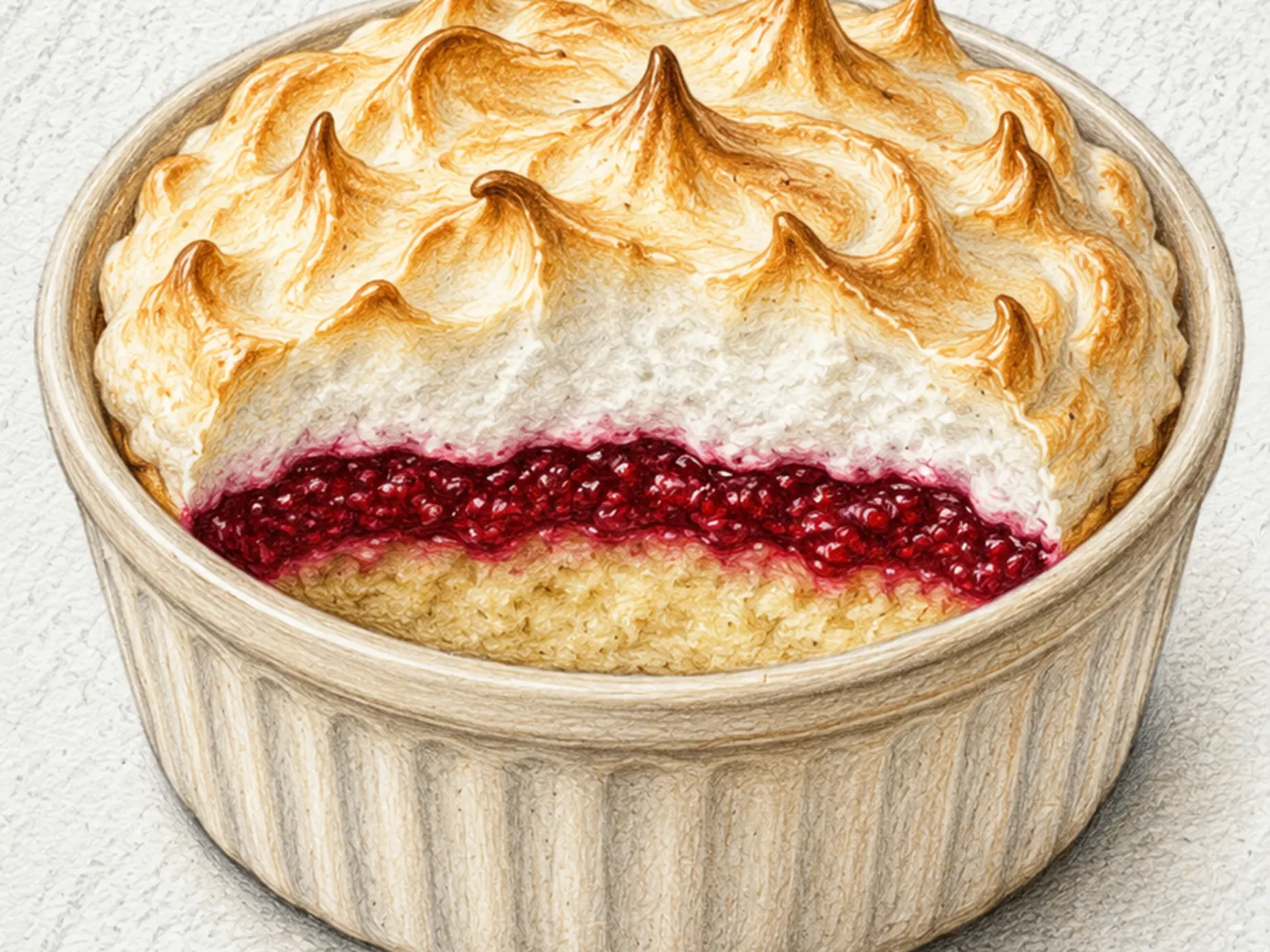
Queen of puddings is a layered British dessert that begins with a base of breadcrumbs soaked in warm vanilla custard and baked until set.
What makes this special
- Breadcrumb custard bakes firm, raspberry jam spreads on top, then meringue crowns Queen of Puddings.
- Yolks go into custard and whites become meringue; no part of the egg is wasted
- All three layers of custard, jam, and meringue must be in one spoonful for full effect
Key ingredients
Core cooking flow
- 1 Preheat the oven to 180C. Separate the 3 eggs into yolks and whites, placing...
- 2 Warm the 450 ml milk over medium-low heat until it steams but does not boil.
- 3 Stir in the 80 g breadcrumbs and let them soak for 5 minutes.
Queen of puddings is a layered British dessert that begins with a base of breadcrumbs soaked in warm vanilla custard and baked until set. A thin layer of raspberry jam is spread over the surface, introducing a tart brightness that cuts through the richness below. Meringue made from the reserved egg whites is then piled on top and returned to the oven until the peaks turn golden, creating a shell that is crisp on the outside yet marshmallow-soft within. Each spoonful should capture all three layers - the dense, creamy custard base, the sharp fruit jam, and the airy meringue - so that the flavors interact on the palate simultaneously. The recipe wastes nothing: yolks enrich the custard while whites become the meringue, a practical economy that reflects its origins in frugal English country kitchens. Served warm, the custard feels almost like a savory bread pudding dressed in dessert clothing; chilled, the jam asserts itself more prominently, and the meringue firms to a gentle chew.
Instructions
Read the steps as a cooking flow: prep, heat, seasoning, doneness control, and finish.
- 1Step
Preheat the oven to 180C.
Separate the 3 eggs into yolks and whites, placing the whites in a completely clean, dry bowl so the meringue can whip properly later.
- 2Control
Warm the 450 ml milk over medium-low heat until it steams but does not boil.
Turn off the heat, then stir in the 25 g butter and part of the sugar until dissolved.
- 3Prep
Stir in the 80 g breadcrumbs and let them soak for 5 minutes.
Let the mixture cool slightly, then mix in the yolks so they blend without scrambling, and pour into a baking dish.
- 4Heat
Bake the custard bread layer for about 20 minutes.
Remove it when the edges are set and the center still has a slight wobble, so the base stays soft instead of drying out.
- 5Season
Stir the 4 tbsp raspberry jam until spreadable, then smooth it in a thin layer over the baked base.
Whip the whites, adding the remaining sugar gradually, until stiff glossy peaks form.
- 6Heat
Spread the meringue over the jam all the way to the edges and lift a few peaks with the spoon.
Bake for 12-15 minutes more, until golden, then rest briefly before serving warm or chilled.
After the steps
Pick a recipe that fits this dish.
Continue with shared ingredients, meal pairings, or a similar method.
Recipes That Go Well With This
More Baking →Based on shared ingredients and meal pairing
Treacle Tart (British Golden Syrup Breadcrumb Tart)
Golden syrup, fresh breadcrumbs, and lemon juice are combined and baked inside a shortcrust pastry shell to create one of Britain's most enduring desserts. The syrup caramelizes gently during baking, developing a deep, toffee-like sweetness, while the breadcrumbs absorb it and give the filling a sticky, dense body. Lemon zest and juice are the essential counterweight - without them, the sweetness would be overwhelming, but their acidity sharpens the syrup into something balanced and compelling. The tart shell benefits from a brief blind bake before filling to keep the base crisp under the wet filling. Breadcrumbs should be coarse rather than fine, preserving a slight texture within the otherwise smooth filling. The tart appears runny when first removed from the oven but firms as it cools, slicing cleanly once at room temperature. An overnight rest allows the flavors to meld and settle, and many consider the tart superior on the second day.
Bread Pudding
Bread pudding transforms leftover bread into a warm, custardy dessert by soaking thick slices in a mixture of eggs, whole milk, and heavy cream, then baking until the custard sets. Allowing the bread to soak for at least twenty minutes before baking ensures the liquid penetrates all the way through each slice so the interior bakes into something closer to a soft, yielding pudding, while the top layer exposed to the oven heat crisps into a golden-brown crust. Cinnamon stirred into the custard base distributes a warm spiced fragrance through the entire dish, and vanilla extract rounds out the egg flavor. Served warm with a scoop of vanilla ice cream or a pour of bourbon caramel sauce, the contrast between the hot pudding and the cold topping adds another dimension. Originally a practical solution to stale bread, this dish has been a fixture of English and American Southern home cooking for generations.
Black Tea Milk Tea (British Condensed Milk Sweet Tea)
Milk tea is prepared by steeping black tea bags in boiling water for exactly four minutes to extract a strong, tannic base, then combining it with whole milk and condensed milk over low heat. Steeping shorter than four minutes leaves the tea pale and thin; longer than four minutes introduces bitterness and astringency that no amount of milk can fully mask. The milk rounds out the tea's sharpness and adds a creamy body, while condensed milk layers on a dense, caramel-like sweetness that sets this version apart from tea simply sweetened with sugar. Regular sugar dissolved early provides the baseline sweetness, and the condensed milk fine-tunes the richness and texture in the final moments. Warming the milk before combining it with the brewed tea helps both blend more smoothly. For an iced version, the mixture must be cooled completely before pouring over ice, since adding hot liquid directly to ice dilutes the drink and washes out the flavor.
Eton Mess (Crushed Meringue, Cream & Strawberry Mix)
Eton mess is a British dessert originating from Eton College, made by roughly folding together broken meringue, whipped cream, and strawberries into a deliberate, unstudied jumble. The name comes from the method itself: there is no careful layering or presentation, just a generous combination of three components mixed loosely in a glass or wide bowl. The meringue is baked low and slow until the outside develops a firm, crisp shell while the inside stays soft and marshmallow-like, then cooled completely before being broken by hand into irregular shards of varying sizes. Strawberries are treated in two ways: some are crushed roughly with a fork so the juice bleeds in red streaks through the white cream, while others remain whole to provide fresh, firm bites of fruit. The heavy cream is whipped only to soft, billowy peaks so it folds around the meringue and fruit loosely rather than sitting in stiff mounds. Every spoonful delivers a different ratio of crunch, softness, tartness, and sweetness depending on which pieces land together, which is the pleasure of the dessert. Because the cream and fruit juices begin softening the meringue the moment they are combined, Eton mess must be assembled and eaten immediately to preserve the textural contrast between crisp and soft.
Serve with this
Cornish Pasty (British Hand Pie with Beef and Root Vegetables)
Cornish pasty is a traditional British hand pie from Cornwall, made by sealing raw diced beef, potatoes, rutabaga, and onion inside a sturdy pastry of flour, butter, salt, and water. The filling is not pre-cooked before sealing, so the meat and vegetables steam inside the crust during baking. Their juices collect and concentrate inside the sealed shell, forming a rich, savory interior gravy that makes the pasty deeply satisfying without any additional sauce. Crimping the edges tightly is essential to contain this liquid during the forty-to-forty-five-minute bake at 200 degrees Celsius. Cutting the filling into pieces no larger than about one centimeter ensures everything cooks evenly through. An egg wash brushed over the surface before baking develops a glossy, amber crust. The pasty originated as a practical working meal for Cornish tin miners, who held the pastry by its thick crimped edge to avoid contaminating the food with dirty hands, then discarded that portion when finished.
Glutinous Rice Cake with Soybean Powder
Injeolmi is a Korean glutinous rice cake made by kneading rice flour dough with hot water, steaming it for fifteen minutes, then pounding or beating it vigorously for at least five minutes to develop the characteristic elasticity. The pounding step determines the final texture: insufficient working produces a weak dough that cracks apart, while thorough pounding yields the signature stretchy, chewy pull that injeolmi is known for. The finished dough is stretched out, cut into bite-sized pieces, and rolled in a mixture of roasted soybean powder and sugar, which coats each piece in a fragrant, toasted-grain aroma. Applying a thin layer of sesame oil to both hands and knife before cutting prevents the dough from sticking, and the soybean powder coating is best applied immediately before serving to keep the surface dry and powdery rather than absorbing moisture. Injeolmi appears regularly at ancestral rites, first birthday celebrations, and traditional ceremonies across Korea.
Seven Layer Salad
Seven layer salad stacks romaine lettuce, sliced cucumber, halved cherry tomatoes, cooked green peas, chopped boiled egg, and thinly sliced red onion in a clear glass bowl, then seals the top with a smooth layer of Greek yogurt mixed with lemon juice. The yogurt cap acts as a moisture barrier, preventing the lower layers from turning soggy and making the salad suitable for advance preparation. Boiled eggs contribute a mild richness and peas add a starchy sweetness that rounds out the crisp vegetable layers, while red onion's sharp bite creates a contrast against the creamy, tangy dressing. Serving requires scooping deep to the bottom so every portion captures all seven layers at once.
Similar recipes
English Trifle (Layered Cake, Custard & Cream Dessert)
English trifle is a layered dessert assembled in a glass bowl, where each stratum contributes a different texture and flavor. Slices of sponge cake are soaked in sherry or fruit juice until they soften into a pudding-like consistency, then covered with a thick vanilla custard that sets gently as it chills. Fresh strawberries and blueberries are scattered between layers, introducing bright acidity and color. Whipped cream crowns the top, providing a light, airy finish. The glass bowl displays the distinct bands of cake, custard, fruit, and cream from the side. Each serving should dig deep enough to capture all layers in a single spoonful, ensuring that the wine-soaked sponge, the smooth custard, and the cream's lightness arrive together.
Toad in the Hole (British Sausages in Yorkshire Pudding)
Toad in the hole bakes pork sausages inside a risen Yorkshire pudding batter by first heating the sausages and oil in an oven pan at 220 degrees Celsius for 10 minutes, then quickly pouring cold batter into the scorching-hot fat. The temperature shock between cold batter and smoking oil is what drives the dramatic puff - if the pan cools before the batter goes in, the rise will be flat and dense. The batter itself is simple: flour, eggs, milk, salt, and pepper, rested for 10 minutes so the gluten relaxes and produces a more even rise. Once in the oven, the door must stay closed for the full 20 to 25 minutes - opening it drops the temperature and collapses the delicate air structure mid-bake. The finished dish has crisp, golden edges and a soft, custardy center cradling the browned sausages.
Sausage Roll
Sausage roll is a British bakery snack made by wrapping seasoned sausage meat in puff pastry, brushing with egg wash, and baking until golden. Mixing the meat with finely minced onion, breadcrumbs, and Dijon mustard adds moisture and flavor that keep the filling juicy after baking. Rolling the pastry around a log of filling and placing the seam side down prevents the roll from opening in the oven. Scoring the top allows steam to escape, which helps the pastry puff into crisp, distinct layers. Baking at 200 degrees Celsius for twenty to twenty-five minutes produces a deep golden shell with flaky, butter-rich layers encasing the savory meat inside. It works equally well as a snack, light meal, or picnic food.