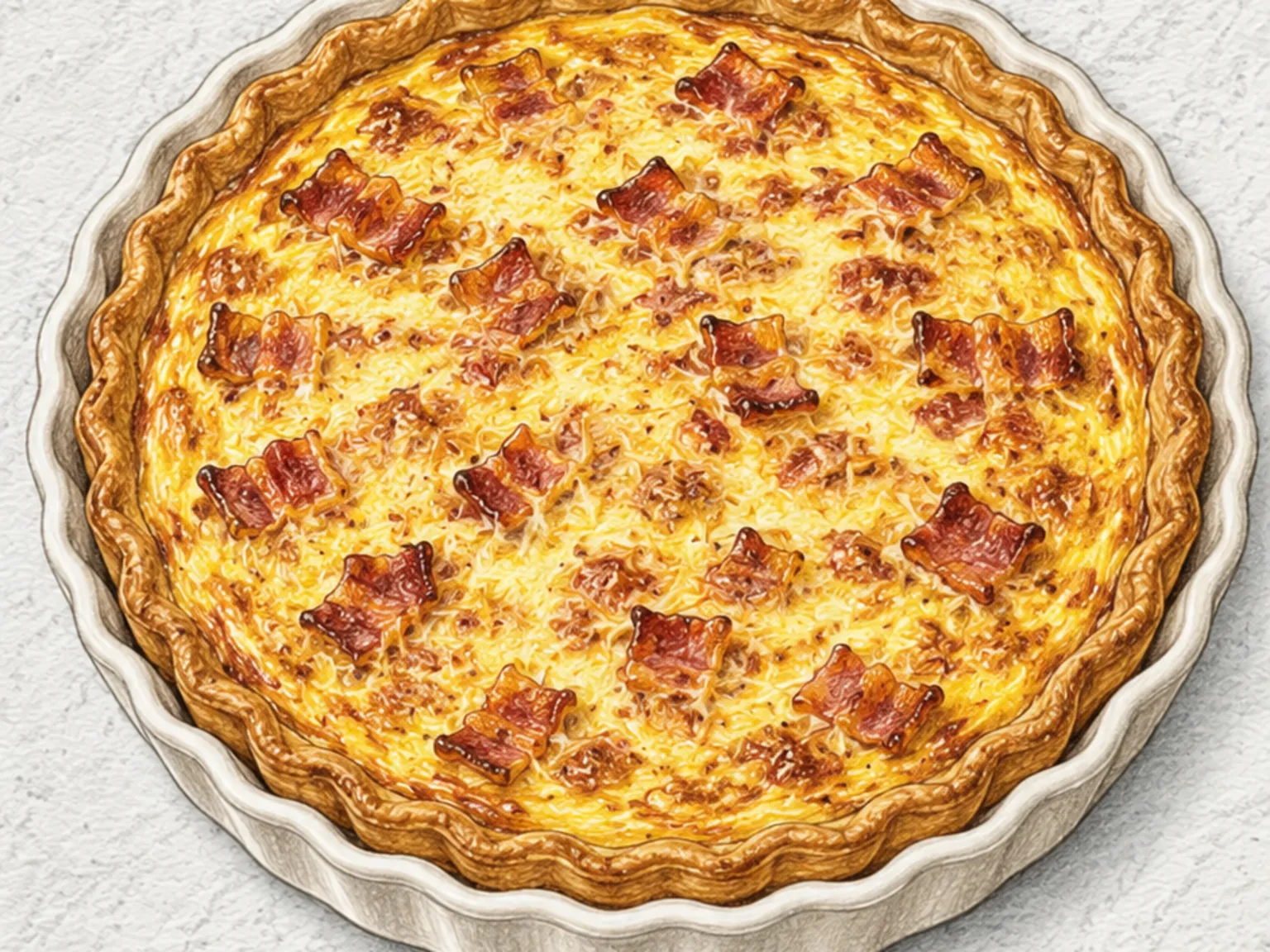
Quiche Lorraine
Quick answer
Quiche Lorraine is a French savory tart that fills a buttery pastry shell with crisp-cooked bacon, grated Gruyere cheese, and a smooth custard made from eggs, heavy cream, and milk.
What makes this special
- Quiche Lorraine features a savory bacon custard baked in a crisp, blind-baked pastry shell.
- Blind baking the crust first prevents the base from turning soggy
- Center still jiggly when removed; residual heat finishes the custard fully
Key ingredients
Core cooking flow
- 1 Preheat the oven to 190C. Fit the pie crust firmly into the tart pan, pressi...
- 2 Blind-bake the crust for 10 minutes to set the base before adding the custard.
- 3 Cook the 140g bacon in a skillet over medium heat until the fat renders and the pieces turn crisp.
Quiche Lorraine is a French savory tart that fills a buttery pastry shell with crisp-cooked bacon, grated Gruyere cheese, and a smooth custard made from eggs, heavy cream, and milk. Blind-baking the crust for ten minutes before adding the filling is essential to prevent a soggy base. The bacon must be drained well so excess fat does not make the custard greasy. Whisking the egg mixture gently avoids incorporating too many air bubbles, which would create an uneven surface after baking. The quiche is done when the center still has a slight jiggle - removing it at this point and resting for ten minutes allows residual heat to set the custard fully, producing a clean slice with a creamy interior.
Instructions
Read the steps as a cooking flow: prep, heat, seasoning, doneness control, and finish.
- 1Step
Preheat the oven to 190C.
Fit the pie crust firmly into the tart pan, pressing it into the corners, then prick the base evenly with a fork so it does not puff up during baking.
- 2Heat
Blind-bake the crust for 10 minutes to set the base before adding the custard.
Remove it when the edges look dry and lightly colored, then let it cool briefly so the filling will not soak in.
- 3Control
Cook the 140g bacon in a skillet over medium heat until the fat renders and the pieces turn crisp.
Drain it well afterward, because excess bacon fat can make the custard heavy and greasy.
- 4Season
In a bowl, combine 3 eggs, 200ml heavy cream, 80ml milk, and 0.5 teaspoon salt.
Whisk gently just until smooth, avoiding excess foam so the baked surface stays even.
- 5Heat
Spread the drained bacon and 90g Gruyere cheese evenly over the cooled crust.
Pour in the custard slowly so it fills the gaps, then bake for about 30 minutes until the edges are set.
- 6Finish
Remove the quiche when the edges are set but the center still jiggles slightly.
Rest it for 10 minutes so residual heat finishes setting the custard, then slice with a clean knife.
After the steps
Pick a recipe that fits this dish.
Continue with shared ingredients, meal pairings, or a similar method.
Recipes That Go Well With This
More Western →Based on shared ingredients and meal pairing
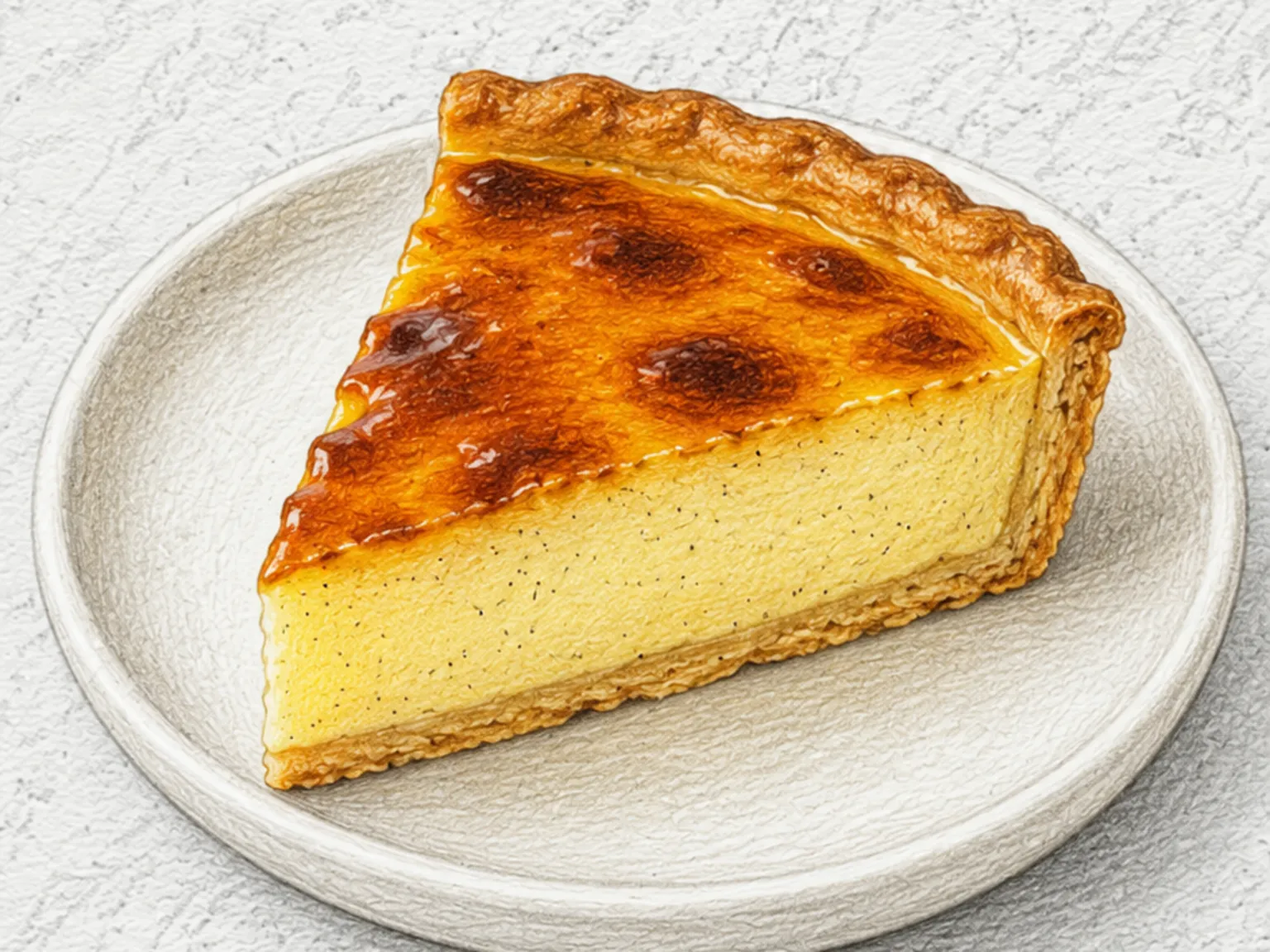
Flan Parisien (Parisian Vanilla Custard Tart)
Flan Parisien is a Parisian bakery staple found in nearly every boulangerie in the city. A buttery shortcrust pastry shell holds a thick, firm vanilla custard that bakes slowly until the top develops caramelized brown spots. The custard is made from milk, eggs, sugar, and cornstarch, which gives it a denser, sliceable consistency that distinguishes it from softer baked custards like creme brulee. When properly cooled, the filling holds its shape when cut yet melts smoothly on the tongue with a clean vanilla flavor. Vanilla bean seeds speckled throughout the custard signal that the real ingredient was used rather than extract. The pastry shell must be blind-baked first to prevent sogginess, then filled and baked again until set. It is served cold, and the contrast between the crisp, buttery shell and the cool, trembling custard makes each bite satisfying. Allowing the flan to cool fully at room temperature before refrigerating prevents the custard from cracking or collapsing when sliced, which is the most common mistake when cutting too soon after baking.
French Onion Tart
The preparation of a French onion tart begins with slicing onions and cooking them in butter using a low heat setting for more than twenty minutes. During this extended cooking duration, the onions collapse into a dark amber mixture, ensuring that their natural sweetness is fully concentrated while the sharp bite associated with raw onions is completely eliminated. Once the onions have reached this state, they are spread in an even layer over a tart shell that has already undergone blind baking to maintain its texture. A custard liquid made from a combination of eggs, heavy cream, and thyme is poured over the onions. Grated Gruyere cheese is then scattered across the top surface before the tart is transferred to an oven preheated to 190 degrees Celsius. The baking process continues until the internal filling has set into a firm consistency and the cheese layer has transformed into a browned, salty crust. The flavor of the caramelized onions is the most prominent characteristic of the dish, providing a sweetness that builds on the palate with each bite. Thyme is used to contribute a distinct herbal note, which functions to offset the richness of the dairy components and prevent the tart from becoming cloying. The addition of Gruyere cheese brings a nutty and salty element that balances the sweet and savory aspects of the tart. This specific dish is known for holding its quality well when served at room temperature, which makes it a versatile choice for inclusion in brunch menus, sequences of wine pairings, or meals eaten outdoors.
Beet and Goat Cheese Salad
Beet and goat cheese salad begins with whole beets wrapped in foil and roasted at 200°C for forty-five to sixty minutes, long enough for their raw, earthy undertone to convert almost entirely into a concentrated, caramel-adjacent sweetness. Peeling the skins while the beets are still warm requires only the pressure of a paper towel - they slip off cleanly - and slicing them before they cool preserves the vivid crimson-purple cross-section that makes the dish visually striking. Crumbled goat cheese placed on the warm slices softens slightly, and its tangy acidity cuts through the dense sweetness of the roasted root rather than competing with it. Walnuts toasted briefly in a dry pan lose much of their raw bitterness, developing a nuttiness that bridges the mineral quality of the beet and the dairy sharpness of the cheese. Balsamic reduction does more than dress the plate: its concentrated sweet-tart intensity ties the separate components into a coherent whole. Arugula underneath the beet slices provides a peppery bitterness that sharpens the contrast against the sweetness, giving the salad a complexity well beyond what its short ingredient list suggests. A simple dressing of extra-virgin olive oil and lemon juice over the greens keeps the balance light and clear.
Pissaladiere (Provencal Caramelized Onion Anchovy Tart)
Pissaladiere is a traditional tart from Provence in southern France, built on a thin bread dough blanketed with slowly cooked onions and adorned with anchovy fillets and black olives arranged in a lattice pattern. The onions must cook in olive oil over low heat for at least forty minutes until their moisture evaporates completely and their natural sugars caramelize into a dark, jam-like sweetness. This thick layer of onion jam makes the tart resemble a pizza visually, but the absence of tomato sauce and the primacy of onion sweetness make it an entirely different dish. The anchovies contribute sea-salt brininess and umami, while the olives add a bitter, savory counterpoint that balances the onion's sweetness. Fresh thyme leaves scattered on top before baking introduce an herbal brightness that lifts the dense, concentrated flavors.
Serve with this
Saenggang Jeonggwa (Candied Ginger)
Saenggang jeonggwa is a traditional Korean candied ginger prepared by slicing fresh ginger thin, blanching it twice to reduce the raw heat, then simmering the pieces slowly in a glaze of sugar and grain syrup. A ten-minute soak in cold water draws out the sharpest bite first, and two rounds of boiling soften the pungency further while leaving the clean, aromatic core intact. The slices are cooked on low heat until the syrup reduces to a thick, glossy coat on the surface, at which point lemon juice is added to introduce an acidity that keeps the sweetness from becoming cloying. Once dried on a rack and rolled in granulated sugar, the finished pieces carry a crisp, crystalline shell on the outside. On the first bite, the sugar crust shatters, and the chewy, syrup-saturated ginger beneath releases a slow, building warmth that lingers well after the piece is finished.
Kimchi Lentil Ragu Tagliatelle
Kimchi lentil ragu tagliatelle is a plant-forward pasta where lentils simmer with tomato puree, wine, and finely diced onion, carrot, and celery for 35 minutes, breaking down into a thick sauce with a meaty texture that contains no actual meat. The Korean-inflected soffritto builds the aromatic base, and as the lentils cook through they release starch that naturally thickens the ragu without any additional binder. Fermented kimchi is added late in the process, preserving its sharp acidity and keeping the fermented flavor present and distinct rather than cooked away. A small amount of sugar smooths the combined tartness of tomato and kimchi so neither dominates. The wide, flat tagliatelle ribbons hold the heavy sauce well, and every strand picks up the full depth of the braise. Without a gram of meat, the dish delivers genuine richness and staying power.
Korean Bokbunja Wine (Black Raspberry Soju-Infused Fruit Wine)
Bokbunja-ju is a deep ruby Korean fruit wine made by layering fresh black raspberries and sugar in a sterilized jar, then covering them with soju along with a strip of lemon peel and a cinnamon stick. At 1.2 kg of fresh fruit per batch, the berry flavor comes through with real concentration. The jar rests in a cool place for at least thirty days and is shaken gently once a week to dissolve the sugar evenly throughout the liquid. After straining through fine cloth, additional bottle aging softens the acidity and rounds out the berry aroma, producing a wine where the warm spice undertones from the cinnamon balance the tartness of the raspberries.
Similar recipes
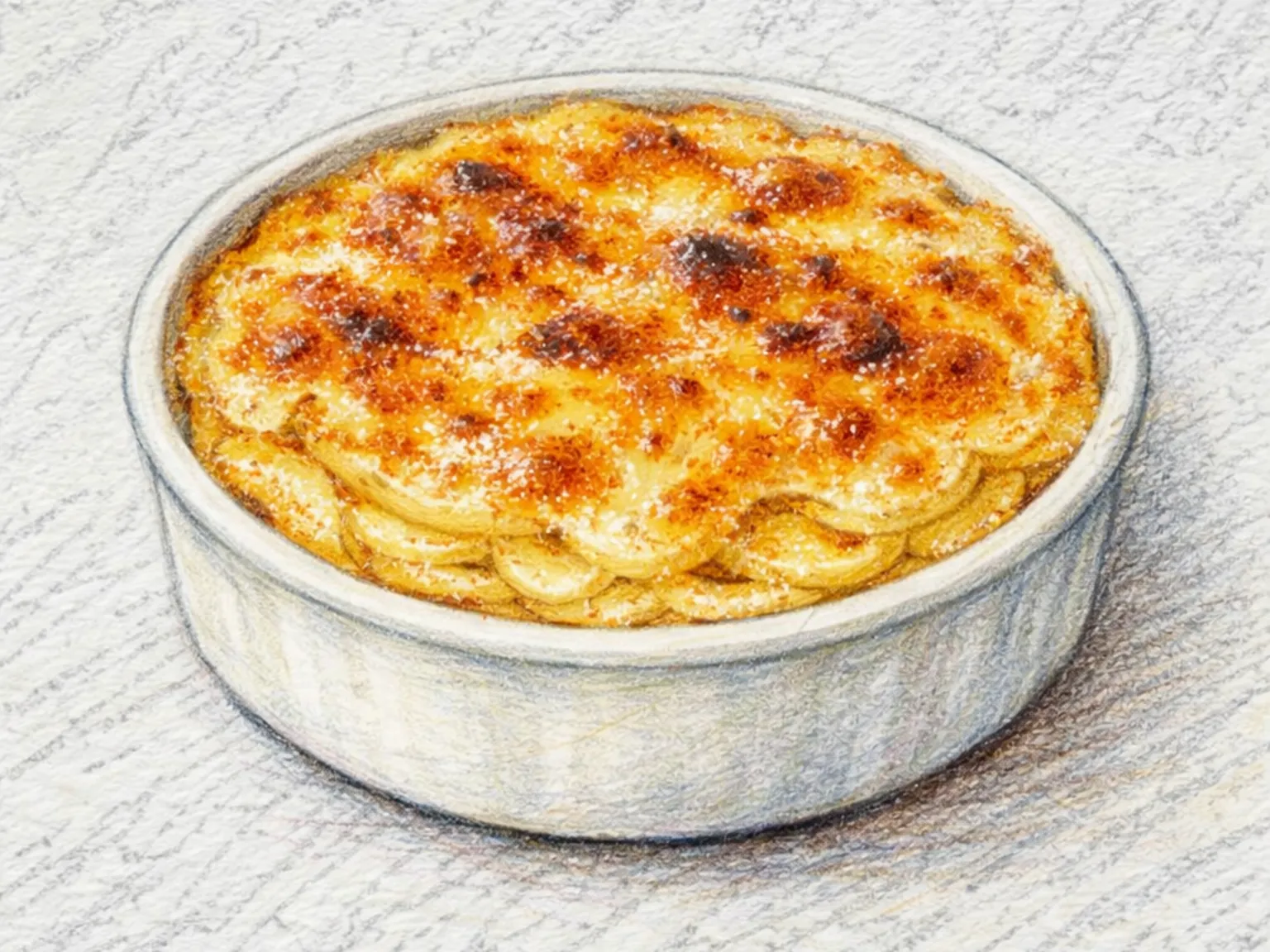
Clafoutis (French Baked Cherry Custard Dessert)
Clafoutis is a traditional French dessert from the Limousin region made by arranging fresh cherries in a buttered baking dish, then pouring over a thin batter of eggs, sugar, milk, and flour and baking at 180 degrees Celsius for thirty to thirty-five minutes. The batter is considerably thinner than pancake batter, and the result when baked is a texture that sits between a creamy custard and a light sponge -- the edges puff and turn golden while the center around the cherries stays moist and yielding. Using unpitted cherries is the traditional method: the pits release a faint almond scent during baking that perfumes the surrounding batter in a way that pitted fruit cannot replicate. The cherries also hold their shape better with the pits in. Vanilla extract deepens the egg-and-milk base, and the cherries' own tart juice seeps into the batter during baking, creating concentrated pockets of fruit flavor that balance the overall sweetness. Clafoutis is served directly from the baking dish, typically dusted with powdered sugar and brought to the table while still warm, because the custard texture softens and loosens slightly as it cools, making the warm version noticeably more appealing. Made with blueberries, plums, or apricots instead of cherries, the dessert takes a different name -- flaugnarde -- though the technique remains identical.
French Omelette
A French omelette is defined entirely by technique, which is precisely why it appears in professional kitchens as a benchmark for a cook's fundamental skill. The eggs are beaten just enough to combine the yolks and whites into a uniform liquid without introducing air, then poured into a butter-coated pan over moderate heat. From that point on, constant stirring with a fork or chopsticks, combined with rhythmic shaking of the pan, coaxes the eggs into the tiniest possible curds that bind together into a seamless, pale yellow sheet. No browning of any kind should appear on the exterior surface. The interior, described in French as baveuse, remains slightly underset with a custard-like center that carries the richness of the egg in its purest form. Folding or rolling the omelette into a neat oval shape should happen within ninety seconds from the moment the egg touches the pan; anything beyond that overcooks the inside. Fillings are minimal by design: fine herbs, a small amount of grated Gruyere, or nothing at all, so the egg remains the sole subject. The simplicity of the ingredients removes every excuse and makes even small errors in heat management immediately visible in the finished result. Practice tightens the margins, but each attempt teaches something precise about timing and temperature.
Fruit Clafoutis (Baked Custard with Fresh Fruit)
Clafoutis is a rustic French baked dessert that suspends fresh seasonal fruit in a thin custard batter and bakes it until the edges puff golden and the center sets to a silky cream. The batter, close to crepe batter in consistency, is made from eggs, milk, flour, and sugar whisked until smooth. Traditionally, unpitted cherries are used because the pits release a faint almond-like fragrance during baking that deepens the overall flavor. Strawberries, blueberries, and plums work equally well, their juices concentrating in the oven heat and creating pockets of intense sweetness against the mild custard. Because the method is little more than mixing and pouring, it requires no special technique. Served warm with a dusting of powdered sugar, the contrast between the crisp rim and the soft interior is what makes this dessert memorable.