Red Bean Butter Macarons (Almond Shells with Red Bean Cream)

Red Bean Butter Macarons (Almond Shells with Red Bean Cream)

Quick answer

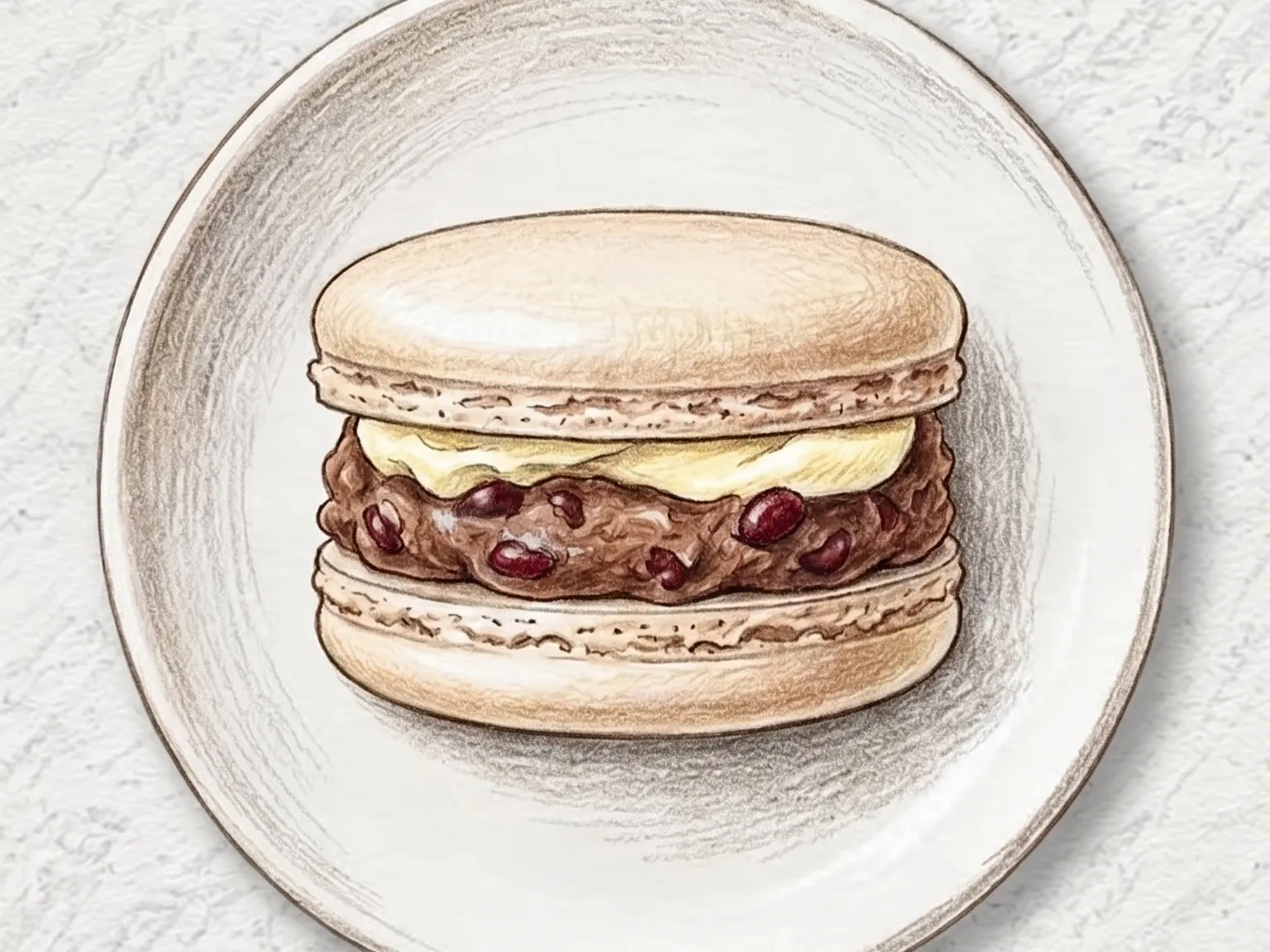
This recipe offers a Korean twist on French macarons, combining almond meringue shells with a filling of sweet red bean paste and softened butter.

What makes this special

  • Red Bean Butter Macarons pair nutty almond shells with a rich, earthy Korean bean filling.
  • Red bean paste mixed with butter creates a filling that is rich yet earthy and nutty
  • One day of refrigerating lets the shell absorb cream moisture for macaron maturation
Total time
56 min
Level
Hard
Servings
4 servings
Ingredients
7
Calories
330 kcal
Protein
6 g

Key ingredients

almond flourpowdered sugaregg whitesugarunsalted butter

Core cooking flow

  1. 1 Sift 110 g almond flour with 110 g powdered sugar twice.
  2. 2 Foam 90 g egg white, then add 90 g sugar in three additions while whipping.
  3. 3 Fold the dry mixture into the meringue with a spatula, scraping the bowl as you go.

This recipe offers a Korean twist on French macarons, combining almond meringue shells with a filling of sweet red bean paste and softened butter. The process starts by sifting almond flour and powdered sugar twice to ensure smooth tops. Egg whites are whipped with sugar to form firm, glossy peaks. During macaronage, the dry ingredients are folded into the meringue until the batter falls in smooth ribbons, which is essential for developing the characteristic ruffled foot. The filling blends unsalted butter, red bean paste, and milk into a smooth cream. Once assembled, the macarons require a full day of resting in the refrigerator. This maturation period allows the shells to absorb moisture from the cream, developing a chewy interior. On humid days, extending the shell drying time by ten minutes helps prevent cracking during baking.

Prep 40min Cook 16min 4 servings
Recipes by ingredient → butter milk

Instructions

Read the steps as a cooking flow: prep, heat, seasoning, doneness control, and finish.

6 steps
  1. 1
    Season

    Sift 110 g almond flour with 110 g powdered sugar twice.

    Press small lumps through the sieve, but discard coarse bits so the shells bake smooth instead of bumpy.

  2. 2
    Season

    Foam 90 g egg white, then add 90 g sugar in three additions while whipping.

    Stop when the meringue is glossy and holds firm peaks, before it turns dry or grainy.

  3. 3
    Prep

    Fold the dry mixture into the meringue with a spatula, scraping the bowl as you go.

    The batter is ready when it falls in ribbons and the trail slowly fades in about 10 seconds.

  4. 4
    Heat

    Pipe even rounds, then tap the tray lightly to release trapped air.

    Rest for 25 minutes, or 10 minutes longer on humid days, then bake at 150°C for 15-16 minutes when the tops feel dry.

  5. 5
    Season

    Cool the shells fully, then check that they lift cleanly from the tray.

    Beat 80 g softened unsalted butter until smooth, then mix in 120 g sweet red bean paste and 1 tablespoon milk.

  6. 6
    Finish

    Match shells of similar size and pipe the filling in the center so it spreads when sandwiched.

    Refrigerate the macarons for one full day to mature, then serve chilled for the best texture.

After the steps

Pick a recipe that fits this dish.

Continue with shared ingredients, meal pairings, or a similar method.

Recipes That Go Well With This

More Baking →

Based on shared ingredients and meal pairing

Dacquoise (Almond Meringue Disc with Butter Cream Filling)
Shared ingredient: almond flour Baking

Dacquoise (Almond Meringue Disc with Butter Cream Filling)

Dacquoise is a French confection originating in the town of Dax in the southwest, made by folding almond flour into stiff beaten egg whites, piping the batter into flat discs, and baking until the surface forms a thin, dry shell. That outer layer cracks cleanly underfoot, while the almond oils inside keep the meringue moist and chewy, so two distinct textures inhabit the same bite. Two discs are sandwiched around a layer of buttercream, which provides richness and holds the halves together; the filling varies widely, vanilla, matcha, pistachio, or fruit curd depending on the baker. In Korean cafes, dacquoise has been scaled down to single-portion bite-sized pieces and individually wrapped for takeaway, a format that has made them one of the most popular items alongside afternoon coffee. The key to the right texture is folding the almond flour into the meringue without deflating it, preserving the open crumb that gives each piece its characteristic chew.

French Macarons
Shared ingredient: almond flour Baking

French Macarons

French macarons are small, round almond meringue sandwich cookies that demand precision at every single step of the process. The shells are made from finely ground almond flour, powdered sugar, and a meringue base, mixed using a technique called macaronage, which means folding the batter until it flows slowly off the spatula like lava and forms a smooth, glossy ribbon when piped. A properly baked macaron has a smooth domed top, a ruffled ring called the foot at its base, and a thin crisp shell that gives way to a chewy, lightly moist interior. The filling between the shells, whether buttercream, ganache, or fruit curd, carries the primary flavor of each variety. Classic options include vanilla and pistachio, while modern interpretations extend to raspberry, salted caramel, yuzu, and matcha. After assembly, macarons must rest in the refrigerator for at least twelve hours, during which moisture from the filling gradually softens the shells into a unified, melt-in-the-mouth texture that is impossible to achieve straight out of the oven. In Parisian patisseries, the quality of a single macaron shell is considered a reliable indicator of the entire shop's technical standard.

Clafoutis (French Baked Cherry Custard Dessert)
Serve together Western

Clafoutis (French Baked Cherry Custard Dessert)

Clafoutis is a traditional French dessert from the Limousin region made by arranging fresh cherries in a buttered baking dish, then pouring over a thin batter of eggs, sugar, milk, and flour and baking at 180 degrees Celsius for thirty to thirty-five minutes. The batter is considerably thinner than pancake batter, and the result when baked is a texture that sits between a creamy custard and a light sponge -- the edges puff and turn golden while the center around the cherries stays moist and yielding. Using unpitted cherries is the traditional method: the pits release a faint almond scent during baking that perfumes the surrounding batter in a way that pitted fruit cannot replicate. The cherries also hold their shape better with the pits in. Vanilla extract deepens the egg-and-milk base, and the cherries' own tart juice seeps into the batter during baking, creating concentrated pockets of fruit flavor that balance the overall sweetness. Clafoutis is served directly from the baking dish, typically dusted with powdered sugar and brought to the table while still warm, because the custard texture softens and loosens slightly as it cools, making the warm version noticeably more appealing. Made with blueberries, plums, or apricots instead of cherries, the dessert takes a different name -- flaugnarde -- though the technique remains identical.

Mille-Feuille (Layered Puff Pastry with Vanilla Cream)
Similar recipe Baking

Mille-Feuille (Layered Puff Pastry with Vanilla Cream)

Mille-feuille stacks three sheets of puff pastry with layers of vanilla pastry cream between them, creating a dessert defined by the tension between crisp and soft. The pastry itself is built through repeated folding with cold butter, generating hundreds of paper-thin layers that puff apart in the oven into shatteringly flaky sheets. Pastry cream - egg yolks, sugar, milk, and a touch of flour cooked to a thick custard - fills the gaps with a smooth richness that yields immediately to the fork. The top is typically dusted with powdered sugar or glazed with fondant, sometimes decorated with a feathered chocolate pattern. Timing matters: once assembled, moisture from the cream migrates into the pastry, so the window for peak crispness is roughly one to two hours. When eaten fresh, each bite collapses with an audible crunch before the cream takes over.

Serve with this

Beet and Goat Cheese Salad
Salads Medium

Beet and Goat Cheese Salad

Beet and goat cheese salad begins with whole beets wrapped in foil and roasted at 200°C for forty-five to sixty minutes, long enough for their raw, earthy undertone to convert almost entirely into a concentrated, caramel-adjacent sweetness. Peeling the skins while the beets are still warm requires only the pressure of a paper towel - they slip off cleanly - and slicing them before they cool preserves the vivid crimson-purple cross-section that makes the dish visually striking. Crumbled goat cheese placed on the warm slices softens slightly, and its tangy acidity cuts through the dense sweetness of the roasted root rather than competing with it. Walnuts toasted briefly in a dry pan lose much of their raw bitterness, developing a nuttiness that bridges the mineral quality of the beet and the dairy sharpness of the cheese. Balsamic reduction does more than dress the plate: its concentrated sweet-tart intensity ties the separate components into a coherent whole. Arugula underneath the beet slices provides a peppery bitterness that sharpens the contrast against the sweetness, giving the salad a complexity well beyond what its short ingredient list suggests. A simple dressing of extra-virgin olive oil and lemon juice over the greens keeps the balance light and clear.

🥗 Light & Healthy 🎉 Special Occasion
Prep 15min Cook 35min 2 servings
Jeungpyeon (Fermented Makgeolli Rice Cake)
Desserts Medium

Jeungpyeon (Fermented Makgeolli Rice Cake)

Jeungpyeon is a traditional Korean fermented rice cake made by mixing rice flour with makgeolli, resting the batter in a warm place for one hour until air pockets form throughout, then steaming for eighteen to twenty minutes. The yeast and lactic acid bacteria in the makgeolli break down the rice starch and generate small bubbles, and a supplementary amount of baking powder ensures the cake rises into a soft, sponge-like crumb. Raisins and pumpkin seeds pressed onto the surface just before steaming absorb heat and steam, the raisins plumping and the seeds releasing their richness directly into the top of the cake. Wrapping the steamer lid in cloth catches condensation before it can drip down and dimple the surface, which is the key to a smooth top. Unlike plain steamed rice cakes, jeungpyeon carries a faint tang and fermentation aroma from the makgeolli that sets it apart. Records place it at Joseon royal banquets, and it remains a particular favorite as a summer dessert when its lightness is most welcome.

🧒 Kid-Friendly 🎉 Special Occasion
Prep 20min Cook 25min 4 servings
Korean Makgeolli Punch (Rice Wine Yuja Citrus Bowl)
Drinks Easy

Korean Makgeolli Punch (Rice Wine Yuja Citrus Bowl)

Makgeolli punch is a fruity Korean rice wine cocktail that combines makgeolli with yuja marmalade, lemon juice, and lemon-lime soda in a large bowl over plenty of ice. The creamy grain character of makgeolli merges with the bright citrus of yuja to create a light, festive drink. Thinly sliced apple floated in the bowl adds crisp bites of fruit between each ladle. A single gentle stir just before serving keeps the carbonation intact and the flavors evenly distributed. The main ingredients are makgeolli, lemon-lime soda, yuja marmalade, and lemon juice, and the recipe depends on careful handling of chilling time and sweetness.

🍺 Bar Snacks 🎉 Special Occasion
Prep 10min 4 servings

Similar recipes

Canelé (Bordeaux Caramelized Rum Vanilla Custard Cake)
Baking Hard

Canelé (Bordeaux Caramelized Rum Vanilla Custard Cake)

Canele is a small French pastry from Bordeaux with a caramelized, deeply browned exterior and a soft, custardy interior perfumed with vanilla and rum. The batter combines milk, eggs, flour, sugar, vanilla bean, and dark rum into a simple mixture, but the technique demands patience. The batter must rest overnight in the refrigerator to relax the gluten and allow the flavors to integrate fully. Traditional copper molds are coated with beeswax before each bake, and this coating is what produces the distinctive lacquered, almost brittle crust during high-temperature baking. When you bite through the shell, it splinters and crackles to reveal the yielding, moist custard beneath, and this dramatic contrast in texture is what makes the pastry remarkable. The vanilla and rum deepen as the surface caramelizes over the long bake, producing a complexity of flavor that far exceeds the simplicity of the ingredient list. Caneles are best eaten within one to two hours of leaving the oven, after which moisture migrating outward from the center gradually softens the crust.

🎉 Special Occasion 🧒 Kid-Friendly
Prep 20min Cook 60min 10 servings
Chocolate Lava Cake
Western Medium

Chocolate Lava Cake

Chocolate lava cake bakes a batter of melted dark chocolate, butter, whole eggs, egg yolks, sugar, and a small measure of flour in buttered ramekins at 220 degrees Celsius for ten to twelve minutes, producing a set crust and molten center from a single brief baking window. The high oven temperature firms the outside and top of the batter into cake while the core stays liquid, so breaking the surface with a spoon releases a slow pour of concentrated warm chocolate. High-cacao dark chocolate provides a complex, bittersweet depth that pairs with the richness of butter fat, and vanilla extract softens and rounds the overall aroma. Timing controls everything in this recipe: overbaking by even two minutes sets the center solid and destroys the signature flow. The edges of each ramekin should feel just firm when pressed lightly through a towel at the ten-minute mark. Ramekins can be filled ahead and refrigerated, but the baking time then needs an extra one to two minutes to account for the colder starting temperature. Serving with a scoop of vanilla ice cream or a spoonful of cold heavy cream creates a striking contrast between the hot, dense chocolate interior and the chilled, lighter dairy.

🎉 Special Occasion 🧒 Kid-Friendly
Prep 15min Cook 12min 2 servings

Tips

Add 10 minutes drying on humid days to prevent cracking.
Flavor and texture improve after maturation.

Nutrition (per serving)

Calories
330
kcal
Protein
6
g
Carbs
31
g
Fat
20
g