Rugelach (Jewish Cream Cheese Crescent Pastry)
Quick answer
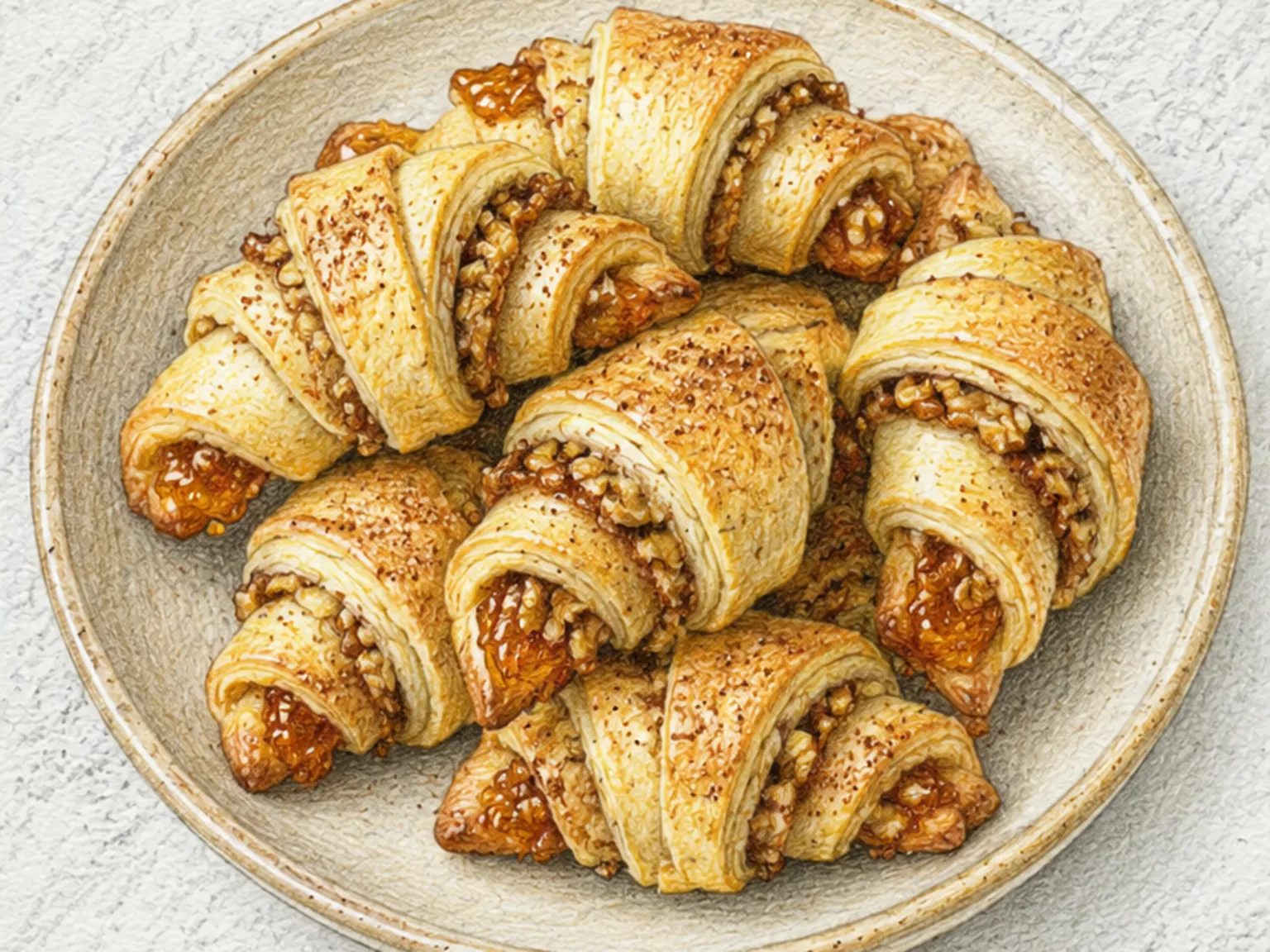
Rugelach are crescent-shaped pastries from the Jewish baking tradition, made with a cream cheese dough that is rolled into a circle, spread with apricot jam, and scattere...
What makes this special
- Cream cheese dough rolled, spread with apricot jam, and curled into crescents defines Rugelach.
- Cream cheese gives the dough a subtle tang and builds flaky layers as it bakes
- Apricot jam, walnut, and cinnamon stack three distinct flavor layers in one small crescent
Key ingredients
Core cooking flow
- 1 Mix the cold cream cheese, 120 g, and butter, 120 g, into 200 g all-purpose flour until a dough forms.
- 2 Take out the cold dough and roll it into an even circle.
- 3 Spread 80 g apricot jam in a very thin, even layer over the surface.
Rugelach are crescent-shaped pastries from the Jewish baking tradition, made with a cream cheese dough that is rolled into a circle, spread with apricot jam, and scattered with chopped walnuts, sugar, and cinnamon before being cut into wedges and rolled from the wide end to the tip. The cream cheese gives the dough a slight tang and an unusually tender crumb, while the butter in the mix creates flaky layers as moisture escapes during baking. Each small pastry delivers a concentrated burst of flavor - the fruit acidity of the jam, the oily richness of walnuts, and the warm spice of cinnamon all arriving together. The dough must be kept cold throughout the shaping process; if it warms and softens, the pastries lose their defined spiral and become difficult to handle. A thin layer of jam is essential - too much causes it to bubble out of the seams and burn on the pan. Once baked and cooled, the exterior is crisp and golden while the interior remains slightly chewy where the filling has caramelized against the dough.
Instructions
Read the steps as a cooking flow: prep, heat, seasoning, doneness control, and finish.
- 1Prep
Mix the cold cream cheese, 120 g, and butter, 120 g, into 200 g all-purpose flour until a dough forms.
Stop before it turns greasy, gather it into one mass, and chill until firm enough to roll.
- 2Step
Take out the cold dough and roll it into an even circle.
If it sticks to your hands or the edges start to sag, return it to the refrigerator and firm it again before continuing.
- 3Control
Spread 80 g apricot jam in a very thin, even layer over the surface.
Avoid piling it up, because thick spots bubble through the seams and burn during baking, so just cover any bare patches.
- 4Season
Finely chop 70 g walnuts, then scatter them with 50 g sugar and 1/2 tsp ground cinnamon.
Press the filling lightly into the jam so it does not slide out while the wedges are rolled.
- 5Prep
Cut the circle into wedges like a pizza, then roll each piece from the wide end toward the tip.
Place them seam side down on the baking pan with space between them so the spirals hold.
- 6Heat
Bake at 180°C for 20-22 minutes, until the outside is golden and the edges look crisp.
Remove from the oven and let the pastries cool so the caramelized jam firms before serving.
After the steps
Pick a recipe that fits this dish.
Continue with shared ingredients, meal pairings, or a similar method.
Recipes That Go Well With This
More Baking →Based on shared ingredients and meal pairing
Gotgam Cream Cheese Roll (Dried Persimmon Rolls)
Gotgam cream cheese roll is a no-cook Korean dessert that requires nothing more than a knife, a bowl, and a refrigerator. Dried persimmons are slit open and flattened into thin sheets, each one acting as the outer wrapper. The filling is cream cheese mixed with honey and fresh lemon juice to balance its natural richness with acidity, and finely chopped walnuts are folded in throughout to add a crunchy, nutty element to every bite. The filling is spread across the opened persimmon, which is then rolled tightly and wrapped in plastic wrap. Twenty minutes in the refrigerator firms the roll enough to slice cleanly. Dipping the knife in warm water and wiping it dry before each cut produces the smoothest cross-sections. The finished slices reveal clearly defined layers: the chewy, caramel-sweet dried persimmon on the outside, the tangy cream cheese in the middle, and flecks of walnut distributed throughout. The combination makes it a natural pairing with wine or a polished addition to a traditional holiday table.
Cream Horn Pastry (Spiral Puff Pastry Cone with Cream Filling)
Cream horns are made by wrapping thin strips of puff pastry around conical metal molds in a tight spiral and baking until the laminated layers separate into a crisp, golden shell. The hundreds of butter-and-dough layers in the pastry open and puff apart in the oven's heat, producing a horn that is structurally firm yet delicate enough to shatter on first bite. Once the horns cool, the metal cone is removed to reveal a hollow pastry ready for filling. A mixture of cream cheese and whipped cream is piped generously inside, delivering smooth, lightly tangy sweetness that plays against the brittle exterior. A final dusting of powdered sugar completes the presentation. The critical rule is timing - filling the horns only just before serving preserves the crispness, as the cream introduces moisture that softens the pastry rapidly.
Black Tea Milk Tea (British Condensed Milk Sweet Tea)
Milk tea is prepared by steeping black tea bags in boiling water for exactly four minutes to extract a strong, tannic base, then combining it with whole milk and condensed milk over low heat. Steeping shorter than four minutes leaves the tea pale and thin; longer than four minutes introduces bitterness and astringency that no amount of milk can fully mask. The milk rounds out the tea's sharpness and adds a creamy body, while condensed milk layers on a dense, caramel-like sweetness that sets this version apart from tea simply sweetened with sugar. Regular sugar dissolved early provides the baseline sweetness, and the condensed milk fine-tunes the richness and texture in the final moments. Warming the milk before combining it with the brewed tea helps both blend more smoothly. For an iced version, the mixture must be cooled completely before pouring over ice, since adding hot liquid directly to ice dilutes the drink and washes out the flavor.
Boston Cream Pie
Boston cream pie is, despite its name, a layered cake rather than a pie. Two rounds of tender sponge sandwich a thick vanilla pastry cream, and the top is cloaked in a glossy dark chocolate glaze. The sponge bakes from cake flour and eggs to a fine, pillowy crumb that compresses gently under a fork without crumbling. The pastry cream -- cooked from milk, cornstarch, and egg yolks -- sets into a thick, silky custard that holds its shape when sliced but melts smoothly on the tongue. The chocolate glaze cools into a thin, shiny shell that cracks cleanly when pressed, mixing with the cream beneath. Each forkful delivers the sequence of bitter chocolate, sweet vanilla custard, and plain sponge in quick succession. Making the custard a day ahead and refrigerating it overnight ensures it holds firmly when the layers are assembled and sliced. Pour the glaze when it has cooled slightly -- warm enough to flow but not so hot that it thins out and drips unevenly.
Serve with this
Omija Bead Ice Cream
This dessert features omija syrup shaped into small frozen spheres using a molecular gastronomy technique. The natural five-flavored profile of omija berries is concentrated into each tiny bead. The recipe uses two types of base mixtures: a clear pink omija juice and an opaque pink liquid made by blending the juice with milk and yogurt powder. These liquids are dropped from a pipette into a cup of cooking oil that has been chilled in the freezer for at least one hour. Upon contact with the cold oil, the droplets solidify into round spheres. The frozen beads are scooped out with a strainer, rinsed in cold water to remove the oil coating, and stored in the freezer. The clear red and milky pink beads are served mixed together, and they can also be added to sparkling water to make a beverage.
Kasespatzle (German Alpine Cheese Dumpling Noodles)
Kasespatzle is an Alpine comfort dish from southern Germany and Austria, made by boiling a thick batter of flour, eggs, and milk into small dumplings, then tossing them with melted Emmental cheese and caramelized onions. The batter must maintain a thick consistency rather than being runny - this is what gives the spaetzle their characteristic chew when boiled and drained. Sliced onion is slowly cooked in butter over low heat until deeply browned, transforming the raw sharpness into a concentrated sweetness. The cooked spaetzle and grated cheese are combined in a hot pan so the cheese melts and coats every dumpling. Topped with the caramelized onions and black pepper, the dish is served immediately while the cheese is still molten and stretchy.
Granola Yogurt Bowl
Granola yogurt bowl is a composed breakfast or snack that starts with a thick base of Greek yogurt and builds upward with sliced banana, kiwi, and blueberries, finished with granola, chia seeds, and a drizzle of honey. Greek yogurt differs from regular yogurt in that most of its liquid whey has been strained away, leaving a denser, higher-protein base that holds its shape in the bowl rather than pooling around the fruit. The tang of the yogurt meets the juicy sweetness of the fruit and creates a balanced flavor that needs no additional sauce or dressing. Granola begins absorbing moisture the moment it contacts the yogurt, so adding it immediately before eating is the only way to keep its crunch intact through the meal. Chia seeds undergo a visible transformation within about five minutes of sitting in moisture, their outer layer swelling into a gel that adds a springy, slightly resistant bite unlike anything else in the bowl. Using unsweetened yogurt puts control of sweetness entirely in the hands of the person eating it, since the honey can be measured to taste, and rotating the fruit with whatever is in season gives a different combination each time without changing the structure of the dish.
Similar recipes
Cinnamon Babka (Jewish Twisted Enriched Bread with Cinnamon Swirl)
Cinnamon babka is a twisted, enriched yeast bread from the Eastern European Jewish baking tradition, built from a dough loaded with butter and eggs that gives it a crumb closer to brioche than ordinary bread. The dough is rolled into a wide rectangle, spread edge to edge with a thick mixture of cinnamon and brown sugar, then rolled tightly into a log. The log is split lengthwise down the center, exposing the spiral filling on both cut surfaces, and the two halves are twisted around each other before being lowered into the loaf pan. This shaping step is what creates the characteristic layered swirl visible in every slice. During baking, the cinnamon sugar melts into sticky, caramelized threads that run through the crumb and saturate the bread with a warm spice aroma. The soft, pull-apart texture of the enriched dough carries the richness of the butter and eggs in every bite, and the contrast between the pale dough and dark cinnamon filling becomes more defined after the loaf cools. Brushing the surface with simple syrup immediately out of the oven seals in moisture and gives the top a glossy, bakery-counter sheen that holds into the next day. The loaf is sweet enough to serve as dessert yet substantial enough to anchor a breakfast table.
Mille-Feuille (Layered Puff Pastry with Vanilla Cream)
Mille-feuille stacks three sheets of puff pastry with layers of vanilla pastry cream between them, creating a dessert defined by the tension between crisp and soft. The pastry itself is built through repeated folding with cold butter, generating hundreds of paper-thin layers that puff apart in the oven into shatteringly flaky sheets. Pastry cream - egg yolks, sugar, milk, and a touch of flour cooked to a thick custard - fills the gaps with a smooth richness that yields immediately to the fork. The top is typically dusted with powdered sugar or glazed with fondant, sometimes decorated with a feathered chocolate pattern. Timing matters: once assembled, moisture from the cream migrates into the pastry, so the window for peak crispness is roughly one to two hours. When eaten fresh, each bite collapses with an audible crunch before the cream takes over.
Korean Cream Cheese Hotdog
Cream cheese hotdog is a Korean street corn dog made by threading sausage and a log of cream cheese together on a stick, coating in wheat batter, rolling in breadcrumbs, and deep-frying at 170 degrees Celsius. The breadcrumb crust fries to a golden, audibly crunchy shell, while the batter layer underneath stays soft and doughy, creating a distinct middle texture between crust and filling. Each bite delivers the salty snap of sausage alongside the smooth, tangy richness of melted cream cheese. Briefly freezing the cream cheese before assembly is the key step - without it, the cheese melts out through the batter before the crust has a chance to set.