Korean Braised Beef Shank

Korean Braised Beef Shank

Quick answer

Satae jjim is a Korean braised beef shank dish that begins with soaking the meat in cold water to draw out blood before any heat is applied.

What makes this special

  • Satae jjim breaks down the dense connective tissue of beef shank into tender pieces over a two-hour, low-heat simmer.
  • Brisket's dense connective tissue breaks along the grain after 2+ hours on low
  • Blood soaking then aromatic braising fully eliminates off-odors in stages
Total time
145 min
Level
Hard
Servings
4 servings
Ingredients
8
Calories
540 kcal
Protein
44 g

Key ingredients

beef shankkorean radishonionsoy saucesugar

Core cooking flow

  1. 1 Soak 900 g beef shank in cold water for 40 minutes.
  2. 2 Put the shank into boiling water and blanch it over high heat for 3 minutes.
  3. 3 Place the shank in a pot with 1200 ml water, 15 g ginger, and 150 g onion.

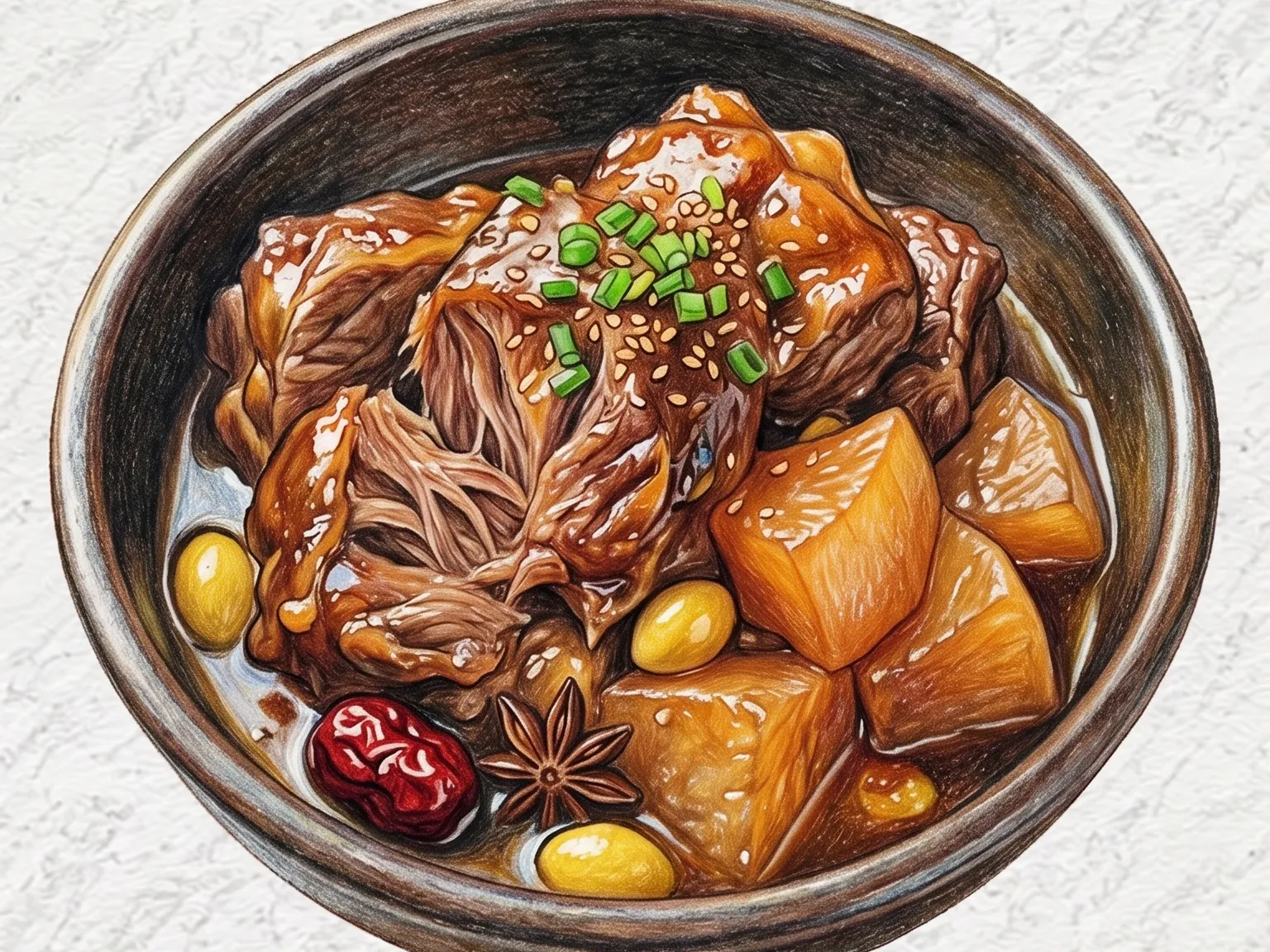
Satae jjim is a Korean braised beef shank dish that begins with soaking the meat in cold water to draw out blood before any heat is applied. The shank is then simmered slowly with aromatics for well over two hours, a duration that is not optional but essential. Shank is dense with connective tissue that turns unpleasantly tough under short, high heat, but extended low heat dissolves that tissue entirely, leaving the beef soft enough to pull apart along its grain with minimal effort. Soy sauce and sugar build a deeply savory-sweet braising liquid that penetrates the meat as it cooks, glazing the exterior with a dark, lacquered sheen. Radish is added in the later stages so it can absorb the concentrated broth without completely losing its texture, contributing a clean, refreshing contrast to the richness of the meat. The finished braise tastes noticeably better after a night in the refrigerator, when the seasoning has fully permeated every fiber and the chilled gelatin, once reheated, naturally thickens the sauce.

Prep 25min Cook 120min 4 servings

Instructions

Read the steps as a cooking flow: prep, heat, seasoning, doneness control, and finish.

6 steps
  1. 1
    Control

    Soak 900 g beef shank in cold water for 40 minutes.

    If the water turns very red halfway through, replace it once to draw out more blood and reduce any heavy meaty odor before cooking.

  2. 2
    Control

    Put the shank into boiling water and blanch it over high heat for 3 minutes.

    Rinse away the foam and residue from the surface so the braising liquid stays cleaner and less cloudy later.

  3. 3
    Control

    Place the shank in a pot with 1200 ml water, 15 g ginger, and 150 g onion.

    Once it boils, lower the heat and simmer gently for 70 minutes, keeping the liquid at small bubbles.

  4. 4
    Control

    Stir in 5 tablespoons soy sauce, 1.5 tablespoons sugar, and 1 tablespoon minced garlic.

    Add 250 g radish in large chunks, then braise over medium heat for 35 minutes so it absorbs the broth without breaking apart.

  5. 5
    Prep

    Spoon the liquid over the meat from time to time so the surface darkens evenly.

    When the radish turns slightly translucent and a chopstick slides in, turn the pieces gently so they do not crumble.

  6. 6
    Control

    When the liquid has reduced and tastes concentrated, lower the heat and cook 10 more minutes.

    Turn off the heat once the beef separates along the grain and looks glossy, then rest briefly before serving.

After the steps

Pick a recipe that fits this dish.

Continue with shared ingredients, meal pairings, or a similar method.

Recipes That Go Well With This

More Steamed →

Based on shared ingredients and meal pairing

Korean Braised Beef Trotter
Shared ingredient: onion Steamed

Korean Braised Beef Trotter

Ujok-jjim is Korean braised beef trotter simmered for over two hours with soy sauce, garlic, ginger, and green onion until the collagen-rich joints turn soft and gelatinous. The long, low braise dissolves the connective tissue into the cooking liquid, making it so concentrated that it sets into a firm jelly when cooled. Sugar and soy sauce create a sweet-savory seasoning that penetrates deep into the layered skin and tendons. Traditionally regarded as a nourishing food for joint health, this is a slow-cooked comfort dish especially popular among older generations in Korea.

Korean Braised Oxtail (Soy Collagen Radish Braise)
Shared ingredient: korean radish Steamed

Korean Braised Oxtail (Soy Collagen Radish Braise)

Kkori-jjim is a Korean braised oxtail dish that begins with an extended soak in cold water to purge blood, followed by a preliminary boil to clean the joints before the main braise. The oxtail pieces go into a pot with soy sauce, sugar, minced garlic, ginger, and rice wine and cook low and slow for two hours or longer. The collagen concentrated in the tail joints breaks down gradually over that time, turning the braising liquid thick, glossy, and deeply gelatinous while the meat loosens away from bone without resistance. Korean radish and carrot cook alongside the meat, contributing natural sweetness and becoming saturated with the savory-sweet sauce. Jujubes and ginkgo nuts lend an herbal nuance and a subtle sweetness that distinguishes this dish from simpler braises. When chilled, the sauce sets into a firm jelly that liquefies again on reheating. The dish appears regularly on Korean holiday tables and is considered restorative food, valued for its concentrated beef flavor and the characteristic springy pull of slow-cooked collagen.

Korean Beef Trotter Soup (Silky Collagen-Rich Slow-Cooked Broth)
Serve together Soups

Korean Beef Trotter Soup (Silky Collagen-Rich Slow-Cooked Broth)

Ujok-tang is a slow-cooked Korean soup made from beef trotters, prized for the extraordinary amount of collagen packed into the bones, tendons, and skin of the cut. The trotters are first soaked for hours in cold water to purge blood and any off-flavors, then placed in a deep pot and simmered at a gentle roll for four to six hours. During that time, the collagen gradually dissolves into the cooking liquid, transforming it from plain water into a milky, opaque broth with a viscous body that coats the spoon and sets firm when chilled. Regular skimming of fat and foam throughout the process ensures the final broth tastes clean rather than greasy. The trotter meat itself falls into two distinct textures: the skin and tendons turn gelatinous and springy, offering a bouncy chew, while the small pockets of muscle between the bones are meltingly soft. Traditional seasoning is limited to coarse salt and freshly ground pepper, allowing the broth's natural richness to speak. A dab of hot mustard or a spoonful of salted shrimp paste on the side provides a sharp contrast that keeps each mouthful interesting. Ujok-tang has long been regarded as a restorative food, particularly valued for its supposed benefits to joints and skin.

Korean Braised Beef and Burdock Steam
Similar recipe Steamed

Korean Braised Beef and Burdock Steam

Ueong sogogi jjim is a Korean braised-and-steamed dish of beef shank and burdock root cooked together in a soy sauce, garlic, and sugar base with just enough liquid to surround the ingredients without submerging them. The shank is first simmered in plain water and skimmed of foam, which produces a clean, clear broth free of the off-flavors that surface during the initial boil. Soy seasoning is added to that broth, the beef cooks for another twenty minutes, and then burdock slices go in with the lid on for fifteen minutes of gentle steaming, during which the root vegetable draws in the beef-enriched liquid through its fibrous structure. Cutting the burdock at a bias to a thickness of roughly 0.5 centimeters keeps its characteristic snap while ensuring the interior cooks through within the target time. The dish is finished when the braising liquid reduces to about half its volume, at which point sesame oil and whole sesame seeds are added to round out the flavor with a nutty finish. The final dish balances the deep, heavy richness of slow-cooked beef shank against the clean, aromatic earthiness that burdock root brings to the plate.

Serve with this

Crispy Mushroom Tangsu (Sweet & Sour)
Side dishes Medium

Crispy Mushroom Tangsu (Sweet & Sour)

Double-fried oyster mushrooms with the same two-stage frying technique used for Korean tangsu pork. Oyster mushrooms fully dried of moisture are coated in a potato starch and flour batter, fried at 170°C, rested to release steam, then returned to 180°C for a second fry that locks in a crisp exterior while keeping the interior chewy. A sweet-sour sauce of soy sauce, vinegar, and sugar is simmered with onion, bell pepper, and carrot, then thickened with a starch slurry. Pouring the sauce over the mushrooms in advance softens the crust quickly, so serving the sauce separately and ladling it on at the table preserves the crunch. The technique produces a texture comparable to the pork version without any meat.

🏠 Everyday 🎉 Special Occasion
Prep 20min Cook 18min 4 servings
Korean Salmon Pot Rice (Salmon Fillet Steamed Directly on Rice)
Rice Medium

Korean Salmon Pot Rice (Salmon Fillet Steamed Directly on Rice)

A whole salmon fillet is placed directly on top of rice in a heavy pot before cooking begins. As the rice steams, the salmon's oils melt downward and seep between the grains, lending a natural richness and sheen without any added fat. During the resting stage the fish finishes cooking gently, turning tender enough to flake apart with chopsticks and mix evenly through the rice. A soy-wasabi sauce drizzled over the bowl and stirred in adds a sharp, salty kick that carries through to the last spoonful.

🎉 Special Occasion 🏠 Everyday
Prep 10min Cook 25min 2 servings
Traditional Kimjang Cabbage Kimchi
Kimchi Hard

Traditional Kimjang Cabbage Kimchi

The golden recipe for traditional winter kimjang cabbage kimchi.

🔥 Trending Now 🥗 Light & Healthy
Prep 60min Cook 60min 4 servings

Similar recipes

Korean Braised Pork Backbone
Steamed Hard

Korean Braised Pork Backbone

Deungppyeo-jjim is pork backbone braised with potato and green onion in a sauce built from doenjang, gochugaru, and soy sauce. After a long, slow simmer the meat tucked between the vertebrae and the cartilage separates from the bone without effort. Doenjang lays a deep, fermented underpinning to the broth while gochugaru brings a sharp, clean heat on top. The potatoes cook until they soften enough to fall apart at the press of a spoon, absorbing the thick, dark cooking liquid around them. Digging out the meat lodged between the bones is part of the pleasure, which is why the dish has long been a favourite pairing with soju. The rich, dense broth also makes it an easy choice for eating over a bowl of steamed rice.

🏠 Everyday 🎉 Special Occasion
Prep 30min Cook 80min 4 servings
Korean Soy Braised Chicken Chunks
Stir-fry Easy

Korean Soy Braised Chicken Chunks

Dakganjang-jjim is a Korean soy-braised chicken dish where bone-in thigh pieces are combined with potatoes, carrots, and onion in a seasoned soy sauce base and simmered over low heat until the liquid reduces and the flavors concentrate. As the braising liquid cooks down, the salinity and umami of the soy sauce penetrate through the chicken skin and into the meat, seasoning it throughout rather than just coating the surface. The thigh cut is intentional - the fat and collagen in bone-in thighs keep the meat moist through the extended cooking time, preventing it from drying out the way leaner cuts would. The vegetables absorb the rendered chicken fat and soy-based cooking liquid as they soften, taking on a deep savory-sweet flavor that requires no additional seasoning. Because the dish contains no chili paste or gochugaru, it is mild in heat and broadly accessible, working equally well as a weeknight dinner main, a side dish over rice, or packed into a lunch box where the flavors continue to develop. The ratio of soy sauce to sugar in the braising liquid can be adjusted to suit individual taste - leaning toward saltier or sweeter without fundamentally changing the character of the dish.

🏠 Everyday 🧒 Kid-Friendly
Prep 15min Cook 30min 4 servings
Korean Soy-Braised Rockfish
Stir-fry Medium

Korean Soy-Braised Rockfish

Ureok-jorim is a Korean soy-braised rockfish simmered with Korean radish, gochugaru, garlic, and rice wine. The radish goes in first and softens in the braising liquid before the cleaned whole fish is placed on top and basted with sauce over medium heat for ten minutes. Rice wine neutralizes any fishiness, while the radish absorbs the salty braising liquid and releases its own sweetness to balance the seasoning naturally. The rockfish flesh stays mild and flakes in soft layers, with gochugaru lending a gentle warmth to the overall dish.

🏠 Everyday 🍱 Lunchbox
Prep 20min Cook 25min 2 servings

Tips

Flavor deepens if chilled overnight and reheated.
Cut radish into large chunks so it holds shape.

Nutrition (per serving)

Calories
540
kcal
Protein
44
g
Carbs
16
g
Fat
33
g