Semla (Swedish Cardamom Bun with Almond Cream)
Quick answer
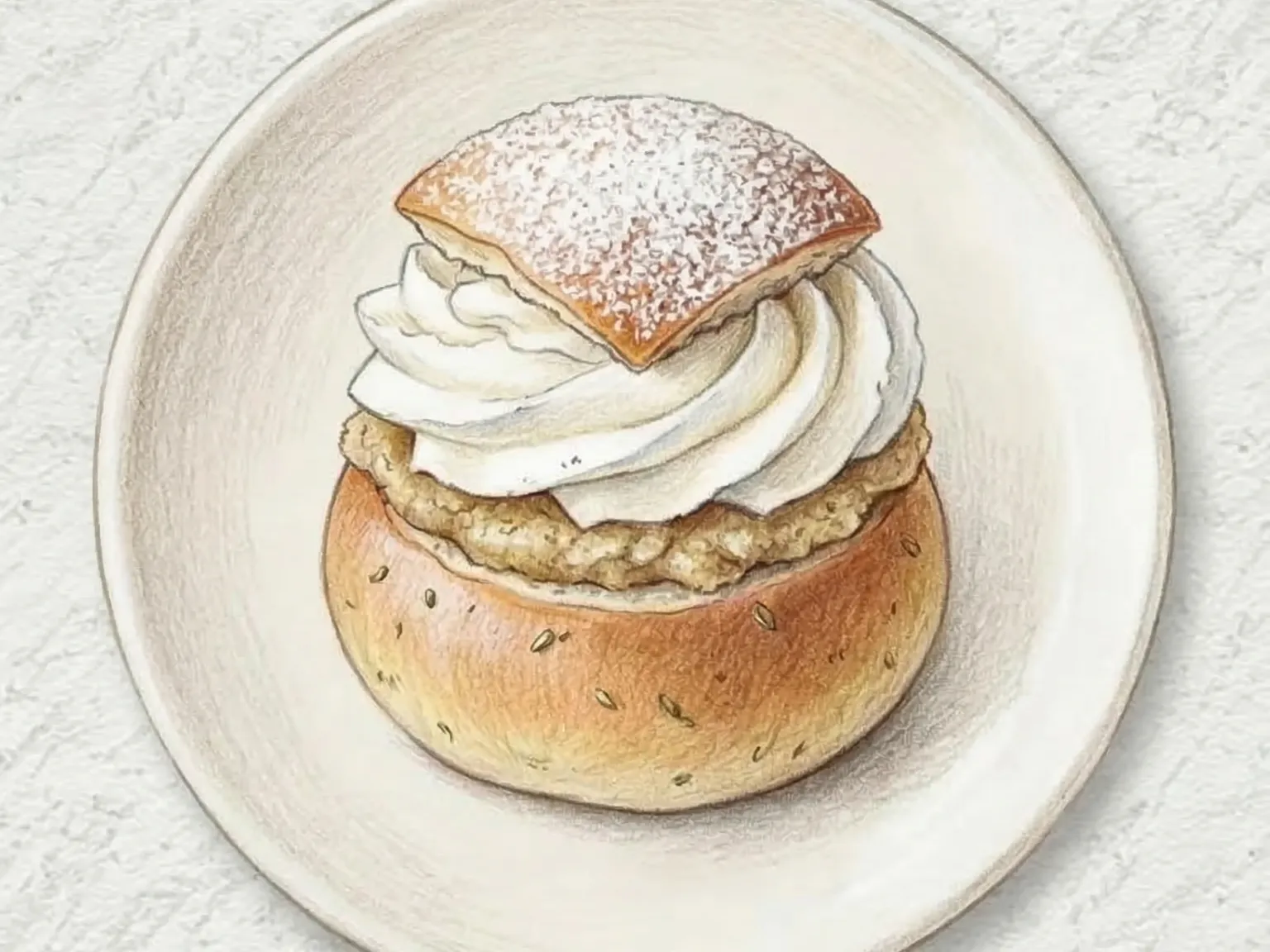
Semla is a Swedish cardamom-scented bun that is baked, cooled, and then hollowed out to make room for a filling of almond paste mixed with the scooped crumb, topped with...
What makes this special
- Semla consists of a Swedish cardamom-scented bun filled with almond paste and whipped cream.
- Cardamom-scented dough paired with dense almond paste filling
- Scooped-out crumbs mixed back into the almond paste filling
Key ingredients
Core cooking flow
- 1 Combine 300 g bread flour, 5 g instant yeast, 45 g sugar, and 1 tsp ground cardamom.
- 2 Add 50 g butter in small pieces once the dough has formed, then knead for 8-10 minutes.
- 3 Let the dough rise in a warm place until it is about doubled.
Semla is a Swedish cardamom-scented bun that is baked, cooled, and then hollowed out to make room for a filling of almond paste mixed with the scooped crumb, topped with a generous mound of whipped cream. The bun itself is soft and fragrant, with cardamom lending an exotic warmth that distinguishes it from ordinary sweet rolls. The almond filling is dense and intensely nutty, providing a rich base layer that the light, billowy cream offsets with its cool freshness. The removed cap of the bun is placed back on top like a lid, and a final dusting of powdered sugar completes the presentation. Timing is important: the bun must cool completely before any cream goes in, or the heat will melt it into a flat puddle. If the cardamom flavor feels too subtle after baking, increasing the spice by half a teaspoon in the dough brings it to the forefront. In Sweden, semla appears in bakeries from January through Easter, and the best versions balance the three components - bread, nut paste, and cream - so that no single element dominates.
Instructions
Read the steps as a cooking flow: prep, heat, seasoning, doneness control, and finish.
- 1Season
Combine 300 g bread flour, 5 g instant yeast, 45 g sugar, and 1 tsp ground cardamom.
Add 160 ml milk and mix until no dry flour remains and the dough gathers into one rough mass.
- 2Step
Add 50 g butter in small pieces once the dough has formed, then knead for 8-10 minutes.
Stop when the surface looks smoother, the dough stretches slightly, and it sticks less to your hands.
- 3Step
Let the dough rise in a warm place until it is about doubled.
If a gentle press springs back slowly, divide it into 4 equal pieces and shape each piece into a tight, smooth ball.
- 4Heat
Let the shaped buns rise again until puffy, then bake at 180C for 15-18 minutes.
Remove them when the tops are evenly golden brown, and cool completely before cutting or adding cream.
- 5Prep
Cut a lid from the top of each cooled bun and scoop out some crumb without breaking the sides.
Mix the crumb with 140 g almond paste, then spoon it back in so the filling is moist and compact.
- 6Finish
Whip 180 ml cold heavy cream until it holds its shape, then pipe or spoon it generously over the almond filling.
Replace the lids, dust lightly with powdered sugar if available, and serve while the cream is cold.
After the steps
Pick a recipe that fits this dish.
Continue with shared ingredients, meal pairings, or a similar method.
Recipes That Go Well With This
More Baking →Based on shared ingredients and meal pairing
Mille-Feuille (Layered Puff Pastry with Vanilla Cream)
Mille-feuille stacks three sheets of puff pastry with layers of vanilla pastry cream between them, creating a dessert defined by the tension between crisp and soft. The pastry itself is built through repeated folding with cold butter, generating hundreds of paper-thin layers that puff apart in the oven into shatteringly flaky sheets. Pastry cream - egg yolks, sugar, milk, and a touch of flour cooked to a thick custard - fills the gaps with a smooth richness that yields immediately to the fork. The top is typically dusted with powdered sugar or glazed with fondant, sometimes decorated with a feathered chocolate pattern. Timing matters: once assembled, moisture from the cream migrates into the pastry, so the window for peak crispness is roughly one to two hours. When eaten fresh, each bite collapses with an audible crunch before the cream takes over.
Swedish Meatballs
Swedish meatballs mix ground beef with sautéed onion, breadcrumbs, egg, and milk, shape the mixture into bite-size balls, brown them in butter, then simmer in a creamy gravy built in the same pan. The key to tender meatballs is minimal handling - overworking the mixture tightens the protein network and produces a tough, dense texture. Browning the meatballs leaves behind caramelized drippings on the pan floor, and these fond bits become the flavor base of the gravy when flour is whisked in to form a roux. Adding milk gradually while stirring prevents lumps, and a splash of Worcestershire sauce introduces a savory depth that rounds out the cream. The gravy's thickness is adjustable at the end - more milk loosens it, less keeps it rich - and serving over mashed potatoes lets nothing go to waste.
Mugwort Crumble Rice Cake
Ssuk beomuri is a traditional Korean spring rice cake made by tossing chopped fresh mugwort into a dry blend of rice flour, glutinous rice flour, and sugar, then steaming the loose mixture in a cloth-lined steamer. Water is worked in gradually by hand rather than poured all at once, a step that produces a texture that crumbles apart lightly while remaining moist inside rather than turning dense or gummy. Glutinous rice flour accounts for about a quarter of the blend and provides enough stickiness to hold the pieces together without making them chewy throughout. Using raw mugwort without blanching preserves the volatile aromatic compounds that would otherwise be lost in hot water, resulting in a deep, grassy fragrance that defines the cake. Steaming at full heat for fifteen minutes followed by a three-minute resting period with the lid on ensures the center cooks through evenly without the surface drying out. A generous topping of sweetened red bean crumble adds a thick, earthy sweetness that complements the clean herbal notes of mugwort. Young spring mugwort harvested between late March and April carries the most concentrated aroma, making that window the ideal season for this cake.
Cream Horn Pastry (Spiral Puff Pastry Cone with Cream Filling)
Cream horns are made by wrapping thin strips of puff pastry around conical metal molds in a tight spiral and baking until the laminated layers separate into a crisp, golden shell. The hundreds of butter-and-dough layers in the pastry open and puff apart in the oven's heat, producing a horn that is structurally firm yet delicate enough to shatter on first bite. Once the horns cool, the metal cone is removed to reveal a hollow pastry ready for filling. A mixture of cream cheese and whipped cream is piped generously inside, delivering smooth, lightly tangy sweetness that plays against the brittle exterior. A final dusting of powdered sugar completes the presentation. The critical rule is timing - filling the horns only just before serving preserves the crispness, as the cream introduces moisture that softens the pastry rapidly.
Serve with this
Korean Fish Cake Soup (Clear Anchovy Radish Broth)
Eomuk-tang is a Korean fish cake soup in which skewered fish cakes and thick radish slices simmer in a clear broth built from dried anchovies and kelp. The kelp must be removed the moment the water begins to boil, otherwise it releases a slimy texture that clouds the broth. Cutting the radish thick allows it to slowly release natural sweetness over the long simmer. Rinsing the fish cakes in hot water before adding them washes away surface oil and keeps the broth clear and clean. Soup soy sauce adjusts the seasoning, and green onion and black pepper finish the pot. Adding the radish before the fish cakes ensures it has enough time to fully soften and sweeten the broth, since it takes longer than the eomuk to cook through.
Fruit Salad (Fresh Seasonal Fruit in Yogurt)
Fruit salad dices apple, banana, kiwi, strawberries, and blueberries into uniform bite-sized pieces and folds them gently into a light dressing of plain yogurt, honey, and lemon juice. Cutting everything to a similar size ensures an even mix of crisp, soft, and juicy textures in every spoonful. The lemon juice serves two purposes - it adds a bright acidity that ties the different fruits together and slows the oxidation that turns apple flesh brown. Banana should be added last to prevent it from turning mushy under the weight of the other ingredients. Using unsweetened yogurt lets the natural sweetness of the fruit stand out more clearly, and chilling the finished salad for about ten minutes allows the fruit juices to merge with the dressing for a more cohesive flavor.
Similar recipes
Linzer Torte (Almond Lattice Tart with Raspberry Jam)
An Austrian tart made with a nut-enriched dough, a generous layer of raspberry jam, and a lattice top that reveals the jewel-red filling beneath. Combining almond flour with wheat flour gives the pastry a short, sandy texture that crumbles gently and melts into the smooth jam on the palate. The butter-heavy dough must be thoroughly chilled before being rolled and cut into strips; warm dough tears and loses definition. Raspberry jam provides a sharp, fruity acidity that stands out against the mellow, nutty backdrop of the crust, while a touch of lemon zest lifts the overall aroma with a bright finish. Baking at 180 degrees Celsius for 30 to 35 minutes brings the jam to a gentle boil, intensifying its color and flavor, while the lattice strips turn golden and slightly crisped at the edges. Resting the tart overnight allows the jam's moisture to soften the boundary between filling and crust, creating a more cohesive slice where pastry and fruit feel unified rather than separate.
Rugelach (Jewish Cream Cheese Crescent Pastry)
Rugelach are crescent-shaped pastries from the Jewish baking tradition, made with a cream cheese dough that is rolled into a circle, spread with apricot jam, and scattered with chopped walnuts, sugar, and cinnamon before being cut into wedges and rolled from the wide end to the tip. The cream cheese gives the dough a slight tang and an unusually tender crumb, while the butter in the mix creates flaky layers as moisture escapes during baking. Each small pastry delivers a concentrated burst of flavor - the fruit acidity of the jam, the oily richness of walnuts, and the warm spice of cinnamon all arriving together. The dough must be kept cold throughout the shaping process; if it warms and softens, the pastries lose their defined spiral and become difficult to handle. A thin layer of jam is essential - too much causes it to bubble out of the seams and burn on the pan. Once baked and cooled, the exterior is crisp and golden while the interior remains slightly chewy where the filling has caramelized against the dough.
Crispy Fan-Cut Potatoes (Garlic Butter Accordion Bake)
Hasselback potatoes are a Swedish dish where potatoes are sliced thinly at close intervals - leaving the bottom intact - then brushed with garlic butter and roasted until the edges fan out and crisp. Melted butter mixed with minced garlic, fresh thyme, and olive oil is brushed over and between the slices before the potatoes go into a 200-degree oven for forty minutes. Midway through baking, the potatoes are removed so the slices can be gently fanned open and given a second coat of butter. Breadcrumbs and Parmesan cheese scattered on top for the final fifteen minutes create a crunchy golden crust that contrasts with the fluffy interior. Placing chopsticks on either side of the potato while slicing acts as a guide to prevent cutting all the way through.