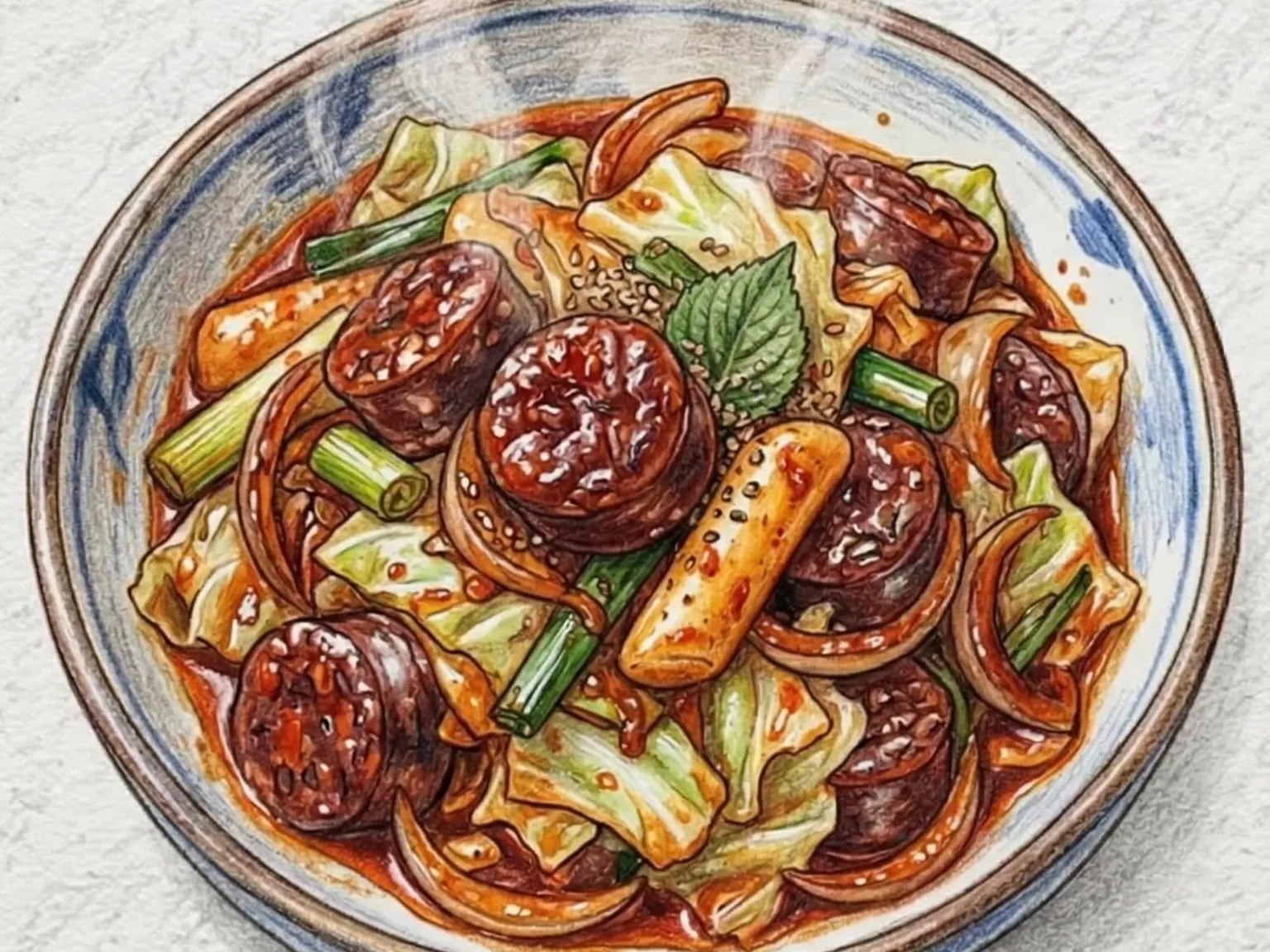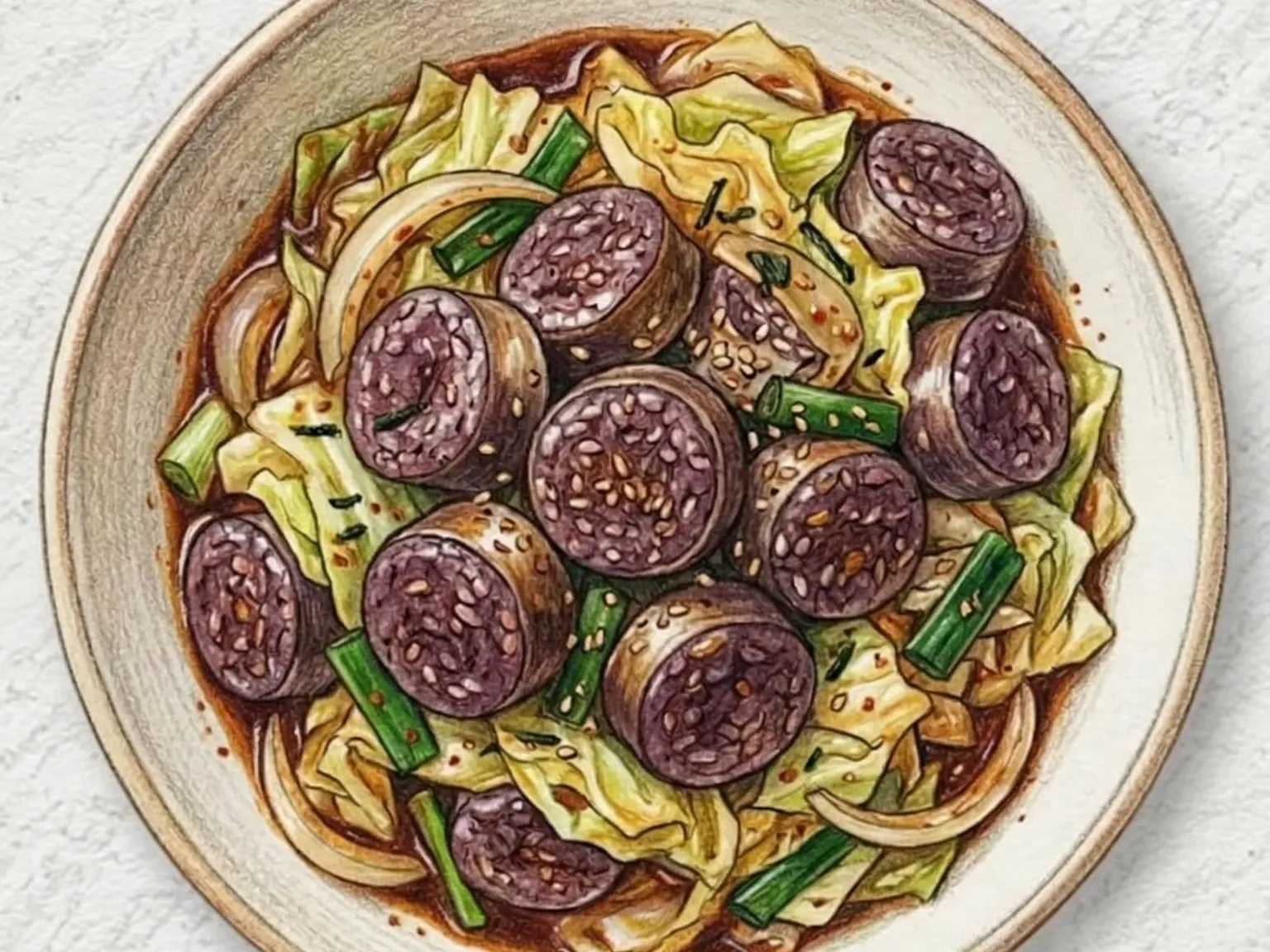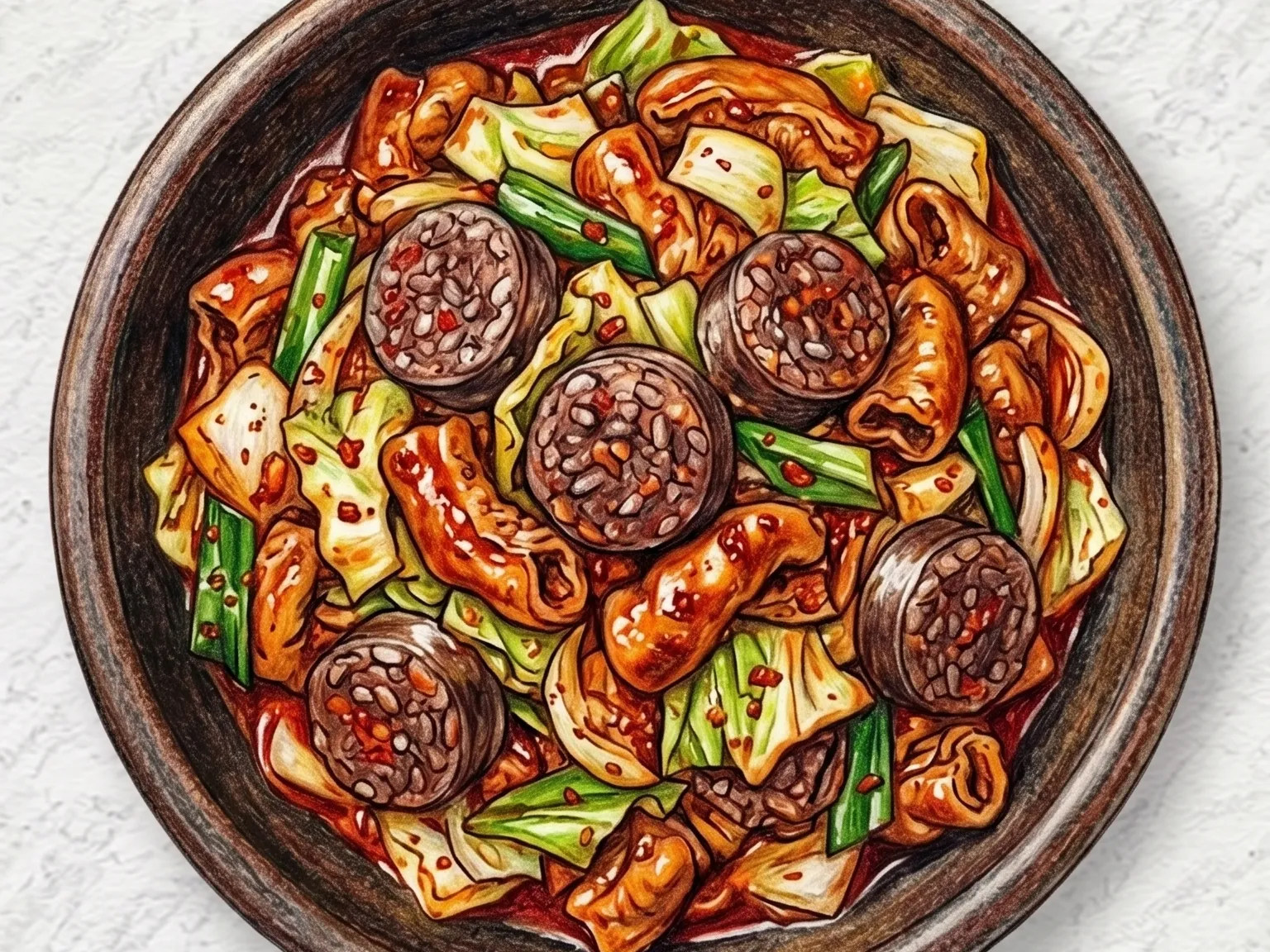
Korean Stir-fried Sundae and Tripe
Stir-fry Medium

Korean Stir-fried Sundae and Tripe

Quick answer

Sundae-gopchang-bokkeum is a bunsik-style stir-fry combining blanched beef tripe and Korean blood sausage (sundae) with cabbage, onion, and scallion in a gochujang-gochugaru sauce.

What makes this special

  • Sundae-gopchang-bokkeum combines seared beef tripe and blood sausage in a spicy gochugaru and cabbage stir-fry.
  • Tripe seared first for char before the gochujang sauce is added
  • Sundae added last to prevent bursting and preserve chewy texture
Total time
38 min
Level
Medium
Servings
3 servings
Ingredients
8
Calories
510 kcal
Protein
24 g

Key ingredients

Korean blood sausagebeef tripecabbageoniongreen onion

Core cooking flow

  1. 1 Pat the 300 g blanched beef tripe dry, then cut it into bite-size pieces.
  2. 2 Slice the 300 g sundae fairly thick, then prepare the cabbage, onion, and green onion.
  3. 3 Heat a wide pan over medium heat, add 1 tablespoon cooking oil, and stir-fry...

Sundae-gopchang-bokkeum is a bunsik-style stir-fry combining blanched beef tripe and Korean blood sausage (sundae) with cabbage, onion, and scallion in a gochujang-gochugaru sauce. The tripe is seared first for a lightly charred exterior, then the spicy sauce is built in the pan before vegetables are added. Sundae goes in last and cooks briefly to prevent the casing from splitting. Each component brings a distinct texture - springy tripe, dense chewy sundae, and sweet crunchy cabbage - unified by the bold, spicy coating.

Prep 20min Cook 18min 3 servings

Instructions

Read the steps as a cooking flow: prep, heat, seasoning, doneness control, and finish.

6 steps
  1. 1
    Season

    Pat the 300 g blanched beef tripe dry, then cut it into bite-size pieces.

    Removing surface moisture helps it sear instead of steam and keeps the spicy sauce from turning watery in the pan.

  2. 2
    Season

    Slice the 300 g sundae fairly thick, then prepare the cabbage, onion, and green onion.

    Avoid very thin sundae slices, because they split easily when tossed with hot vegetables and sauce.

  3. 3
    Control

    Heat a wide pan over medium heat, add 1 tablespoon cooking oil, and stir-fry the tripe for about 3 minutes.

    Toss often until the outside looks lightly browned and smells savory, not raw.

  4. 4
    Season

    Lower the heat, then add 1.5 tablespoons each gochujang and gochugaru.

    Stir for about 30 seconds so the seasoning coats the tripe evenly, scraping the pan if the paste starts to stick.

  5. 5
    Control

    Add the 180 g cabbage and 100 g onion, then return to medium heat and stir-fry for about 3 minutes.

    Stop when the vegetables have softened slightly but the cabbage still keeps some crunch.

  6. 6
    Finish

    Add the sundae and 50 g green onion at the end, then toss gently for only about 2 minutes.

    Turn off the heat before the sundae casing opens, and serve while the sauce is glossy.

After the steps

Pick a recipe that fits this dish.

Continue with shared ingredients, meal pairings, or a similar method.

Recipes That Go Well With This

More Stir-fry →

Based on shared ingredients and meal pairing

Korean Stir-fried Sundae with Vegetables
Shared ingredient: sundae (korean blood sausage) Stir-fry

Korean Stir-fried Sundae with Vegetables

Sundae yachae bokkeum stir-fries Korean blood sausage with cabbage, onion, and scallion in a sauce of gochujang, soy sauce, and gochugaru. The vegetables go into the pan first to drive off excess water so the sauce clings better, while the sundae is added later to keep its casing intact and its filling dense and chewy. The combined seasoning creates a spicy-salty glaze that coats the sundae slices evenly. Compared to sundae-gopchang-bokkeum, this version skips the tripe and leans heavier on vegetables, making it a lighter take on the same street food flavor.

Korean Stir-fried Sundae (Sundae Bokkeum)
Shared ingredient: sundae (korean blood sausage) Street food

Korean Stir-fried Sundae (Sundae Bokkeum)

Sundae-bokkeum is a spicy Korean stir-fry of blood sausage with cabbage, onion, and green onion in a sauce made from gochujang, gochugaru, soy sauce, sugar, and garlic. High heat and a short cooking time are essential because prolonged stir-frying causes the sundae casing to burst and the filling to toughen, while the cabbage and onion release just enough moisture as they wilt to help the sauce coat every piece evenly. The seasoning stacks direct heat from gochujang, a gentler radiant warmth from gochugaru flakes, and sweetness from sugar into a multidimensional spicy-sweet profile. Green onion is held until the very last moment so its fragrance survives the heat; added earlier, the aroma disappears before the dish reaches the table. Adding tteokbokki rice cakes transforms the dish into the popular combo known as tteoksuni, and a layer of melted cheese on top rounds out the spice.

Korean Stir-fried Balloon Flower Root
Serve together Side dishes

Korean Stir-fried Balloon Flower Root

Doraji -- balloon flower root -- has been cultivated in Korea for centuries, valued in cooking and herbal medicine alike. The raw root carries a pronounced bitterness from saponins, so it must be shredded into thin strips, rubbed vigorously with salt, left for ten minutes, then rinsed twice in cold water. The salt scrub draws out the saponins while preserving the root's firm, snappy bite. A base of green onion goes into the pan first to build a fragrant oil, then the prepared doraji stir-fries for two minutes before gochujang, soy sauce, and oligosaccharide syrup go in for another three minutes. The heat is raised at the end to drive off moisture, so the sauce tightens and clings to each strip rather than pooling in the pan. The result is a glossy, sweet-spicy banchan with a distinctly chewy pull.

Korean Spicy Tteok and Sundae Stir-Fry
Similar recipe Stir-fry

Korean Spicy Tteok and Sundae Stir-Fry

Tteokbokki-sundae-bokkeum combines chewy rice cakes and Korean blood sausage in a spicy-sweet gochujang, soy sauce, and sugar sauce. The rice cakes are soaked first and then simmered in the sauce so the seasoning penetrates their dense, glutinous interior. Sundae is added near the end and stirred briefly to prevent the casing from bursting. Each bite alternates between the elastic pull of the rice cakes coated in red sauce and the heavier, starchy chew of the sundae filling - a recreation of the classic Korean street food pairing of tteokbokki and sundae in a single pan.

Serve with this

Korean Grilled Mackerel Rice Bowl
Rice Medium

Korean Grilled Mackerel Rice Bowl

Mackerel fillet is pan-seared skin-side down until the skin turns crisp and golden, then served over rice with a quick sauce of soy sauce, cooking wine, oligosaccharide syrup, minced ginger, and softened onion. The oily flesh of the mackerel absorbs the soy-ginger glaze, producing a clean, salty-sweet finish without fishiness. Keeping the pan still for the first minute of searing is the key technique for achieving skin that crisps evenly rather than steaming in its own moisture. Brushing the fillet with a little cooking wine before cooking further neutralizes any residual odor. Chopped chives scattered on top complete the bowl with color and a mild onion bite. Cooking the sauce in the same pan using the rendered mackerel fat deepens the umami and ties the two components together.

🏠 Everyday 🍺 Bar Snacks
Prep 15min Cook 20min 2 servings
Korean Seafood Hot Pot Soup
Soups Medium

Korean Seafood Hot Pot Soup

Haemul-tang is a Korean seafood hot pot that throws together crab, shrimp, clams, and squid in a fiery, brick-red broth. The liquid starts with gochugaru and plenty of garlic, building a spicy base that the seafood then amplifies with its own briny juices. Radish chunks soften as the pot bubbles, thickening the broth slightly and adding a cool sweetness behind the heat. Green onions and cheongyang peppers go in toward the end for a sharp, vegetal bite. The magic of haemul-tang lies in the convergence of flavors: crab shells release a sweet, crustacean stock; clams open to spill their liquor; shrimp and squid contribute distinct textures from snappy to chewy. The pot is brought to the table still at a rolling boil, and diners pick through the shells and tentacles while the broth continues to concentrate.

🏠 Everyday 🎉 Special Occasion
Prep 25min Cook 30min 4 servings
Korean Ham-Packed Budae Jjigae
Stews Easy

Korean Ham-Packed Budae Jjigae

This version of budae jjigae is built around a generous load of Spam and Vienna sausages, simmered alongside well-fermented kimchi in a wide pot of anchovy or dashi stock. Gochujang and Korean chili flakes build layered heat while the kimchi's sourness cuts through the salt of the processed meats and keeps the overall flavor from becoming one-dimensional. Adding a bundle of ramen noodles toward the end allows them to absorb the deeply seasoned broth as they cook. With 900ml of stock, this is a communal pot meant to be shared at the table. Budae jjigae originated in the years after the Korean War, when surplus American military rations such as ham and sausage were combined with Korean staples near military base towns. The ham-forward version puts the salty, meaty character of the processed ingredients at the center of the dish.

🍺 Bar Snacks 🏠 Everyday
Prep 15min Cook 20min 2 servings

Similar recipes

Korean Spicy Beef Intestine Stir-fry
Stir-fry Hard

Korean Spicy Beef Intestine Stir-fry

Gopchang-bokkeum is a Korean stir-fry of cleaned beef intestines tossed over high heat with onion, cabbage, scallion, gochujang, and gochugaru. The intestines develop a springy chew while releasing their natural fat, which melds with the spicy seasoning to create an intensely savory sauce. Vegetables stay crisp and soak up the bold flavors as the dish cooks quickly. It is one of the most popular late-night dishes in Korea, often served sizzling on a hot plate alongside rice and soju. Adding seasoning in stages makes it easier to adjust saltiness, sweetness, and heat without covering the base ingredients.

🍺 Bar Snacks 🏠 Everyday
Prep 25min Cook 15min 2 servings
Korean Stir-fried Chicken Gizzards
Stir-fry Medium

Korean Stir-fried Chicken Gizzards

Dak-ttongjip-bokkeum is a stir-fried dish made from chicken gizzards cooked over high heat with garlic and cheongyang chili pepper. The gizzard, known as the near-wi in Korean, is the thick muscular organ a chicken uses to grind its food. It contains very little fat, is high in protein, and stays firm through cooking in a way that ordinary chicken meat does not. Proper cleaning before cooking is essential. The yellow inner lining and any adjacent odorous tissue must be removed entirely, or the finished dish will carry an off smell that no amount of seasoning can cover. Once cleaned and scored lightly on the surface to help seasoning penetrate, the gizzards go into a very hot pan. The goal is a fast, high-heat cook that sears the outside while leaving the interior tender and springy. Extended cooking over lower heat makes them chewy and tough. The texture is the defining quality of this dish - dense, elastic, and slightly resistant to the bite, with a mild savory nuttiness that deepens the longer you chew. Cheongyang chili cuts through any residual heaviness and adds a clean, quick heat. Garlic provides a deep aromatic foundation that complements the protein. Soy sauce and mirim season the stir-fry with a balance of salt and restrained sweetness. The dish is ordered frequently alongside beer or soju, where its chewy texture and moderate heat make it a satisfying accompaniment to cold drinks. It also works well as a rice side dish.

🍺 Bar Snacks 🏠 Everyday
Prep 20min Cook 12min 2 servings
Korean Blood Sausage Skewers
Street food Easy

Korean Blood Sausage Skewers

Soondae-kkochi are Korean blood sausage skewers threaded alternately with onion and green onion pieces, pan-grilled and glazed with a sauce made from gochujang, ketchup, oligosaccharide syrup, and soy sauce. Applying the glaze in two separate rounds rather than all at once is critical: the first coat caramelizes and sets, then a second layer is brushed on over low heat to build a glossy, deeply lacquered finish without burning. The sundae must be cooked slowly over low heat, rolling it gently so the casing does not split while the interior stays chewy throughout. Onion and scallion segments release their moisture on the grill, concentrating into a natural sweetness that balances the bold, iron-rich flavor of the sausage and provides a textural shift between bites. A scatter of toasted sesame seeds over the finished skewers adds a final layer of nutty fragrance.

🧒 Kid-Friendly ⚡ Quick
Prep 15min Cook 12min 2 servings

Tips

Add sundae near the end so it does not split.
Pre-cooked tripe shortens total cooking time.

Nutrition (per serving)

Calories
510
kcal
Protein
24
g
Carbs
18
g
Fat
38
g