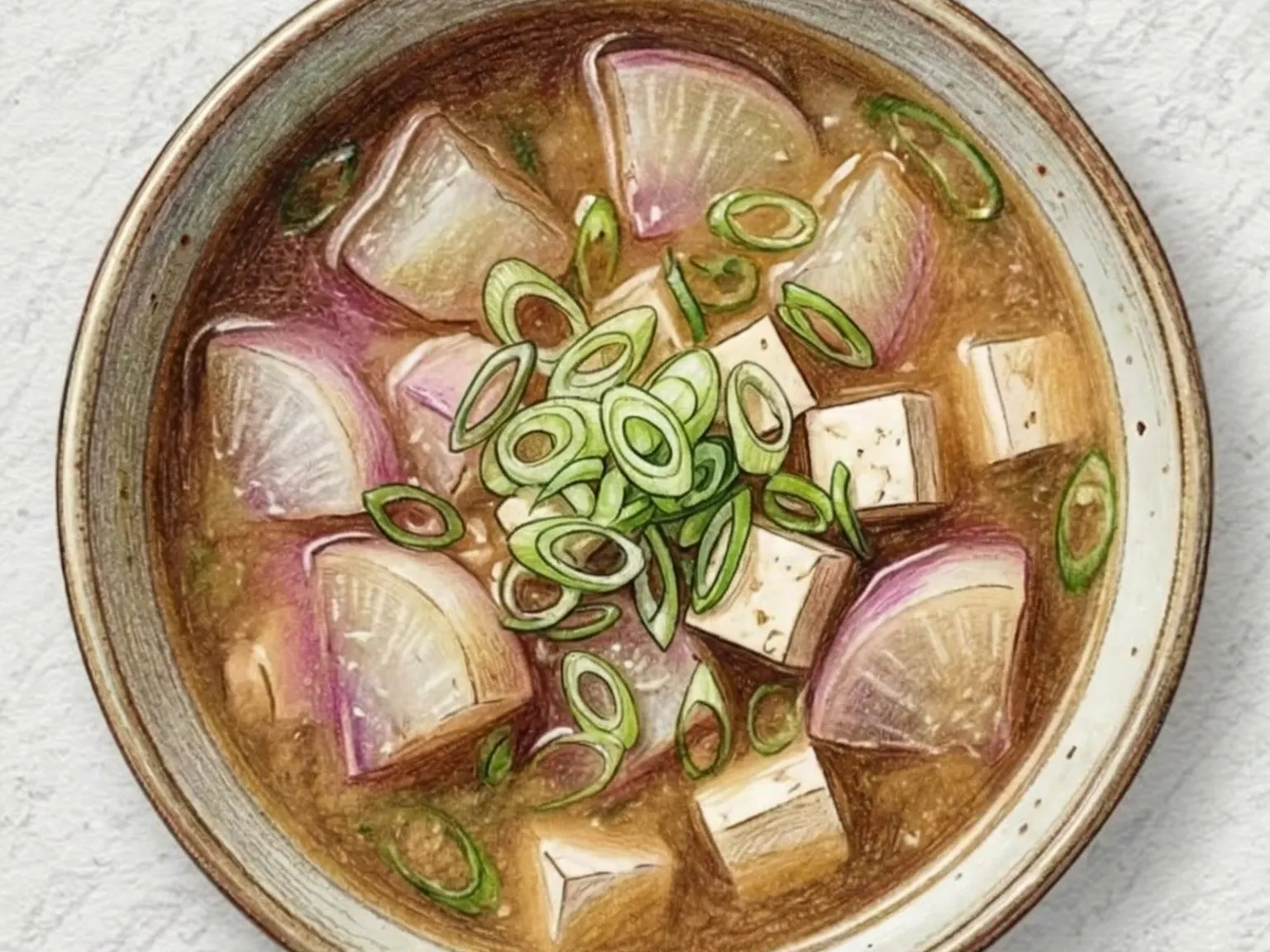
Korean Turnip Soybean Paste Soup
Soups Easy

Korean Turnip Soybean Paste Soup

Quick answer

Sunmu doenjang-guk is a homestyle soybean paste soup that uses turnip as its starring vegetable and rice-rinsing water as its liquid base.

What makes this special

  • Sunmu doenjang-guk uses rice-rinsing water to soften the salty fermented soybean broth.
  • Rice water rounds off doenjang saltiness with gentle starch body
  • Purple pigment from turnip skin tints the broth more delicately than regular doenjang soup
Total time
40 min
Level
Easy
Servings
4 servings
Ingredients
9
Calories
145 kcal
Protein
8 g

Key ingredients

turnipsoybean pastedried anchoviesdried kelpfirm tofu

Core cooking flow

  1. 1 Rinse 450 g turnips well to remove grit, then peel them thinly and cut into bite-size chunks.
  2. 2 Put 1500 ml water, 18 g dried anchovies, and 6 g dried kelp in a pot over medium heat.
  3. 3 Remove the anchovies and kelp, then place 2 tablespoons soybean paste in a s...

Sunmu doenjang-guk is a homestyle soybean paste soup that uses turnip as its starring vegetable and rice-rinsing water as its liquid base. The starchy water softens the doenjang's salinity, giving the broth a rounded, almost creamy quality that straight water cannot achieve. Turnips cook faster than daikon and yield a more delicate sweetness, along with a faint peppery edge that adds quiet complexity. As the turnip pieces simmer, a subtle purple blush from the skin tints the broth, making it a shade more elegant than an ordinary doenjang-guk. Cubed tofu is a natural companion, its neutral creaminess absorbing the fermented broth, while sliced scallion adds a final aromatic layer. The soup is at its best between autumn and early winter when turnips are in season, their sugars concentrated by cooler soil temperatures. Because the ingredient list is short, the quality of the doenjang matters more here than in busier soups - a well-aged paste with deep fermentation will carry the bowl, while a mediocre one will leave it flat.

Prep 15min Cook 25min 4 servings

Instructions

Read the steps as a cooking flow: prep, heat, seasoning, doneness control, and finish.

6 steps
  1. 1
    Prep

    Rinse 450 g turnips well to remove grit, then peel them thinly and cut into bite-size chunks.

    Leave a little purple skin if it looks clean, as it will lightly tint the broth without toughening the soup.

  2. 2
    Control

    Put 1500 ml water, 18 g dried anchovies, and 6 g dried kelp in a pot over medium heat.

    Once it starts boiling, lower the heat and simmer gently for 10 minutes so the stock stays clean, not bitter.

  3. 3
    Step

    Remove the anchovies and kelp, then place 2 tablespoons soybean paste in a sieve and dissolve it into the broth.

    Press out the lumps with a spoon so the soup tastes smoother and less muddy.

  4. 4
    Control

    Add the turnip and simmer over medium heat for about 12 minutes.

    It is ready for the next step when the edges look slightly translucent and a chopstick slides in with gentle resistance.

  5. 5
    Control

    Cut 180 g firm tofu into cubes, add it with 1 tablespoon minced garlic, and lower the heat to medium-low.

    Simmer 6 minutes without hard boiling so the tofu warms through without breaking apart.

  6. 6
    Control

    Slice 1 green onion and 1 Cheongyang chili, add them, and simmer for 2 more minutes.

    Taste the broth before serving, and if it is too salty, add about 100 ml water to round it out.

After the steps

Pick a recipe that fits this dish.

Continue with shared ingredients, meal pairings, or a similar method.

Recipes That Go Well With This

More Soups →

Based on shared ingredients and meal pairing

Korean Napa Cabbage Doenjang Soup
Shared ingredient: firm tofu Soups

Korean Napa Cabbage Doenjang Soup

Baechu doenjang guk is a foundational Korean soup built on anchovy-kelp stock seasoned with fermented soybean paste and napa cabbage. Straining the doenjang through a fine sieve as it dissolves into the hot stock keeps the broth visually clear while extracting the full depth of its fermented, earthy flavor. The cabbage stalks go into the pot first and simmer for five minutes alone, drawing out their inherent sweetness before the leaf sections and cubed tofu are added. A small spoonful of gochujang introduced at this point gives the broth a gentle heat and a reddish cast that adds both visual contrast and flavor complexity beyond doenjang alone. Sliced cheongyang chili and scallion are stirred in during the final two minutes, contributing sharpness and aroma without turning limp. Doenjang saltiness varies significantly between brands and aged batches, so starting with a conservative amount and adjusting by taste prevents over-salting. As the cabbage softens fully, its natural sweetness seeps gradually into the broth, where it finds a natural balance with the deep fermented character of the paste. It is among the most accessible soups in Korean home cooking, requiring only the most common pantry and refrigerator ingredients.

Korean Spinach Soybean Paste Soup
Shared ingredient: firm tofu Soups

Korean Spinach Soybean Paste Soup

Sigeumchi-doenjang-guk is a foundational Korean soup that combines spinach with soybean paste in anchovy-kelp stock, producing a broth that is earthy, warm, and deeply familiar to anyone who grew up eating Korean home cooking. Doenjang is dissolved into the simmering stock first, establishing a savory, slightly funky baseline. Spinach is added near the end and wilts within seconds, contributing a soft green color and a faint bitterness that, rather than clashing with the fermented paste, amplifies its complexity. Tofu is a common addition that gives the soup more substance and a creamy counterpoint to the leafy greens. Garlic and green onion handle the aromatics, and no chili is used, keeping the soup on the gentle end of the Korean flavor spectrum. The key technical point is timing: spinach left in boiling liquid too long turns dull and mushy, so experienced cooks drop it in and turn off the heat almost immediately. This soup is one of the most frequently prepared versions of doenjang-guk in Korean kitchens precisely because spinach is available year-round, affordable, and cooks in moments. It pairs seamlessly with any banchan spread and never competes for attention on the table.

Korean Sesame Porridge (Toasted Sesame Silky Rice Porridge)
Serve together Rice

Korean Sesame Porridge (Toasted Sesame Silky Rice Porridge)

Kkaejuk is a traditional Korean porridge made by grinding toasted sesame seeds to a fine powder and simmering them with soaked rice, water, and milk until the mixture reaches a silky, cream-soup consistency. Toasting the seeds before grinding is not optional -- raw sesame lacks the deep, roasted fragrance that defines the dish, and the heat of toasting develops oils and aroma compounds that grinding alone cannot produce. Constant stirring over low heat prevents the mixture from scorching and coaxes the rice grains into breaking down completely, merging with the sesame base so no distinct texture remains. Milk enriches the body beyond what water alone provides and gives the finished porridge a warm ivory color. The simplest version is seasoned with nothing but salt and served with a drizzle of honey or rice syrup, letting the roasted sesame flavor carry the bowl without distraction. Easily digestible and gentle on the stomach, kkaejuk has a long tradition as a morning meal, a recovery food for the sick, and a postpartum nourishment dish in Korean households.

Korean Soybean Paste Stew
Similar recipe Stews

Korean Soybean Paste Stew

Doenjang-jjigae is a standard Korean stew made by dissolving fermented soybean paste in water and simmering it with vegetables and tofu. To ensure a smooth broth without grits, the paste is strained through a fine sieve into the water. Harder vegetables like potatoes and onions are added first to soften and release their natural sweetness into the broth. Zucchini and minced garlic follow, balancing the soup's richness. In the final stage, tofu and chopped green chili are added, providing a clean kick that cuts through the deep, earthy taste of the fermented soybean paste. Simmering green onions at the very end adds a fresh aroma. The savory stew pairs naturally with steamed rice and various side dishes.

Serve with this

Korean Broccoli Doenjang Salad
Side dishes Easy

Korean Broccoli Doenjang Salad

Blanched broccoli tossed in doenjang dressing is a modern Korean banchan that pairs Western ingredients with traditional fermented seasoning. Florets and thinly sliced stems blanch for ninety seconds in salted boiling water, then shock in cold water to lock in vivid green color and a firm, crisp bite. The dressing is built from doenjang stirred with rice vinegar and oligosaccharide syrup, combining fermented salt depth, acidity, and a gentle natural sweetness that lifts rather than masks the vegetable's mild bitterness. Using the stems alongside the florets eliminates waste and adds textural variety to each bite. Ready in under ten minutes and holds well refrigerated for two days.

🥗 Light & Healthy 🏠 Everyday
Prep 10min Cook 5min 4 servings
Korean Garlic Scape Kimchi
Kimchi Easy

Korean Garlic Scape Kimchi

Maneul jong kimchi is a garlic scape kimchi made by lightly brining freshly harvested scapes, then dressing them in a seasoning paste of gochugaru, fish sauce, and plum syrup blended with pureed onion and pear. The scapes' sharp, piercing garlic aroma does not diminish through fermentation - it persists alongside the stems' crisp bite, delivering alternating pulses of heat and umami that build with each chew. Pear works into the base to introduce a fruit sweetness that blunts the chili intensity, while fish sauce provides the fermented backbone that grounds the entire kimchi. Trimming the fibrous bottoms before seasoning produces a more uniform snap throughout. Leaving the jar at room temperature for roughly two days allows the flavors to integrate and mellow into balance before refrigerating. This is a seasonal kimchi made only in spring when garlic scapes appear in the market, and its combination of raw green pungency and assertive garlic heat sets it apart from any other variety in the Korean kimchi repertoire.

🍱 Lunchbox 🏠 Everyday
Prep 30min Cook 5min 4 servings
Korean Kimchi Pork Jeon (Fermented Kimchi and Pork Crispy Pancake)
Pancakes Easy

Korean Kimchi Pork Jeon (Fermented Kimchi and Pork Crispy Pancake)

Well-fermented kimchi and pork shoulder are the backbone of this hearty Korean pancake. Kimchi brine is mixed directly into the batter, intensifying both the crimson color and the tangy, fermented depth of flavor. A small amount of sugar balances the acidity, while green onion and onion distribute contrasting texture throughout each bite. Pressing the pancake flat in a generously oiled pan over high heat produces deeply caramelized, crispy edges. The kimchi should not be squeezed too dry before mixing in, since residual moisture keeps the interior soft and prevents the finished pancake from becoming dense. Pork shoulder should be cut into small pieces so it cooks through before the exterior over-browns. The kimchi's seasoning is assertive enough that no dipping sauce is required, making this a complete side dish on its own.

🍺 Bar Snacks 🏠 Everyday
Prep 20min Cook 18min 4 servings

Similar recipes

Korean Spring Cabbage Soybean Paste Soup
Soups Easy

Korean Spring Cabbage Soybean Paste Soup

Bomdong doenjang-guk is a seasonal Korean home soup made by simmering spring cabbage and doenjang in rice-rinsing water, which adds a subtle starchy body to the broth and softens the saltiness of the paste. The thicker cabbage stems go in first to soften properly while retaining some bite, and the tender leaves are added at the end to hold their natural sweetness and color. Tofu, a pinch of red chili flakes, and green onion round out the bowl with depth and mild heat. A drop of sesame oil just before serving adds a nutty finishing aroma. Spring cabbage has a high water content and turns mushy quickly, so the leaves should be added less than two minutes before turning off the heat.

🏠 Everyday 🥗 Light & Healthy
Prep 15min Cook 20min 4 servings
Korean Shepherd's Purse Soup
Soups Easy

Korean Shepherd's Purse Soup

Naengi-guk is a Korean spring soup made with anchovy-kelp stock, doenjang, and fresh shepherd's purse (naengi). Naengi is a cruciferous plant gathered from paddies, field edges, and roadsides in early spring, and both the root and the leaves are used. The root contributes an earthy, mineral fragrance and the leaves carry a slightly bitter green quality that together define the soup's character. The stock is made from dried anchovies and kelp simmered and strained, providing a clean umami base. Doenjang is dissolved through a mesh strainer rather than stirred directly into the pot, which keeps the broth clear rather than murky while still delivering the fermented soybean depth. Diced tofu simmers in the seasoned broth until warmed through. Naengi goes in during the final two to three minutes of cooking: longer exposure to heat breaks down the aromatic compounds in the herb and erases the spring fragrance that makes the soup worth making in the first place. The pairing of naengi's earthy bitterness with the fermented depth of the doenjang and the clean mineral tone of the anchovy stock produces a flavor that is distinctly seasonal and difficult to replicate outside of spring. Soup soy sauce, salt, and a small amount of garlic complete the seasoning. In Korean food culture, naengi-guk on the table is understood as one of the clearest signs that winter is finished.

🏠 Everyday 🥗 Light & Healthy
Prep 15min Cook 20min 4 servings
Korean Doenjang Thin Noodle Soup
Noodles Easy

Korean Doenjang Thin Noodle Soup

Doenjang somyeon is a Korean noodle soup of thin wheat noodles in a fermented soybean paste broth built on anchovy stock. Potato, zucchini, and onion - or whatever vegetables are available - go into the broth first, simmering until they release their moisture and natural sugars into the liquid, which rounds out the earthy doenjang base. The somyeon noodles take only three to four minutes to cook, so they go in last to stay firm. Sliced green onion scattered on top adds a clean, bright note against the fermented broth. The ingredient list is short and adaptable, but the doenjang delivers enough layered depth to make this a satisfying weeknight dinner without any complex technique.

🏠 Everyday ⚡ Quick
Prep 10min Cook 15min 2 servings

Tips

If available, add turnip greens at the end for extra texture and aroma.
Adjust saltiness by adding about 100 ml water depending on your doenjang.

Nutrition (per serving)

Calories
145
kcal
Protein
8
g
Carbs
14
g
Fat
7
g