Sweet and Sour Pork
Asian Medium

Sweet and Sour Pork

Quick answer

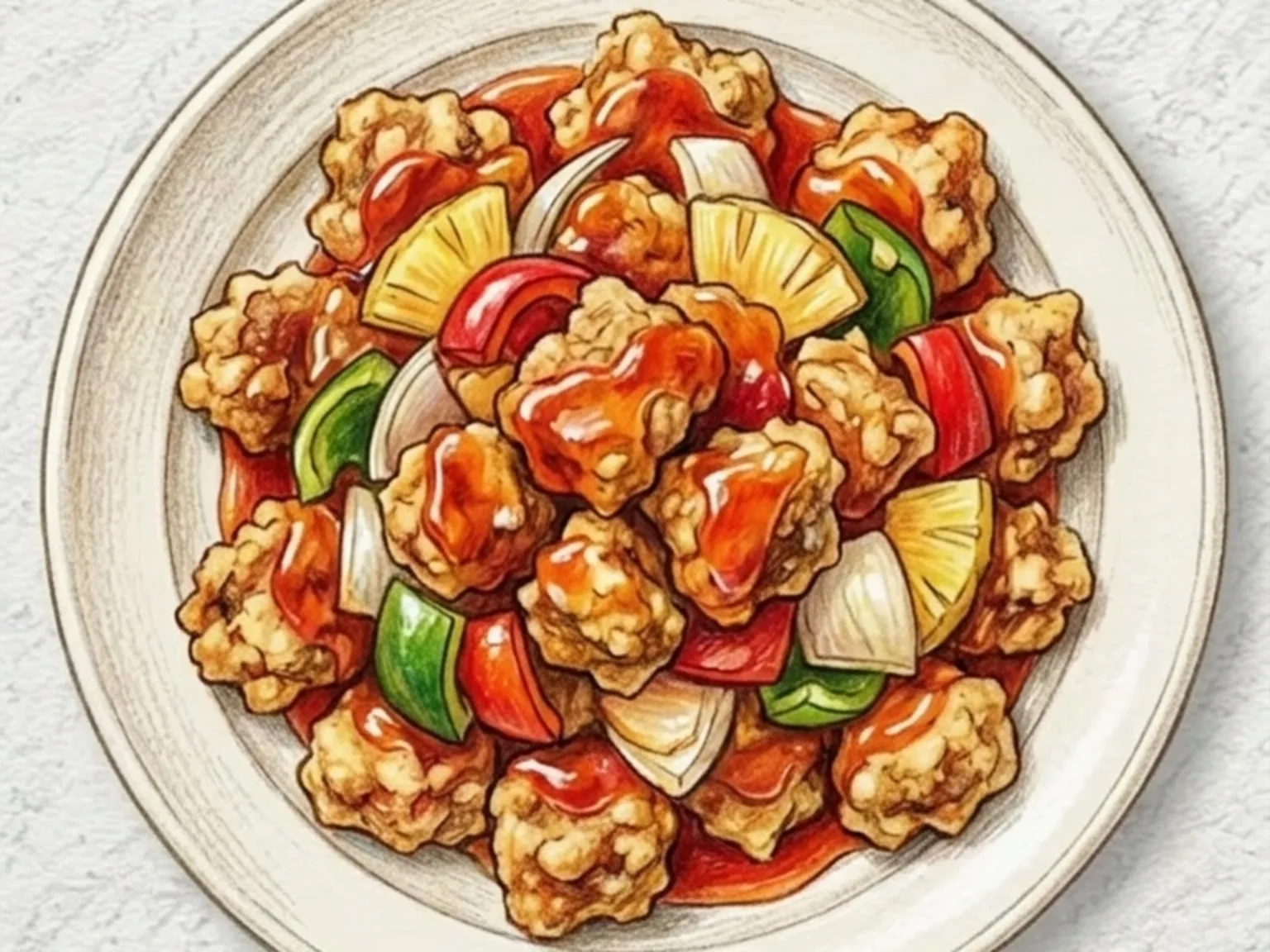
Sweet and sour pork, known in Korea as tangsuyuk, is a Chinese-Korean dish of double-fried pork pieces served under a glossy, tangy sauce.

What makes this special

  • Sweet and Sour Pork features double-fried meat coated in a glossy, tangy sauce with fruit and onions.
  • Double frying at 175°C separates a crunchy crust from a tender interior
  • Boiling the ketchup-vinegar sauce brings out a fruity sweetness
Total time
45 min
Level
Medium
Servings
4 servings
Ingredients
9
Calories
500 kcal
Protein
25 g

Key ingredients

pork loincornstarcheggbell pepperonion

Core cooking flow

  1. 1 Cut 400 g pork loin into even bite-sized pieces, then pat the surface dry so the coating sticks well.
  2. 2 Beat 1 egg and coat the pork lightly, then add the 100 g cornstarch in portions.
  3. 3 Heat the oil to 175 degrees Celsius and add the pork without crowding the pan.

Sweet and sour pork, known in Korea as tangsuyuk, is a Chinese-Korean dish of double-fried pork pieces served under a glossy, tangy sauce. Bite-sized cuts of pork loin are coated in egg and cornstarch, then fried twice at 175 degrees Celsius-the first pass cooks the inside, and the second crisps the crust to a shattering crunch. The sauce is built from ketchup, sugar, vinegar, and soy sauce, brought to a quick boil and tossed with stir-fried bell pepper and onion, which contribute color and a fresh vegetal crunch. Timing is everything: the sauce is poured over the pork at the very last moment so the coating stays audibly crisp when bitten into. The interplay between the crunchy exterior, the soft pork within, and the bright, fruity sauce makes this one of the most popular dishes at Chinese restaurants across Korea.

Prep 25min Cook 20min 4 servings
Recipes by ingredient → egg onion vinegar soy sauce

Instructions

Read the steps as a cooking flow: prep, heat, seasoning, doneness control, and finish.

6 steps
  1. 1
    Season

    Cut 400 g pork loin into even bite-sized pieces, then pat the surface dry so the coating sticks well.

    Cut the bell pepper and onion into similar pieces so they cook evenly in the sauce.

  2. 2
    Step

    Beat 1 egg and coat the pork lightly, then add the 100 g cornstarch in portions.

    Toss until every piece looks pale and dry on the outside, with no wet patches that could burst in the oil.

  3. 3
    Heat

    Heat the oil to 175 degrees Celsius and add the pork without crowding the pan.

    Fry the first time until the coating turns light golden and the pork is cooked through, adjusting the heat if the oil drops too much.

  4. 4
    Heat

    Lift the pork out and let it rest briefly so steam escapes from the crust.

    Return it to 175 degrees Celsius oil for the second fry, then remove it as soon as the outside feels firm and crisp.

  5. 5
    Control

    In a pan, combine 3 ts ketchup, 2 ts sugar, 2 ts vinegar, and 1 ts soy sauce over medium heat.

    When the edges bubble and the sauce looks glossy, add the vegetables and stir-fry until just crisp-tender.

  6. 6
    Finish

    Spread the fried pork on a serving plate instead of piling it high, so trapped steam does not soften the crust.

    Pour the hot sauce over it only at the last moment and serve immediately while the coating is still crisp.

After the steps

Pick a recipe that fits this dish.

Continue with shared ingredients, meal pairings, or a similar method.

Recipes That Go Well With This

More Asian →

Based on shared ingredients and meal pairing

Lion's Head Meatballs (Chinese Braised Large Pork Meatballs with Cabbage)
Shared ingredient: starch for dusting Asian

Lion's Head Meatballs (Chinese Braised Large Pork Meatballs with Cabbage)

Lion's head meatballs are a hallmark of Huaiyang cuisine from eastern China. Each meatball is shaped to the size of a fist from a loose mixture of ground pork, minced water chestnuts, and aromatics - the water chestnuts keeping the interior moist and giving it a subtle crunch even after long braising. The meatballs nestle into napa cabbage leaves in a clay pot, then simmer gently in a light soy and ginger broth until the cabbage wilts into silky ribbons and the pork turns spoon-tender. The name comes from how the cabbage wraps around each ball like a lion's mane. Served with steamed rice, the mild broth doubles as a soup course.

Hot and Sour Soup
Shared ingredient: egg Asian

Hot and Sour Soup

Hot and sour soup is among the most widely recognized Chinese soups, and its defining character comes not from chili but from two specific sources: black vinegar's sharp acidity and white pepper's slow, creeping heat. Chicken broth forms the base, simmered with cubed tofu, reconstituted wood ear mushrooms, and sliced shiitake. A cornstarch slurry is worked in gradually, small additions at a time, to build a lightly viscous consistency without tipping the broth into something gluey and heavy. Beaten egg is poured in a thin, steady stream while the soup is stirred, forming delicate ribbons that float throughout. Two timing rules matter: the slurry goes in slowly, and the vinegar goes in last, after the heat is reduced, because its volatile aroma dissipates quickly if boiled. Wood ear mushrooms provide a springy, almost cartilaginous chew that contrasts with the softness of the tofu and the wispy egg threads. The white pepper heat lingers and builds after each spoonful, arriving late rather than hitting immediately, which gives the soup its characteristic slow warmth.

Beet and Goat Cheese Salad
Serve together Salads

Beet and Goat Cheese Salad

Beet and goat cheese salad begins with whole beets wrapped in foil and roasted at 200°C for forty-five to sixty minutes, long enough for their raw, earthy undertone to convert almost entirely into a concentrated, caramel-adjacent sweetness. Peeling the skins while the beets are still warm requires only the pressure of a paper towel - they slip off cleanly - and slicing them before they cool preserves the vivid crimson-purple cross-section that makes the dish visually striking. Crumbled goat cheese placed on the warm slices softens slightly, and its tangy acidity cuts through the dense sweetness of the roasted root rather than competing with it. Walnuts toasted briefly in a dry pan lose much of their raw bitterness, developing a nuttiness that bridges the mineral quality of the beet and the dairy sharpness of the cheese. Balsamic reduction does more than dress the plate: its concentrated sweet-tart intensity ties the separate components into a coherent whole. Arugula underneath the beet slices provides a peppery bitterness that sharpens the contrast against the sweetness, giving the salad a complexity well beyond what its short ingredient list suggests. A simple dressing of extra-virgin olive oil and lemon juice over the greens keeps the balance light and clear.

Guo Bao Rou (Sweet and Sour Crispy Pork)
Similar recipe Asian

Guo Bao Rou (Sweet and Sour Crispy Pork)

Guo bao rou, literally pot-wrapped meat, is the flagship dish of Northeastern Chinese cuisine, developed in Harbin during the late Qing Dynasty to accommodate Russian diplomats who found traditional Chinese flavors unfamiliar. To suit their palate, the dish was built around a sharp vinegar-sugar balance, and that foundation has persisted to the present day. The technique centers on double-frying: pork tenderloin or loin is sliced thin, coated heavily in potato starch, fried once to set the exterior, then fried a second time at higher temperature to puff the starch into a glassy, shattering crust. The sauce of vinegar, sugar, and soy sauce is reduced in a screaming-hot wok until it caramelizes, and the fried pork must be tossed through in thirty seconds flat. Exceed that window and the starch drinks the sauce, collapsing the crunch entirely. The original Harbin version is pale in color with a pronounced acidic edge. As the dish traveled south through China and into Korean-Chinese restaurants, cooks began substituting ketchup, producing the sweeter and more vividly red version familiar today in Korean establishments. The finished piece delivers three distinct layers of texture simultaneously: a translucent caramelized sauce coating on the surface, a brittle expanded starch shell beneath it, and soft yielding meat at the center.

Serve with this

Black Tea Milk Tea (British Condensed Milk Sweet Tea)
Drinks Easy

Black Tea Milk Tea (British Condensed Milk Sweet Tea)

Milk tea is prepared by steeping black tea bags in boiling water for exactly four minutes to extract a strong, tannic base, then combining it with whole milk and condensed milk over low heat. Steeping shorter than four minutes leaves the tea pale and thin; longer than four minutes introduces bitterness and astringency that no amount of milk can fully mask. The milk rounds out the tea's sharpness and adds a creamy body, while condensed milk layers on a dense, caramel-like sweetness that sets this version apart from tea simply sweetened with sugar. Regular sugar dissolved early provides the baseline sweetness, and the condensed milk fine-tunes the richness and texture in the final moments. Warming the milk before combining it with the brewed tea helps both blend more smoothly. For an iced version, the mixture must be cooled completely before pouring over ice, since adding hot liquid directly to ice dilutes the drink and washes out the flavor.

🍺 Bar Snacks 🧒 Kid-Friendly
Prep 5min Cook 10min 2 servings
Beef Brisket Perilla Cream Fettuccine
Noodles Medium

Beef Brisket Perilla Cream Fettuccine

Chadol perilla cream fettuccine pairs Italian cream sauce with thinly sliced Korean beef brisket and the resinous fragrance of perilla leaves. The brisket is seared in a dry, hot pan without added oil, since its own fat content is sufficient and extra oil prevents proper caramelization on the edges. After searing and draining the rendered fat, the crisped brisket is folded back into a sauce of heavy cream and milk so its savory depth permeates every drop. Perilla leaves must be added only when the heat is turned off, because their volatile aromatic oils evaporate quickly; adding them too early leaves only a faint bitterness. The perilla's herbal note lifts the heaviness of the cream and introduces a register absent from any European herb. Fettuccine's broad, flat surface catches sauce generously, ensuring each bite is fully coated without the sauce pooling at the bottom of the bowl. Grated Parmigiano-Reggiano adds sharpness and salt, while cracked black pepper gives a punctuating finish. The dish works because the rich fat of the brisket and the clean herbal top note of perilla occupy different flavor registers and strengthen rather than compete with each other.

🎉 Special Occasion 🏠 Everyday
Prep 15min Cook 18min 2 servings
Korean Cutlassfish Pot Rice
Rice Medium

Korean Cutlassfish Pot Rice

Galchi sotbap is a Korean one-pot rice dish in which cutlassfish seasoned with soy sauce and ginger is arranged on top of soaked rice along with sliced radish and shiitake mushroom, then cooked together in a heavy pot over direct heat. As the rice steams, the oils from the fish seep down through the grains, carrying a clean, rich marine savoriness into every layer of the pot. Radish softens slowly alongside the rice and releases a gentle sweetness that supports the fish without competing with it. Ginger handles any potential fishiness, keeping the overall flavor bright and unclouded. Shiitake mushroom contributes earthiness, added umami, and a chewy counterpoint to the tender fish and rice. The aroma released when the lid is lifted - soy-seasoned fish, steamed grain, and caramelized crust - is a considerable part of the eating experience. A soy-sesame dipping sauce is provided for mixing through the rice, layering in salt and nuttiness. The rice crust that forms at the base of the pot, called nurungji, adds a toasted crunch. The dish is finest in autumn when cutlassfish from the waters around Jeju Island and Korea's southern coast carry their peak fat content.

🎉 Special Occasion
Prep 25min Cook 30min 4 servings

Similar recipes

Tanghuru (Chinese-Style Candied Fruit Skewers)
Street food Medium

Tanghuru (Chinese-Style Candied Fruit Skewers)

Tanghuru is a candied fruit dessert made by skewering fresh strawberries, grapes, or other fruits and dipping them into sugar syrup heated to 150 degrees Celsius, the hard-crack stage. At this precise temperature, the syrup sets into a thin, glass-like candy shell around each fruit; any lower and it remains sticky without hardening. Biting through the brittle sugar coating releases the fresh juice of the fruit inside, creating a sharp contrast between pure sugar sweetness and the fruit's natural tartness. The fruit must be thoroughly dried before dipping so the candy layer adheres in an even, transparent coat.

🧒 Kid-Friendly 🏠 Everyday
Prep 15min Cook 10min 2 servings
Kung Pao Chicken
Asian Medium

Kung Pao Chicken

Kung pao chicken is one of the defining dishes of Sichuan cuisine, built around diced chicken, roasted peanuts, and dried chilies in a sauce that hits spicy, sweet, sour, and numbing at the same time. The chicken is cut into small cubes and given a brief marinade of soy sauce and cornstarch, which seals moisture in and creates a light coating that takes on color quickly in a screaming-hot wok. Dried red chilies and Sichuan peppercorns are fried in oil as the very first step, pulling their heat and the distinctive mala tingling sensation into the fat before anything else goes in. This flavored oil becomes the foundation the entire dish is built on. Soy sauce, black vinegar, and sugar are added at the end and reduced into a glossy glaze that coats every surface. Roasted peanuts go in last so they stay crunchy, and chopped scallion brings a clean, fresh finish. The interplay of sharp chili heat, tongue-numbing peppercorn, tangy vinegar, and toasty peanut in a single bite is what carries this dish beyond Sichuan into kitchens worldwide.

🍺 Bar Snacks 🎉 Special Occasion
Prep 20min Cook 10min 2 servings
Korean Pineapple Chicken Stir-Fry
Stir-fry Easy

Korean Pineapple Chicken Stir-Fry

Pineapple dak-bokkeum stir-fries bite-sized chicken pieces with fresh pineapple chunks in a sauce of soy sauce, vinegar, and sugar. The chicken is dusted in cornstarch before cooking, which helps the glaze adhere and gives each piece a lightly thickened exterior. Pineapple's sharp acidity cuts through the soy-based sweetness, creating a pronounced sweet-sour cycle with every bite. The short cook time keeps the chicken moist inside while the fruit softens just enough to release its tropical fragrance.

🏠 Everyday 🌙 Late Night
Prep 15min Cook 10min 2 servings

Tips

Pour sauce at the last moment to keep the pork crispy.

Nutrition (per serving)

Calories
500
kcal
Protein
25
g
Carbs
52
g
Fat
20
g