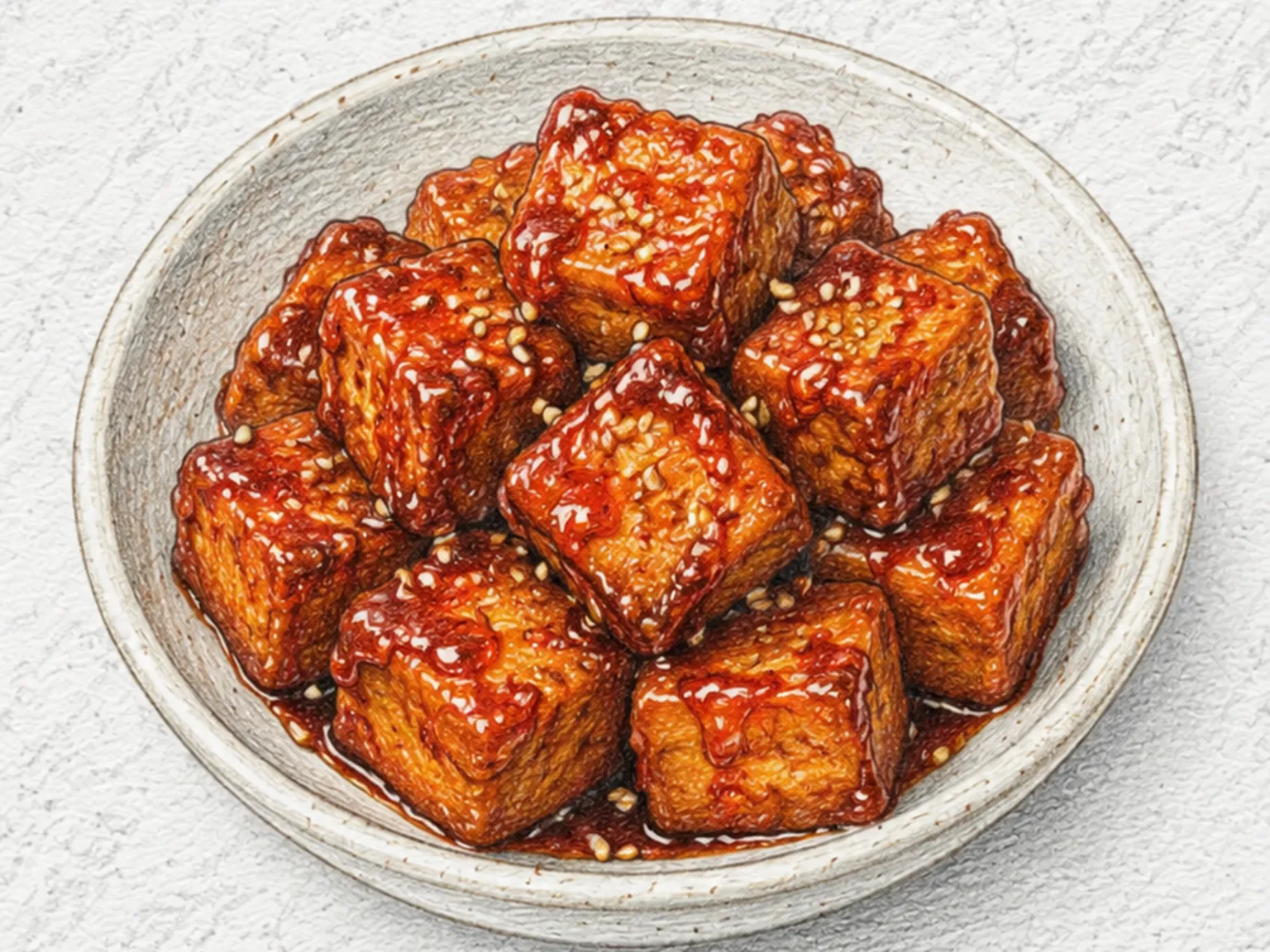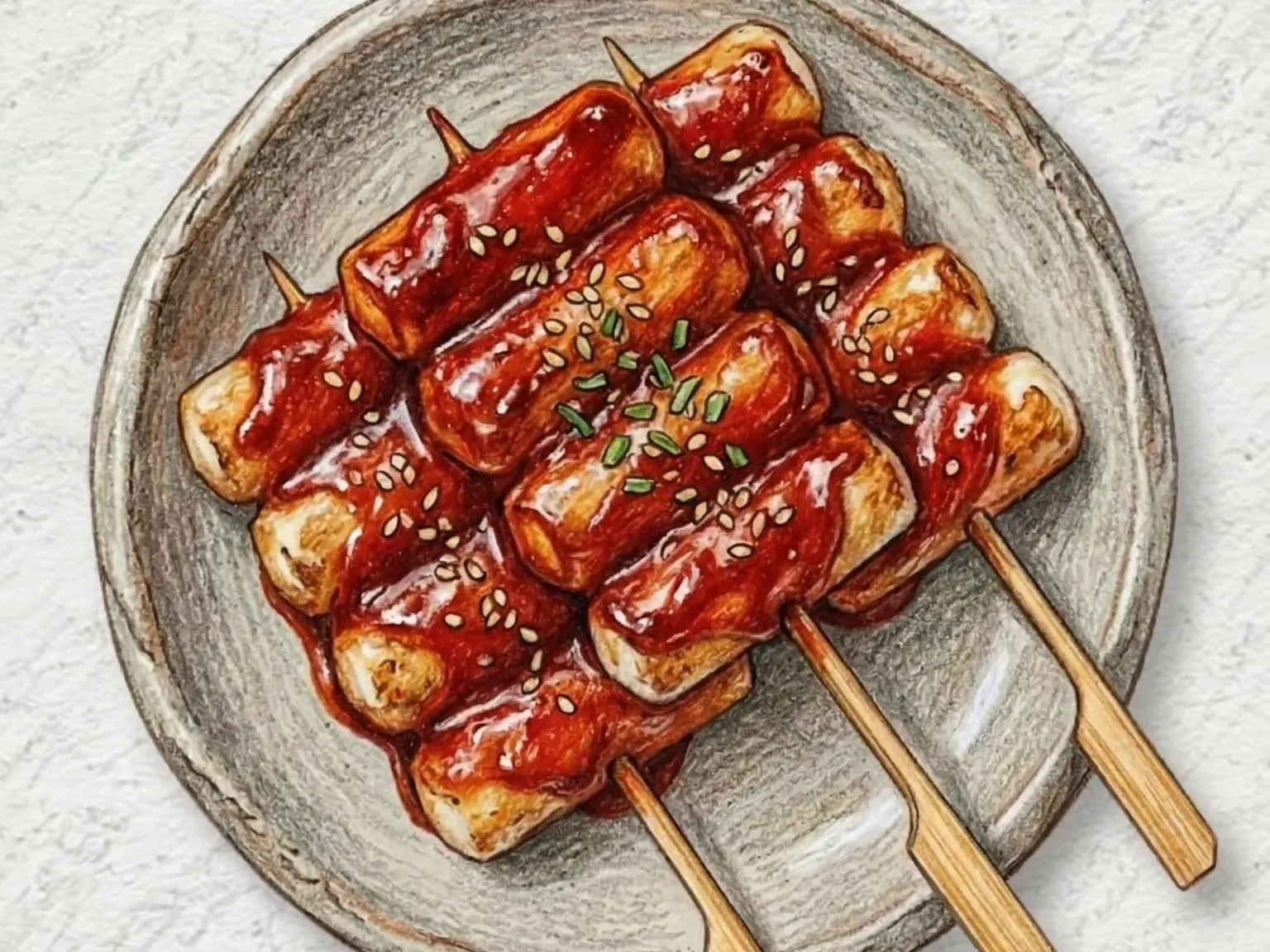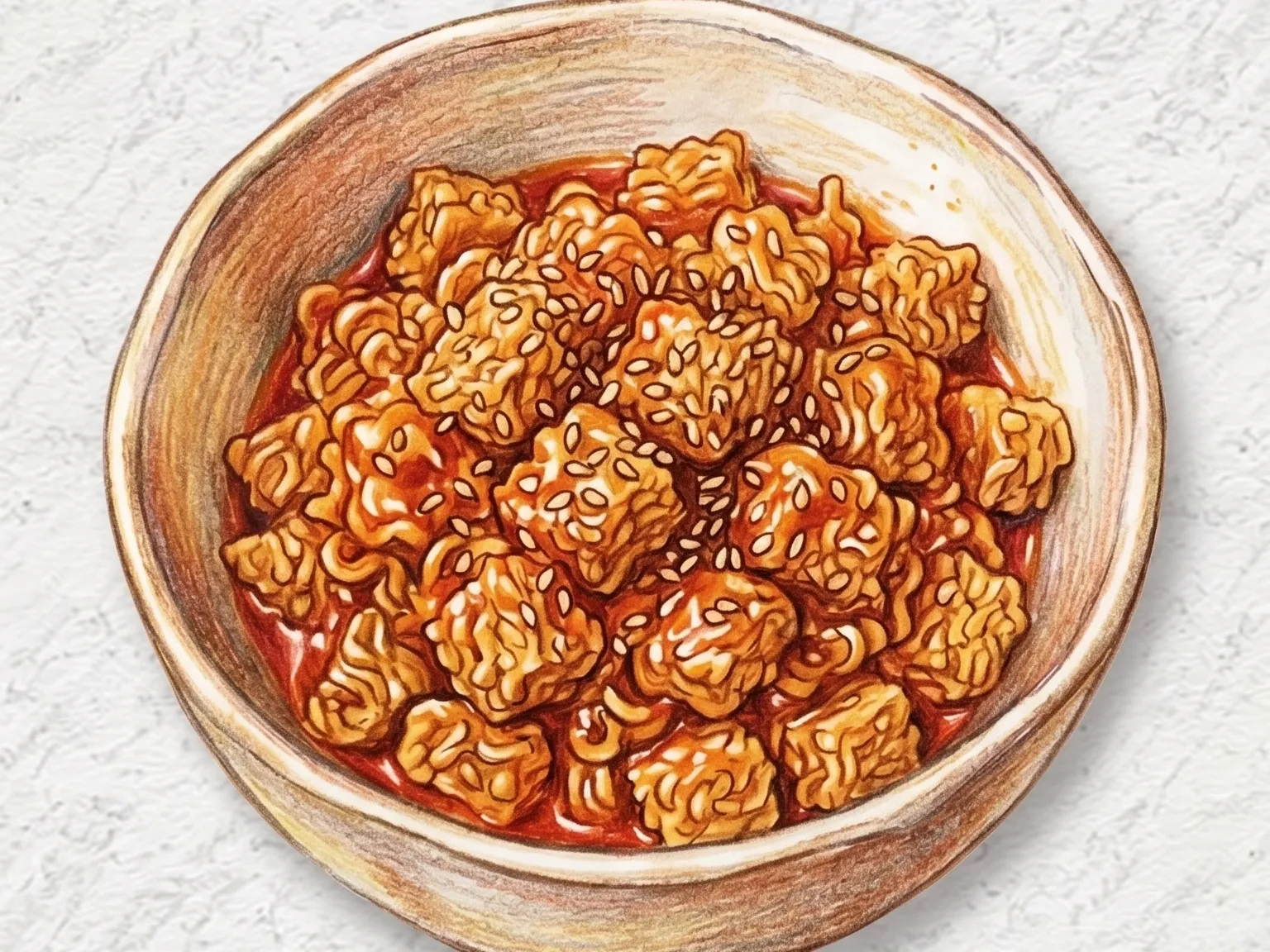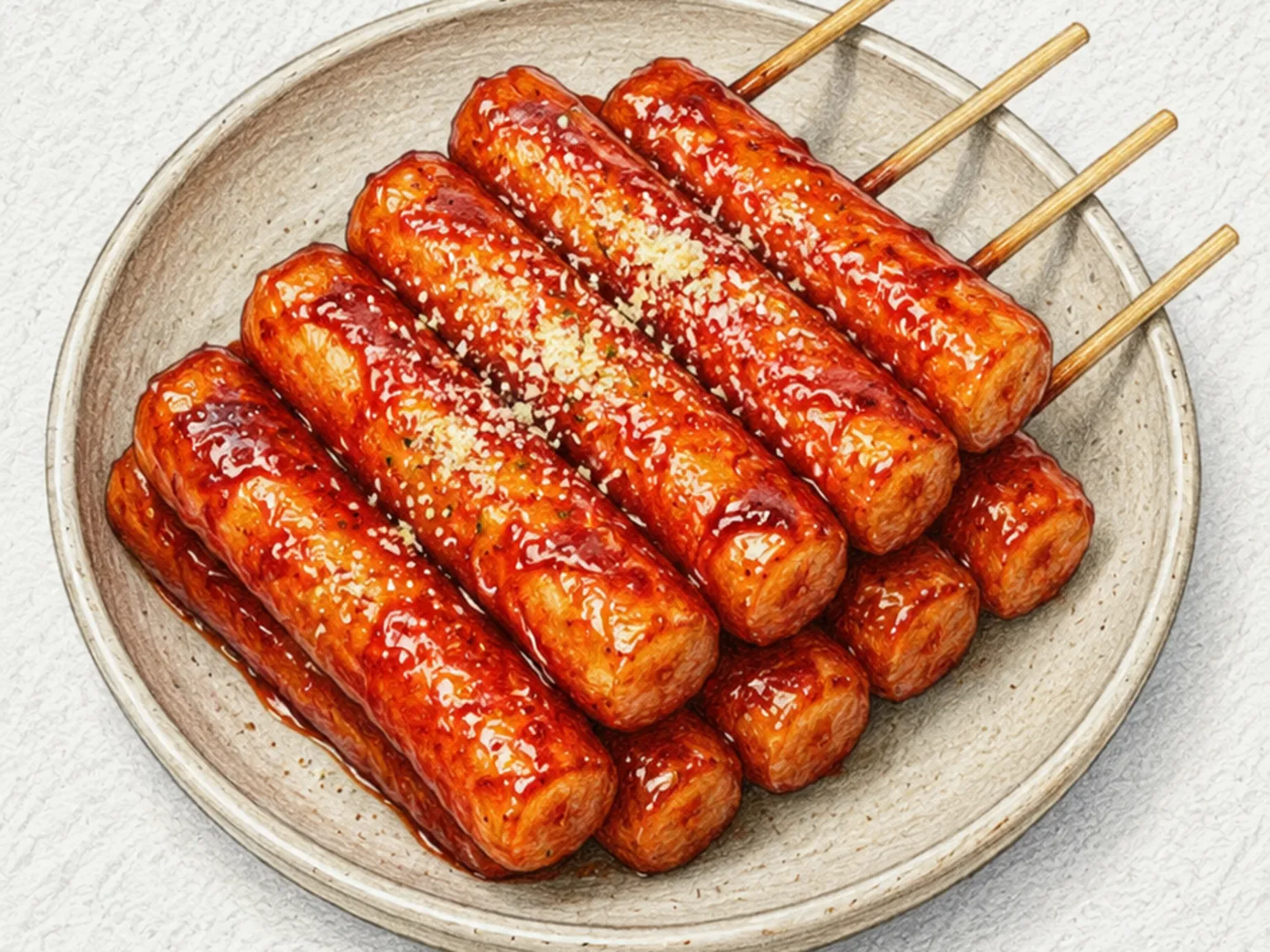
Korean Tteok Kkochi Yangnyeom Gui (Grilled Rice Cake Skewers)
Quick answer
Cylinder rice cakes are threaded onto skewers, lightly brushed with oil, and rolled on a grill pan over medium heat for six to seven minutes until the exterior turns golden.
What makes this special
- Tteok-kkochi-yangnyeom-gui employs a double-glaze technique for a glossy finish on grilled rice cakes.
- Two coats of sauce applied while grilling build the signature glossy red lacquer finish
- Rolling for 6-7 minutes first creates a lightly crisp shell around the chewy glutinous core
Key ingredients
Core cooking flow
- 1 If the 500 g cylinder rice cakes feel firm, soak them in warm water for 5 minutes, then drain and pat dry.
- 2 Thread the rice cakes evenly onto skewers, leaving a little space so they can roll.
- 3 Mix 2 tbsp each gochujang, ketchup, and oligosaccharide syrup with 1 tsp soy...
Cylinder rice cakes are threaded onto skewers, lightly brushed with oil, and rolled on a grill pan over medium heat for six to seven minutes until the exterior turns golden. A sauce of gochujang, ketchup, oligosaccharide syrup, soy sauce, and minced garlic is applied in two rounds, building a glossy red glaze that clings to the surface. The outer layer develops a slight crispness while the inside remains stretchy and dense - that textural duality is the hallmark of this dish. A light dusting of cheese powder turns it into a kid-friendly snack, and it stands as one of the most iconic items in Korean street-food culture.
Instructions
Read the steps as a cooking flow: prep, heat, seasoning, doneness control, and finish.
- 1Step
If the 500 g cylinder rice cakes feel firm, soak them in warm water for 5 minutes, then drain and pat dry.
Do not soak too long, or the surface may split when skewered.
- 2Step
Thread the rice cakes evenly onto skewers, leaving a little space so they can roll.
Brush the surface thinly with 1 tbsp neutral oil, wiping away pooled oil to prevent splattering in the pan.
- 3Season
Mix 2 tbsp each gochujang, ketchup, and oligosaccharide syrup with 1 tsp soy sauce and 0.5 tsp minced garlic.
Stir until smooth so the glaze spreads evenly and does not burn in thick spots.
- 4Control
Heat a grill pan over medium heat, add the skewers, and roll them for 6-7 minutes.
Aim for lightly golden surfaces and a slightly firmer outside while keeping the inside chewy.
- 5Season
Lower the heat to medium-low, brush on a thin layer of sauce, and grill for 2-3 more minutes.
Turn often, because the syrup and ketchup can scorch quickly over strong heat.
- 6Finish
Brush once more at the end to build a glossy red coating, then sprinkle with 1 tsp sesame seeds.
Serve warm, while the outside is lightly crisp and the center still feels chewy.
After the steps
Pick a recipe that fits this dish.
Continue with shared ingredients, meal pairings, or a similar method.
Recipes That Go Well With This
More Grilled →Based on shared ingredients and meal pairing
Korean Sotteok-Sotteok Skewers
Cylinder-shaped rice cakes and mini sausages are skewered in alternating order, then pan-grilled for six to seven minutes until the surfaces turn golden. A glaze made from gochujang, ketchup, soy sauce, oligosaccharide syrup, and minced garlic is brushed on and cooked for two to three more minutes until glossy and sticky. Each skewer delivers a contrast between the dense chew of rice cake and the snappy bite of sausage, unified by the sweet-spicy coating. Originally a Korean street-food staple, sotteok-sotteok is also popular for camping trips and can be made quickly in an air fryer.
Korean Grilled Rice Cake Skewers
Tteokkochi are pan-seared rice cake skewers glazed in a thick gochujang-based sauce that builds depth through a combination of ketchup, oligosaccharide syrup, soy sauce, and minced garlic simmered down until the sauce reduces and concentrates. The rice cakes are first seared in a thin layer of oil until a lightly crisp shell forms across the surface before any sauce is applied, creating a textural contrast between the outer crust and the soft, chewy interior that defines what a good tteokkochi should feel like. The ketchup introduces a mild tomato acidity that tempers and rounds the raw heat of the gochujang, while the syrup adds sweetness without the grainy texture of sugar. After the sauce is brushed on, rolling the skewers over low heat for another minute fuses the glaze to the rice cake surface so it adheres firmly and does not peel off as the skewers cool. Adjusting the ratio of ketchup to syrup shifts the balance between sweetness and acidity, making it straightforward to tailor the sauce to individual preference. Making the sauce in a larger batch and storing it separately saves time on repeat preparations.
Korean Spicy Stir-Fried Anchovies
Spicy stir-fried anchovies (maeun myeolchi-bokkeum) toss medium-sized dried anchovies in a gochujang-gochugaru glaze, occupying the opposite end of the flavor spectrum from the sweet jiri-myeolchi version and targeting adult palates. Medium anchovies are larger and thicker than the tiny variety, requiring individual head-and-gut removal to eliminate bitterness - a tedious prep step that nonetheless determines the dish's clean finish. After dry-toasting to drive off moisture, the anchovies simmer in a sauce of gochujang, gochugaru, soy sauce, oligosaccharide, and minced garlic until each piece is coated in a rust-colored glaze. The gochujang's fermented heat combines with gochugaru's vivid red to create both flavor depth and visual appeal. The larger anchovy size delivers a satisfying crunch that lingers alongside a lasting savory umami. Heat intensity is adjustable via gochugaru quantity - adding chopped cheongyang chili ratchets it up another notch. This banchan doubles as a soju drinking snack, appearing as frequently on bar tables as on dinner tables.
Korean Sotteok Sotteok Skewers
Sotteok-sotteok is a Korean street snack of alternating mini sausages and cylinder rice cakes on a skewer, pan-grilled and coated in a sweet-spicy glaze of gochujang, ketchup, and oligosaccharide syrup. The rice cakes are soaked in warm water beforehand to soften them, ensuring they cook through on the pan and achieve maximum chewiness. Sausages are lightly scored to prevent splitting, and the skewers are rolled over medium heat until evenly browned. The glaze is tossed on quickly over low heat so it clings in a glossy layer, and the sauce gradually seeps into the rice cakes with each bite.
Serve with this
Diet Konjac Fried Rice
Diet Konjac Fried Rice is a low-calorie alternative to traditional fried rice, featuring chicken breast, eggs, and vegetables. The key step involves rinsing the konjac rice and dry-frying it in a pan without oil. This technique evaporates excess moisture and transforms the wet grains into a firm, chewy texture. To overcome the bland flavor of konjac, the dish uses a small combination of soy sauce and oyster sauce seasoned along the edges of the pan. Chopped green onions and carrots are sautéed in oil before adding chicken breast. Pushing these ingredients to one side to scramble the eggs separately keeps the eggs tender instead of rubbery. Finishing with a pinch of black pepper completes the savory profile. For longer satiety, cooking the konjac grains mixed with regular rice in a one-to-one ratio is recommended.
Chicken Mu (Korean Fried Chicken Radish Pickle)
The crunchy, sweet-sour radish pickle served with every order of Korean fried chicken - now easy to make at home in under 15 minutes. Cubed radish is submerged in a cooled brine of vinegar, sugar, salt, and whole black peppercorns. Using fully cooled brine rather than hot is critical for maintaining the radish's firm, snapping crunch. Ready to eat after one day of refrigeration, its bright acidity cleanses the palate between bites of crispy chicken. Stored in a glass jar, this pickle keeps for over a week.
Korean Scallion Egg Soup (Quick Two-Ingredient Clear Broth)
Daepa gyeran-guk is a Korean scallion and egg soup that comes together in under ten minutes with just two main ingredients. Adding the green onion in two separate stages is what gives the broth complexity: the first portion simmers for three minutes, sweetening and deepening the stock, while the second goes in raw at the very end for a sharp, grassy bite. The egg must be drizzled in a thin, steady stream over reduced heat and left completely undisturbed for thirty seconds - this produces silky, delicate ribbons rather than broken scrambled pieces. Adding the egg over high heat or stirring immediately causes the broth to turn cloudy and the egg to clump. Soup soy sauce seasons the broth cleanly without darkening it, and a single drop of sesame oil finishes the bowl with a subtle, nutty fragrance that underscores the sweetness of the green onion.
Similar recipes
Korean Grilled Chicken Skewers
Dak-kkochi-gui is a Korean grilled chicken skewer built on the flavors of street-stall cooking, made by threading bite-sized chicken breast or thigh onto bamboo sticks and painting them with a sauce of gochujang, soy sauce, honey, and minced garlic. Thigh meat is the better choice because its higher fat content keeps each piece juicy over direct heat, while breast will dry out quickly. Applying the glaze in two or three separate coats rather than all at once builds a thick, sticky, caramelized surface. Cutting the chicken into uniform cubes ensures even cooking, and alternating pieces with slices of green onion or bell pepper adds moisture and prevents the meat from tightening up. Turning the skewers frequently over medium heat keeps the sugars in the sauce from scorching while the surface develops an even, deep char. The same result comes out well in an air fryer at 200 degrees Celsius for twelve to fourteen minutes. Gochujang's fermented heat against the sweetness of honey and the smell of searing meat is the unmistakable signature of Korean pojangmacha.
Korean Grilled Garaetteok
Garaetteok-gui cuts cylindrical rice cakes into eight-centimeter sticks, skewers them, and pan-grills while rotating for even browning before applying a glaze. The glaze combines soy sauce, gochujang, honey, minced garlic, and sesame oil, brushed on once the surface turns golden, then cooked one more minute on low heat so it sets into a thin, sticky coat rather than burning. Grilling drives moisture from the outer layer of the rice cake, forming a slightly firm shell, while the interior softens further from the retained heat -- the contrast between crisp outside and chewy inside is the defining quality of the preparation. Rice cakes that start out stiff benefit from a twenty-second microwave burst before grilling to ensure the center softens evenly throughout. Applying the glaze in two thin layers instead of one thick coat prevents it from running off the surface and gives a more even finish. Keep the heat low during the final stage to avoid scorching the sugars in the gochujang and honey.
Korean Blood Sausage Skewers
Soondae-kkochi are Korean blood sausage skewers threaded alternately with onion and green onion pieces, pan-grilled and glazed with a sauce made from gochujang, ketchup, oligosaccharide syrup, and soy sauce. Applying the glaze in two separate rounds rather than all at once is critical: the first coat caramelizes and sets, then a second layer is brushed on over low heat to build a glossy, deeply lacquered finish without burning. The sundae must be cooked slowly over low heat, rolling it gently so the casing does not split while the interior stays chewy throughout. Onion and scallion segments release their moisture on the grill, concentrating into a natural sweetness that balances the bold, iron-rich flavor of the sausage and provides a textural shift between bites. A scatter of toasted sesame seeds over the finished skewers adds a final layer of nutty fragrance.