Korean Rice Puff Gangjeong
Quick answer
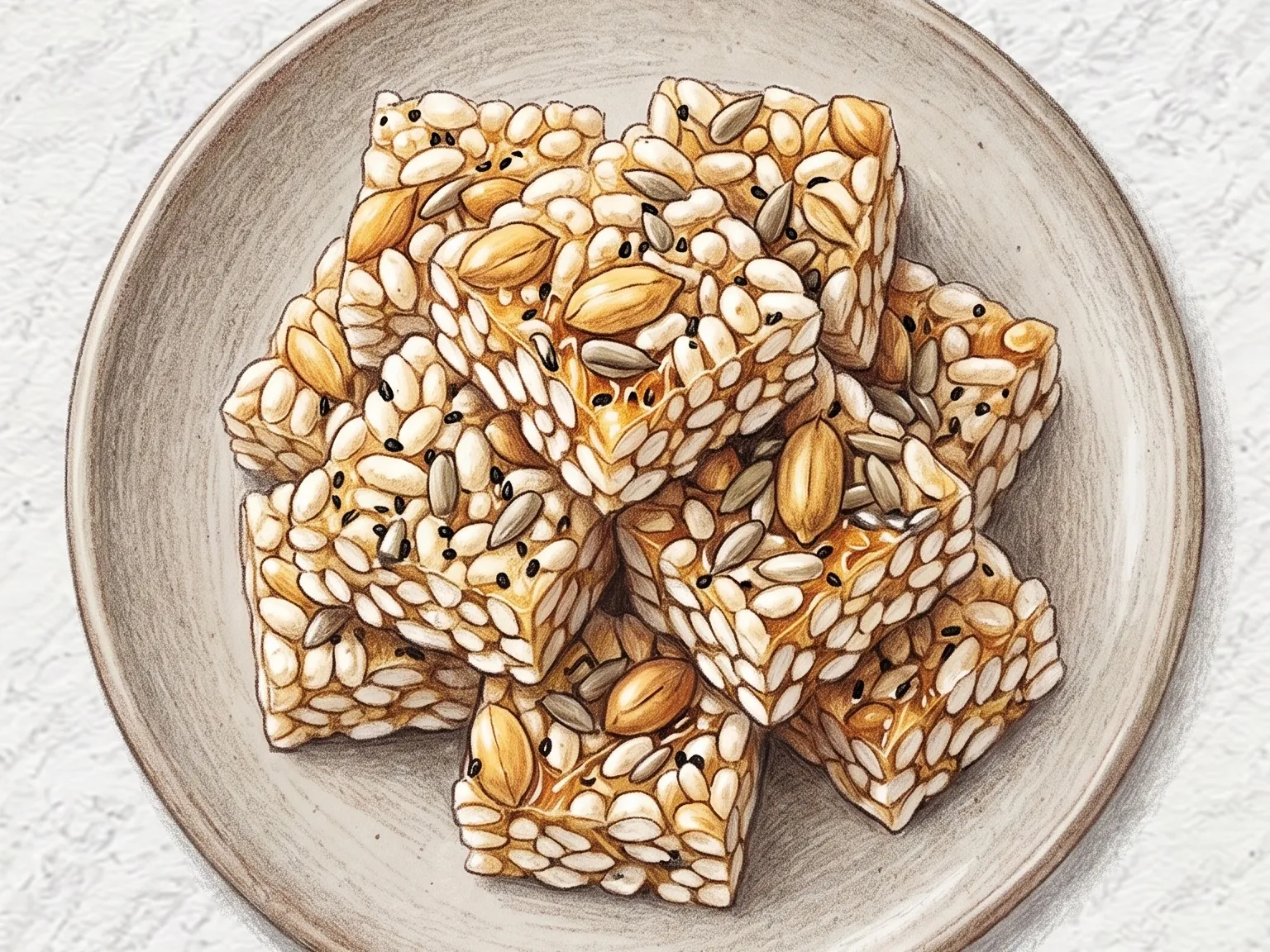
Ssal-gangjeong is a traditional Korean confection made by binding puffed rice, roasted peanuts, sunflower seeds, and black sesame in a syrup of rice malt and sugar, then...
What makes this special
- Puffed rice and roasted peanuts bound in rice malt syrup create these crisp Korean confections.
- Syrup pulled off heat at the thread stage keeps the texture crisp yet crumbly
- Puffed rice lightness contrasts with the firm crunch of peanuts and sunflower seeds
Key ingredients
Core cooking flow
- 1 Combine 180 g puffed rice, 50 g roasted peanuts, 30 g sunflower seeds, and 1...
- 2 Put 120 g rice syrup, 1 tablespoon sugar, and 0.2 teaspoon salt in a pan over low heat.
- 3 When small bubbles form around the edges and the syrup loosens, cook about 3 minutes more over low heat.
Ssal-gangjeong is a traditional Korean confection made by binding puffed rice, roasted peanuts, sunflower seeds, and black sesame in a syrup of rice malt and sugar, then pressing the mixture into a mold to set. Controlling syrup temperature is essential: heating too high makes the bars rock-hard once cooled, so stopping when the syrup forms soft threads keeps the final texture crisp yet breakable. The airy crunch of puffed rice contrasts with the firm bite of whole nuts, while black sesame adds a lingering toasty undertone. Scoring the slab before it fully cools produces clean cuts, and storing in an airtight container preserves the crispness for several days.
Instructions
Read the steps as a cooking flow: prep, heat, seasoning, doneness control, and finish.
- 1Prep
Combine 180 g puffed rice, 50 g roasted peanuts, 30 g sunflower seeds, and 1 tablespoon black sesame seeds in a large bowl.
Line the mold with parchment first so the hot mixture can be pressed immediately.
- 2Control
Put 120 g rice syrup, 1 tablespoon sugar, and 0.2 teaspoon salt in a pan over low heat.
Avoid constant stirring, and gently tilt the pan so the sugar dissolves without crystallizing on the sides.
- 3Control
When small bubbles form around the edges and the syrup loosens, cook about 3 minutes more over low heat.
Lift a spatula to check: if thin threads stretch from the syrup, turn off the heat immediately.
- 4Prep
Pour the hot syrup over the puffed rice mixture and fold quickly from bottom to top with a wide spatula.
Break up clumps as you work, stopping when the white puffed rice looks evenly glossy.
- 5Prep
Transfer the mixture to the parchment-lined mold and lightly oil your hands or spatula before pressing.
Press just enough to level and compact the surface, because packing it too firmly can make the bars dense and tough.
- 6Prep
While the slab is still warm, score cutting lines with a lightly oiled knife, then let it cool completely before separating the pieces. Store the cooled bars in an airtight container to block moisture and keep them crisp.
After the steps
Pick a recipe that fits this dish.
Continue with shared ingredients, meal pairings, or a similar method.
Recipes That Go Well With This
More Street food →Based on shared ingredients and meal pairing
Five-Grain Crispy Bars (Korean Puffed Rice and Seed Honey Bars)
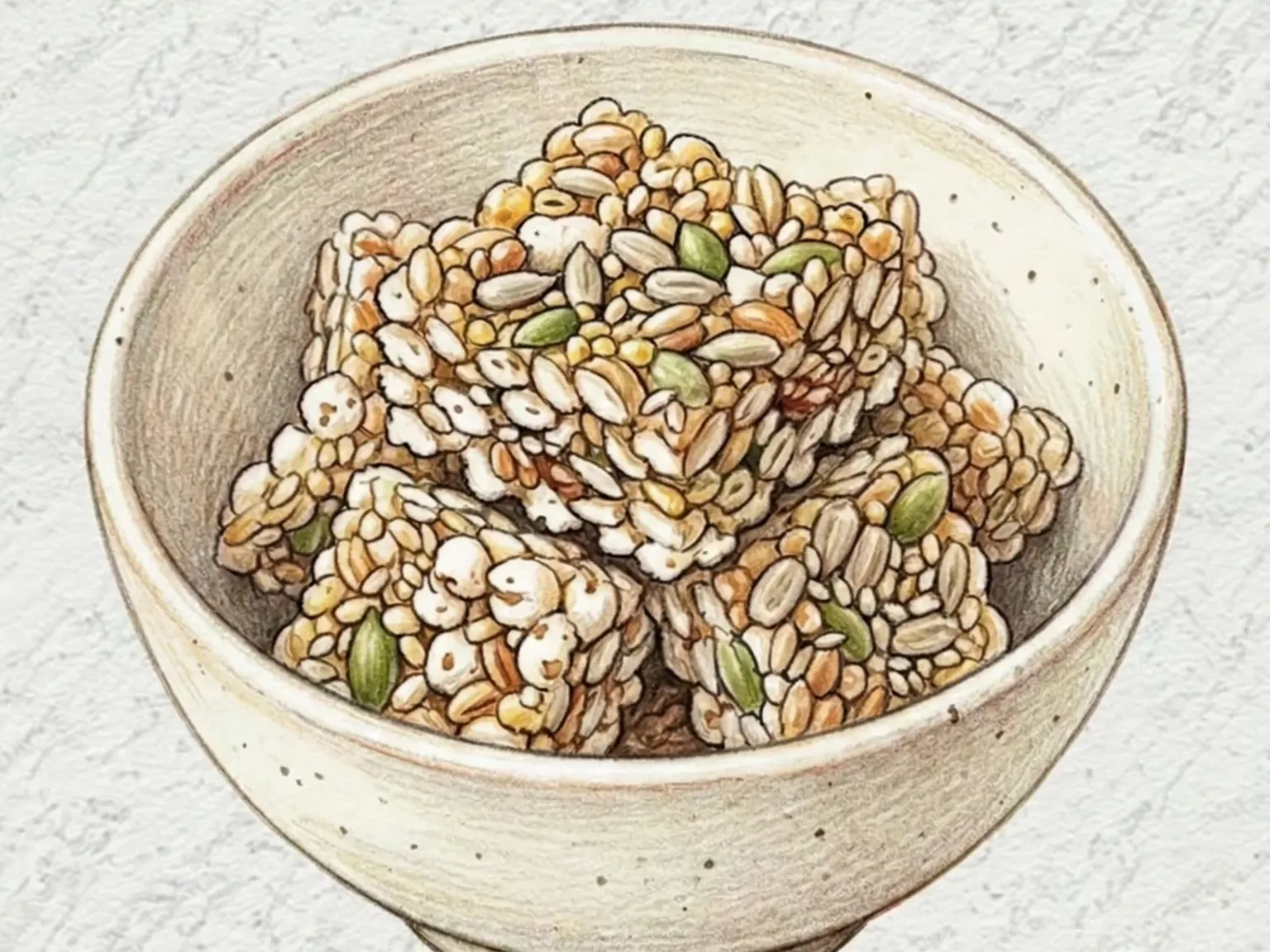
Ogok gangjeong is a traditional Korean grain bar that binds five ingredients - puffed rice, toasted brown rice, sunflower seeds, pumpkin seeds, and black sesame - with a syrup of rice syrup and honey. The syrup simmers over low heat for two to three minutes to build viscosity, then gets poured over the grain mixture and pressed into a lined pan within one minute before it sets. Each bite layers the airy crunch of puffed rice against the denser chew of brown rice, while sunflower and pumpkin seeds contribute a rich oiliness and black sesame delivers a roasted undertone throughout. Cutting with a lightly oiled knife after the bars cool completely produces clean edges, and airtight storage keeps them crisp for several days.
Korean Rice Puff Confection
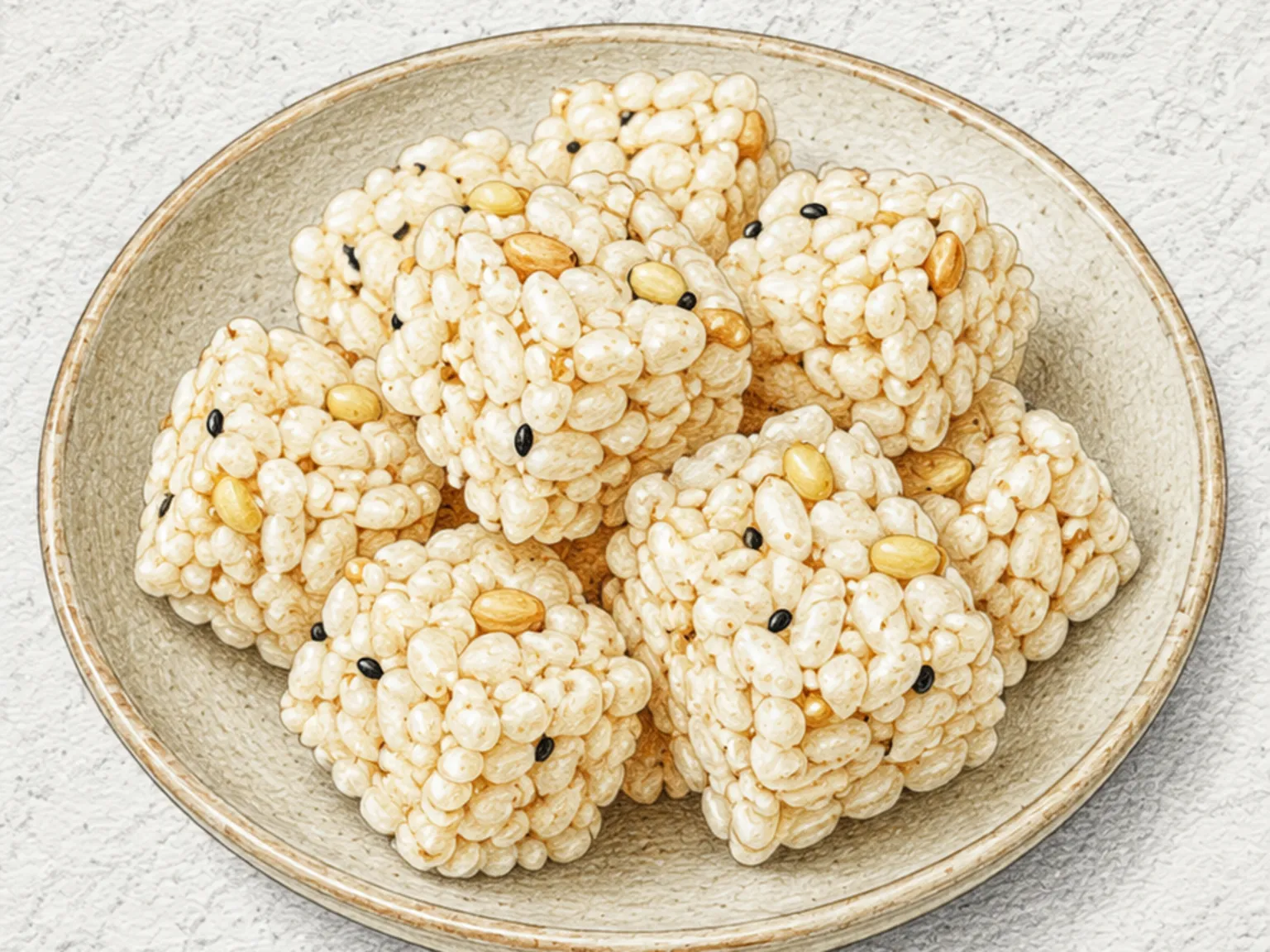
Gangjeong is a traditional Korean confection made from puffed glutinous rice bound together with warm grain syrup and pressed into molds to set. The production begins with glutinous rice that is soaked, steamed, dried thoroughly, and then deep-fried until each grain expands into a white, airy puff. The timing of the next step matters: the puffs must be turned through the hot grain syrup quickly, before the syrup cools, so that the coating bonds everything together evenly without sogginess. As the syrup cools, it hardens into a structure that feels solid when pressed but shatters cleanly under the teeth, then dissolves into a gentle sweetness on the tongue. The grain syrup is mild and naturally caramel-like, not aggressively sweet, so the toasted, nutty character of the puffed rice remains the dominant flavor. Black sesame seeds, pine nuts, or peanuts folded in before pressing add layers of nuttiness and a pleasant variation in texture. Brightly colored versions dyed with food coloring are a traditional fixture on Korean holiday tables. An oven-drying method that skips the deep frying step exists for those who want to reduce oil use, though the texture differs slightly. Stored in an airtight container away from humidity, gangjeong keeps its crunch for several days.
Candied Sweet Potato
Goguma mattang is a Korean candied sweet potato snack made by cutting peeled sweet potatoes into large chunks and deep-frying them at 170 degrees Celsius until the interior turns floury and soft. A syrup of sugar, corn syrup, water, and a measured splash of soy sauce is cooked separately until large, foamy bubbles form - the visual cue for adding the fried sweet potatoes. Everything must be coated within thirty seconds to lock in a thin, glass-like caramel shell that crisps and turns translucent as it cools. The soy sauce shifts the flavor from purely sweet to a rounded, slightly savory depth. Pre-draining surface moisture from the cut sweet potatoes reduces oil splatter during frying and helps the syrup grip the pieces evenly. Black sesame seeds are scattered over the finished pieces for a toasted, nutty note, and each piece is spread individually on parchment paper while still warm so they cool without sticking together.
Honey Rice Puff Cookies (Korean Double-Fried Puffed Glutinous Rice)
Yugwa is a traditional Korean rice puff cookie that is prepared using a base of glutinous rice flour mixed with makgeolli, which is a type of fermented Korean rice wine. This dough is shaped into individual pieces and then left to dry for a duration of at least two hours. This drying period is a mandatory step in the process because any residual moisture within the dough will lead to dangerous oil splattering when the pieces are placed into the frying fat. The cooking process requires a specific two-stage frying technique involving both low and high oil temperatures to facilitate a dramatic expansion of the dough. Tiny air pockets are created within the mixture by the yeast present in the makgeolli during the initial preparation stages. These pockets expand rapidly during the second frying stage at a higher heat, which results in the hollow internal structure that is the defining characteristic of the cookie. Once the frying is complete, the pieces are tossed in a warm glaze consisting of honey and rice syrup. This sticky coating serves to anchor a final layer of puffed rice to the exterior of the cookie. Ground cinnamon is incorporated into the recipe to provide a subtle warm spice that complements the nutty and fermented flavors of the glutinous rice. When consumed, the finished cookie shatters into light, airy shards, offering a texture that is nearly weightless compared to other varieties of Korean confections. Traditionally, yugwa is featured on tables during ancestral rites for the Chuseok and Seollal holidays and remains a common choice for gift-giving during these festive seasons.
Serve with this
Korean Rolled Omelette (Layered Vegetable Egg Roll)
Gyeran-mari - Korean rolled omelette - is a staple of Korean lunchboxes and dinner tables, a dish every Korean home cook masters early. Finely diced carrot, onion, and scallion are mixed into beaten eggs and poured in a thin stream across a lightly oiled rectangular pan. When the egg layer is half-set, it is rolled from one side to the other, then more egg mixture is poured beside the roll and the process repeats three to four times, building concentric yellow layers visible when sliced. Air trapped between the thin sheets gives the omelette its characteristic pillowy softness. Temperature control is critical - too hot and the egg browns; too cool and the layers will not bond. After cooking, wrapping the roll in a bamboo mat or kitchen towel for two minutes sets its shape into a clean cylinder. Found in school cafeterias, picnic bento boxes, and family dinners across Korea.
Korean Buckwheat Mixed Noodles
Memil makguksu is a Gangwon-do regional dish where nutty buckwheat noodles are mixed with a soy sauce, vinegar, and gochugaru dressing that balances sweet, sour, and spicy notes. Buckwheat noodles have low gluten content and break apart easily when overcooked, so precise timing is essential during boiling. Rinsing several times in cold water removes surface starch and prevents clumping. Chopped kimchi brings fermented tang and a crunchy bite, while julienned cucumber adds freshness and a crisp contrast. A touch of sesame oil gives the dressing a glossy richness, and extra vinegar can be added at the table to sharpen the acidity to individual preference.
Korean Dalgona Coffee (Whipped Instant Coffee Foam Milk)
Dalgona coffee is made by whipping equal parts instant coffee, sugar, and hot water with a hand mixer for three to five minutes until stiff, caramel-colored peaks form, then spooning the foam over iced milk. The whipped layer carries a concentrated, bittersweet coffee flavor that gradually blends into the cold, neutral milk below as you stir. A light dusting of cocoa powder on top introduces a faint chocolate note, and increasing the sugar slightly helps the whipped cream hold its stiff structure longer.
Similar recipes
Korean Milk Rice Porridge
Tarakjuk is a traditional Korean milk rice porridge made by coarsely grinding soaked rice, simmering it in water first to initiate gelatinization, then gradually incorporating milk over sustained stirring. Grinding the rice coarsely rather than to a fine paste preserves some texture in the finished porridge, preventing it from becoming uniformly smooth. Once the rice has been simmered in plain water and the starch begins to thicken the base, milk is added in two or three separate additions over ten minutes of constant stirring. Pouring all the milk in at once risks splitting due to the temperature differential between the cold dairy and the hot starch base. Each addition is stirred in fully before the next portion goes in, allowing the proteins and fats in the milk to incorporate evenly without curdling. A small pinch of salt and a measured amount of sugar are added to tie together the toasty, nutty character of the grain and the mild sweetness of the dairy -- neither should dominate. A final three minutes of simmering brings the porridge to a consistency that flows slowly off the back of a spoon. Pine nuts on top contribute a richly oily nuttiness, and a pinch of ground cinnamon adds a warm, aromatic finish. Historical records from the Joseon period note tarakjuk as a medicinal restorative prepared in the royal court.
Barley Puff Brittle (Korean Puffed Barley Walnut Sesame Candy)
Bori-gangjeong is a Korean barley puff brittle made by tossing puffed barley and roughly chopped walnuts with toasted sesame seeds in a syrup of rice malt, sugar, and honey cooked precisely to 118 degrees Celsius. Temperature is the deciding variable: below that threshold the brittle never fully sets and stays soft and sticky even when cool, while above it the result hardens into something that resists the teeth uncomfortably. Once the correct temperature is reached, the mixture must be worked quickly - the syrup sets fast. Sesame oil stirred in at the very end coats the barley in a layer of nutty fragrance that ties the toasty grain, the honey sweetness, and the dense crunch of walnut together. Scoring the slab while it is still pliable is essential: cuts made after the brittle fully sets tend to crack rather than slice cleanly, and the pieces lose their uniform shape. The deep sweetness of the rice malt syrup and the nuttiness of the barley combine into a straightforward but lingering flavor that keeps the hand returning to the plate.
Korean Sweet Glutinous Rice
Glutinous rice is soaked, steamed, and dressed with a mixture of soy sauce, sesame oil, and honey, then studded with jujubes, chestnuts, and pine nuts before a second steaming. The double-steaming process gives the rice a dense, chewy stickiness while the soy sauce penetrates each grain and tints it a deep amber. Jujubes lend a natural caramel-like sweetness, chestnuts add a crumbly, starchy contrast, and pine nuts contribute a subtle oiliness that enriches the overall taste. Traditionally prepared for the first full moon festival, yakbap is equally enjoyable as an everyday snack or packed lunch.