Zongzi (Chinese Bamboo-Wrapped Sticky Rice Dumplings)
Asian Hard

Zongzi (Chinese Bamboo-Wrapped Sticky Rice Dumplings)

Quick answer

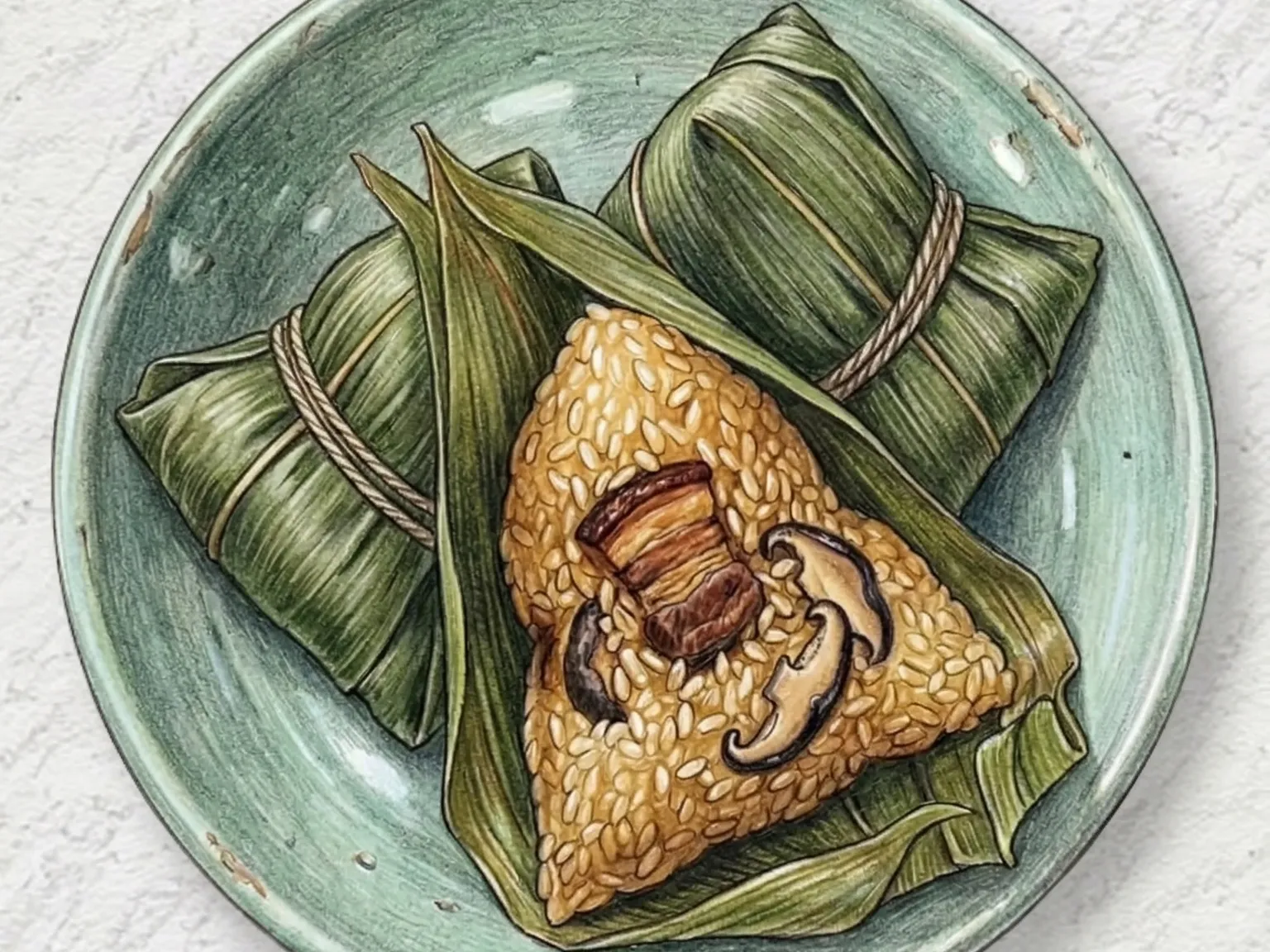
Zongzi are traditional Chinese sticky rice dumplings wrapped in bamboo leaves and simmered for hours.

What makes this special

  • Zongzi are bamboo-wrapped glutinous rice dumplings filled with soy-braised pork and mushrooms.
  • Bamboo leaf aroma seeps into the sticky rice during the 2-hour boil
  • Glutinous rice absorbs pork belly fat and soy sauce while compressing into a dense chew
Total time
180 min
Level
Hard
Servings
4 servings
Ingredients
8
Calories
540 kcal
Protein
18 g

Key ingredients

glutinous ricepork bellyshiitake mushroomssoy sauceoyster sauce

Core cooking flow

  1. 1 Soak 500 g glutinous rice for at least 4 hours, until the grains no longer f...
  2. 2 Cut 300 g pork belly into large chunks so each dumpling gets a distinct piece.
  3. 3 Rehydrate the 6 shiitake mushrooms and cut them in half.

Zongzi are traditional Chinese sticky rice dumplings wrapped in bamboo leaves and simmered for hours. Glutinous rice is soaked overnight, then bundled around a filling of soy-braised pork belly and rehydrated shiitake mushrooms seasoned with oyster sauce. The bamboo leaves are folded into a tight shape and secured with kitchen twine before being submerged in boiling water for two hours or more. During this cooking, the rice absorbs the rendered fat and seasoning from the pork, becoming dense, sticky, and deeply flavored. The bamboo leaves impart a subtle grassy fragrance that permeates every grain. While traditionally eaten during the Dragon Boat Festival, zongzi are available year-round across southern China.

Prep 60min Cook 120min 4 servings
Recipes by ingredient → shiitake mushrooms soy sauce

Instructions

Read the steps as a cooking flow: prep, heat, seasoning, doneness control, and finish.

6 steps
  1. 1
    Heat

    Soak 500 g glutinous rice for at least 4 hours, until the grains no longer feel hard in the center when pressed.

    Boil the 16 bamboo leaves for 30 minutes so they bend without cracking during wrapping.

  2. 2
    Season

    Cut 300 g pork belly into large chunks so each dumpling gets a distinct piece.

    Coat it with 3 tablespoons soy sauce, 1 tablespoon oyster sauce, and 1 teaspoon sugar, then marinate for 20 minutes so the seasoning penetrates.

  3. 3
    Control

    Rehydrate the 6 shiitake mushrooms and cut them in half.

    Stir-fry them with the marinated pork over medium heat only briefly, stopping when the pork surface looks lightly cooked and the soy and mushroom aroma rises.

  4. 4
    Step

    Overlap two bamboo leaves and shape them into a cone, then add a base layer of rice first.

    Do not overfill; pack in rice, pork with mushroom, and more rice in that order so the top closes cleanly.

  5. 5
    Heat

    Fold the leaves tightly into a triangular bundle and secure them firmly with kitchen twine.

    Press each bundle gently with your hand; if it shifts or opens easily, retie it before cooking to prevent the rice from leaking out.

  6. 6
    Finish

    Submerge the zongzi completely in boiling water and simmer over low heat for at least 2 hours, keeping them covered with water.

    Drain and rest for 10 minutes, then unwrap and serve warm when the rice is dense and sticky.

After the steps

Pick a recipe that fits this dish.

Continue with shared ingredients, meal pairings, or a similar method.

Recipes That Go Well With This

More Asian →

Based on shared ingredients and meal pairing

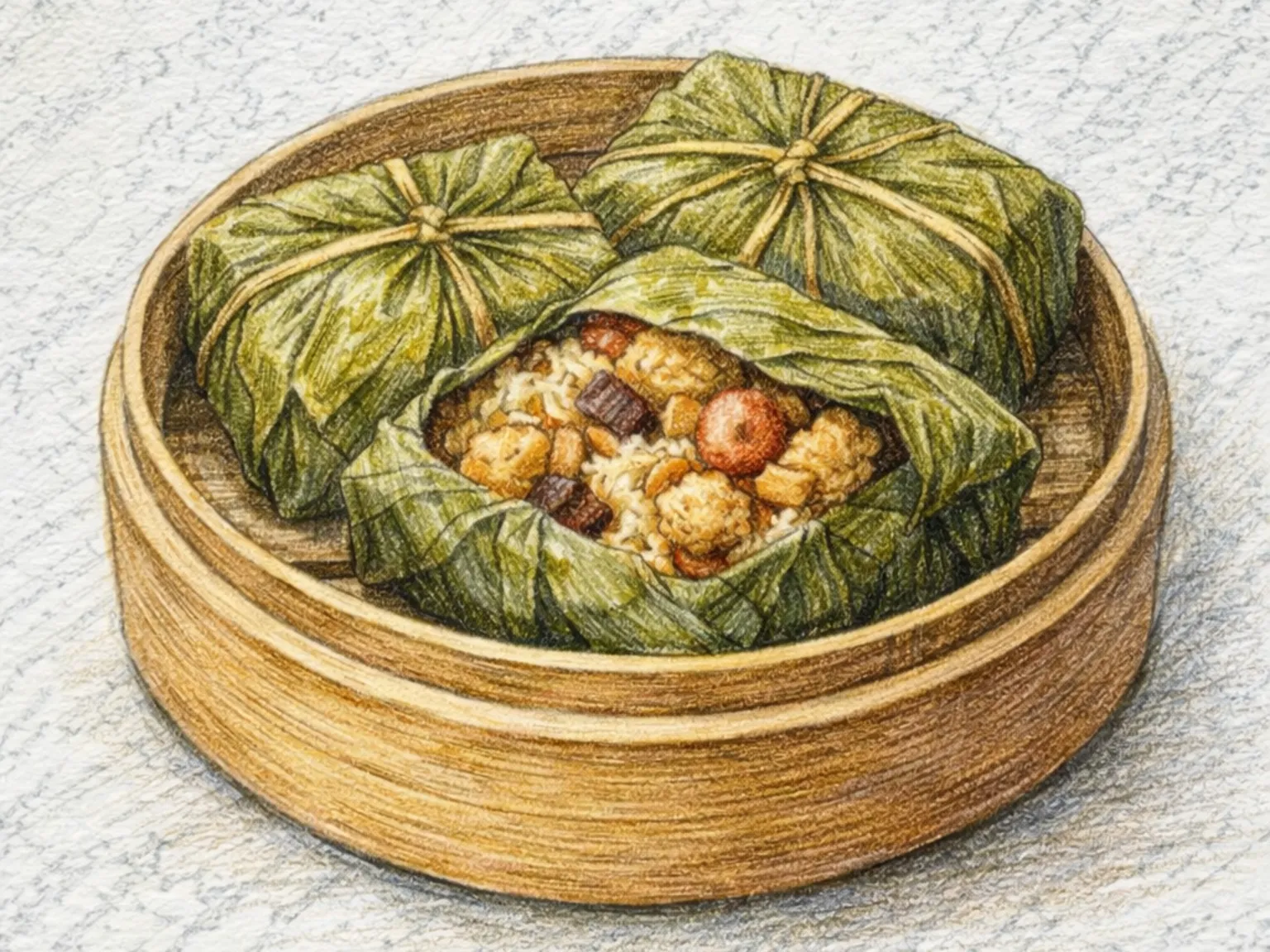
Lo Mai Gai (Cantonese Lotus Leaf Glutinous Rice with Chicken)
Shared ingredient: glutinous rice Asian

Lo Mai Gai (Cantonese Lotus Leaf Glutinous Rice with Chicken)

Lo mai gai is a Cantonese dim sum staple of glutinous rice packed with diced chicken, shiitake mushrooms, Chinese sausage, and dried shrimp, all seasoned with oyster sauce and soy sauce, then wrapped tightly in dried lotus leaves and steamed. The lotus leaf is not incidental to the dish. When the package is exposed to steam heat, the leaf releases a grassy, subtly earthy fragrance that penetrates the rice and cannot be recreated by substituting parchment or foil. The glutinous rice absorbs the seasoning from the filling as it cooks, drawing in the savory-sweet fat of the Chinese sausage, the concentrated marine umami of the dried shrimp, and the deep, woodsy aroma of shiitake mushrooms. These flavors fuse into the rice so that every spoonful carries all of them at once rather than tasting like individual components. The parcel arrives at the table in a bamboo steamer, and unfolding the leaf at the table releases a rush of steam carrying the unmistakable lotus fragrance. The traditional way to eat it is directly off the opened leaf.

Bao Zai Fan (Cantonese Claypot Rice with Chinese Sausage)
Shared ingredient: oyster sauce Asian

Bao Zai Fan (Cantonese Claypot Rice with Chinese Sausage)

Bao zai fan - claypot rice - is a Cantonese winter dish served in Hong Kong dai pai dong stalls and Guangzhou old-quarter restaurants for well over a century. Raw rice cooks directly in a heated clay vessel with Chinese sausage, cured meats, or marinated chicken layered on top; their rendered fats drip down and season the grains as they absorb liquid. Clay retains heat well after leaving the flame, continuing to toast the bottom layer of rice into a golden, crackling crust called fan jiu - the most coveted part of the whole dish. A sauce of dark soy, light soy, sugar, and sesame oil is poured over at the table and stirred through, staining the white rice amber and releasing a rush of caramelized soy fragrance. Within a single pot, textures shift from sticky-soft grains on top through a chewy middle layer to a shattering crust at the bottom - a range that has kept claypot rice central to Cantonese comfort eating despite the patience it demands.

Yu Sheng Prosperity Salad
Serve together Salads

Yu Sheng Prosperity Salad

Yu sheng prosperity salad arranges thinly sliced sashimi-grade salmon and finely julienned daikon, carrot, and cucumber in a ring on a large platter, dressed with plum sauce, lemon juice, and sesame oil, then tossed vigorously just before eating. The salmon must be sashimi-grade for food safety, and patting it dry before slicing thin allows the sweet-tart plum sauce to cling more effectively to the fish surface. Cutting all vegetables as finely as possible maximizes the surface area in contact with the dressing, ensuring every chopstick-full carries the full spectrum of flavors. Keeping the prepared vegetables chilled maintains the freshness of the raw fish once assembled. Sesame seeds sprinkled on top add a nutty aroma that layers over the fruity plum sauce, completing the festive character of the dish.

Jianbing (Chinese Savory Breakfast Crepe)
Similar recipe Asian

Jianbing (Chinese Savory Breakfast Crepe)

Jianbing is a northern Chinese street breakfast crepe assembled on a flat griddle within minutes. A thin batter of mung bean flour and wheat flour is spread into a wide circle, then an egg is cracked directly on top and smeared across the surface while still liquid. Chopped scallion is scattered over the egg before the crepe is flipped briefly to set the other side. Sweet bean sauce and chili sauce are brushed on, followed by fresh cilantro and a crispy fried wonton sheet that provides the signature crunch. The mung bean flour gives the batter a distinctive nutty flavor and slightly crisp edge that plain wheat flour cannot replicate. The whole assembly is folded into a neat rectangle meant to be eaten by hand. Timing is critical for the wonton cracker, which should be added last to prevent sogginess, creating a layered contrast of soft crepe, runny egg, sharp sauce, and shattering crunch.

Serve with this

Korean-Chinese Chicken Broth Noodles
Noodles Medium

Korean-Chinese Chicken Broth Noodles

Gis-myeon is a Korean-Chinese noodle soup in which thin wheat noodles are served in a clear, pale chicken broth topped with delicate ribbons of egg that have been poured in a fine stream and cooked into floating wisps. The broth begins with chicken breast simmered in water with aromatics; once the stock is strained and clarified, the cooked chicken is shredded into fine threads and reserved as the main garnish. Beaten egg is drizzled very slowly into the gently boiling stock while stirring in one direction, which produces the characteristic silk-like strands rather than broken scrambled curds. The seasoning is deliberately minimal: only soup soy sauce and salt are used, keeping the broth light, clean, and transparent enough to see the noodles beneath. A small measure of starch slurry stirred in just before serving gives the liquid a subtle viscosity that allows it to cling to each strand of noodle, ensuring flavor in every bite rather than leaving a watery pool at the bottom of the bowl.

🎉 Special Occasion 🏠 Everyday
Prep 15min Cook 20min 2 servings
Tomato Egg Rice Bowl (Stir-fried Tomatoes with Soft Scrambled Eggs)
Rice Easy

Tomato Egg Rice Bowl (Stir-fried Tomatoes with Soft Scrambled Eggs)

Ripe tomatoes are cut into wedges and stir-fried over high heat until they release their juices and form a natural, tangy sauce. Beaten eggs are poured in and gently folded so they stay soft and barely set, mingling with the tomato pulp. A small amount of sugar and soy sauce brings the sweet-tart balance into focus. Spooned over hot rice, the sauce soaks into the grains and the whole bowl comes together in under ten minutes, drawing on the simplicity of Chinese home cooking. It can be served as a one-bowl meal, with simple accompaniments chosen to match the sauce, broth, or topping.

🏠 Everyday ⚡ Quick
Prep 10min Cook 12min 2 servings
Clear Korean Rice Wine (Traditional Fermented Yakju)
Drinks Hard

Clear Korean Rice Wine (Traditional Fermented Yakju)

Yakju is a traditional Korean clear rice wine produced by steaming soaked glutinous rice for 35 minutes, then fermenting it with crushed nuruk starter, dry yeast, and water for seven to ten days at room temperature. Daily stirring distributes the yeast culture evenly, and sliced ginger and jujube are added during fermentation to suppress off-flavors and contribute subtle aromatics. After fermentation, the solids are allowed to settle completely so only the clear upper liquid is carefully decanted, giving yakju its transparent appearance and refined taste distinct from cloudy makgeolli. Two days of cold aging in the refrigerator rounds off the sharp alcohol edge, bringing forward a smooth, grain-forward character.

🍺 Bar Snacks 🎉 Special Occasion
Prep 25min Cook 35min 4 servings

Similar recipes

Century Egg and Pork Congee
Asian Medium

Century Egg and Pork Congee

Century egg and pork congee - pi dan shou rou zhou - is the defining Cantonese breakfast, served from dawn at congee shops across Hong Kong, Guangzhou, and the broader Pearl River Delta. The congee base demands a full hour of slow simmering over low heat, during which the rice grains break down entirely into a silky, fluid suspension. In Cantonese this texture is called sang shui - meaning the rice and water have become indistinguishable from each other - and anything short of that is considered undercooked. Lean pork is sliced thin and added during the final minutes, cooking through immediately in the residual heat of the porridge without toughening. Century egg - duck egg preserved in an alkaline mixture of clay, ash, and salt for several weeks - transforms dramatically in the process: the white sets into translucent, trembling amber jelly and the yolk becomes a creamy, dark-green semi-solid with a dense, sulfurous depth. Cubed and stirred through the porridge, the egg's alkaline richness cuts through the clean blandness of the rice base, while the pork provides a grounding savory note. White pepper, a few drops of sesame oil, and sliced scallion finish the bowl. The congee thickens rapidly once it leaves the heat, narrowing the window of ideal texture, so it must be eaten as soon as it is served.

🏠 Everyday 🎉 Special Occasion
Prep 15min Cook 50min 2 servings
Black Sesame Tangyuan (Glutinous Rice Balls with Sesame Paste Filling)
Baking Medium

Black Sesame Tangyuan (Glutinous Rice Balls with Sesame Paste Filling)

Black sesame tangyuan are Chinese glutinous rice dumplings filled with a dense, jet-black sesame paste and traditionally served in a light ginger broth during Yuanxiao Festival and the Winter Solstice -- occasions when eating round dumplings represents family reunion and wholeness. The filling is made by grinding toasted black sesame seeds and mixing them with sugar and softened butter until a thick, almost solid paste forms; chilling this paste before wrapping makes it much easier to handle and prevents it from oozing out during shaping. The outer dough is shaped from glutinous rice flour mixed with just enough boiling water to create a smooth, pliable skin that seals without cracking. Dropped into boiling water, the dumplings are ready when they float to the surface, at which point they should be transferred promptly to avoid overcooking and tearing. A single bite breaks through the springy, chewy exterior and releases the molten sesame filling, which flows out with concentrated nuttiness. Served in a ginger syrup made by simmering fresh ginger slices with rock sugar, the warmth and mild spice of the broth complement the heavy richness of the sesame, making the bowl feel balanced despite its density. The textural contrast between the elastic skin and the flowing interior is what makes tangyuan distinctly satisfying.

🎉 Special Occasion 🧒 Kid-Friendly
Prep 30min Cook 10min 4 servings
Lotus Seed Mooncake (Sweet Lotus Paste in Golden Syrup Crust)
Baking Hard

Lotus Seed Mooncake (Sweet Lotus Paste in Golden Syrup Crust)

Lotus seed paste is wrapped in a thin dough of golden syrup, neutral oil, alkaline water, and flour, then pressed into decorative molds and baked to produce this iconic Chinese Mid-Autumn Festival pastry. The syrup-based dough remains pliable and moist even after baking, unlike a standard pie crust, creating a skin that yields softly under the teeth before giving way to the dense, sweet filling. The ratio of filling to dough is intentionally high, so each bite delivers concentrated lotus seed flavor. Mooncake molds stamp intricate patterns onto the surface, but a heavy-handed egg wash blurs those details; a single thin coat preserves the design while adding a glossy, amber sheen. Baking in two stages at 190 degrees Celsius, with the egg wash applied between them, ensures even coloring without over-browning. The crucial final step is resting: sealed in an airtight container for at least one day, the dough absorbs oil from the filling in a process called hui-you, softening its texture and harmonizing the flavors into a cohesive whole.

🎉 Special Occasion 🧒 Kid-Friendly
Prep 40min Cook 30min 4 servings

Tips

If tied too loosely, the dumplings may open while simmering.
Avoid overfilling so wrapping stays neat and secure.

Nutrition (per serving)

Calories
540
kcal
Protein
18
g
Carbs
63
g
Fat
22
g