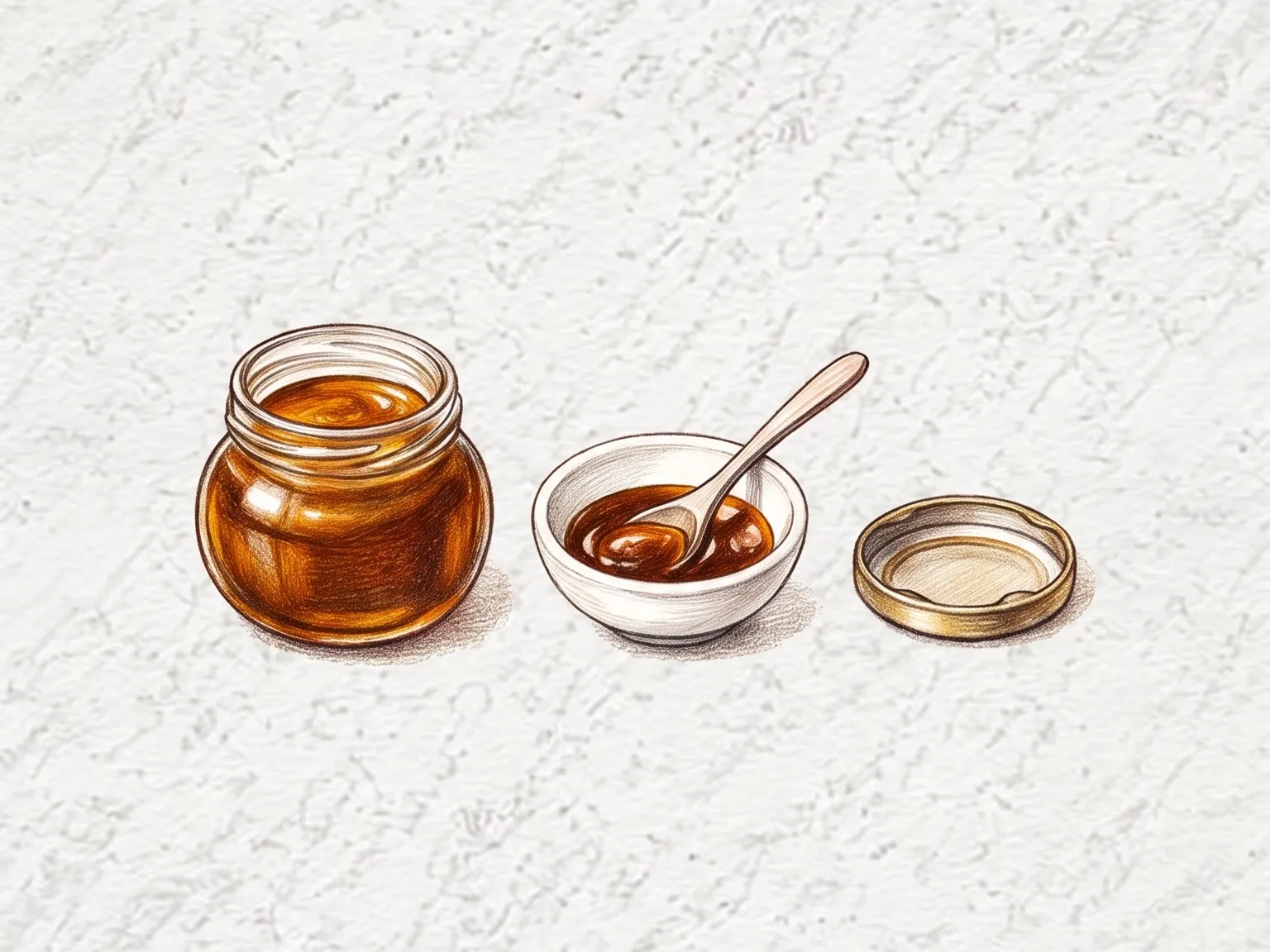
Korean Bellflower Root Syrup Preserve (Doraji-cheong)
Quick answer
- Total time
- 105 min
- Level
- Medium
- Yield
- 1 batch
- Ingredients
- 4
About this dish
Some cooks slice raw bellflower root and leave it in honey, but here peeled doraji is pureed with Korean pear, mixed with honey equal to the weight of the root and cooked down over low heat for more than an hour.
Read more
Because the fiber cooks down with it, the syrup turns thick enough to spoon, like a loose jam, and it can go into hot water the same day. Most failures happen at the bottom of the pot. Once the honey is in, the puree catches easily, so scrape the base with a spatula every five minutes, and take the pot off the heat while the syrup is still a little looser than jam, because it firms up as it cools. Unlike baedoraji-cha, the pear and bellflower tea that is simmered and strained for each pot, a jar of doraji-cheong waits in the refrigerator, two spoonfuls per cup.
Ingredients
Instructions
Stops the screen from turning off while you cook.
- 1
If you bought whole roots, pull off the fine rootlets, scrape away the skin with a knife and weigh out 400 g.
Already peeled doraji needs only a rinse in cold water to remove any soil.
- 2
Sprinkle the root with 1 tablespoon coarse salt and rub it hard for about 3 minutes; when the liquid turns cloudy, rinse two or three times in cold water. Chew a piece to check that no saltiness remains, shake off the water and cut the root into 2 cm (¾ inch) lengths.
- 3
Peel and core the pear, weigh out 400 g and cut it into large chunks.
- 4
Blend the pear first until it turns to juice, then add the root and blend until no bits remain.
Do not add water unless the blades spin freely, and then only 1 tablespoon at a time.
- 5
Pour the puree into a wide, heavy-bottomed pot over medium heat.
When it starts bubbling at the edges, stir in the 400 g of honey and turn the heat down to low.
- 6
Cook uncovered over low heat for at least 1 hour.
With the honey in, the puree sticks easily, so scrape the whole base with a spatula every 5 minutes, and lower the heat further if it spatters.
- 7
While it cooks, wash two 500 ml glass jars and their lids with detergent, put them in a pot and cover with cold water.
Once the water boils, give it 5 more minutes, then lift the jars out with tongs and stand them upside down until the insides are dry.
- 8
It is done when a spatula drawn across the bottom leaves a path that stays open for a moment before slowly closing, and the color has deepened to amber. It thickens as it cools, so stop while it is still a little looser than jam.
- 9
Turn off the heat and leave it for about 10 minutes until the steam dies down, then divide it between the sterilized jars.
Cover them with a clean cloth until completely cool, then close the lids and refrigerate.
- 10
For a cup, put 2 tablespoons of doraji-cheong in a mug, pour in 200 ml of hot water and stir until it loosens.
The pulp settles, so stir once more halfway through.
References checked
These references were consulted when this page was prepared or corrected. A source check does not mean the recipe was independently kitchen-tested.
- 도라지 활용법 보도자료: 배도라지청 만드는 법 (2016-02-23)
농촌진흥청 · Checked: 2026-10-26
- 이달의 식재료: 도라지 (구입요령, 보관법, 손질법)
농촌진흥청 농식품올바로 · Checked: 2026-10-26
- 배 도라지 생강 청 (모두누리단 서포터즈, 2020-12-03)
농림축산식품부 농식품정보누리 · Checked: 2026-10-26
- 1세 미만 영아 벌꿀 섭취 주의 홍보 포스터 및 리플릿 (2017-05-15)
식품의약품안전처 · Checked: 2026-10-26
Use-up ingredient planner
Turn these ingredients into two more meals
The overlap excludes basic seasonings. Open the next recipe and your selected dishes will stay with you.
Korean Grilled Garaetteok
honey
Korean Grilled Chicken Skewers
honey
Korean Lemon Pepper Dakgangjeong
honey