Perfectly Salted Cabbage
Kimchi Medium

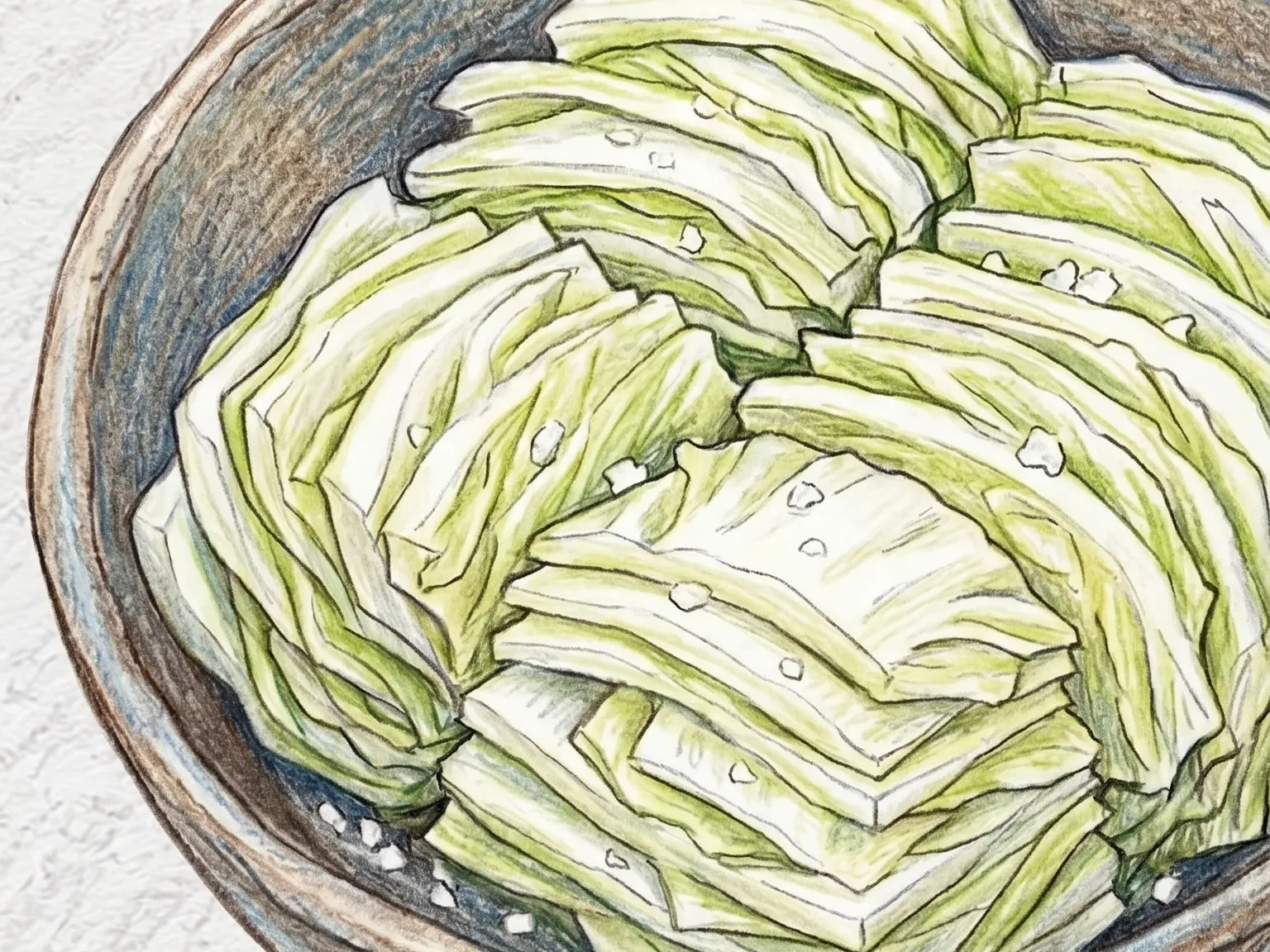
Perfectly Salted Cabbage

Quick answer

The secret to perfectly salting cabbage for the best kimchi texture.

What makes this special

  • Kelp and shiitake broth provide the umami backbone for properly salted Sogeum-baechu cabbage.
  • Sea salt dissolved in kelp and shiitake broth gives the brine umami backbone
  • Flipping midway ensures even brining across thick and thin layers in 6-8 hours
Total time
490 min
Level
Medium
Servings
4 servings
Ingredients
6
Calories
40 kcal
Protein
2 g

Key ingredients

Napa CabbageCoarse Sea SaltWaterDried KelpDried Shiitake Mushroom

Core cooking flow

  1. 1 Trim any damaged outer leaves from 2 heads of napa cabbage.
  2. 2 Put 2 L water, 1 piece dried kelp, and 2 dried shiitake mushrooms in a pot over medium heat.
  3. 3 Dissolve 1 cup coarse sea salt fully into the cooled base to make the brine.

The secret to perfectly salting cabbage for the best kimchi texture.

Prep 10min Cook 480min 4 servings

Instructions

Read the steps as a cooking flow: prep, heat, seasoning, doneness control, and finish.

6 steps
  1. 1
    Prep

    Trim any damaged outer leaves from 2 heads of napa cabbage.

    Cut only a deep slit through the base, then pull the cabbage apart by hand so the leaves stay intact and the white stems split cleanly.

  2. 2
    Control

    Put 2 L water, 1 piece dried kelp, and 2 dried shiitake mushrooms in a pot over medium heat.

    Once it boils, simmer 5 minutes, then cool completely so hot liquid does not soften the cabbage too quickly.

  3. 3
    Season

    Dissolve 1 cup coarse sea salt fully into the cooled base to make the brine.

    Use aged salt with the bitterness drained out, and add the optional 1/2 tsp New Sugar only if using it.

  4. 4
    Season

    Dip each cabbage half deeply in the brine so liquid reaches between the leaves.

    Sprinkle the remaining 1 cup coarse sea salt mainly between the thick white stems, using less on the tender leafy parts.

  5. 5
    Season

    Place the cabbage in a large container and pour in the remaining brine.

    Salt for 6-8 hours, turning the top and bottom pieces after 3-4 hours so pressure and brine reach every section evenly.

  6. 6
    Season

    The cabbage is ready when a white stem bends softly without snapping.

    Rinse 3 times under running water, then set the cut sides down and drain at least 2 hours so kimchi seasoning can cling well.

After the steps

Pick the next recipe from here.

Continue with a similar dish, a pairing, or the same category.

Tips

Use aged sea salt with the bitterness drained out for the best flavor.
Drain the water for at least 2 hours so the kimchi seasoning sticks well.

Nutrition (per serving)

Calories
40
kcal
Protein
2
g
Carbs
8
g
Fat
0
g

Recipes to Cook Together

More Kimchi →

Serve with this

Country-style Soybean Paste Stew
Stews Easy

Country-style Soybean Paste Stew

A traditional stew featuring the deep, earthy flavor of country-style fermented soybean paste.

🔥 Trending Now 🏠 Everyday
Prep 15min Cook 20min 2 servings
Korean Grilled Hard Clams with Doenjang Sauce
Grilled Medium

Korean Grilled Hard Clams with Doenjang Sauce

Baekhap doenjang gui is a Korean grilled clam dish where hard clams are topped with a doenjang sauce and cooked over direct flame or in an oven. The clams must be purged in salt water for at least three hours before cooking, then shucked so that only the half shell carrying the meat remains. The sauce -- doenjang, minced garlic, cheongyang chili, and sesame oil -- is spread in a thin layer over each clam; too thick a coating and the fermented salt of the doenjang drowns out the natural brininess of the shellfish itself. Over high direct heat for three to four minutes, the doenjang surface scorches lightly, developing a caramelized, roasted aroma while the clam meat contracts and concentrates its juices within the shell. Finely sliced scallion scattered on top adds a green visual accent against the brown doenjang glaze. Timing is critical: the moment the liquid pooled in the concave shell begins to bubble, the clams should be lifted off the heat immediately, because even one additional minute toughens the meat to the point of unpleasantness. The dish depends on the interplay between two distinct kinds of salt -- the oceanic brine of the clam and the fermented depth of the doenjang -- which converge into a single concentrated bite that rewards restraint in the sauce application.

🍺 Bar Snacks 🏠 Everyday
Prep 25min Cook 9min 4 servings
Braised Boneless Jokbal
Steamed Easy

Braised Boneless Jokbal

A special dish of boneless pork trotter braised in a savory soy-based sauce.

🔥 Trending Now 🏠 Everyday
Prep 15min Cook 30min 2 servings
Korean Ginger Pumpkin Porridge
Rice Easy

Korean Ginger Pumpkin Porridge

Kabocha pumpkin is steamed for 15 minutes and pureed until velvety, then thickened with sweet rice flour dissolved in cold water to prevent lumps. A teaspoon of fresh ginger juice adds a warm, peppery undercurrent beneath the pumpkin's natural sweetness, sharpening the finish without overpowering the squash. The porridge is stirred continuously over medium-low heat as the rice flour gradually builds body, and pine nuts scattered on top contribute an oily, resinous richness that complements the sweetness. This recipe yields four servings, making it well suited for sharing.

🥗 Light & Healthy 🏠 Everyday
Prep 15min Cook 30min 4 servings

Similar recipes

Fresh Whole Cabbage Kimchi
Kimchi Medium

Fresh Whole Cabbage Kimchi

Crispy and refreshing whole cabbage kimchi made to be eaten fresh.

🔥 Trending Now 🥗 Light & Healthy
Prep 40min Cook 15min 4 servings
Korean Napa Cabbage Kimchi
Kimchi Medium

Korean Napa Cabbage Kimchi

Baechu kimchi is Korea's definitive fermented food - salted napa cabbage layered with a seasoning paste of gochugaru, anchovy fish sauce, garlic, ginger, and glutinous rice paste, then fermented at controlled temperatures until the correct balance of salt, heat, umami, and lactic acid develops. Kimchi is not a pickled vegetable in the Western sense; it is a living fermented food whose character changes continually from the moment it is made. The salting step is the technical foundation. Coarse sea salt draws moisture from the cabbage over six to eight hours, making the stems flexible while leaving the characteristic crunch intact. Under-salting results in kimchi that weeps too much liquid during fermentation and turns mushy; over-salting suppresses microbial activity and masks the seasoning. The glutinous rice paste in the seasoning serves two purposes simultaneously: it acts as an adhesive that keeps the seasoning paste clinging to each leaf rather than sliding off, and it provides fermentable sugars that give the lactobacillus bacteria an early food source, accelerating the initial fermentation. Julienned radish adds textural contrast, and scallions contribute a layer of savory depth. After one day at room temperature to establish the bacterial culture, the kimchi moves to cold storage where lactic acid accumulates slowly. At two to three weeks, the heat from gochugaru, the umami from fish sauce, and the acidity from fermentation reach their optimal equilibrium. Older kimchi - four weeks or more - develops a pronounced sourness and deeper, more fermented flavor that makes it better suited for cooking in kimchi-jjigae or kimchi-bokkeum than for eating raw.

🍱 Lunchbox 🥗 Light & Healthy
Prep 50min 4 servings
Korean White Kimchi (Non-Spicy Napa Pear Fermented)
Kimchi Medium

Korean White Kimchi (Non-Spicy Napa Pear Fermented)

Baek kimchi is a Korean white kimchi made without gochugaru, producing a completely non-spicy, clear-broth fermented vegetable. Napa cabbage is salted and wilted, rinsed, then layered with julienned radish, sliced garlic, and ginger tucked between the leaves. Pureed pear serves as a natural sugar source that feeds fermentation, while dried jujubes add a subtle background sweetness to the brine. Salted water is poured over the assembled cabbage, the container is sealed, and after one day at room temperature the kimchi moves to the refrigerator for a slow ferment. Without chili heat, the flavor centers on the clean lactic acidity that develops over time, balanced by the natural sweetness of pear and jujube and the warm bite of garlic and ginger dissolved into the brine. The fermentation is slower than standard kimchi, reaching optimal taste at two to three weeks. It is eaten with its brine, either on its own or as a palate-clearing side alongside fatty meat dishes. Before chili peppers were introduced to the Korean peninsula in the late sixteenth century, kimchi without gochugaru was the standard form, and baek kimchi is considered the closest modern equivalent to those pre-chili preparations.

🏠 Everyday 🍱 Lunchbox
Prep 50min Cook 20min 4 servings
Traditional Kimjang Cabbage Kimchi
Kimchi Hard

Traditional Kimjang Cabbage Kimchi

The golden recipe for traditional winter kimjang cabbage kimchi.

🔥 Trending Now 🥗 Light & Healthy
Prep 60min Cook 60min 4 servings
Korean Fresh Cabbage Kimchi
Side dishes Easy

Korean Fresh Cabbage Kimchi

Geotjeori is kimchi's immediate cousin - raw napa cabbage dressed in gochugaru seasoning and eaten right away without any fermentation. The cabbage is salted for about twenty minutes to draw out moisture and soften the texture slightly, then squeezed dry and tossed with red pepper flakes, anchovy fish sauce, minced garlic, minced ginger, sugar, and a finishing drop of sesame oil. The brief salting pulls just enough water from the leaves to let the seasoning coat them evenly while keeping the cabbage noticeably crisper than fermented kimchi. Without the lactic acid produced during aging, the flavor profile is fresher and more direct - the heat of the gochugaru and the savory depth of the fish sauce come through cleanly rather than sitting under layers of fermented complexity. Geotjeori is best eaten the day it is made and should be used within a day or two if refrigerated. Koreans pair it with grilled pork belly, alongside doenjang-jjigae, or as a quick substitute when the aged kimchi jar runs empty.

🏠 Everyday 🍱 Lunchbox
Prep 20min 6 servings
Korean Napa Cabbage Doenjang Soup
Soups Easy

Korean Napa Cabbage Doenjang Soup

Baechu doenjang guk is a foundational Korean soup built on anchovy-kelp stock seasoned with fermented soybean paste and napa cabbage. Straining the doenjang through a fine sieve as it dissolves into the hot stock keeps the broth visually clear while extracting the full depth of its fermented, earthy flavor. The cabbage stalks go into the pot first and simmer for five minutes alone, drawing out their inherent sweetness before the leaf sections and cubed tofu are added. A small spoonful of gochujang introduced at this point gives the broth a gentle heat and a reddish cast that adds both visual contrast and flavor complexity beyond doenjang alone. Sliced cheongyang chili and scallion are stirred in during the final two minutes, contributing sharpness and aroma without turning limp. Doenjang saltiness varies significantly between brands and aged batches, so starting with a conservative amount and adjusting by taste prevents over-salting. As the cabbage softens fully, its natural sweetness seeps gradually into the broth, where it finds a natural balance with the deep fermented character of the paste. It is among the most accessible soups in Korean home cooking, requiring only the most common pantry and refrigerator ingredients.

🏠 Everyday 🥗 Light & Healthy
Prep 12min Cook 20min 4 servings