Handmade Piped Carnation Cookies
Quick answer
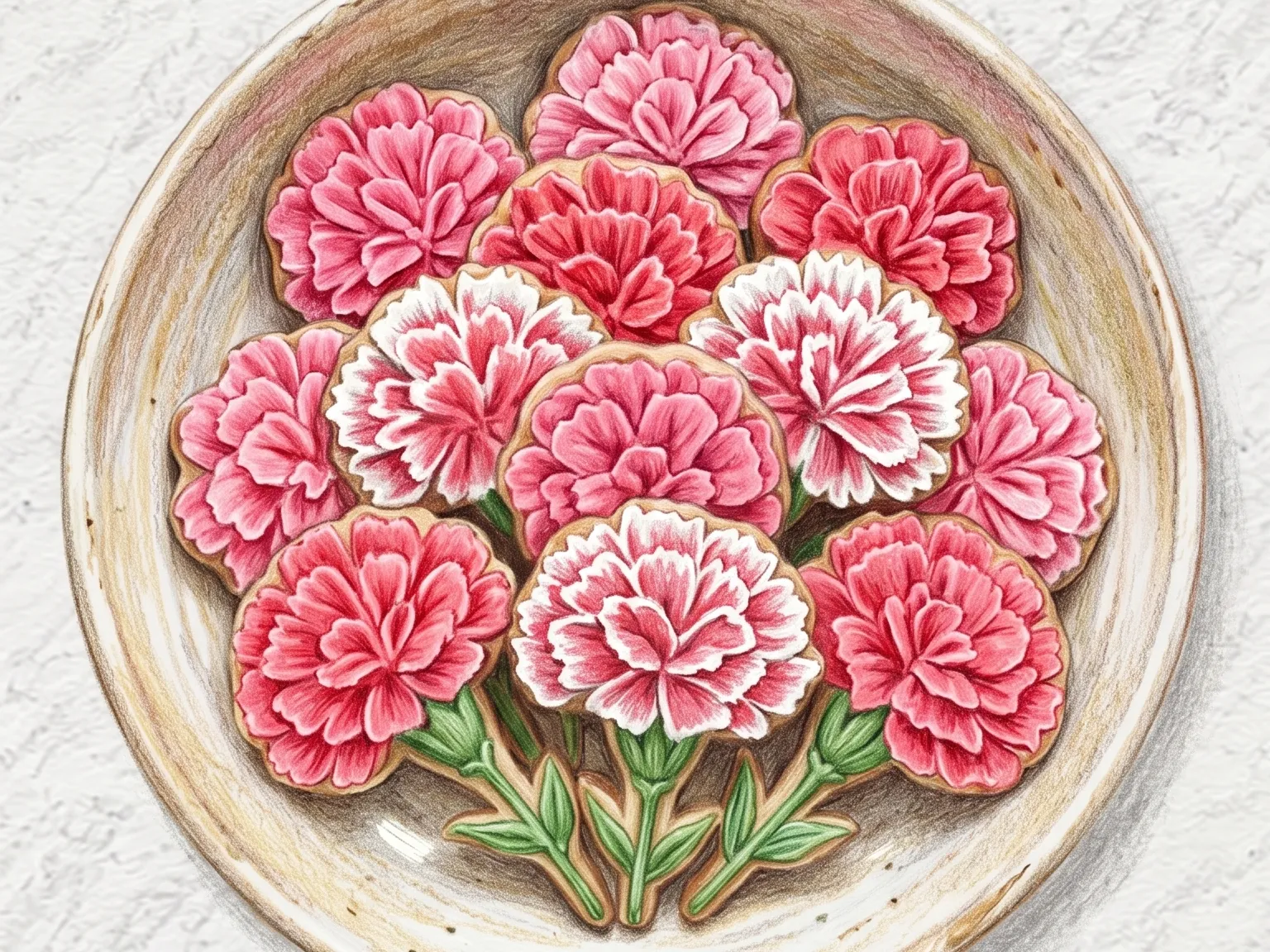
Beautiful carnation-shaped cookies created with piped dough to express gratitude.
- Handmade Piped Carnation Cookies use egg whites to maintain a bright red hue after baking.
- Egg white instead of yolk keeps the red more vivid after baking
Key ingredients
Core cooking flow
- 1 Cream room-temperature butter with powdered sugar and salt until light.
- 2 Add egg whites in 2-3 batches and mix thoroughly until emulsified.
- 3 Sift in cake flour and almond flour; fold gently to complete the cookie dough.
Beautiful carnation-shaped cookies created with piped dough to express gratitude.
What Makes This Special
- Handmade Piped Carnation Cookies use egg whites to maintain a bright red hue after baking.
- Egg white instead of yolk keeps the red more vivid after baking
- Petal-tip piping creates individually defined petal edges
- 4:1 red-to-green dough ratio mirrors carnation's flower-to-leaf proportion
Instructions
- 1
Cream room-temperature butter with powdered sugar and salt until light.
- 2
Add egg whites in 2-3 batches and mix thoroughly until emulsified.
- 3
Sift in cake flour and almond flour; fold gently to complete the cookie dough.
- 4
Color 4/5 of the dough red and the remaining 1/5 green using food coloring.
- 5
Pipe red dough using a petal tip to form the carnation flower shape.
- 6
Add leaf shapes with green dough and bake at 160°C for 15 minutes.
Tips
Nutrition (per serving)
Recipes to Cook Together
More Baking →Serve with this
ACV Honey Ginger Tea
A warm healthy tea that maximizes the benefits of ACV for digestion and blood sugar control.
Omija Bead Ice Cream
A unique dessert of five-flavored Omija frozen into cute bead shapes.
Mortadella Pistachio Sandwich
A luxurious Italian sandwich featuring mortadella and savory pistachio paste.
Chia Seed Yuja Dressing Tofu Salad
A healthy salad with refreshing yuja dressing and crunchy chia seeds.
Similar recipes
Gingerbread Men
Gingerbread men are spiced cookies shaped like small figures, made from a dough enriched with molasses, ground ginger, cinnamon, and cloves. The molasses contributes a deep amber color and a bitter undertone that distinguishes these cookies from simpler butter cookies, while the spice blend delivers a warmth that builds gently across the palate. Chilling the dough for at least one hour before rolling ensures it holds its shape through cutting and baking, so the finished cookies emerge with crisp, defined edges rather than rounded, puffy outlines. Once fully cooled, royal icing piped into eyes, mouths, and buttons turns each cookie into a small edible character. The ideal texture balances a snappy bite at the rim with a slightly chewy center that keeps the cookie from crumbling apart. Stored in a sealed container, the cookies improve over a day or two as the spice flavors meld and deepen. The recipe is simple enough for children to help with shaping and decorating, making it a fixture of winter holiday baking in many households.
Meringue Cookies
Built from nothing more than egg whites and sugar, meringue cookies are baked low and slow until nearly all moisture evaporates, leaving behind a shell that shatters at the slightest pressure and dissolves on the tongue in seconds. The interior is a lattice of tiny air cells - so fragile that each piece weighs almost nothing despite its volume. A small measure of vanilla extract tames any residual egginess and adds a gentle perfume. Humidity is the one enemy: stored outside an airtight container, the cookies turn tacky and lose their snap within hours. Folding in a spoonful of cocoa powder or matcha before piping shifts both the color and flavor profile without altering the texture. They pair well with black coffee or tea, where their sweetness serves as a counterpoint to bitterness.
Chocolate Chip Cookies
Chocolate chip cookies are the most commonly baked cookie in American home kitchens, and despite a seemingly simple ingredient list the recipe conceals a precise set of variables that separate a good cookie from a great one. The ratio of brown sugar to granulated white sugar is the single most important decision: more brown sugar introduces molasses, which is hygroscopic and holds moisture in the finished cookie, producing a chewy, dense texture; more white sugar encourages the dough to spread in the oven and crisps the edges. Creaming softened butter with the sugars until the mixture turns pale and fluffy incorporates air into the dough, which gives the baked cookie lift and a slightly cakey interior. Chocolate chips, whether semi-sweet, dark, or a mixture, melt during baking and spread into the surrounding dough before re-solidifying as the cookie cools, forming pockets of concentrated chocolate distributed unevenly through each cookie. The moment to pull the tray from the oven is when the edges have set and turned golden while the center still appears underdone and almost raw-looking, because the residual heat of the pan continues to cook the interior as the cookies rest and cool. Pressing flaky sea salt into the surface of each cookie just before baking sharpens all the flavors, making the chocolate taste more chocolatey and the butter taste more buttery. Eaten warm, within minutes of coming out of the oven, a good chocolate chip cookie barely holds together and melts at the edges with the slightest pressure. That fragile, yielding moment is the whole point.
Florentine Cookies (Caramel Almond Lace with Chocolate)
Florentine cookies are thin, lace-like biscuits made by stirring sliced almonds, candied orange peel, and dried cherries into a hot caramel of sugar, butter, and heavy cream, then spooning small pools of the mixture onto a lined baking sheet. In the oven, the caramel re-liquefies and spreads, binding the nuts and fruit into flat, crisp discs with a translucent amber surface. The baked rounds are fragile and catch the light like stained glass when held up. Once cooled, one side is coated with tempered dark chocolate, and a fork is dragged through the surface just before setting to create the classic wave pattern. The texture sequence is distinctive: the first bite shatters the caramel shell cleanly, then gives way to chewy pockets of dried fruit embedded in the caramel. Flavor-wise, toasted caramel sweetness opens first, followed by the bitter note of orange peel, the nuttiness of almonds, and finally the deep bitterness of dark chocolate. The combination is considerably more layered than the cookies' fragile appearance suggests. Stored in an airtight container, they hold their snap well for several days, making them a reliable choice for gift boxes or holiday platters.
Rosemary Focaccia
Rosemary focaccia is an Italian olive-oil bread made from a high-hydration dough that is proofed twice, dimpled with fingertips, topped with rosemary, minced garlic, and flaky salt, and baked at 220 degrees Celsius. The wetter the dough, the better the signature open crumb and chewy interior develop, so resisting the urge to add extra flour during handling is important. A sixty-minute first proof followed by a thirty-minute second proof gives the yeast enough time to produce the gas that creates a light, airy structure. Generous olive oil pooled in the dimples essentially fries the surface during baking, creating crisp pockets across the top. Cooling for ten minutes after baking lets steam escape and sharpens the contrast between the crunchy crust and the moist, pillowy crumb inside.
Cornbread
Cornbread is a Southern American quick bread made from cornmeal, flour, sugar, baking powder, milk, egg, and melted butter, baked until golden. Mixing the wet and dry ingredients separately and combining them with minimal stirring prevents overdeveloping gluten, which keeps the crumb tender and moist rather than tough. Baking at 200 degrees Celsius for twenty-two to twenty-five minutes produces a crisp exterior with a lightly sweet, nutty interior characteristic of cornmeal. The bread pairs well with stews, chili, and soups; its coarse grain absorbs broth and sauce effectively, making every bite more flavorful the longer it sits in the bowl.