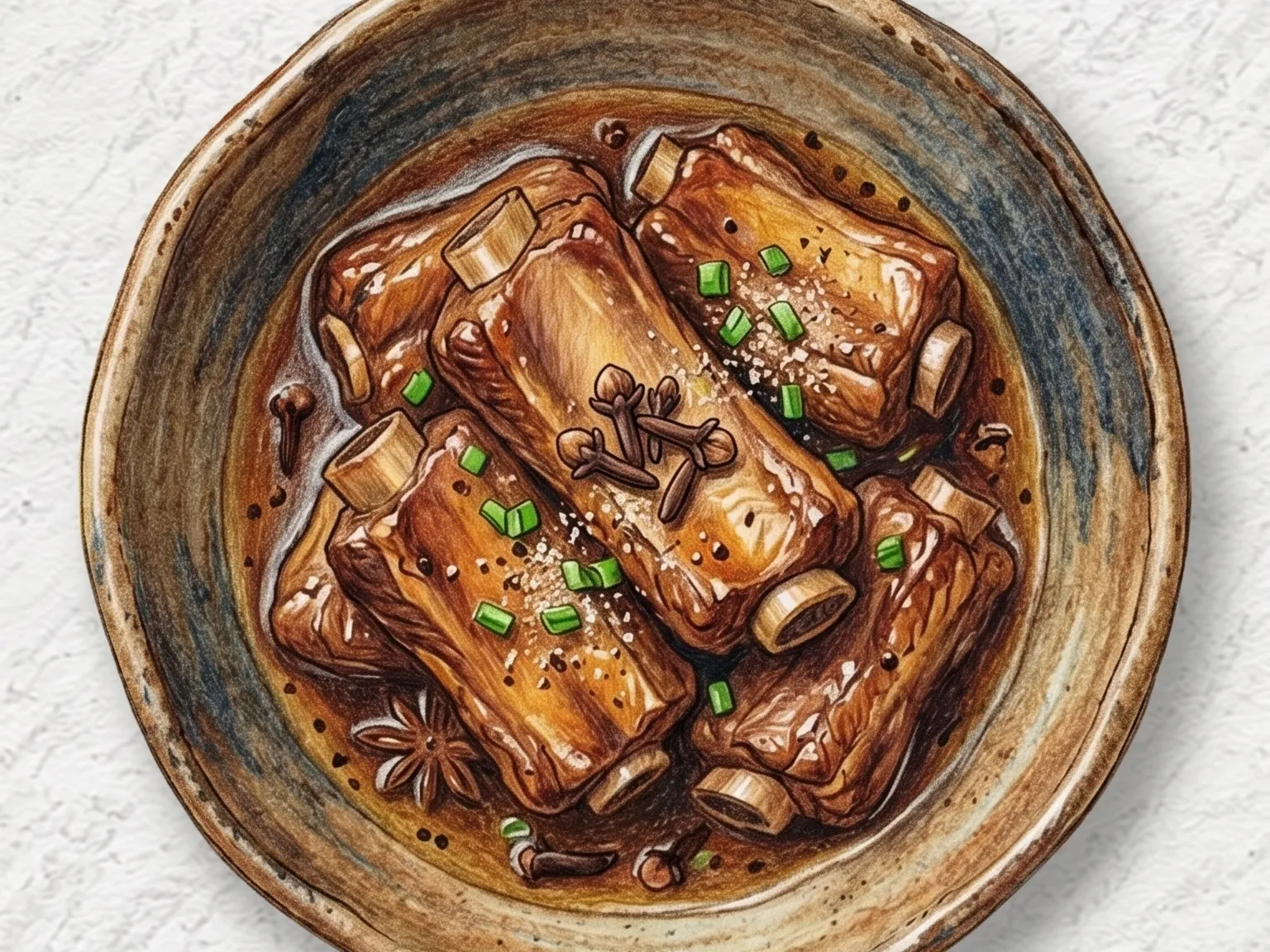
Clove-Scented Lu Shui Braised Pork Ribs
Quick answer
A Taiwanese-style braised pork rib recipe infused with the deep aroma of cloves.
What makes this special
- Clove-scented Lu Shui pork ribs are braised in a deep, resinous broth of star anise and cloves.
- Cloves and star anise build a deep, resinous spice base
- Bing tang caramelized before the ribs go in for glossy mahogany color
Key ingredients
Core cooking flow
- 1 Soak 800g pork ribs in cold water for 30 minutes to draw out blood, then bla...
- 2 Heat 1 tablespoon of oil in a pan over medium heat, add 30g rock sugar, and...
- 3 Add the blanched ribs to the pan and stir-fry over medium-high heat for 2 mi...
A Taiwanese-style braised pork rib recipe infused with the deep aroma of cloves.
Instructions
Read the steps as a cooking flow: prep, heat, seasoning, doneness control, and finish.
- 1Heat
Soak 800g pork ribs in cold water for 30 minutes to draw out blood, then blanch in boiling water for 5 minutes, skimming off any foam and impurities before draining.
- 2Control
Heat 1 tablespoon of oil in a pan over medium heat, add 30g rock sugar, and stir continuously for 2-3 minutes until the sugar melts and turns deep amber in color.
- 3Control
Add the blanched ribs to the pan and stir-fry over medium-high heat for 2 minutes, turning them frequently so the caramel coats all sides evenly and glossily.
- 4Control
Add 5 cloves, 2 star anise, 20g sliced ginger, and 1 green onion stalk, then stir-fry over medium heat for 1-2 minutes until the spices bloom and release a warm, sweet aroma.
- 5Control
Pour in 100ml soy sauce, 1 tablespoon dark soy sauce, 2 tablespoons Shaoxing wine, and enough water (about 500-600ml) to fully submerge the ribs, then bring to a vigorous boil over high heat.
- 6Control
Cover and reduce heat to low, simmering for 40-50 minutes until the meat pulls away from the bone easily, then uncover for the final 5 minutes to reduce the braising liquid to a glossy, concentrated sauce.
After the steps
Pick the next recipe from here.
Continue with a similar dish, a pairing, or the same category.
Tips
Nutrition (per serving)
Recipes to Cook Together
More Asian →Serve with this
Yu Sheng Prosperity Salad
Yu sheng prosperity salad arranges thinly sliced sashimi-grade salmon and finely julienned daikon, carrot, and cucumber in a ring on a large platter, dressed with plum sauce, lemon juice, and sesame oil, then tossed vigorously just before eating. The salmon must be sashimi-grade for food safety, and patting it dry before slicing thin allows the sweet-tart plum sauce to cling more effectively to the fish surface. Cutting all vegetables as finely as possible maximizes the surface area in contact with the dressing, ensuring every chopstick-full carries the full spectrum of flavors. Keeping the prepared vegetables chilled maintains the freshness of the raw fish once assembled. Sesame seeds sprinkled on top add a nutty aroma that layers over the fruity plum sauce, completing the festive character of the dish.
Korean-Chinese Chicken Broth Noodles
Gis-myeon is a Korean-Chinese noodle soup in which thin wheat noodles are served in a clear, pale chicken broth topped with delicate ribbons of egg that have been poured in a fine stream and cooked into floating wisps. The broth begins with chicken breast simmered in water with aromatics; once the stock is strained and clarified, the cooked chicken is shredded into fine threads and reserved as the main garnish. Beaten egg is drizzled very slowly into the gently boiling stock while stirring in one direction, which produces the characteristic silk-like strands rather than broken scrambled curds. The seasoning is deliberately minimal: only soup soy sauce and salt are used, keeping the broth light, clean, and transparent enough to see the noodles beneath. A small measure of starch slurry stirred in just before serving gives the liquid a subtle viscosity that allows it to cling to each strand of noodle, ensuring flavor in every bite rather than leaving a watery pool at the bottom of the bowl.
Tomato Egg Rice Bowl (Stir-fried Tomatoes with Soft Scrambled Eggs)
Ripe tomatoes are cut into wedges and stir-fried over high heat until they release their juices and form a natural, tangy sauce. Beaten eggs are poured in and gently folded so they stay soft and barely set, mingling with the tomato pulp. A small amount of sugar and soy sauce brings the sweet-tart balance into focus. Spooned over hot rice, the sauce soaks into the grains and the whole bowl comes together in under ten minutes, drawing on the simplicity of Chinese home cooking.
Korean Fish Cake Soup (Clear Anchovy Radish Broth)
Eomuk-tang is a Korean fish cake soup in which skewered fish cakes and thick radish slices simmer in a clear broth built from dried anchovies and kelp. The kelp must be removed the moment the water begins to boil, otherwise it releases a slimy texture that clouds the broth. Cutting the radish thick allows it to slowly release natural sweetness over the long simmer. Rinsing the fish cakes in hot water before adding them washes away surface oil and keeps the broth clear and clean. Soup soy sauce adjusts the seasoning, and green onion and black pepper finish the pot. Adding the radish before the fish cakes ensures it has enough time to fully soften and sweeten the broth, since it takes longer than the eomuk to cook through.
Similar recipes
Hokkien Lor Mee (Braised Gravy Noodles)
Hokkien lor mee is a thick-gravy noodle dish from the Chinese communities of Singapore and Malaysia, built on chicken stock seasoned with dark soy sauce and five-spice powder. The dark soy gives the broth its deep mahogany color and intense saltiness, while five-spice, with its blend of star anise and cinnamon, layers in aromatic complexity. A cornstarch slurry is added gradually to thicken the broth to a glossy, almost sauce-like consistency that coats the yellow noodles completely. Bean sprouts are blanched for just one minute to retain their crunch, and halved boiled eggs provide a creamy element. The traditional finishing touch is raw minced garlic and a splash of black vinegar, both of which cut through the heavy gravy and keep each spoonful from becoming monotonous.
Lion's Head Meatballs (Chinese Braised Large Pork Meatballs with Cabbage)
Lion's head meatballs are a hallmark of Huaiyang cuisine from eastern China. Each meatball is shaped to the size of a fist from a loose mixture of ground pork, minced water chestnuts, and aromatics - the water chestnuts keeping the interior moist and giving it a subtle crunch even after long braising. The meatballs nestle into napa cabbage leaves in a clay pot, then simmer gently in a light soy and ginger broth until the cabbage wilts into silky ribbons and the pork turns spoon-tender. The name comes from how the cabbage wraps around each ball like a lion's mane. Served with steamed rice, the mild broth doubles as a soup course.
Lu Rou Fan (Taiwanese Braised Pork Belly Rice Bowl)
Lu rou fan is Taiwan's most deeply embedded comfort food, a bowl of steamed white rice topped with minced pork that has been braised low and slow in soy sauce, rice wine, and five-spice powder until the fat renders completely and the cooking liquid reduces into a thick, glossy sauce. Star anise and cinnamon permeate the meat during the long simmer, contributing a warm, aromatic layer that is present but never sharp enough to dominate. Sold from roadside stalls and neighborhood restaurants across Taiwan at all hours and at minimal cost, it is both an everyday staple and a dish people return to throughout their lives. Pickled daikon served alongside cuts through the richness of the braising sauce with its crunch and acidity, providing the contrast that makes the combination more satisfying than either element alone. A soy-braised egg with a jammy yolk adds another textured component, and a small bunch of blanched greens rounds out the bowl with something light and clean. The braising liquid deepens significantly with time, so simmering for at least thirty minutes over gentle heat is what separates a properly developed lu rou fan from a rushed version.
Century Egg and Pork Congee
Century egg and pork congee - pi dan shou rou zhou - is the defining Cantonese breakfast, served from dawn at congee shops across Hong Kong, Guangzhou, and the broader Pearl River Delta. The congee base demands a full hour of slow simmering over low heat, during which the rice grains break down entirely into a silky, fluid suspension. In Cantonese this texture is called sang shui - meaning the rice and water have become indistinguishable from each other - and anything short of that is considered undercooked. Lean pork is sliced thin and added during the final minutes, cooking through immediately in the residual heat of the porridge without toughening. Century egg - duck egg preserved in an alkaline mixture of clay, ash, and salt for several weeks - transforms dramatically in the process: the white sets into translucent, trembling amber jelly and the yolk becomes a creamy, dark-green semi-solid with a dense, sulfurous depth. Cubed and stirred through the porridge, the egg's alkaline richness cuts through the clean blandness of the rice base, while the pork provides a grounding savory note. White pepper, a few drops of sesame oil, and sliced scallion finish the bowl. The congee thickens rapidly once it leaves the heat, narrowing the window of ideal texture, so it must be eaten as soon as it is served.
Chinese Red-braised Pork Belly
Hongshao rou is a traditional Chinese red-braised pork belly dish where thick-cut pork is slowly simmered in soy sauce, sugar, cooking wine, ginger, and scallion. The meat is first seared to render excess fat, then braised on low heat until the seasoning penetrates deeply. As it cooks, the pork becomes fork-tender and the sauce reduces into a thick, glossy glaze with a deep reddish hue. It is one of the most beloved home-cooked dishes across China, served simply over steamed rice. The benchmark for a well-made version is pork that yields at the slightest pressure from chopsticks.
Dongpo Pork (Chinese Soy-Braised Melt-in-Mouth Pork Belly)
Dongpo rou is a Chinese-style pork belly braised slowly in soy sauce, rice wine, sugar, ginger, and green onion until the fat turns translucent and the lean sections absorb a deep mahogany glaze. The belly is cut into thick five-centimeter squares and tied with kitchen twine so the layers stay together over the long cook. Searing the pieces briefly in hot oil before moving them to the braising liquid is not decorative; the Maillard reaction at the surface builds color and aroma that carry into the finished dish. Long cooking over low heat renders the fat layers meltingly soft, while the lean portions turn a deep mahogany from the soy and sugar. Rice wine drives off any porkiness and ginger sharpens the finish, though the dominant impression is a sweet, deeply savory richness. Named after the Song dynasty poet Su Dongpo, the dish is appreciated for the luxurious texture of the rendered fat as much as for its flavor. Reducing the braising liquid separately and spooning it over the finished pieces produces a glossy coat that makes the plated result visually striking.