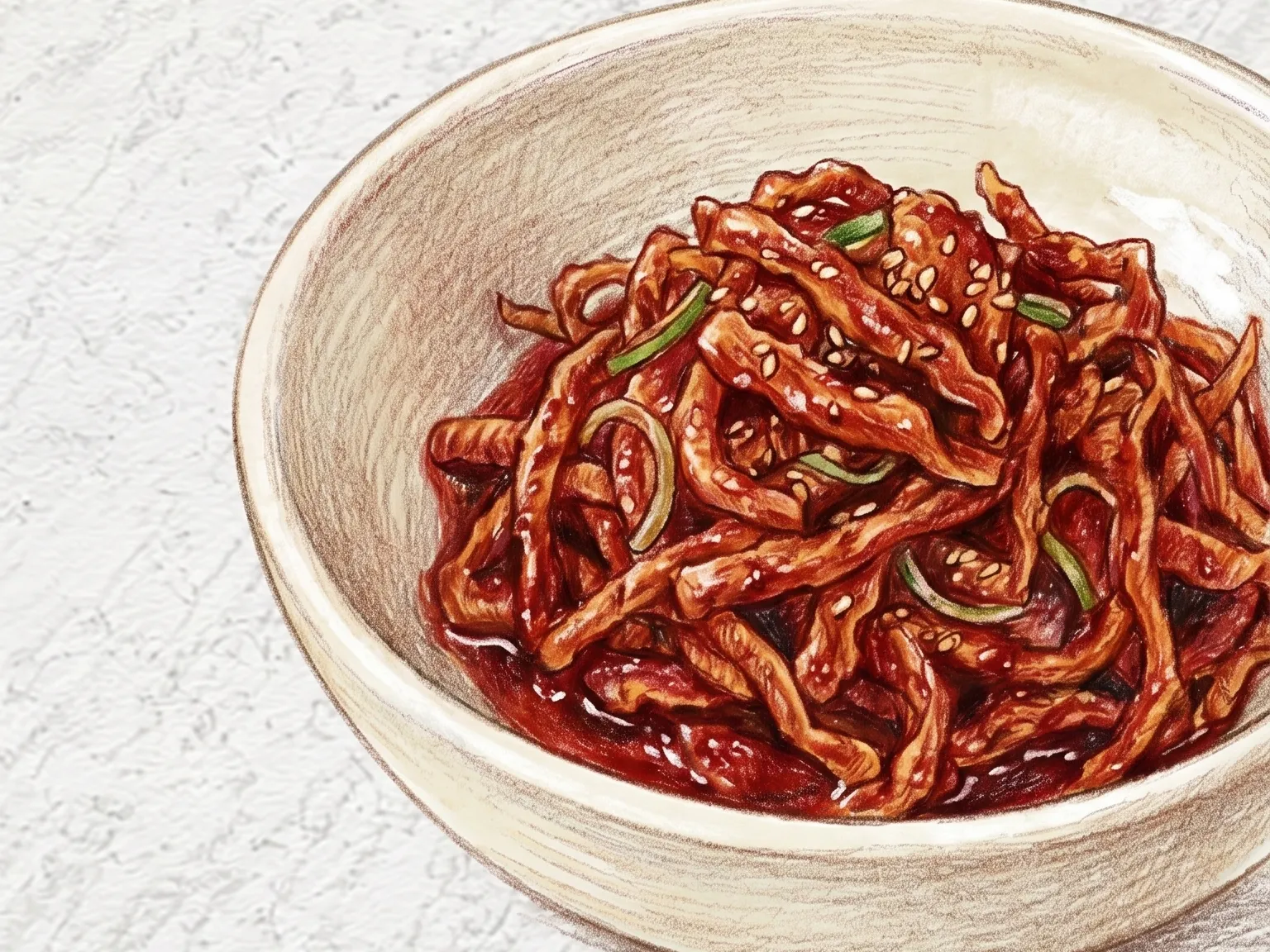
Ogeurakji (Dried Radish Strips)
Quick answer
Authentic Gyeongsang-do style crunchy dried radish strips.
What makes this special
- Gyeongsang-style dried radish soaked 20 minutes then rubbed with anchovy sauce and rice syrup, coating each strip in a thick, glossy heat.
- 20-minute soak controls how much chew the dried radish strips retain
- Jocheong (rice syrup) instead of sugar coats strips with a heavy, glossy sheen
Key ingredients
Core cooking flow
- 1 Soak 100g dried radish strips in cold water for 20 minutes only, then lift t...
- 2 Rinse the soaked strips 2 or 3 times in fresh water to reduce excess saltiness.
- 3 In a bowl, combine 4 tablespoons chili powder, 3 tablespoons anchovy sauce...
Authentic Gyeongsang-do style crunchy dried radish strips.
Instructions
Read the steps as a cooking flow: prep, heat, seasoning, doneness control, and finish.
- 1Step
Soak 100g dried radish strips in cold water for 20 minutes only, then lift them out while the centers still feel slightly firm.
Avoid a longer soak, or the strips will lose their chewy crunch.
- 2Control
Rinse the soaked strips 2 or 3 times in fresh water to reduce excess saltiness.
Squeeze hard with both hands until almost no drops come out, because leftover water will thin the seasoning.
- 3Season
In a bowl, combine 4 tablespoons chili powder, 3 tablespoons anchovy sauce, 3 tablespoons rice syrup, and 1 tablespoon soy sauce.
Stir until the chili powder is fully moistened and the sauce looks thick, glossy, and even.
- 4Season
Pour all the seasoning over the drained radish strips and massage firmly by hand for 1 to 2 minutes.
Press and rub until the red color works into the strips and the surface feels evenly coated and slightly sticky.
- 5Season
Add 1 tablespoon minced garlic first and loosen any clumps through the seasoned radish.
Add 30g chives cut into 3cm lengths at the end, then fold gently so the pieces stay fresh and are not crushed.
- 6Finish
Sprinkle 1 tablespoon sesame seeds evenly, then check that the taste is salty, sweet, and spicy without being watery.
Serve right away, or seal and refrigerate for one day so the seasoning penetrates more deeply.
After the steps
Pick the next recipe from here.
Continue with a similar dish, a pairing, or the same category.
Tips
Nutrition (per serving)
Recipes to Cook Together
More Side dishes →Serve with this
Korean Braised Tofu with Kimchi
Dubu-kimchi-jorim is firm tofu braised with well-fermented aged kimchi in a sauce of soy sauce, gochugaru, minced garlic, and a pinch of sugar. The sharp acidity of the aged kimchi mellows during braising while its deep, fermented flavor remains fully intact. The tofu absorbs the chili-stained braising liquid like a sponge, carrying the kimchi flavor into every bite. Sugar takes the edge off the sourness just enough, and sesame oil stirred in at the end ties all the flavors together. Pressing the tofu before cooking prevents excess moisture from diluting the sauce, and pan-frying the pieces until golden on both sides before braising creates a firmer surface that holds together better. This dish is an efficient way to use kimchi that has sat in the refrigerator for months, as the stronger the sourness, the better suited it is for braising. Adding thinly sliced pork shoulder deepens the flavor considerably. It goes best spooned generously over a bowl of hot steamed rice.
Korean Beurokolli Saeu Bokkeum (Broccoli Shrimp Stir-fry)
Peeled and deveined shrimp are seasoned with cooking wine and pepper, then stir-fried over high heat alongside blanched broccoli. The shrimp reach their ideal texture the instant they turn pink; cooking any further causes the proteins to contract and the flesh to toughen. Blanching the broccoli briefly beforehand means it releases less water once it hits the pan, keeping the sauce concentrated and clinging to the ingredients rather than pooling at the bottom. Soy sauce and oyster sauce form the savory backbone, while sliced garlic infused into the oil at the start builds a fragrant base that runs through every mouthful. Bell pepper adds a crisp snap and a vivid color. The whole dish takes under fifteen minutes and delivers a full plate of protein and vitamin C in a light, satisfying format. Served over steamed rice, it works just as well as a rice bowl.
Refreshing Spicy Mulhoe Broth
A golden ratio recipe for a refreshing, spicy, and sweet-and-sour Mulhoe broth.
Korean Bollak Ganjang Gui (Soy-Glazed Rockfish Grill)
Bolak-ganjang-gui is a Korean soy-glazed rockfish dish where fillets are brushed with a sauce of soy sauce, cooking wine, minced garlic, ginger juice, and honey, then grilled over medium-high heat. Half the glaze is applied first and left for just ten minutes, long enough for the salt and sweetness to penetrate the surface without pulling out moisture from the lean fish. Starting skin-side down for four minutes builds a crisp base, and brushing on the remaining glaze during the final minutes of cooking lets the honey caramelize into a glossy, dark-brown coating. A finish of sesame oil and sliced green onion adds a nutty, sharp layer on top of the savory-sweet glaze. Rockfish has very little fat, so the total cooking time should stay within eight to nine minutes to prevent the flesh from drying out.
Similar recipes
Korean Seasoned Dried Radish Strips
Mumallaengi-muchim dresses rehydrated dried radish strips in a gochujang-based sauce - a Korean preservation banchan rooted in the pre-refrigeration practice of slicing winter radish and air-drying it in cold winds. Dehydration concentrates the radish's natural sugars and transforms its texture from crisp to chewy, creating a ingredient with more depth than the fresh root. Soaking time determines the outcome: twenty minutes in cold water softens the strips enough to be pleasant while retaining the springy chew that is the whole point of using dried radish. Over-soaking produces a limp, waterlogged result indistinguishable from fresh radish. The dressing blends gochujang, gochugaru, vinegar, sugar, garlic, and sesame oil into a sweet-sour-spicy balance, with vinegar playing a particularly important role - it adds brightness to the dried radish's concentrated, earthy flavor. After mixing, a ten-minute rest allows the sauce to permeate the porous fibers evenly. Because the finished banchan contains almost no free moisture, it travels exceptionally well in lunchboxes and keeps refrigerated for over a week.
Korean Seasoned Dried Pollock Strips
Hwangtaechae-muchim dresses shredded dried pollock strips in a no-cook gochujang sauce - sharing the same core ingredient as hwangtae-po jorim but taking a completely different approach. While the braised version simmers the strips in liquid for a moist finish, this muchim keeps them closer to their original dry state, preserving a chewy, almost jerky-like bite. If the strips are too stiff, a light mist of water followed by a two-minute rest softens them just enough without losing that chew. The dressing combines gochujang, gochugaru, oligosaccharide syrup, and vinegar into a sweet-sour-spicy trio that earns this dish its bap-doduk (rice thief) reputation. A small addition of mayonnaise coats the surfaces with a thin fat layer, preventing the rough texture that dried fish can have. Start to finish, this banchan takes under fifteen minutes.
Korean Braised Dried Radish Greens with Doenjang
Dried radish greens, once rehydrated and boiled tender, are braised in a doenjang-based seasoning until the liquid reduces to a concentrated glaze. The fermented soybean paste melts into the coarse fibers of the greens, infusing each strand with deep, earthy umami. A splash of anchovy stock is added after the initial stir-fry in perilla oil, and the pan is covered so the greens can absorb the broth slowly over low heat. As the liquid evaporates, the seasoning thickens and clings to every piece, producing a chewy, salty-savory bite that releases its flavors gradually when chewed. Gochugaru contributes a mild, lingering warmth rather than sharp heat, while garlic softens into a mellow sweetness that rounds out the intensity of the doenjang. Patience during the final reduction is essential: only when the braising liquid has nearly disappeared does the dish reach the dense, flavorful consistency that makes it an ideal topping for steamed rice.
Korean Braised Dried Pollack
Dried pollack - bugeo - is traditionally hung on racks in Gangwon-do's frigid mountain air through freeze-thaw cycles all winter. The strips rehydrate in cold water, then braise in soy sauce, gochujang, sugar, and garlic. As liquid reduces, the pollack's spongy texture absorbs the sweet-salty-spicy sauce deeply, taking on a layered seasoning throughout. Finished with sesame oil, bugeo jorim tastes better after a day and keeps nearly a week - a classic fridge banchan.
Korean Dried Radish Soy Pickles
Mu mallaengi jangajji is a Korean pickled dried radish that exploits the concentrating effect of dehydration to achieve a depth of sweetness and chew that fresh radish pickles cannot match. The dried radish strips are first soaked in lukewarm water to restore their flexibility, then coated with gochugaru before being submerged in a brine of soy sauce, vinegar, and sugar that has been briefly boiled and cooled. Drying collapses the radish cell walls and concentrates the natural sugars, so when the rehydrated strips absorb the brine, the sweetness hits in layers beneath the chili heat. The texture of the rehydrated strips is distinctly chewy rather than crisp, which makes each bite feel satisfying and substantial. Soy sauce provides a dense, savory floor while vinegar lifts the salt and keeps the palate clean, and a scatter of toasted sesame seeds adds a faintly nutty finish. After resting for a day the seasoning stabilizes and the flavors meld, producing a banchan assertive enough to carry a full bowl of plain rice on its own.
Korean Stir-fried Dried Pollock Strips
Hwangtae-chae-bokkeum is a Korean side dish of shredded dried pollock strips soaked until fully soft, then stir-fried in a gochujang, oligosaccharide syrup, and soy sauce glaze. Hwangtae is a specific type of dried pollock produced by repeated freeze-thaw cycles in cold mountain air over winter, which gives it a lighter, spongier texture than ordinary dried pollock -- that porosity is what allows it to absorb the seasoning so completely during cooking. Soaking the dried strips in cold water for at least twenty minutes is necessary to rehydrate the flesh fully; squeezing out the excess moisture before adding them to the pan helps the glaze cling evenly rather than diluting in the pan. As the pollock fries, it drinks in the seasoning and turns chewy and moist, with the gochujang's heat and the syrup's sweetness working together to neutralize any residual fishiness. A finishing drizzle of sesame oil and a scatter of sesame seeds rounds out the flavor. The dish keeps well in the refrigerator for four to five days, making it a practical banchan to prepare in advance for lunchboxes or as a casual snack alongside drinks.