Salads

Salads Recipes

213 recipes. Page 7 of 9

Salads are light, healthy dishes built around fresh vegetables and fruits. From classic Caesar and Greek salads to Korean-style tofu salads and grain bowls, the range is broad. The dressing makes all the difference - and homemade versions are fresher and free of additives.

Salads
Naengi Beef Salad (Shepherd's purse)
Salads Medium

Naengi Beef Salad (Shepherd's purse)

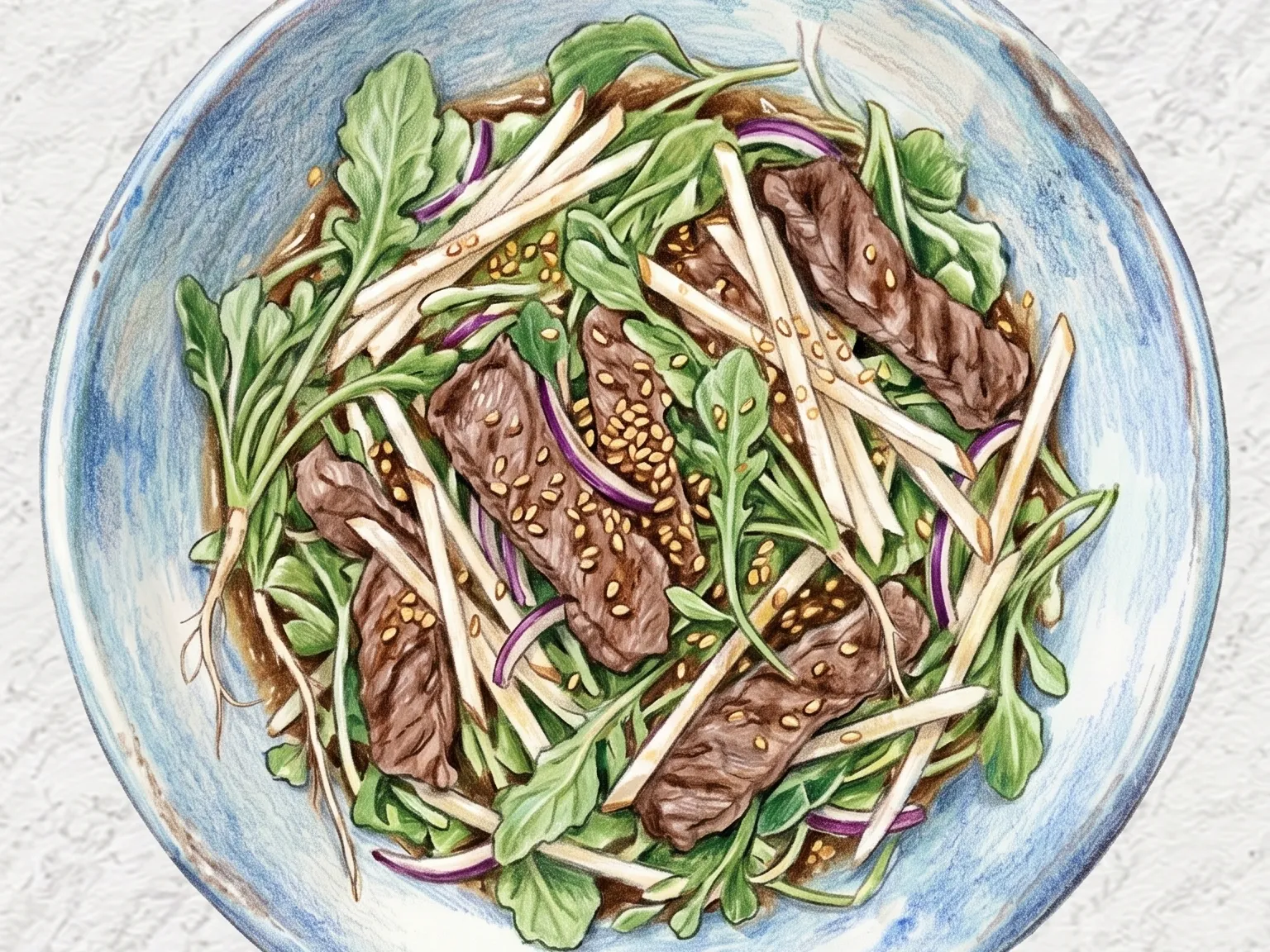
Fresh naengi - shepherd's purse - is blanched to mellow its earthy bite while keeping the fragrance intact. Beef sirloin is sliced thin and seared quickly so the surface chars lightly and the center stays moist. Julienned Korean pear bridges the beef's richness and the naengi's mild bitterness with clean sweetness. A dressing of soy sauce, vinegar, sesame oil, and plum extract balances salty, sour, and subtly sweet, while red onion and toasted sesame seeds finish with sharpness and nutty crunch.

🥗 Light & Healthy 🏠 Everyday
Prep 25min Cook 10min 4 servings
Naengi Doenjang Mushroom Salad
Salads Easy

Naengi Doenjang Mushroom Salad

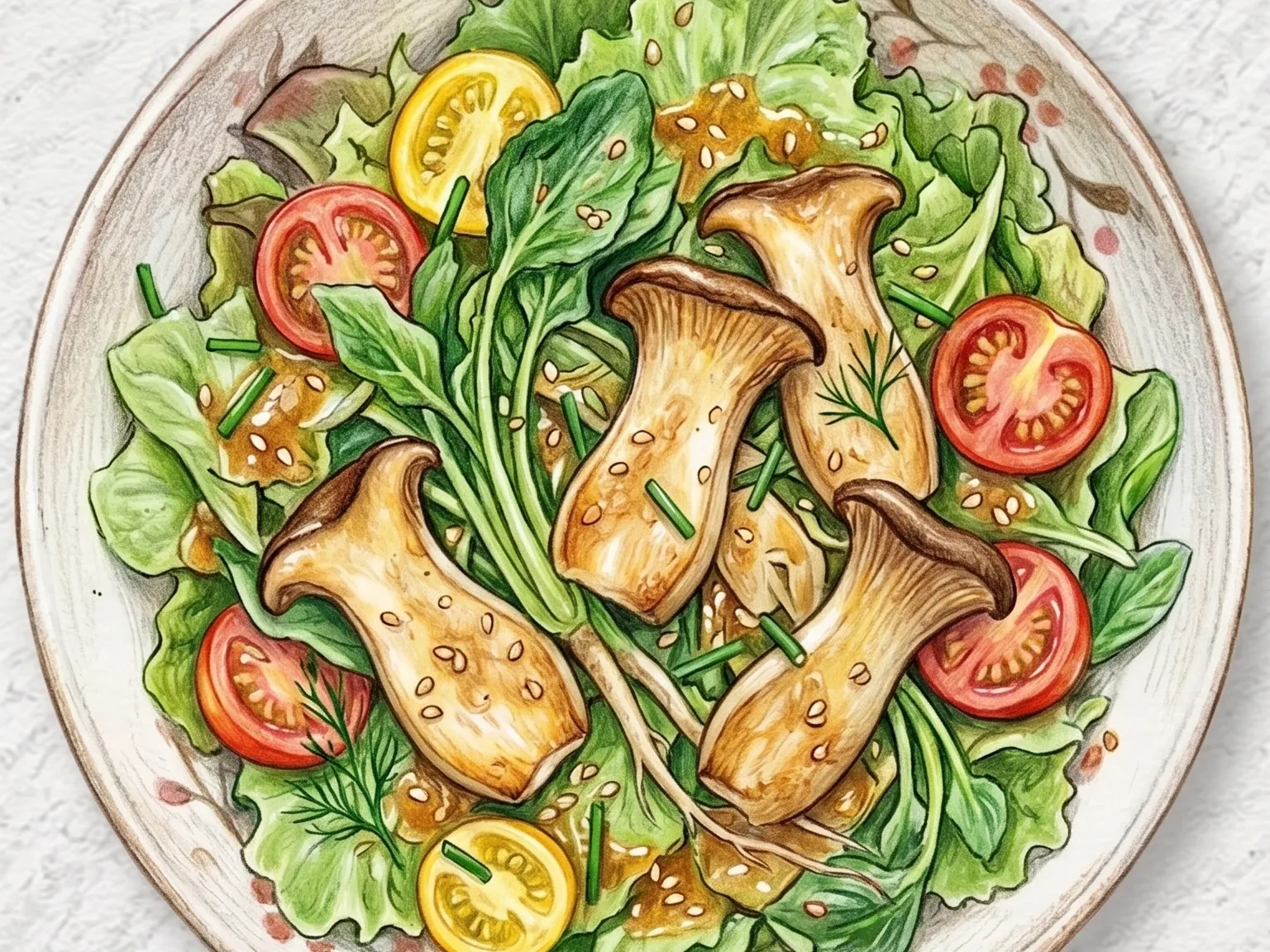
Naengi is blanched for about thirty seconds in boiling water to remove its raw grassy edge while keeping the earthy, faintly sweet spring aroma that makes it distinctive. Oyster mushrooms go onto a dry, well-heated pan with no oil, pressed gently as they cook, so the moisture evaporates and the surfaces caramelize to a light golden color, concentrating their savory depth. The dressing is made by dissolving doenjang in yuja marmalade, rice vinegar, and sesame oil, producing a layered flavor that is nutty and fermented at the base with a bright citrus lift. Baby greens spread across the plate as a soft, neutral bed, and halved cherry tomatoes add bursts of juice that cut through the weight of the fermented paste. A few drops of sesame oil and toasted sesame seeds add a roasted, nutty finish, and minced garlic folded into the dressing contributes a quiet warmth that ties the individual flavors together without dominating. Using freshly foraged naengi in early spring gives the salad a vivid seasonal character that dried or stored greens cannot replicate.

🥗 Light & Healthy ⚡ Quick
Prep 15min Cook 10min 2 servings
Naengi Scallop Yuja Salad
Salads Medium

Naengi Scallop Yuja Salad

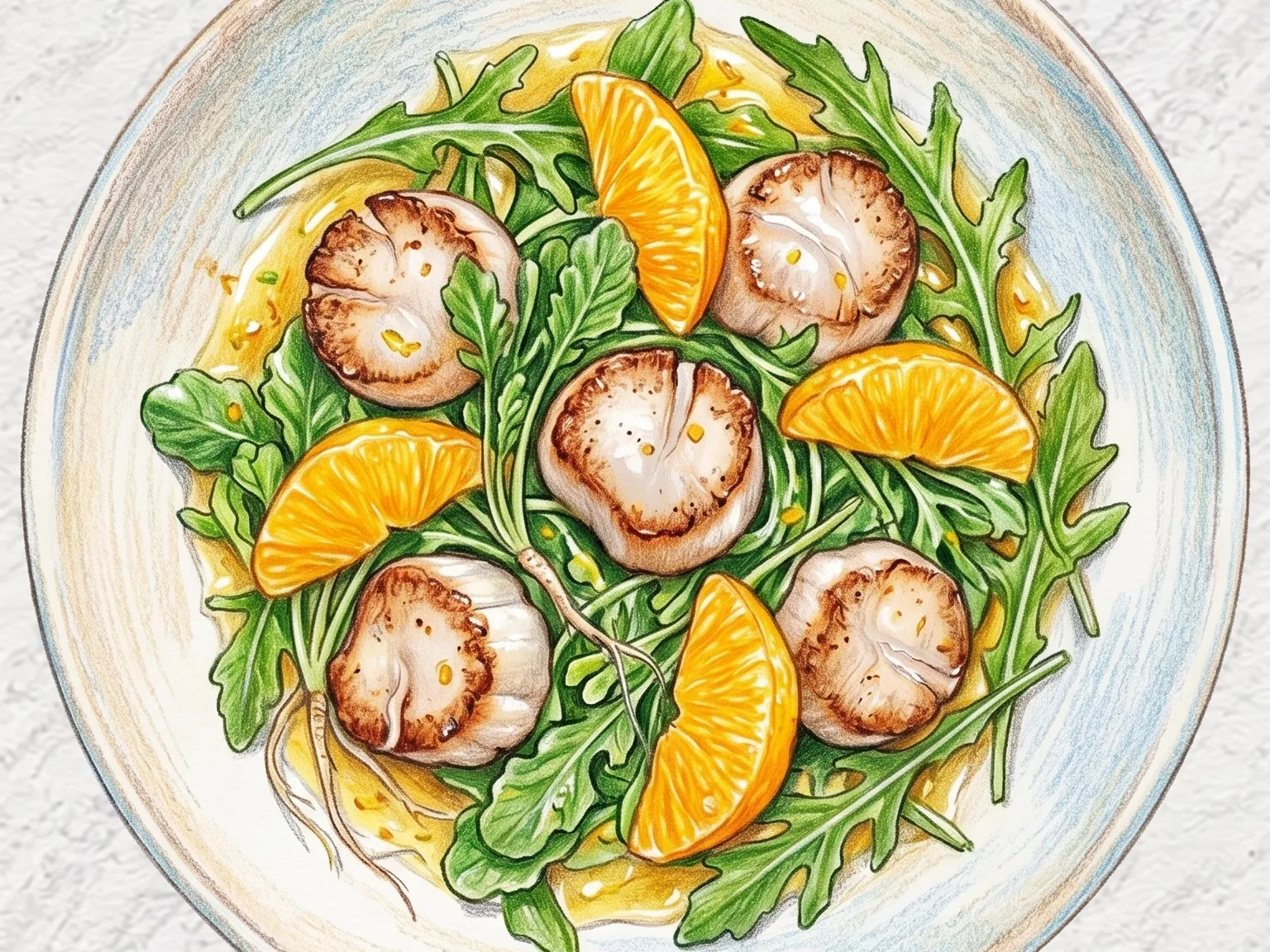
Scallops are seared in butter over high heat, touching the pan only long enough for the Maillard reaction to produce a caramelized crust on the outside while the center stays translucent and tender. That contrast between the browned exterior and the soft interior is the structural anchor of this salad. Blanched naengi, a spring herb with an earthy, faintly bitter character distinct to Korean wild greens, contrasts directly against the scallop's clean sweetness. Arugula brings a peppery sharpness that adds tension and depth to the overall flavor. The dressing is made by whisking yuja marmalade into white wine vinegar and olive oil, and the floral citrus note of yuja acts as a bridge between the seafood and the spring greens, unifying what could otherwise be a collection of unrelated ingredients. Orange segments placed on top add a layer of sweet acidity and vivid color. The finished plate is clean, bright, and aromatically precise, equally appropriate as a first course in a multi-dish meal or as the centerpiece of a casual guest dinner.

🥗 Light & Healthy 🏠 Everyday
Prep 20min Cook 6min 2 servings
Napa Cabbage Pear Black Sesame Salad
Salads Easy

Napa Cabbage Pear Black Sesame Salad

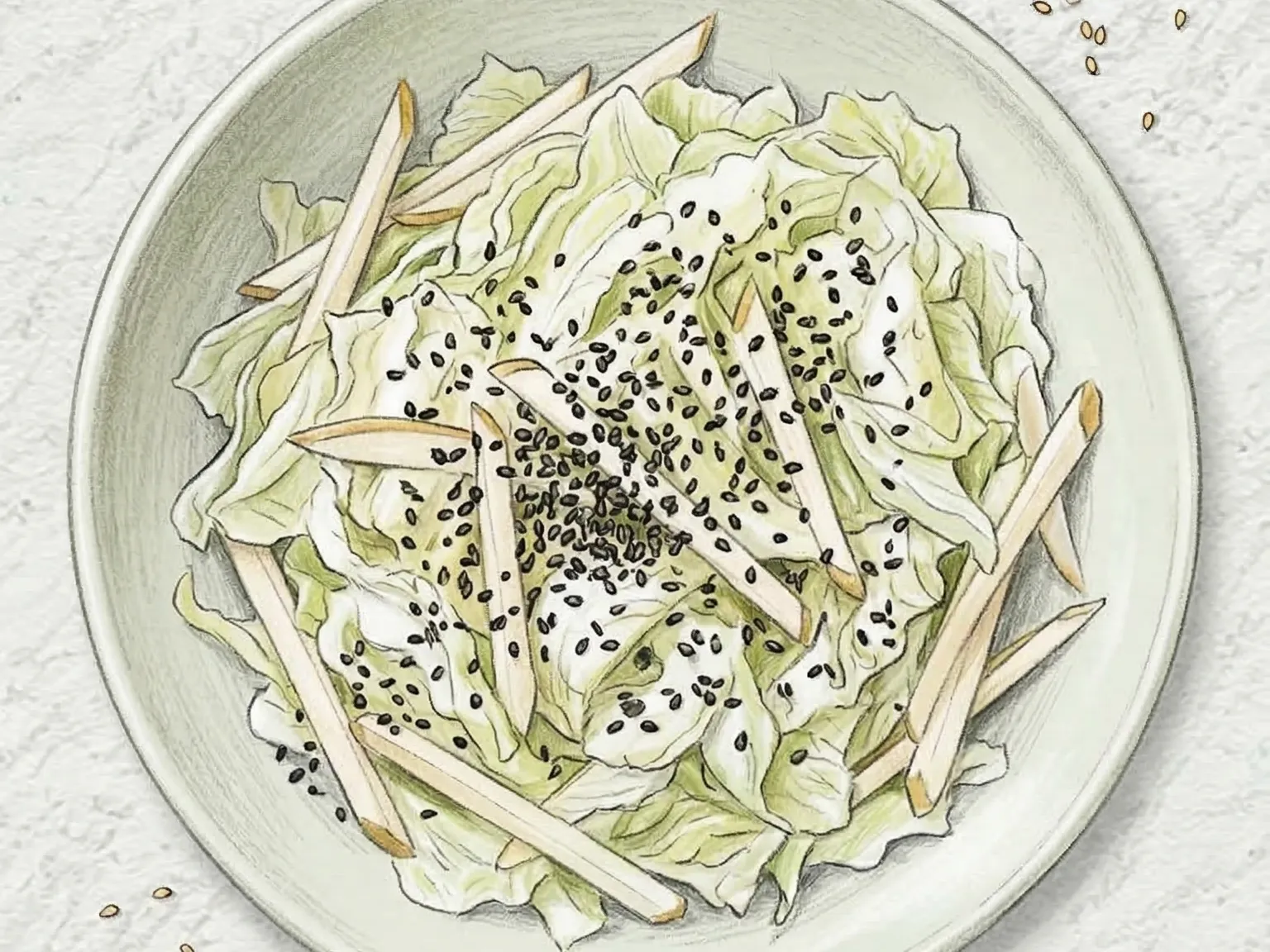
Napa cabbage is shredded fine for maximum crunch, and Korean pear is cut to matching width so its clear sweetness merges seamlessly with the cabbage's mild crispness. Julienned carrot adds color throughout, while toasted black sesame seeds release a deep nuttiness with each bite. The dressing blends plain yogurt with rice vinegar and honey, staying creamy yet light enough to let the raw ingredients come through without being masked. Salt is kept minimal so the natural sweetness of pear and cabbage leads, making this salad a strong choice as a palate cleanser after a rich or oily main course. Scattering the black sesame seeds just before serving prevents them from absorbing moisture and ensures they retain their satisfying crunch against the soft, juicy pear and crisp cabbage.

🥗 Light & Healthy ⚡ Quick
Prep 15min 2 servings
Narae (Seven-Ingredient Vinegar Salad)
Salads Medium

Narae (Seven-Ingredient Vinegar Salad)

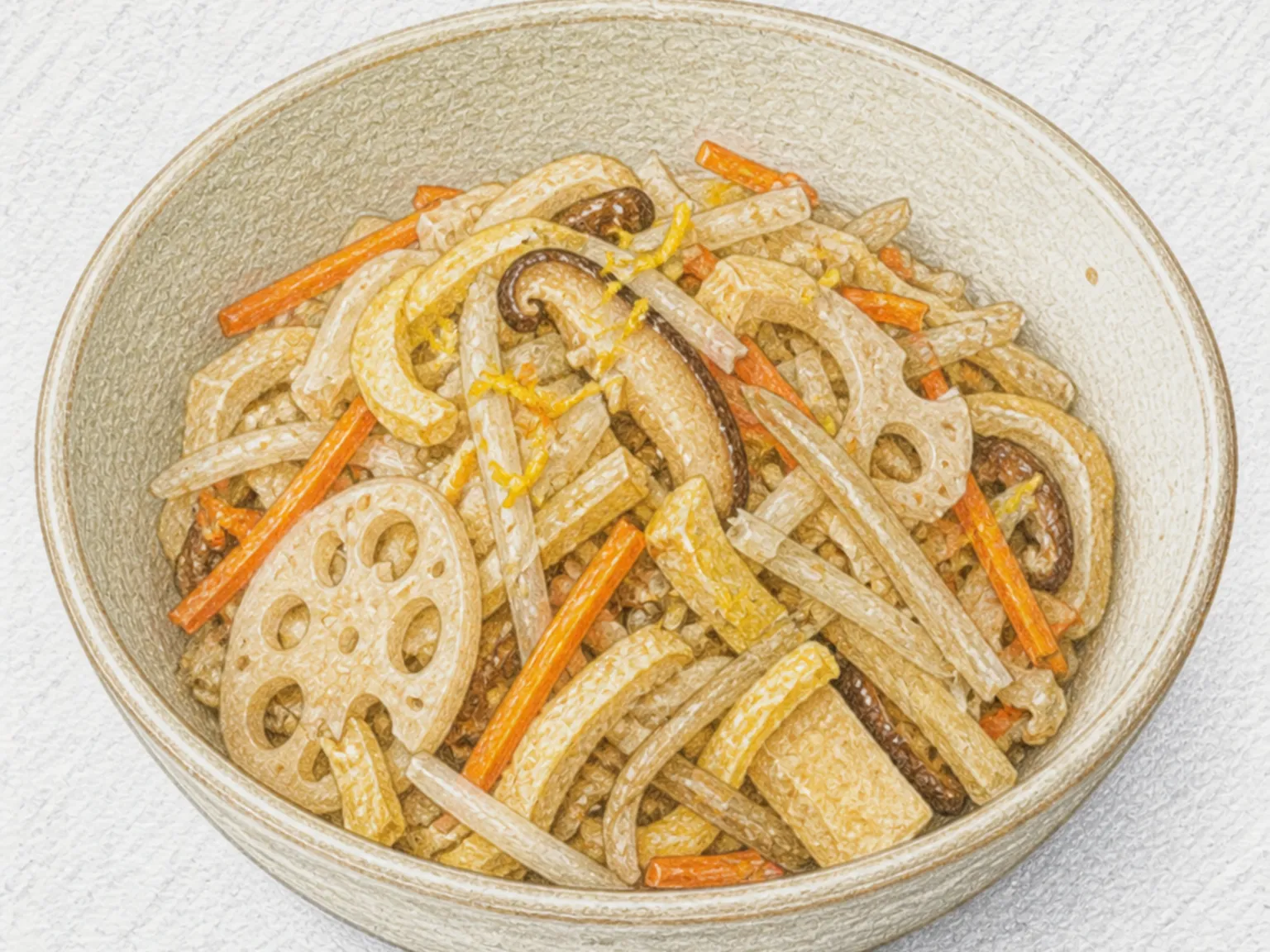
Narae is a Tokushima salad that cooks seven ingredients separately before dressing them in a sweet seasoned vinegar: daikon, carrot, dried shiitake, fried tofu, lotus root, burdock, and koya tofu. Daikon, carrot, lotus root, mushroom, and fried tofu simmer in shiitake soaking liquid; burdock is boiled on its own; and koya tofu absorbs a lightly sweet soy broth. Once all three groups are thoroughly drained, they are tossed with rice vinegar, sugar, light soy sauce, mirin, and sake and left to take on the seasoning. Sesame and yuzu peel finish a dish served at memorials and equinox observances, and now also eaten at home and in school meals.

🎉 Special Occasion 🏠 Everyday
Prep 35min Cook 25min 4 servings
Nuta (Wakegi and Whale Skin with Mustard Miso)
Salads Medium

Nuta (Wakegi and Whale Skin with Mustard Miso)

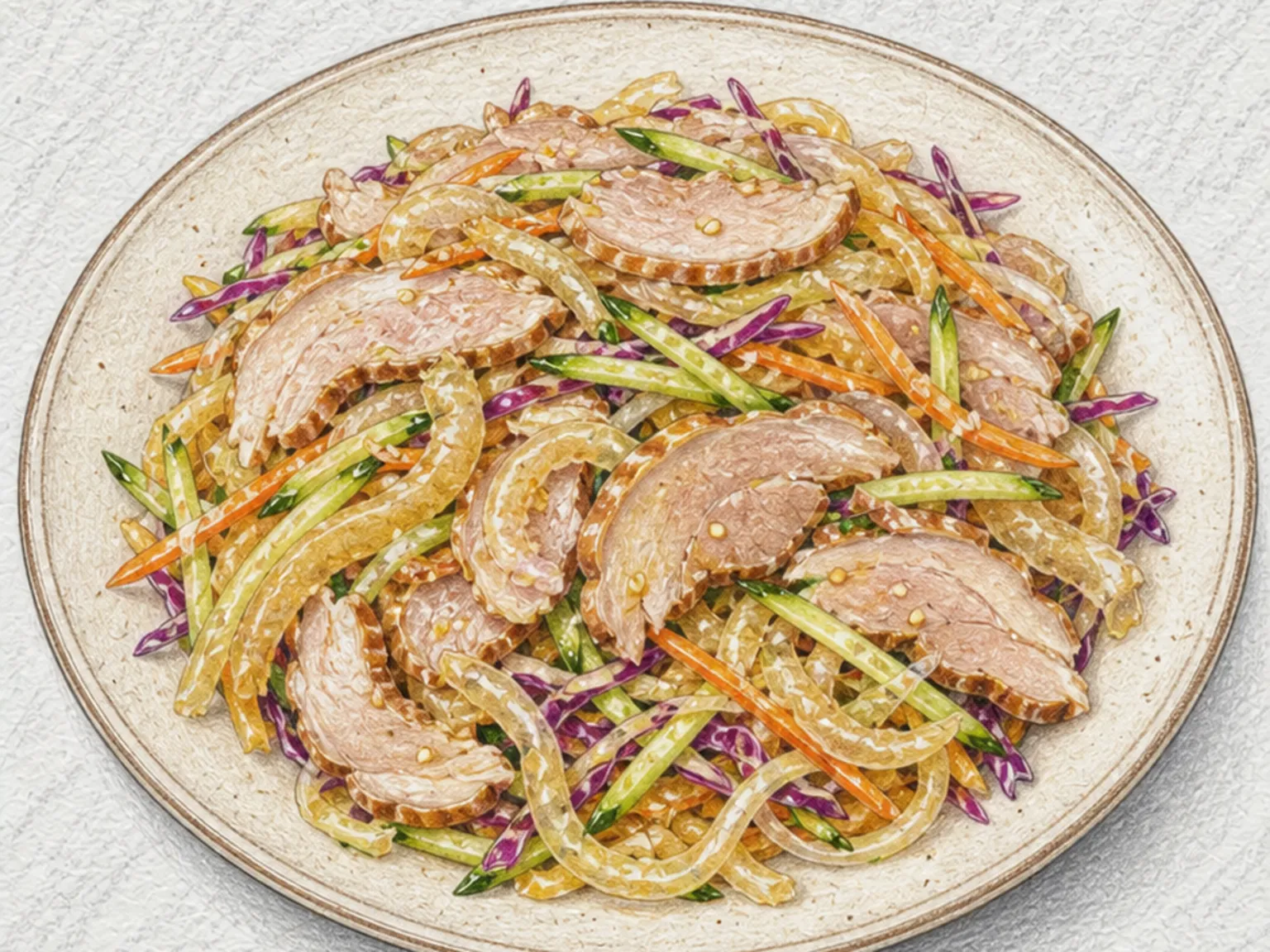
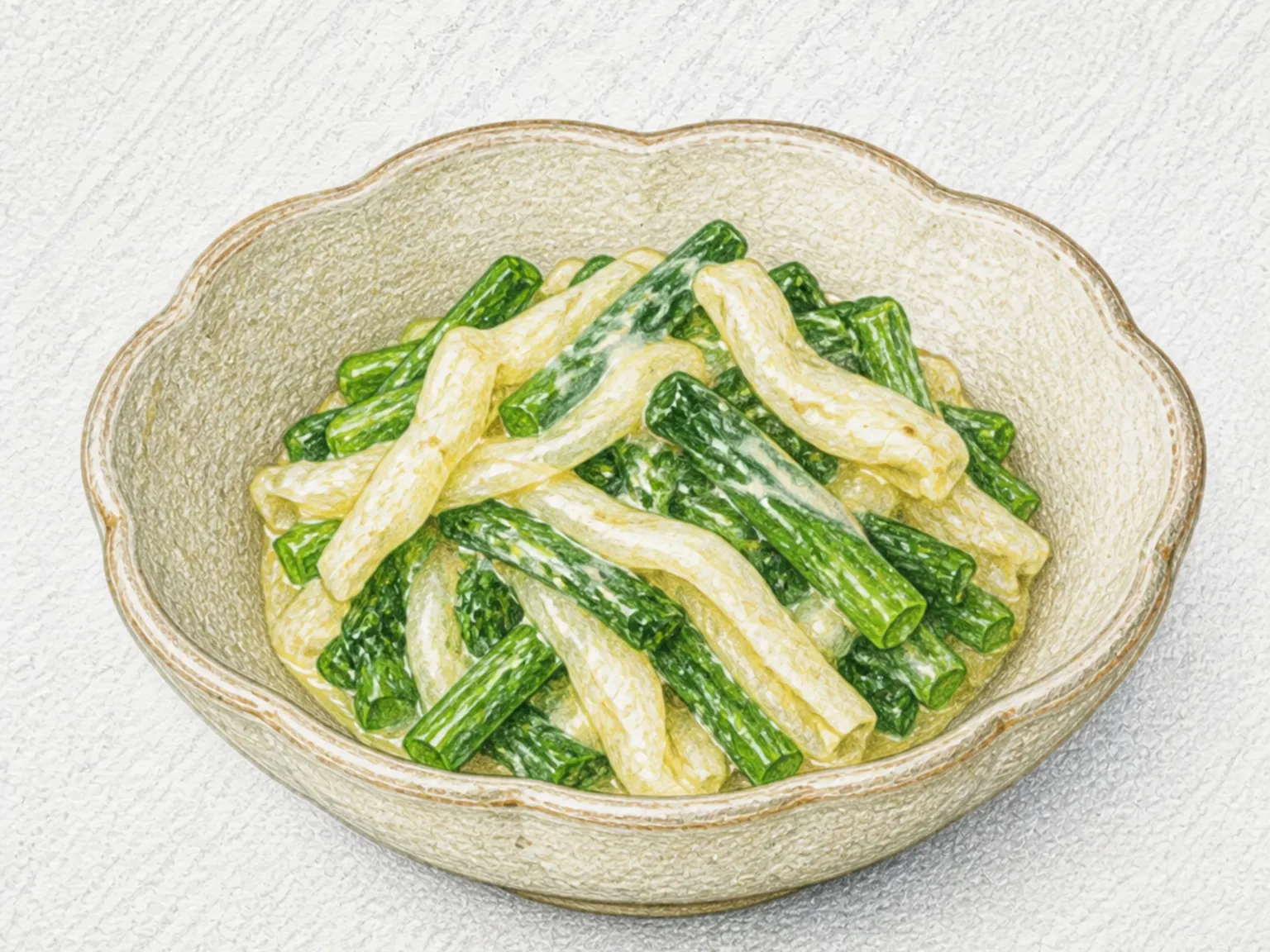
Nuta is a spring side dish from the Kitaura area of Yamaguchi, pairing lightly boiled wakegi scallions with obaike and a thick dressing of white miso, sugar, vinegar, and mustard. Obaike is a regional product made by thinly slicing and blanching the skin and fatty tissue near a whale's tail, giving it a crisp yet resilient bite. The pairing reflects Nagato's whaling history and the local practice of using many parts of the animal; around Hagi, the dish is also called negi-ae. Pressing slippery moisture from the scallions with the back of a knife and adding the sauce immediately before serving keeps the dressing thick instead of watery.

🎉 Special Occasion
Prep 20min Cook 10min 4 servings
Ohitashi (Seri and Spinach in Dashi)
Salads Easy

Ohitashi (Seri and Spinach in Dashi)

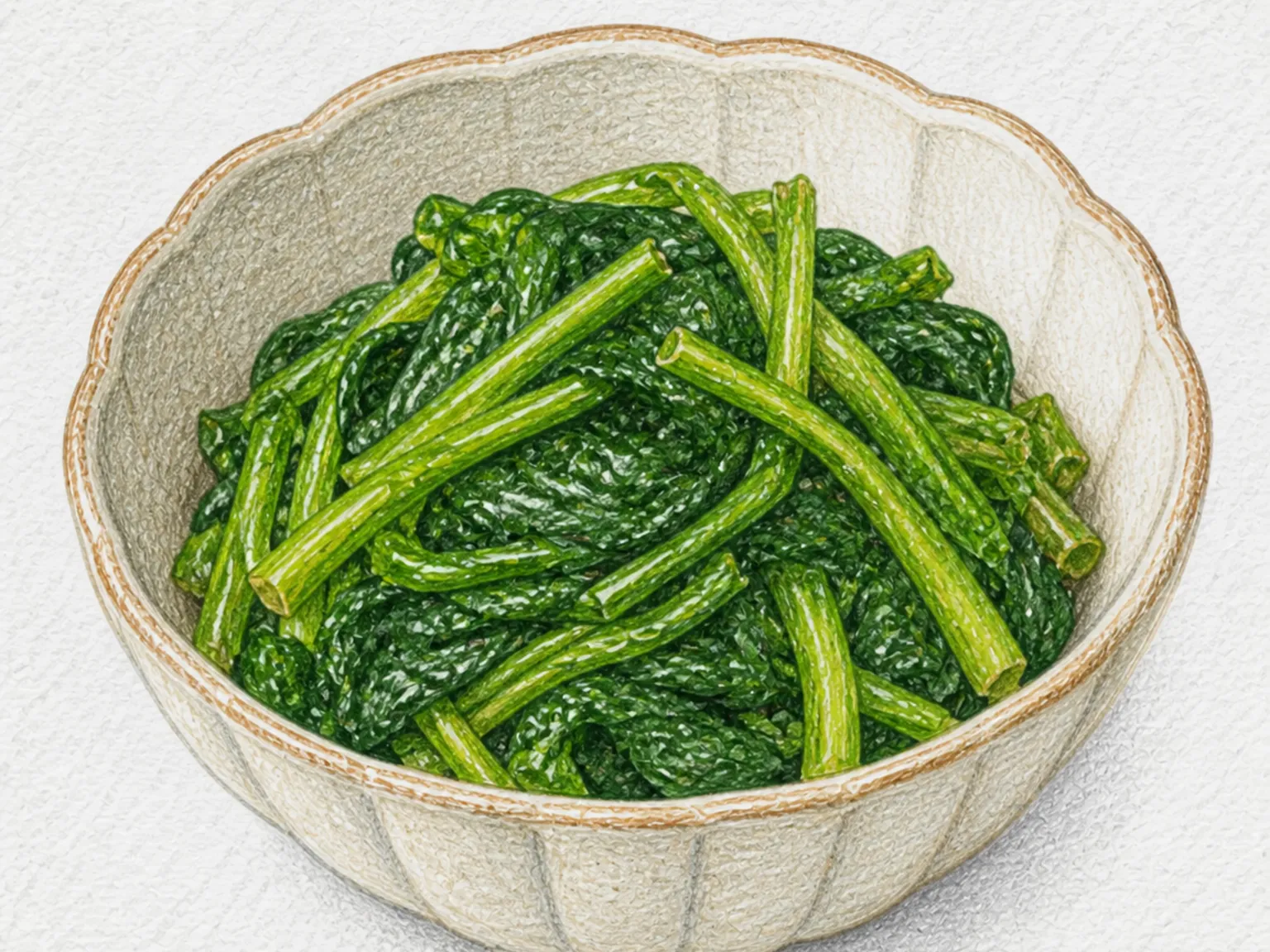
Ohitashi makes four portions by blanching 60 g Kuroda seri and 140 g spinach separately, then steeping both greens in chilled dashi seasoning for 8 to 12 hours. Boil 15 ml mirin in a small pan over medium heat for 30 seconds. Add 90 ml dashi and 15 ml light soy sauce, stop the heat as soon as the mixture boils once, and transfer it to a wide container. Cool it completely and refrigerate it before the vegetables enter. Trim damaged leaves and root ends from the seri and spinach, wash them twice in cold water, and cut them into aligned lengths of 4 to 5 cm. Immerse the spinach stems in vigorously boiling water for 20 seconds, add the leaves for another 20 seconds, and chill them. In the same water, blanch the seri stems for 15 seconds and the leaves for only 15 seconds more. Separate timing keeps the tender spinach from overcooking while the seri stems retain a distinct bite. Align the cooled greens and press them gently between the palms to remove water; do not twist them, which can crush the stems. Divide them into four bundles, submerge them fully in the cold seasoning, cover, and refrigerate. Just before serving, distribute both vegetables evenly and spoon 1 tablespoon of the soaking dashi over each dish.

🏠 Everyday 🥗 Light & Healthy
Prep 15min Cook 10min 4 servings
Korean Cucumber Doenjang Salad
Salads Easy

Korean Cucumber Doenjang Salad

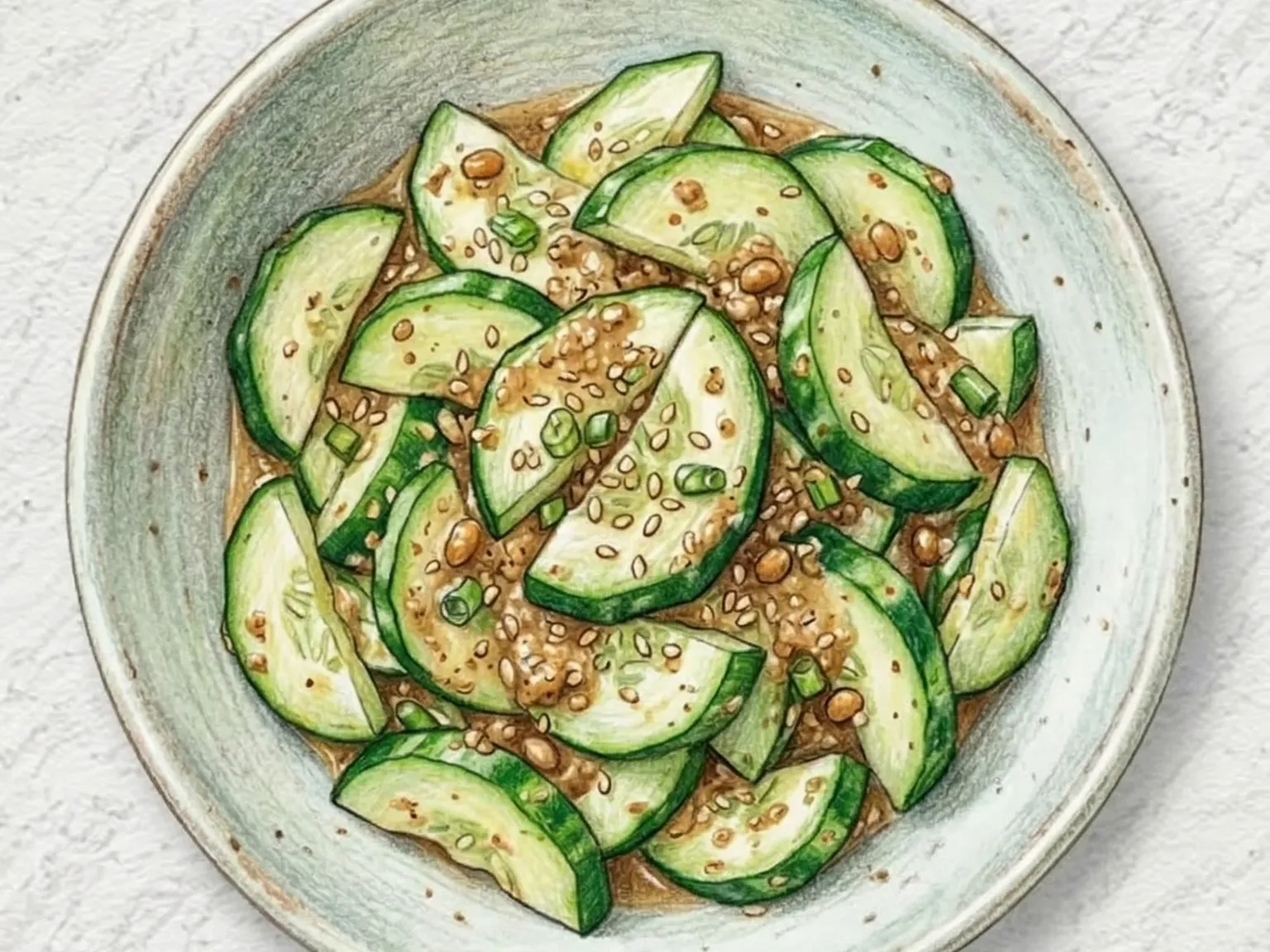
Oi-doenjang-muchim dresses cucumber in a doenjang-based seasoning - a milder alternative to the gochugaru-forward oi-muchim, foregrounding the fermented soybean paste's savory depth over spicy heat. Cucumber is sliced into half-moons or diagonal cuts and salted for five minutes to draw out moisture; skipping this step dilutes the dressing into a watery puddle. The seasoning blends doenjang, soup soy sauce, minced garlic, sesame oil, and sesame seeds, with the doenjang quantity being the critical ratio - too much and the dish is aggressively salty, too little and the cucumber's blandness dominates. Roughly one tablespoon of doenjang to two cucumbers is the working proportion. The cucumber's cool moisture meets doenjang's deep umami to produce a combination that is refreshing yet substantial enough to anchor a rice meal, especially in summer. This banchan must be eaten promptly after assembly - over time, osmotic pressure draws water from the cucumber and collapses its crunch. Served alongside grilled meat, the doenjang's savoriness complements the char while cleansing the palate.

🏠 Everyday 🍱 Lunchbox
Prep 10min 2 servings
Korean Spicy Cucumber Salad
Salads Easy

Korean Spicy Cucumber Salad

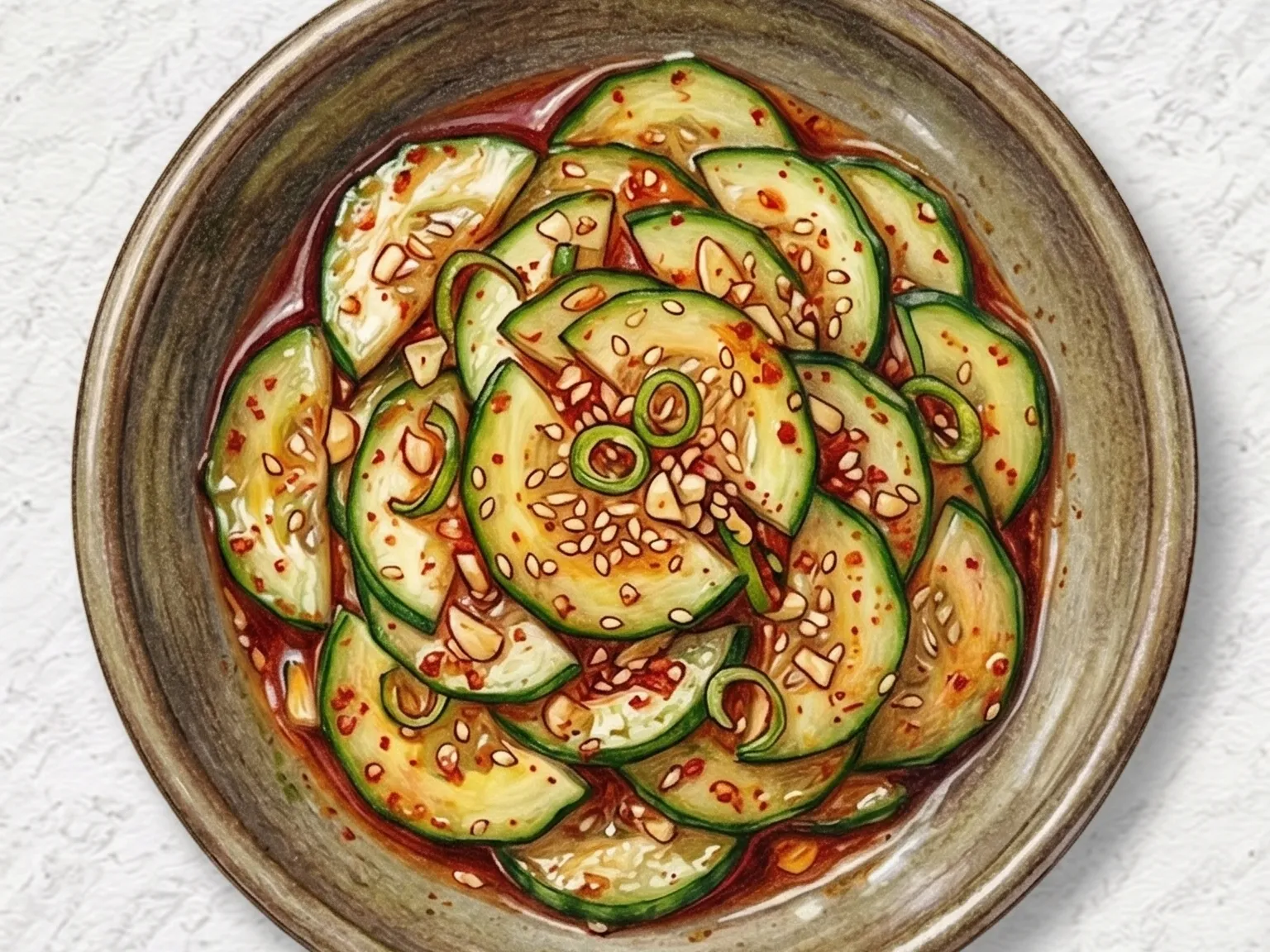
Oi-muchim - Korean spicy cucumber salad - is one of the most frequently served vegetable banchan on summer Korean tables, tossing thinly sliced cucumber in gochugaru, garlic, vinegar, and sesame oil. Slicing the cucumber as thin as possible with a mandoline or knife is important - thin slices absorb the dressing rapidly and deliver a texture that is simultaneously crunchy and yielding. Salting for ten minutes and squeezing out the released water is the pivotal step; undrained cucumber turns the dressing into a diluted puddle. The seasoning mixes gochugaru, minced garlic, vinegar, sugar, sesame oil, and sesame seeds - vinegar amplifies the cucumber's natural freshness while gochugaru provides a gentle trailing heat. Assembling immediately before serving is essential, as osmotic action wilts the cucumber within thirty minutes. This banchan tops naengmyeon and bibimbap or stands alone alongside rice. When summer heat suppresses appetite, oi-muchim is often the first dish Korean diners reach for - its cool, sharp bite cuts through the lethargy.

🏠 Everyday 🍱 Lunchbox
Prep 15min 4 servings
Squid and Cucumber Chojang Salad
Salads Medium

Squid and Cucumber Chojang Salad

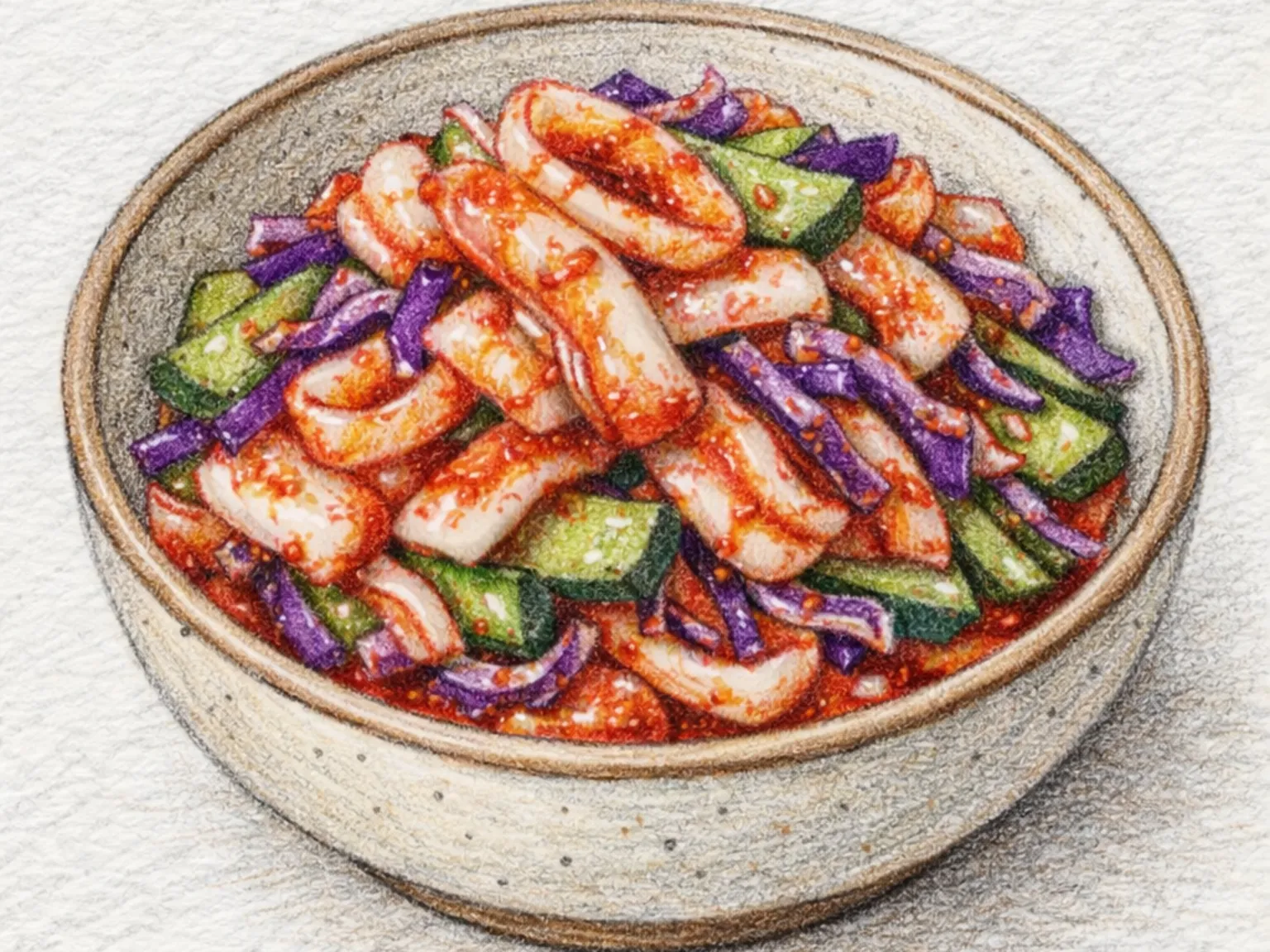
Score shallow diagonal lines across the inner surface of 240g cleaned squid, then cut it into bite-size pieces so it curls evenly as it cooks. Bring water to a full boil, add the squid, and keep it over medium-high heat for exactly 2 minutes 30 seconds. Remove it as soon as the flesh turns white and contracts. The total blanching time should stay under 3 minutes because longer cooking makes squid tough. Move the pieces directly into ice water to stop the residual heat. Once cold, drain them in a sieve and press away surface moisture with paper towels. Cut 160g cucumber into half-moons and finely shred 70g red cabbage, blotting either vegetable if its surface is wet. For the chojang, whisk 1 tablespoon gochujang with 1.5 tablespoons vinegar, 1 tablespoon maesil-cheong, and 0.5 teaspoon minced garlic until smooth. Stir in 1 teaspoon sesame oil last. Wait until just before serving to combine the cold squid, cucumber, and cabbage with the dressing, then toss quickly. Sprinkle 1 teaspoon sesame seeds over the salad before the vegetables release liquid, divide into 2 portions, and serve cold.

🥗 Light & Healthy ⚡ Quick
Prep 16min Cook 4min 2 servings
Korean Spicy Squid Salad (Gochujang Blanched Squid)
Salads Easy

Korean Spicy Squid Salad (Gochujang Blanched Squid)

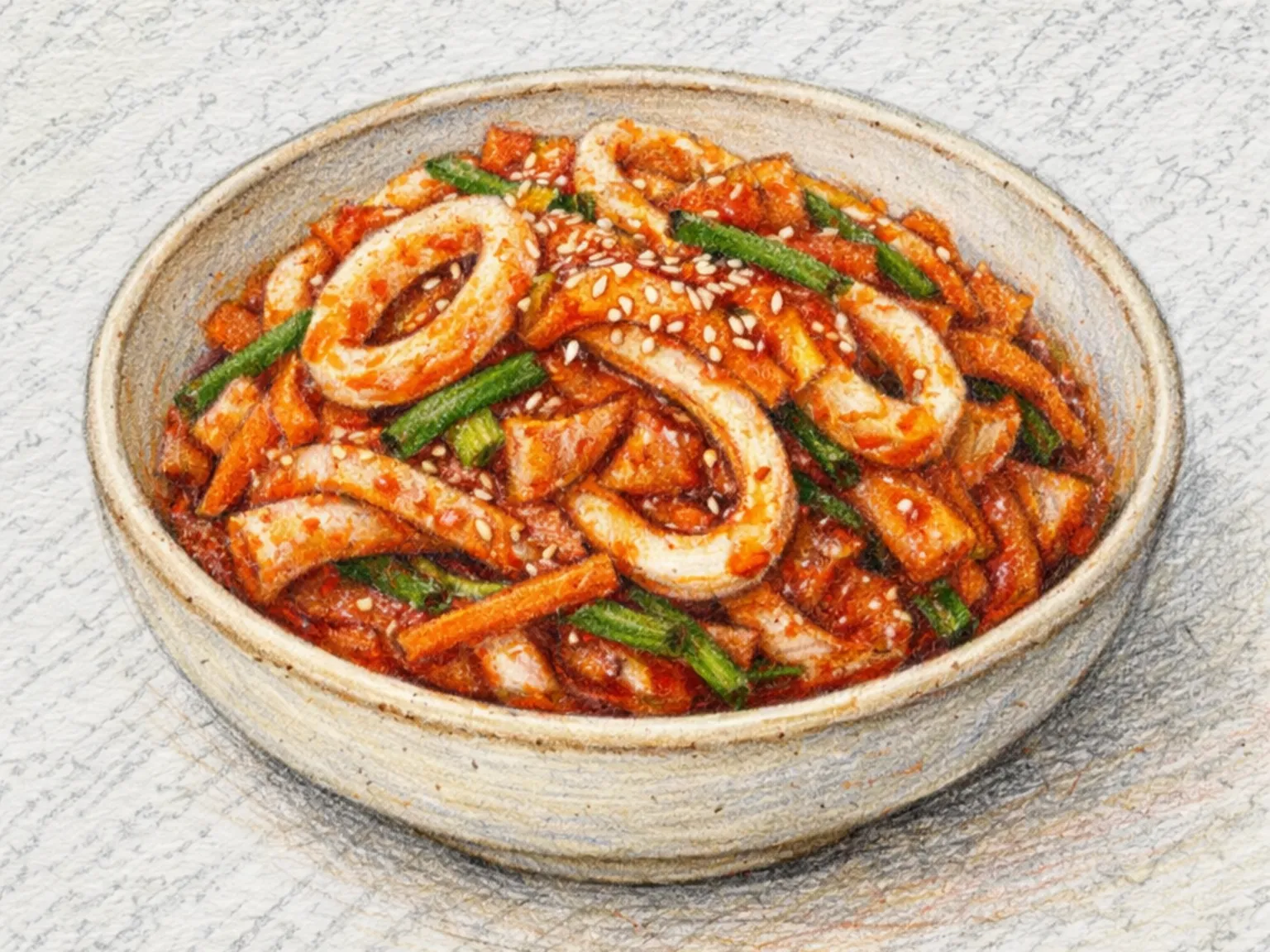
Ojingeo-muchim tosses blanched squid in a gochujang-vinegar dressing for a tangy, spicy seafood banchan that works equally well as a rice side dish or as anju with drinks. Squid, unlike vegetables, has an extremely narrow blanching window that determines the entire outcome: one minute to ninety seconds in boiling water is the limit. Beyond that, the proteins contract and the texture turns rubbery; under that, the interior stays translucent and fishy. Plunging into ice water immediately after blanching halts carryover cooking and locks in the ideal springy-bouncy texture. The dressing combines gochujang, gochugaru, vinegar, sugar, garlic, sesame oil, and sesame seeds, with vinegar playing the pivotal role - it introduces a sharp acidity over the squid's marine umami, forming a triangular balance with the chili heat. Julienned onion and cucumber mixed in add textural variety and stretch the portion. A popular variation stirs in one tablespoon of mayonnaise, whose emulsified fat wraps around the heat and produces a milder, creamier version.

🏠 Everyday 🍱 Lunchbox
Prep 15min Cook 5min 4 servings
Squid Naengi Chojang Salad
Salads Medium

Squid Naengi Chojang Salad

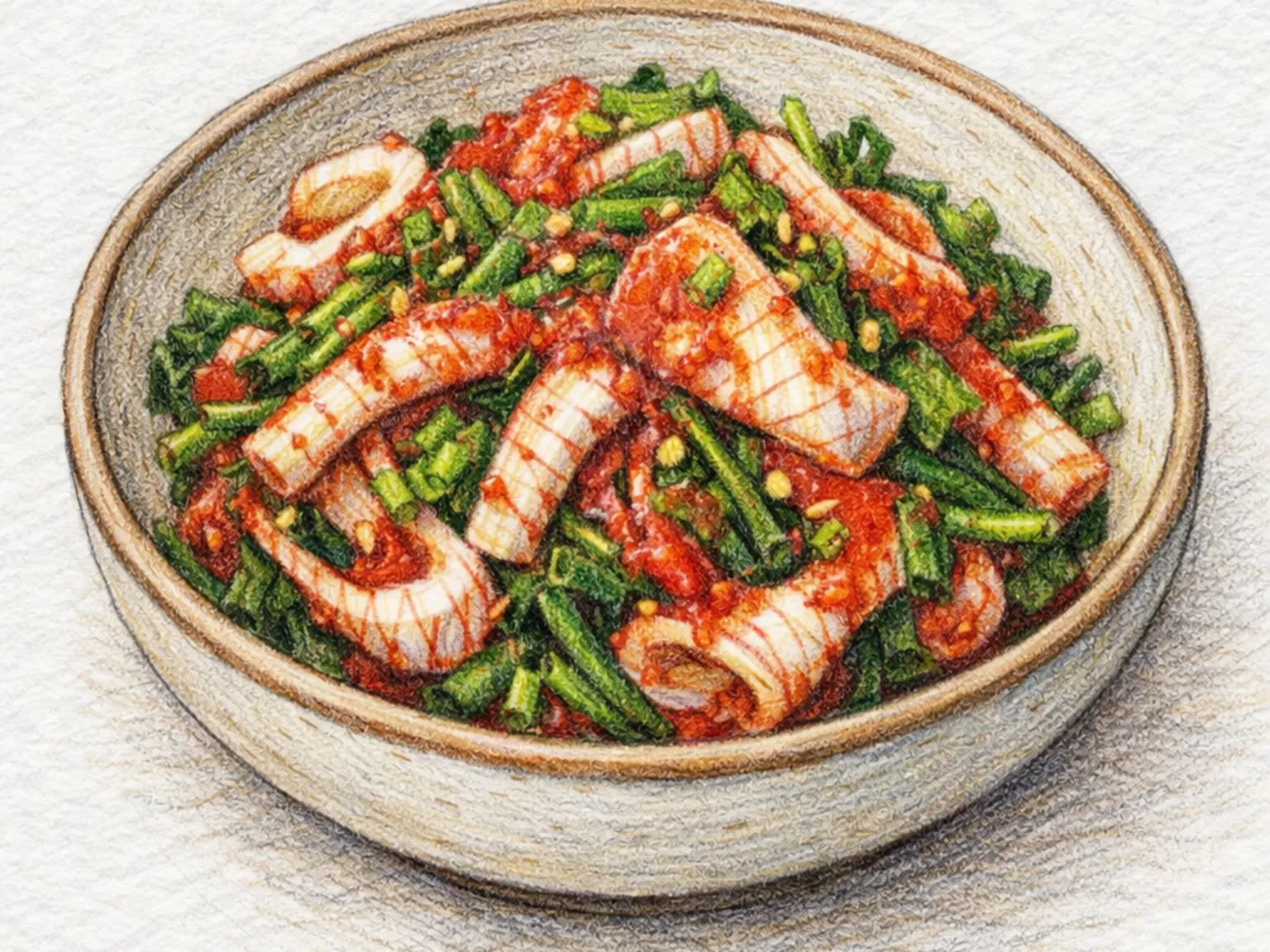
Preparing squid for a seasonal salad involves a quick blanching process in boiling water for less than thirty seconds. This precise timing keeps the seafood tender and prevents it from turning rubbery or tough. Shepherd's purse, or naengi, contributes an earthy aroma characteristic of early spring that complements the oceanic profile of the squid. Crisp lettuce and fresh cucumber provide a crunchy texture that contrasts with the soft seafood pieces. The dressing relies on a combination of gochujang, rice vinegar, and oligosaccharide syrup to create a spicy, tangy, and mildly sweet foundation for the ingredients. To finish the sauce, sesame oil contributes a nutty scent while minced garlic adds a sharp, aromatic quality that integrates the different components. Careful cleaning of the naengi to remove soil and fine roots is necessary before briefly blanching it in salted water to eliminate bitterness and preserve its fragrance. Serving this dish cold during the early spring months highlights the specific seasonal qualities of the ingredients. For variations, scallops or shrimp can replace the squid, as they both pair well with the spicy dressing. Similarly, spring cabbage or wild chives can substitute for the shepherd's purse to maintain the seasonal character of the salad.

🥗 Light & Healthy 🏠 Everyday
Prep 20min Cook 4min 2 servings
Korean Scallion Salad (Spicy Green Onion Grilled Meat Side)
Salads Easy

Korean Scallion Salad (Spicy Green Onion Grilled Meat Side)

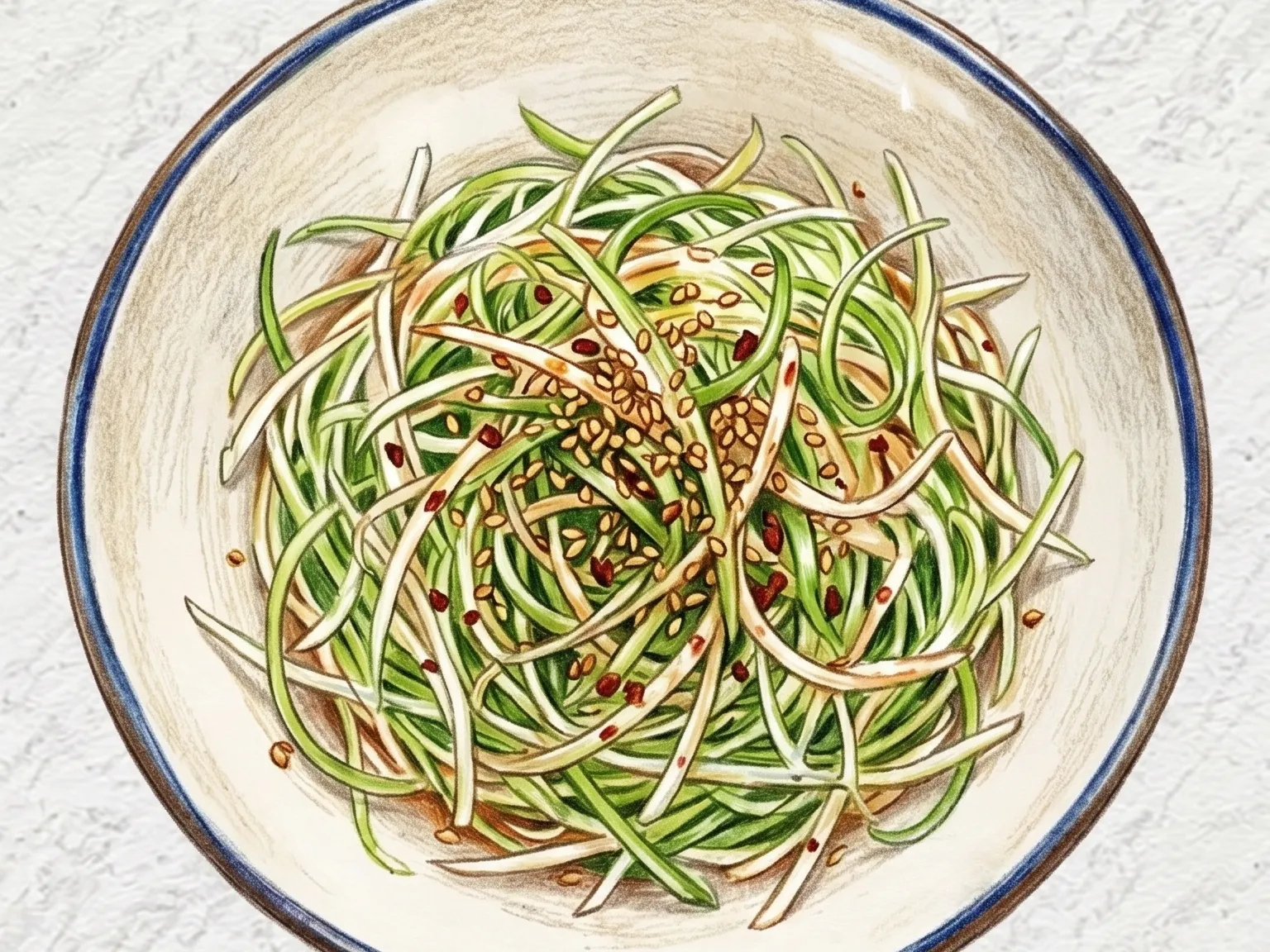
Pa-muchim is a julienned green onion salad that serves as a classic accompaniment to Korean grilled meat. The onions are soaked in cold water for 10 minutes to draw out harsh sulfur compounds, leaving only a clean crispness behind. A dressing of soy sauce, red pepper flakes, sugar, vinegar, and sesame oil coats the thin strands, delivering a balance of salty, sweet, sour, and spicy notes in each bite. Toasted sesame seeds scattered on top contribute a lingering nuttiness. The salad should be eaten promptly after tossing, as the onions begin to wilt within minutes; placed on top of grilled pork belly or bulgogi, the sharp freshness cuts through the richness of the meat.

🏠 Everyday 🍱 Lunchbox
Prep 10min 4 servings
Panzanella Salad (Italian Ciabatta Bread Salad)
Salads Easy

Panzanella Salad (Italian Ciabatta Bread Salad)

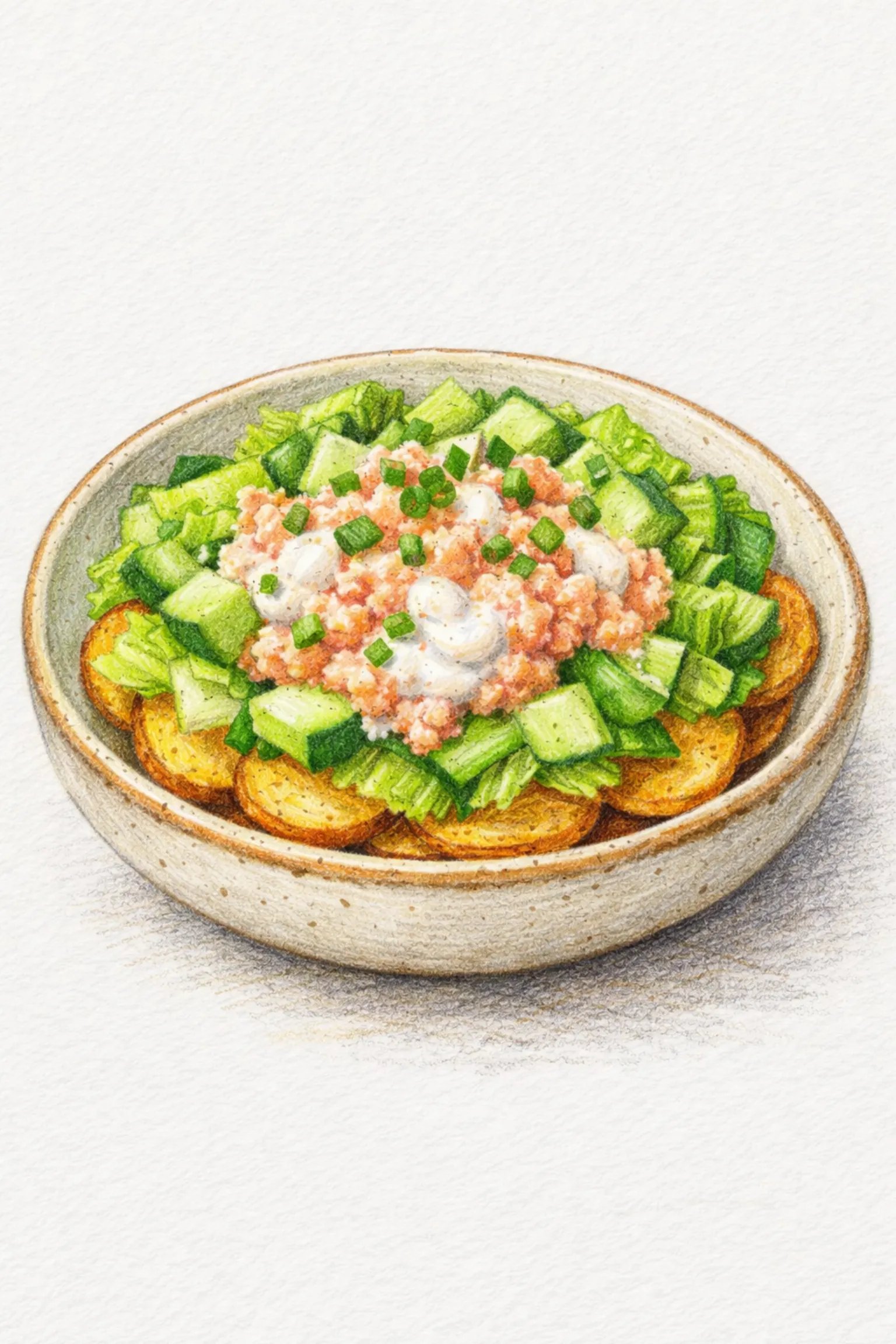
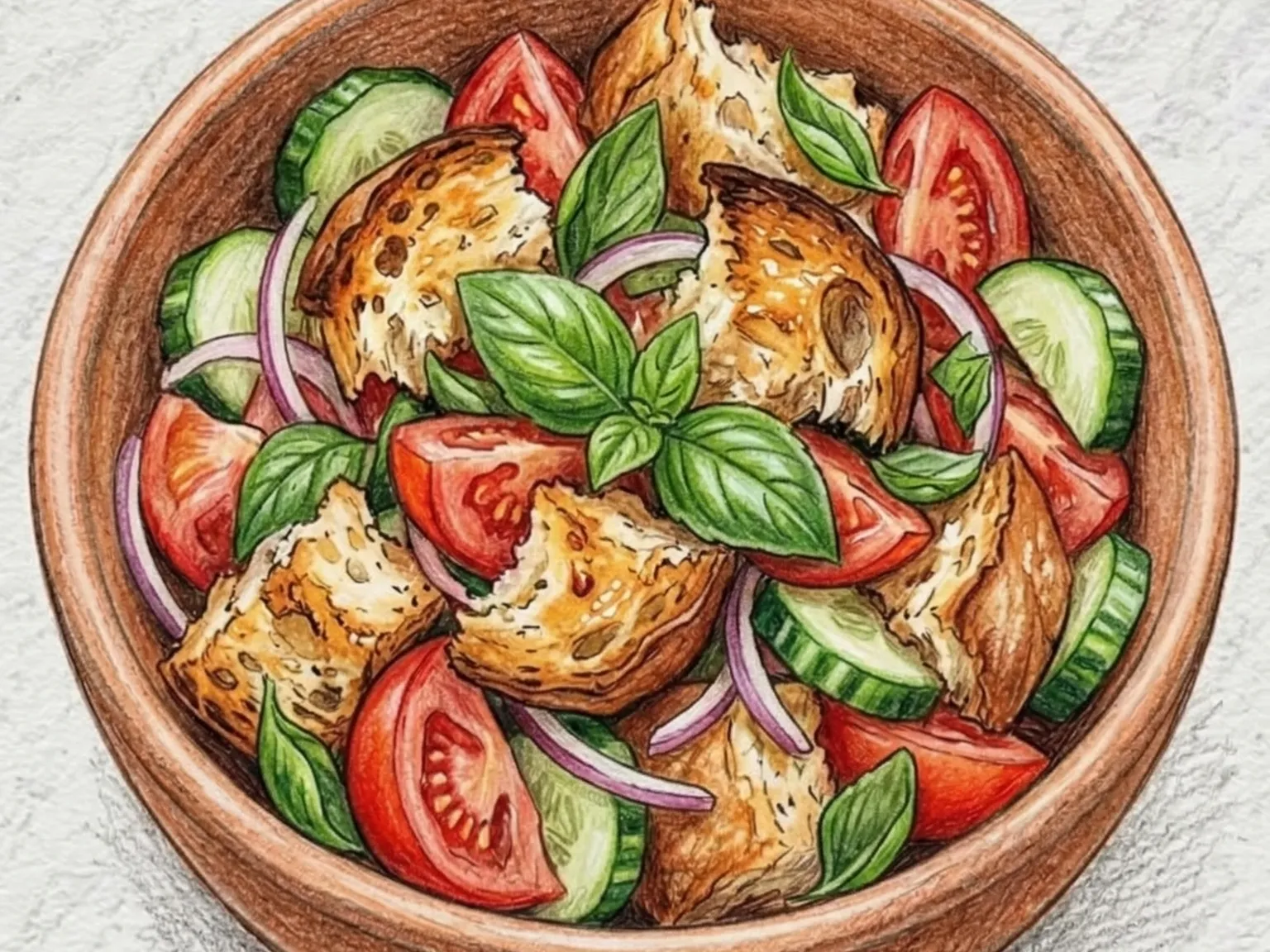
Stale ciabatta is torn into rough chunks, drizzled with olive oil, and toasted in the oven until the exterior is crisp while the interior remains slightly chewy. Ripe tomatoes are cut into large pieces and salted briefly to draw out their juice, and that released liquid soaks into the bread and becomes the sweet-tart flavor that defines the dish. Cucumber and red onion add crunch and pungency, while torn basil leaves release their fragrance across the plate. A vinaigrette of red wine vinegar and good olive oil binds everything together. The salad reaches its best point after resting fifteen to twenty minutes, once the bread has absorbed enough dressing and tomato juice to soften slightly without going completely soggy, a balance that is the defining characteristic of a well-made panzanella. Using genuinely stale bread matters here: fresh bread soaks through too quickly and disintegrates, while properly dried ciabatta holds its structure and provides a textural contrast with the juicy tomatoes and crisp vegetables. Panzanella originated as a practical summer dish in Tuscany, where leftover bread was too valuable to discard, and it remains most rewarding when made with ripe summer tomatoes at the peak of the season.

🥗 Light & Healthy ⚡ Quick
Prep 15min Cook 10min 2 servings
Korean Tofu and Bell Pepper Salad
Salads Easy

Korean Tofu and Bell Pepper Salad

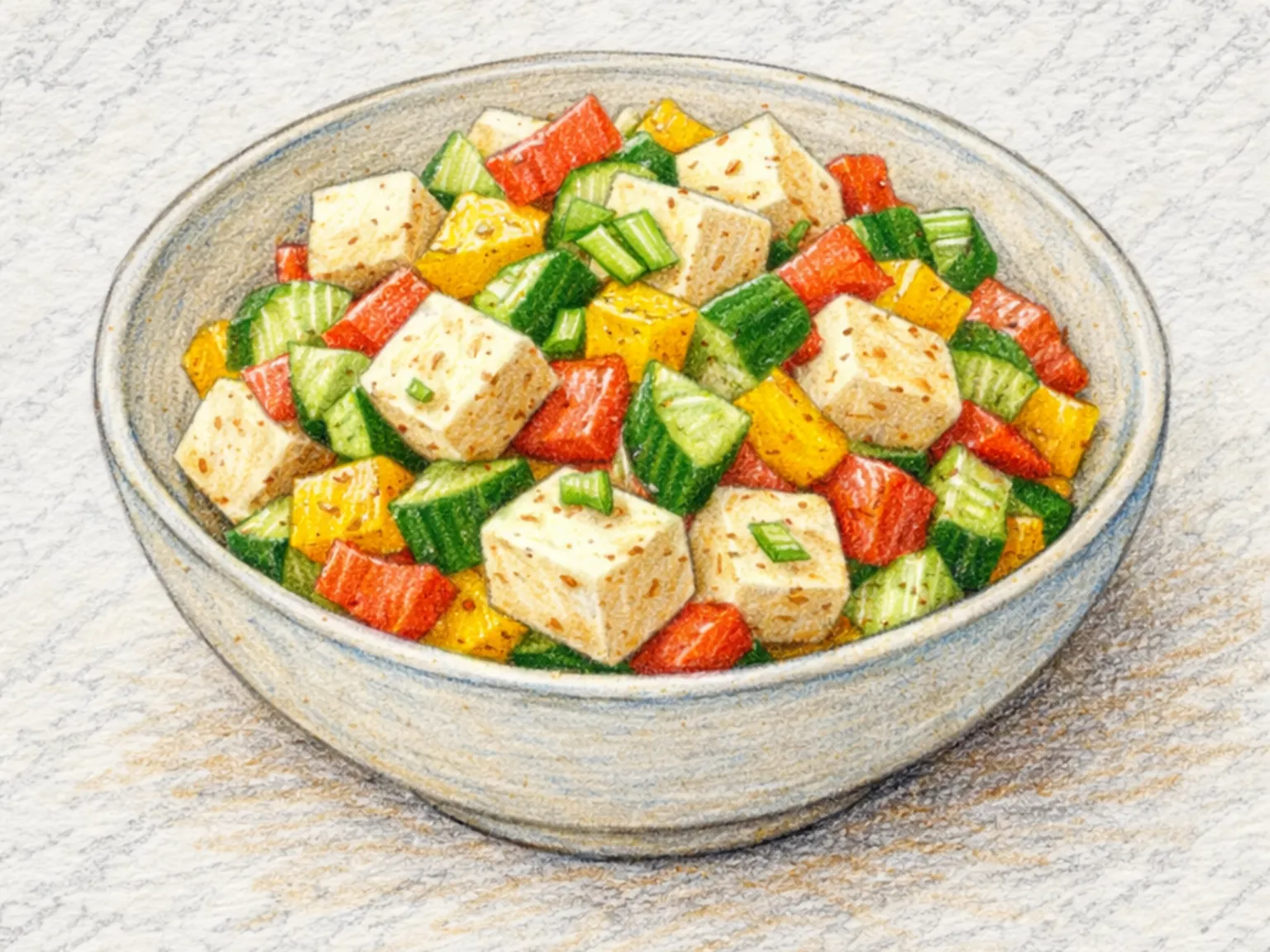
Paprika-dubu-muchim combines 300 grams of blanched firm tofu, crumbled coarsely by hand, with julienned red and yellow bell peppers, cucumber, and onion in a soy-vinegar dressing. Blanching the tofu for just one minute removes any raw bean flavor while preserving a soft, creamy texture that contrasts with the crisp, sweet snap of the peppers. The onion is soaked in cold water for three minutes to tame its bite before joining the bowl. Sesame oil and minced garlic round out the dressing, adding depth without heaviness. Chilling the finished dish for 10 minutes before serving sharpens the vegetable flavors and makes the tofu firmer to the bite.

🥗 Light & Healthy 🏠 Everyday
Prep 12min Cook 3min 2 servings
Pazı Borani (Turkish Swiss Chard with Yogurt)
Salads Easy

Pazı Borani (Turkish Swiss Chard with Yogurt)

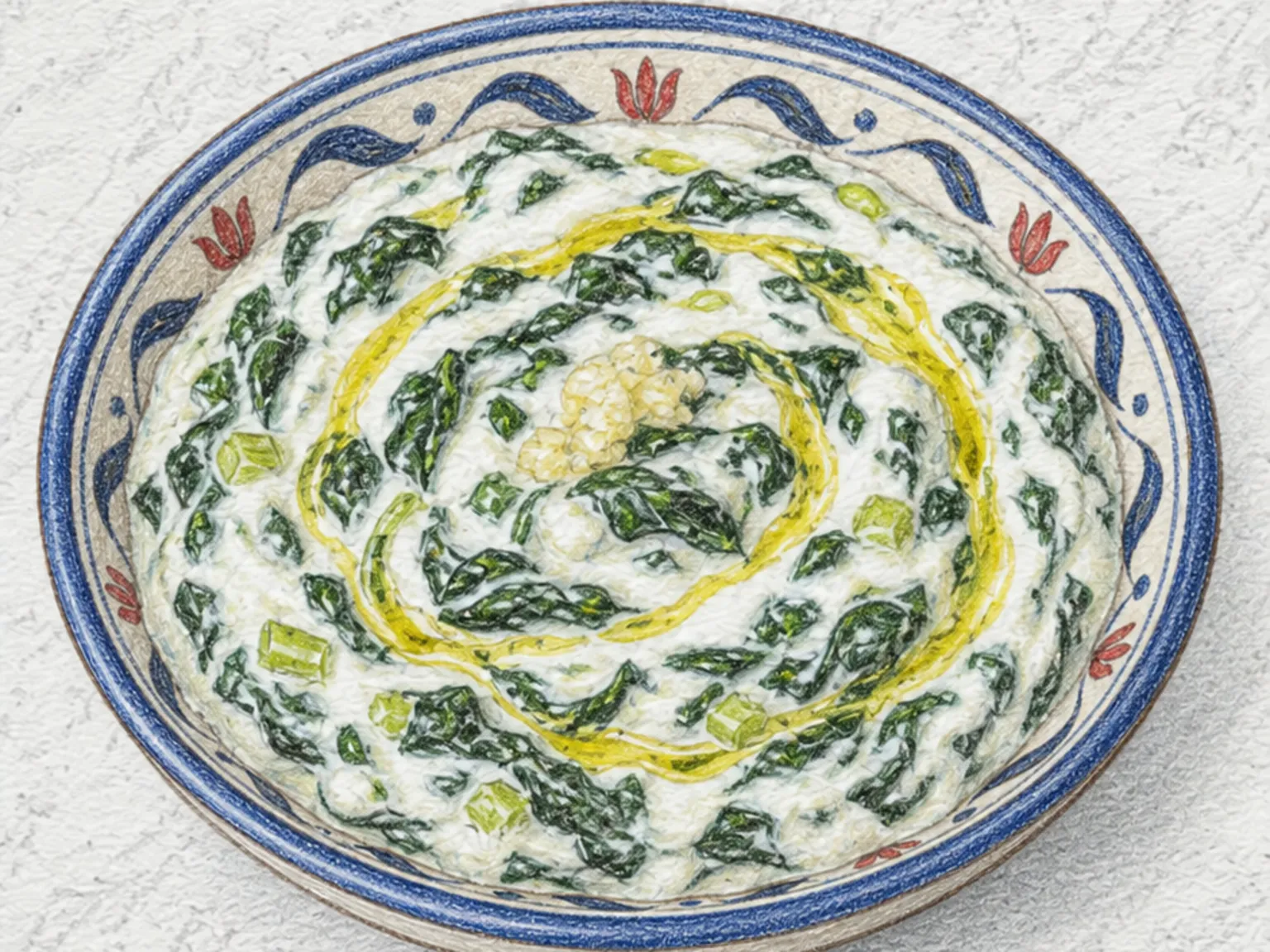
The critical boundary in pazı borani comes between cooking the Swiss chard and mixing it with yogurt. The sautéed greens need to cool completely before they enter the sauce, since residual heat and moisture can loosen the thick yogurt. For 2 servings, use 300 g Swiss chard, 200 g Greek yogurt, 80 g onion, and 10 g garlic. Wash the chard thoroughly, drain it, and chop both the leaves and stems into bite-sized pieces. Finely chop the onion and mince the garlic, keeping the garlic ready to divide between the pan and the yogurt. Heat 20 ml of the total 30 ml olive oil in a pan. Sauté the onion with half of the minced garlic, then add the chard and cook until the leaves and stems have wilted. Remove the cooked chard from the heat and let it cool until no warmth remains. While it cools, combine 200 g thick, low-moisture Greek yogurt with the remaining garlic and 5 g salt. Stir until the garlic and salt are evenly distributed through the yogurt. Fold the fully cooled chard into this sauce and coat the chopped leaves and stems before transferring the mixture to a plate. Put the remaining 10 ml olive oil and 2 g red chili flakes in a small pan and heat them briefly. Drizzle the red chili oil over the yogurt-coated chard as the final layer. The finished borani should hold a thick coating instead of releasing water, with the sharp garlic and warm chili oil remaining distinct against the cool yogurt and tender greens.

🏠 Everyday
Prep 10min Cook 15min 2 servings
Danggam Jogae Naengchae Salad (Persimmon Clam Chilled Salad)
Salads Medium

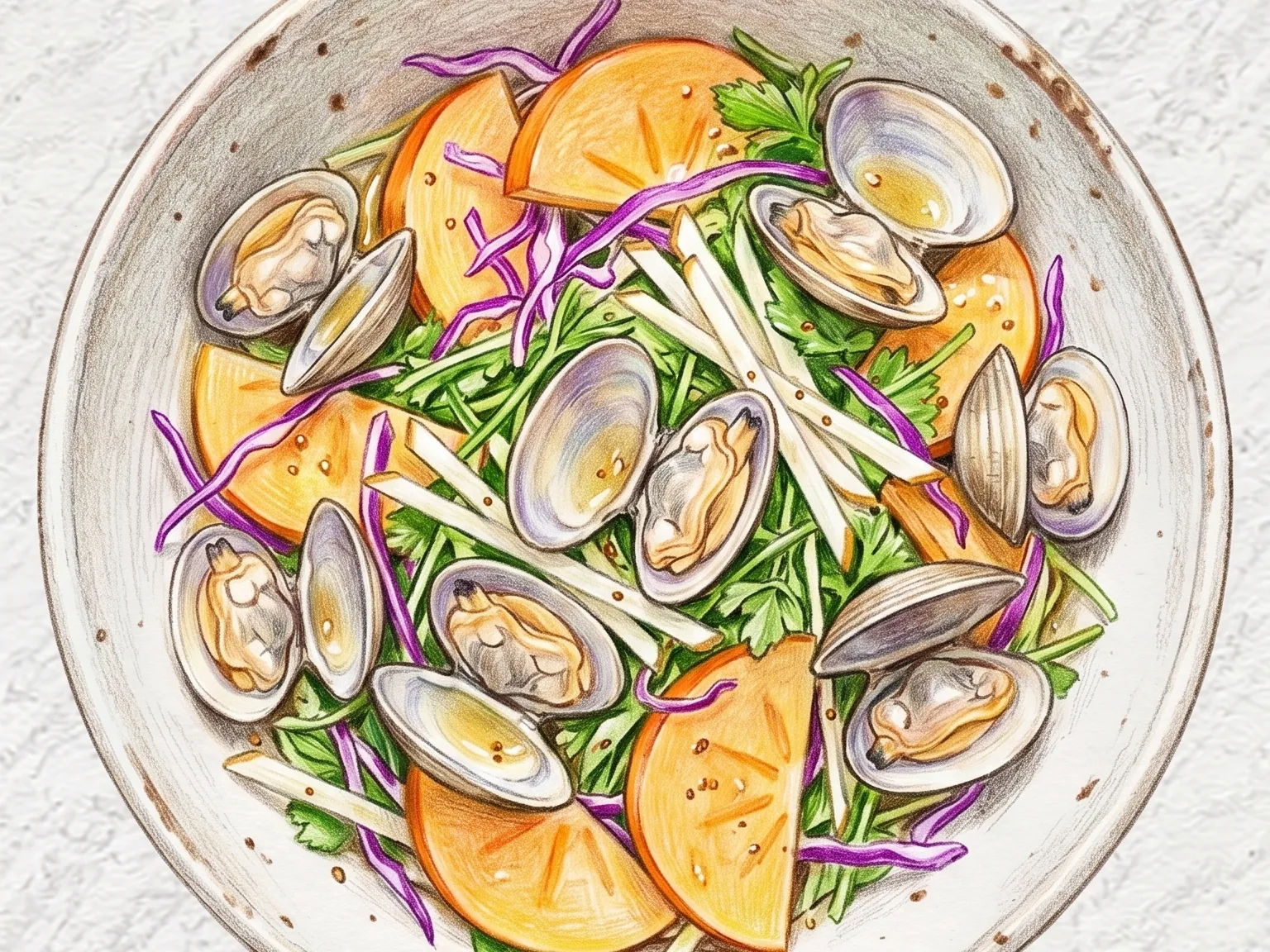
Danggam Jogae Naengchae Salad (Persimmon Clam Chilled Salad)

Persimmon jogae naengchae salad blanches clam meat just long enough to bring out its briny ocean flavor, then layers it with thinly sliced sweet persimmon whose honeyed taste creates an unexpected counterpoint to the shellfish. Minari, Korean water parsley, contributes a grassy bitterness that holds the sweet and salty elements in balance, while shredded red cabbage adds firm crunch and a vivid purple color that keeps the dish visually striking. Julienned Korean pear releases generous juice as it sits with the other ingredients, acting as a natural dressing that coats everything without the need for added oil. A final seasoning of vinegar and hot mustard paste brings sharp acidity and a piercing nasal heat that complete the clean, bracing aftertaste that defines a well-made Korean chilled salad. The layered interplay of color, fragrance, and texture makes this a fitting seasonal starter for a formal spread. Surf clams or pollock fillet can replace the manila clams without any change to the method.

🥗 Light & Healthy 🏠 Everyday
Prep 20min Cook 6min 4 servings
Turkish White Bean Salad (Turkish Cooked White Beans Salad)
Salads Easy

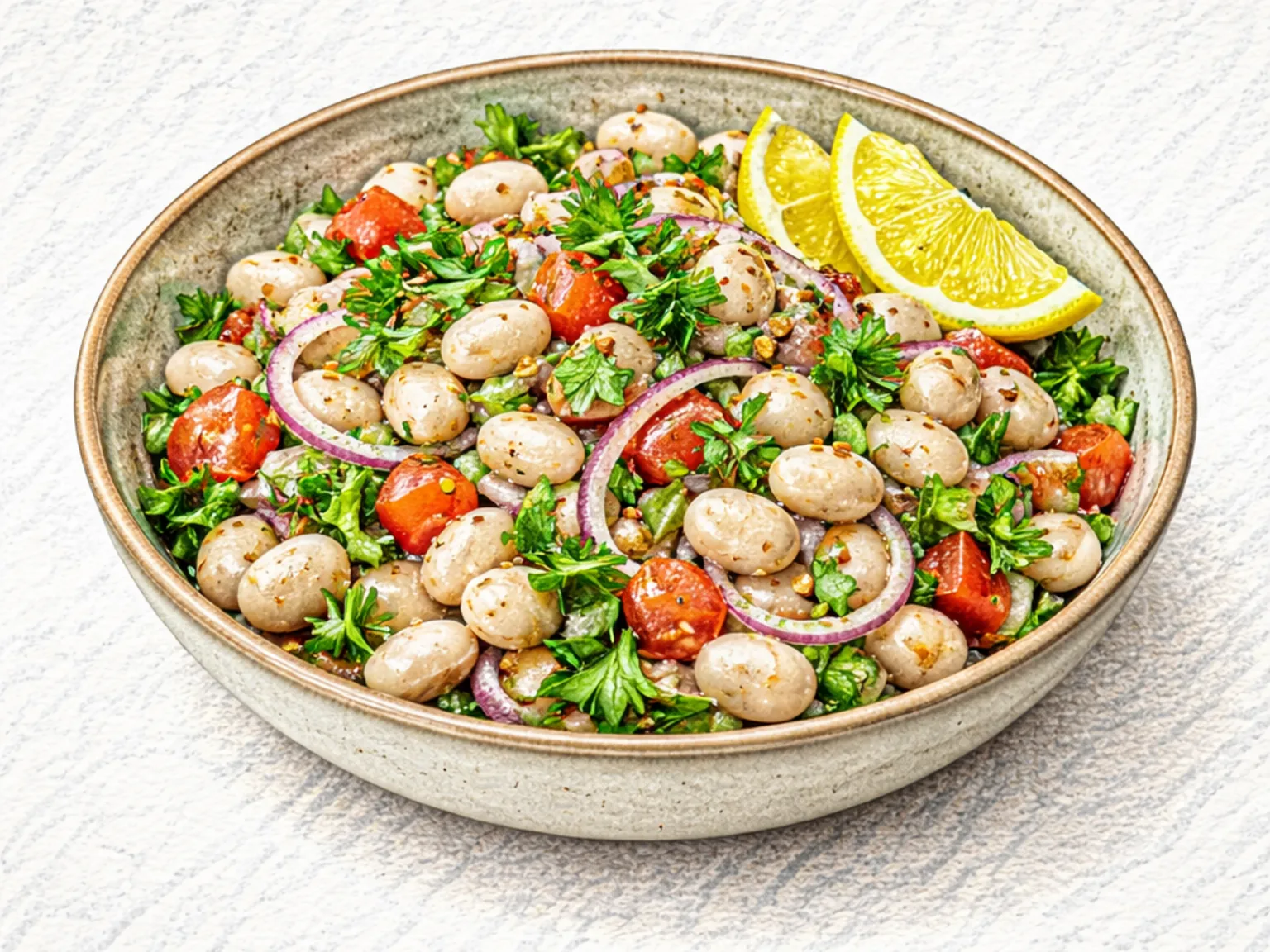
Turkish White Bean Salad (Turkish Cooked White Beans Salad)

Rinse 280 g cooked white beans lightly under running water in a sieve. Move them gently so they do not break, then drain until no water pools underneath. Slice 70 g red onion very thinly and soak it in cold water for about 5 minutes. Drain it once the sharp bite softens so its water does not dilute the dressing. Remove the thick stems from 20 g parsley and chop the leaves roughly; cutting them too finely can make them soft and watery. Whisk 2 tablespoons olive oil, 1.5 tablespoons lemon juice, and 1 tablespoon vinegar until the surface looks slightly thick and the oil no longer separates. Add the beans and onion first, folding from the bottom upward. When the beans look evenly glossy, add the parsley and turn the mixture once more without crushing them. Sprinkle 0.5 teaspoon sumac evenly so its acidity does not gather in one spot. Leave the salad at room temperature for about 10 minutes. Check the acidity and onion sharpness just before serving 2 portions with bread or grilled meat.

🥗 Light & Healthy ⚡ Quick
Prep 15min 2 servings
Quinoa Salad
Salads Easy

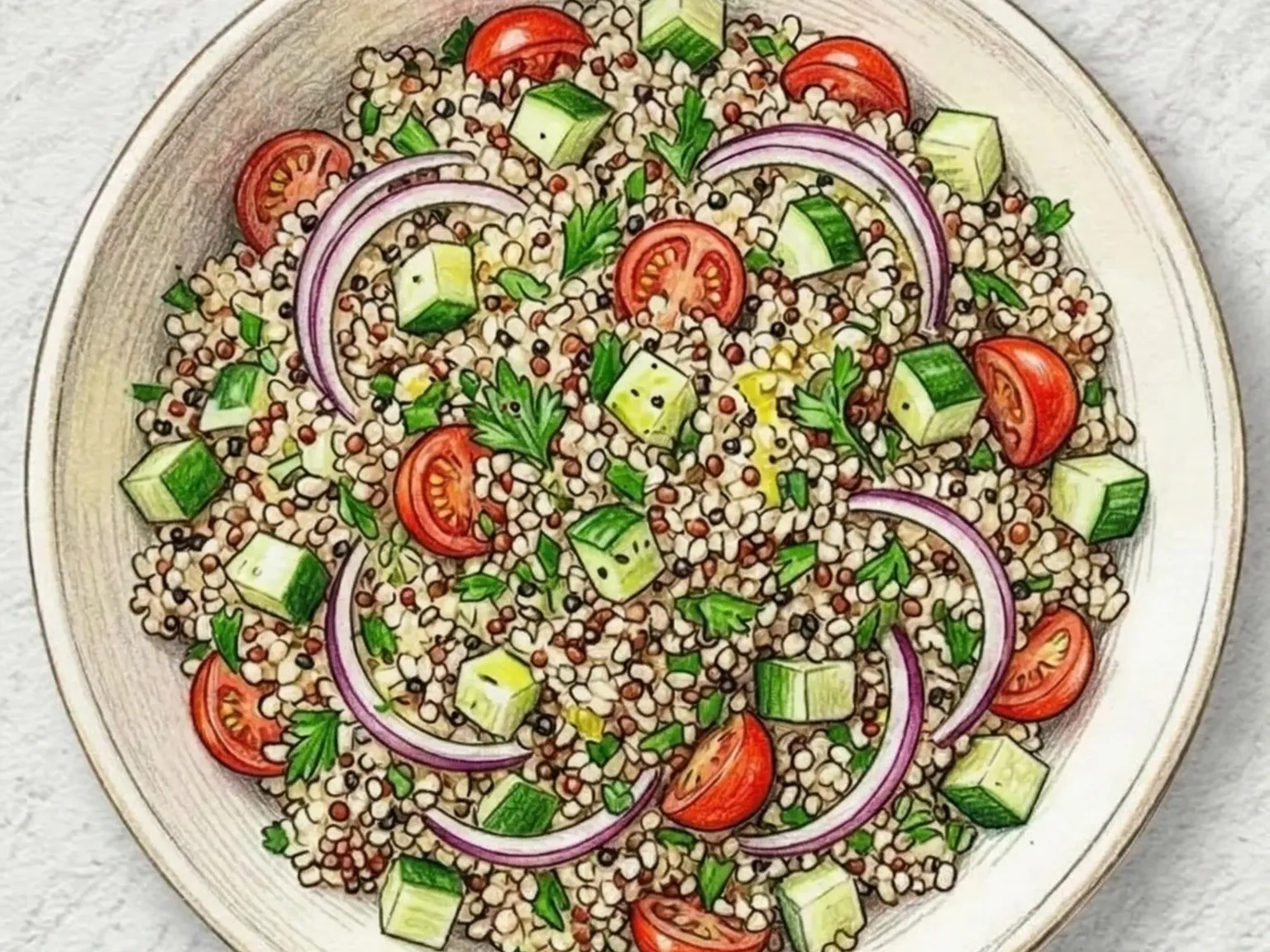
Quinoa Salad

Quinoa is boiled until fluffy and cooled to preserve its distinctive pop-when-bitten texture. Diced cucumber and halved cherry tomatoes mix in juicy crunch that energizes the mild grain base. Thinly sliced red onion adds sharpness, and generous chopped parsley pushes the herbal character forward. The dressing stays minimal - olive oil and lemon juice - letting raw ingredients speak clearly. As a complete protein containing all essential amino acids, quinoa makes this a nutritionally balanced light meal in a single bowl.

🥗 Light & Healthy ⚡ Quick
Prep 15min Cook 15min 2 servings
Spanish Orange Cod Salad (Spanish Salt Cod Salad)
Salads Medium

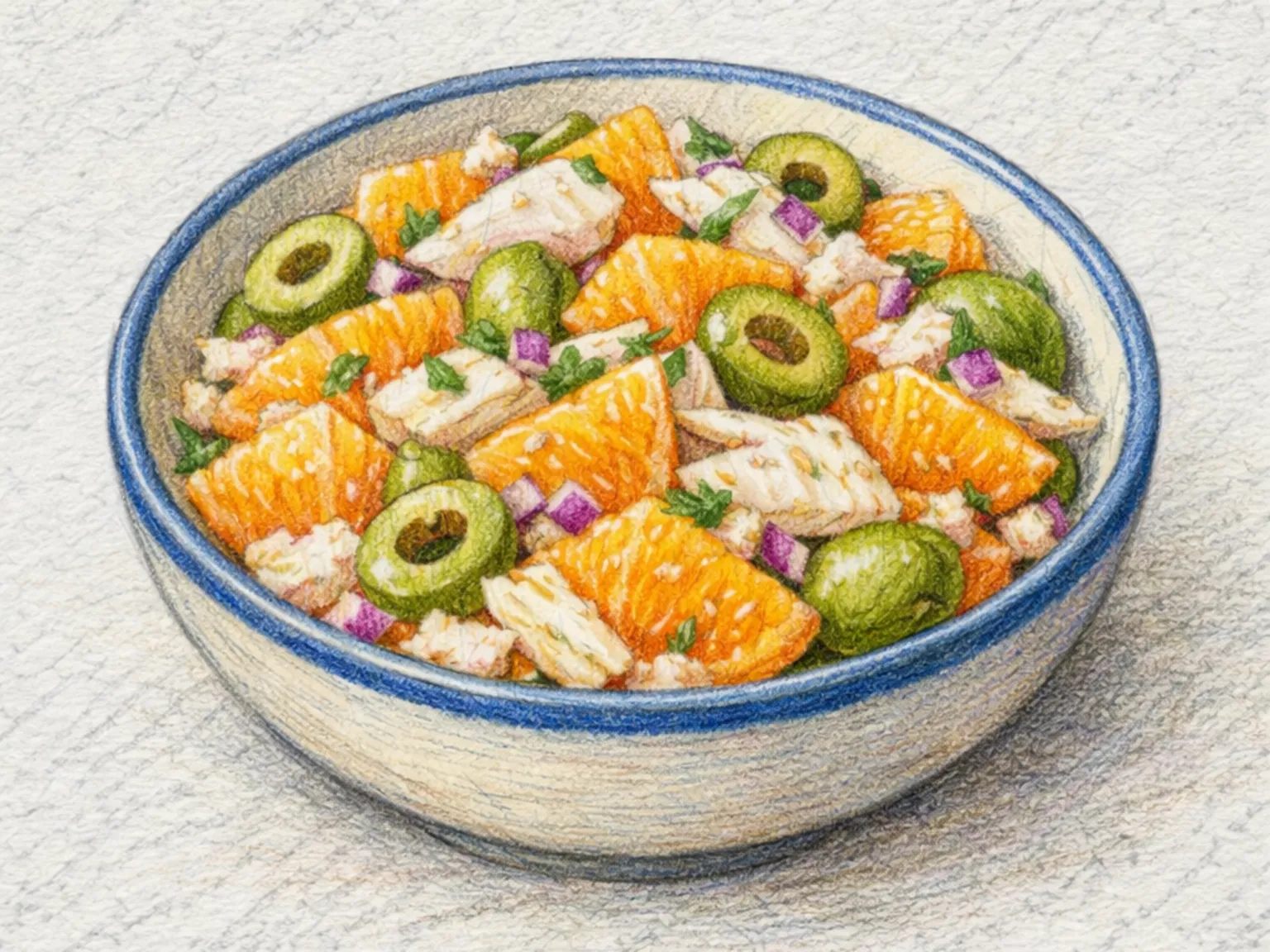
Spanish Orange Cod Salad (Spanish Salt Cod Salad)

Remojon is a traditional spring festival salad from Andalusia in southern Spain, built around salt cod that has been soaked in cold water for at least twenty-four hours to draw out the preserved brine before the fish is shredded along the grain into chewy, light flakes. Thick-cut orange segments provide a burst of sweet, juicy acidity that stands in direct contrast to the residual saltiness of the fish, creating the tension at the center of the dish. Thinly sliced red onion and whole black olives add layers of pungent sharpness and deep brininess that widen the overall flavor profile without competing with each other. Good-quality extra virgin olive oil draws every element together into a cohesive whole, coating each piece with a smooth, fruity richness. A measured splash of white wine vinegar tightens the entire salad and gives it a clean definition, while flat-leaf parsley scattered over the top provides a final note of fresh, green fragrance. The salad is well suited to being served tapas-style alongside wine or dry sherry, and because all the components can be prepared in advance, it assembles quickly at the table and makes a composed, elegant starter for guests.

🥗 Light & Healthy 🏠 Everyday
Prep 20min Cook 8min 2 servings
Roasted Brussels Sprout Salad
Salads Easy

Roasted Brussels Sprout Salad

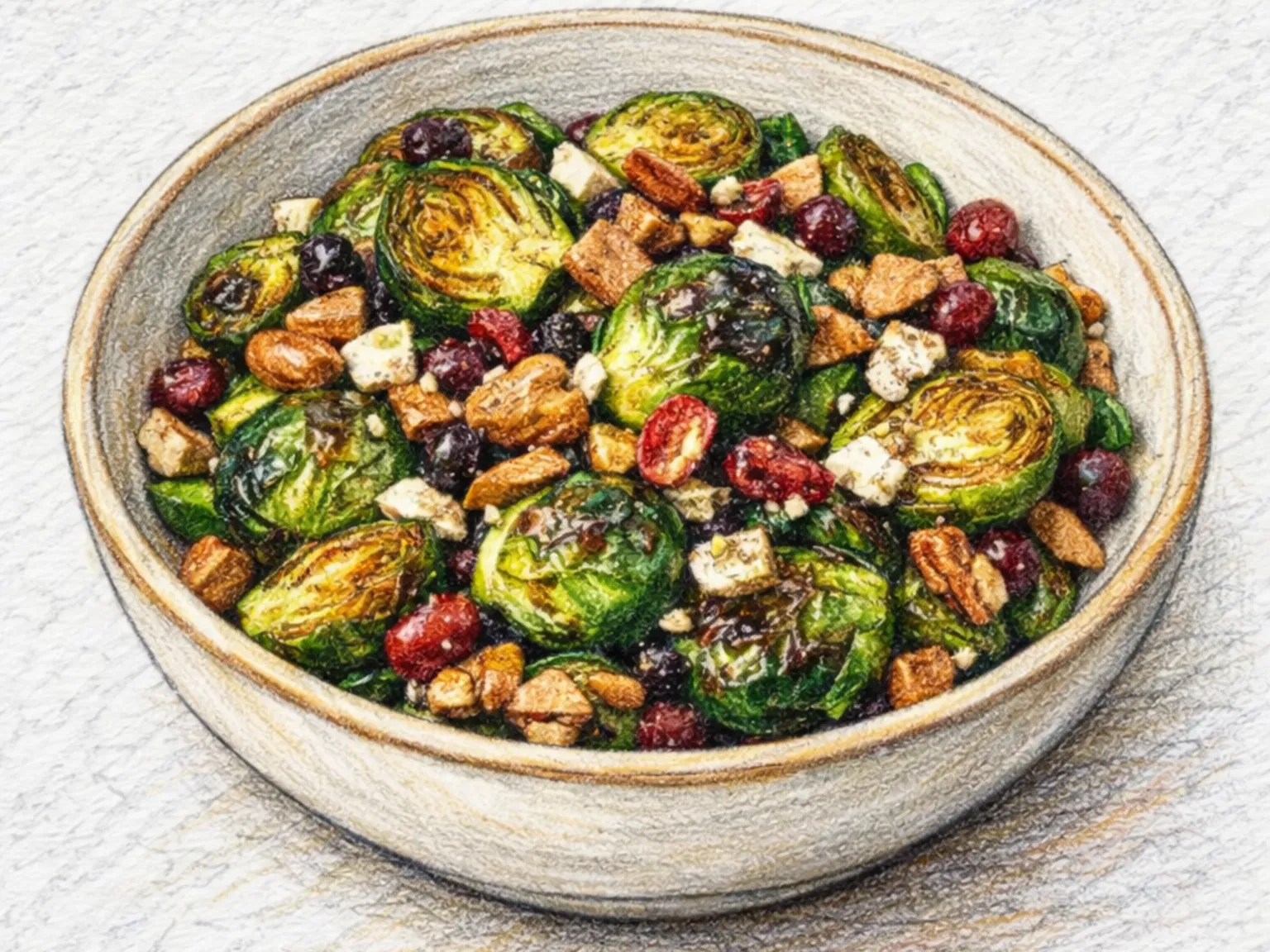
Brussels sprouts are halved and tossed with olive oil, then roasted at high heat until the outer leaves blacken at the edges and the cut faces turn deep brown and caramelized. That concentrated sweetness is the foundation of the salad. Roughly chopped walnuts echo the roasted nuttiness of the sprouts, and dried cranberries cut through with a tart-sweet fruitiness that prevents the dish from feeling too heavy. A vinaigrette made from Dijon mustard and apple cider vinegar introduces sharp acidity and a mild pungency that balance the caramelized sweetness of the sprouts. Grated parmesan scattered over the top adds a salty, umami-forward finish that ties the other flavors together. Winter sprouts that have been exposed to frost lose their bitterness and develop a pronounced natural sweetness, making the cold-weather season the best time for this salad. Dressing the sprouts while they are still hot allows the vinaigrette to absorb into the cut surfaces and season them from within, rather than coating them on the outside.

🥗 Light & Healthy 🏠 Everyday
Prep 15min Cook 20min 2 servings
Roasted Cauliflower Tahini Salad
Salads Easy

Roasted Cauliflower Tahini Salad

Cauliflower florets reach a specific texture and flavor profile when roasted in a mixture of olive oil and salt. This process continues in the oven until the edges of the vegetable turn a deep golden brown. This dry heat method creates a transformation that is distinct from moist heat methods like steaming or boiling. High oven temperatures trigger caramelization and the Maillard reaction, which together extract a nutty and slightly sweet complexity from the cauliflower. This development is significant because the vegetable is otherwise quite mild and neutral in its raw or boiled state. The concentrated flavor resulting from roasting provides the necessary foundation for the tahini dressing. Because the dressing is thick and carries a heavy sesame richness, it requires the caramelized depth of the roasted cauliflower to act as a balance. Without this roasting process, the dressing might easily overpower a vegetable that has not developed its own strong character. The preparation of the sauce involves whisking tahini paste with fresh lemon juice and minced garlic. This mixture is stirred until it becomes smooth. The acidity from the lemon juice is essential here as it cuts through the density of the sesame paste. This ensures the final sauce remains bright on the palate instead of feeling heavy or overly thick. To complete the dish, large amounts of chopped flat-leaf parsley are scattered over the top. This addition introduces a vivid green color and a clean herbal quality that serves to offset the richness of both the tahini and the oil used during the roasting process. A light dusting of cumin or smoked paprika can be applied as a final step to sharpen the Middle Eastern characteristics of the salad. The final result presents a series of layered flavors including the toasted sesame from the tahini, the caramelized edges of the cauliflower, the sharp acid of the lemon, and the clean finish provided by the parsley. Each of these components acts as a distinct note within the overall composition. This combination is a common staple in Middle Eastern culinary traditions. It functions well when served alongside flatbread or as an accompaniment to grilled portions of meat or fish.

🥗 Light & Healthy 🏠 Everyday
Prep 15min Cook 25min 2 servings
Roasted Eggplant Pomegranate Salad
Salads Easy

Roasted Eggplant Pomegranate Salad

Cut 500g eggplant into 1.5cm half-moons, sprinkle all surfaces evenly with 2g salt, and leave them for 10 minutes. When beads of moisture appear, press the pieces dry with paper towels. Preheat the oven to 220C. Brush the eggplant with 15ml olive oil and spread it in a single layer without overlap so steam does not collect around the pieces. Roast for 12 minutes. When the edges turn lightly brown, flip each slice and roast for 3 minutes more. Remove the eggplant when the center is soft but every piece still holds its shape. Slice 60g red onion very thinly and soak it in cold water. Once its sharp aroma has softened, drain it thoroughly so it does not wet the 70g arugula. Whisk the remaining 15ml olive oil with 15ml red wine vinegar, 10g honey, 2g salt, and 1g black pepper until the honey dissolves completely. Toss the arugula and drained onion lightly with this dressing first. Place the still-warm eggplant and 90g pomegranate seeds on top, then fold the salad together gently once. Divide it among four servings and serve immediately while the warm eggplant can absorb the dressing without losing its shape.

🥗 Light & Healthy 🏠 Everyday
Prep 20min Cook 15min 4 servings
Roasted Kabocha Miso Nut Salad
Salads Easy

Roasted Kabocha Miso Nut Salad

Kabocha squash is sliced into half-moons and roasted in a hot oven until the cut surfaces caramelize and the flesh turns chestnut-soft and dry in the best possible way. The dressing combines white miso, rice vinegar, and maple syrup into a mixture where salt, acid, and a restrained sweetness reinforce each other and amplify the roasted squash underneath. Arugula provides the peppery, slightly bitter base that keeps the salad from tipping too sweet. Chickpeas add lean protein and a firm, satisfying chew that holds up against the tender squash. Walnuts, crushed roughly rather than chopped fine, contribute crunch and a deep, roasted nuttiness that layers well with the soft squash in each forkful. The contrast between textures, tender squash against resistant walnut, is what makes this salad interesting across every bite. Autumn kabocha, at the peak of its natural sugar content, delivers the most pronounced sweetness, and the dish is filling enough to stand as a vegetarian main course with nothing else alongside it. If using refrigerated squash, adjust oven time and temperature to ensure even caramelization.

🥗 Light & Healthy 🎉 Special Occasion
Prep 15min Cook 25min 4 servings

About Salads

Seasonal produce provides the best flavor and nutrition. Whether you are looking for a full meal replacement or a vivid side dish, these salad recipes offer balanced, straightforward options.