Western Recipes
662 recipes. Page 15 of 28
This category brings Western-style dishes - pasta, steak, risotto, gratin, and more - into the home kitchen. In Korea, "Western food" (yangsik) includes not only authentic European recipes but also Korean-adapted classics like donkatsu (pork cutlet) and hambak steak (Hamburg steak).
Japanese Napolitan Spaghetti
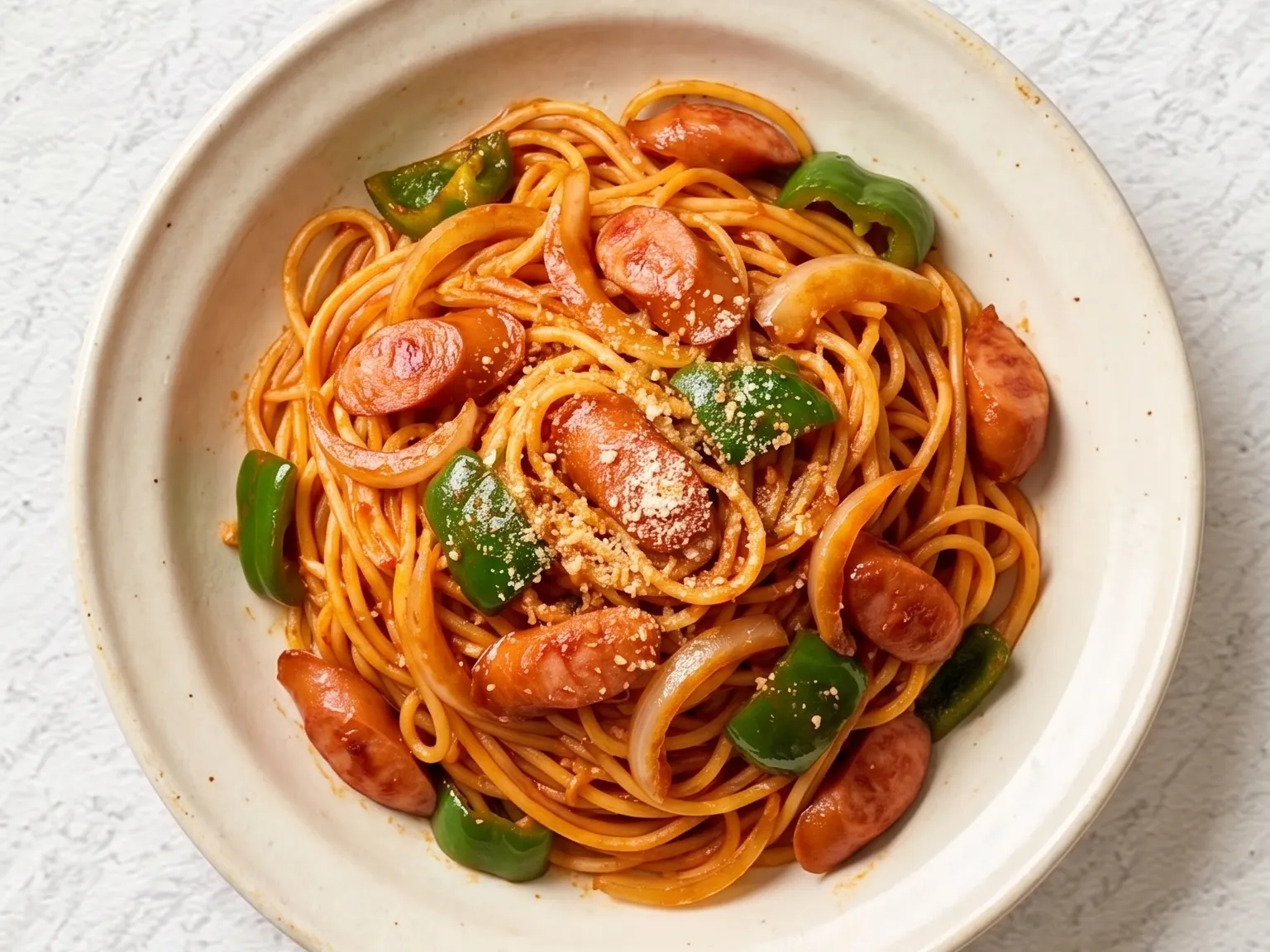
Napolitan spaghetti is a Japanese yoshoku pasta stir-fried with ketchup, sausage, onion, and green bell pepper that traces its origins to postwar Japan, when imported ingredients were scarce and cooks adapted Western techniques with locally available pantry staples. Cooking the ketchup in the pan first drives off moisture and concentrates its tomato sweetness, transforming it from a condiment into a sauce base with genuine depth. Worcestershire sauce adds a layer of fermented complexity that ketchup alone cannot provide. The sausage goes in first to render its fat and build flavor, followed by onion and pepper stir-fried quickly over high heat to retain their texture. Spaghetti cooked al dente with a quarter cup of pasta water reserved helps the sauce cling to the noodles when tossed together in the pan. A knob of butter stirred in at the end rounds off the ketchup's acidity and gives the finished dish a glossy, sweet-savory character that has made napolitan a beloved nostalgic dish in Japanese home cooking.
Taco Salad
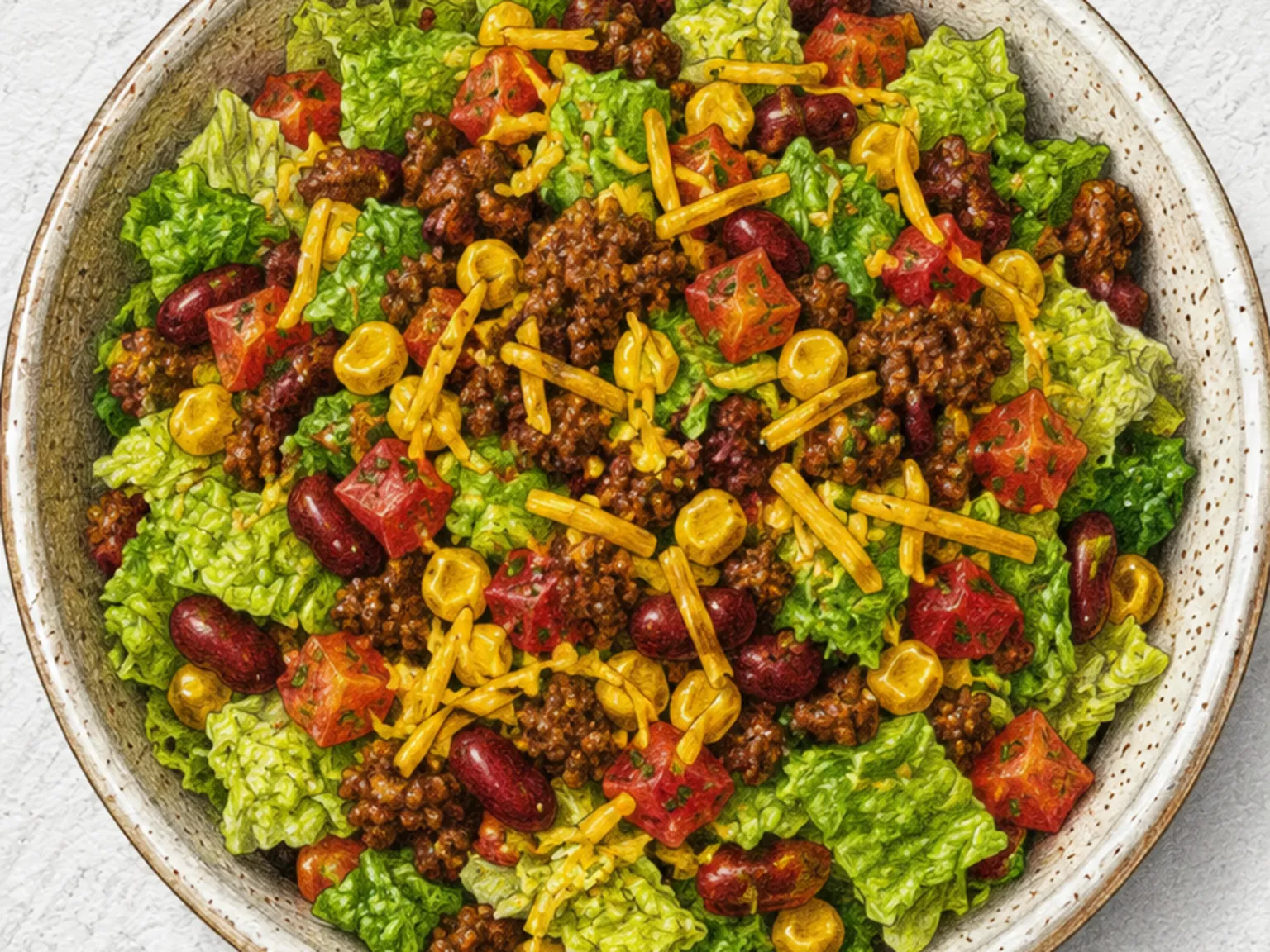
Taco salad layers cooked ground beef, kidney beans, and corn over romaine, then adds tomato salsa, cheddar, and lime. Wash 160 g romaine, remove as much water as possible, and tear it into bite-size pieces. Drain 120 g kidney beans and 100 g corn kernels thoroughly as well. Heat a pan over high heat, add 1 tbsp olive oil, and spread 200 g ground beef in an even layer. Break up large clumps with a spatula as the meat cooks. Once no red color remains, continue cooking over high heat for another 2 to 3 minutes, stirring until the pan is dry and the beef edges are lightly browned. Lower the heat to medium, add the drained beans and corn, and warm them for about 1 minute while folding gently enough to keep the beans intact. Put the romaine in a large bowl, place the warm beef mixture on top, and add 120 g tomato salsa. Toss lightly, sprinkle over 50 g cheddar cheese, and squeeze in 1 lime immediately before serving. Fold only once or twice and serve promptly so the warm topping has little time to wilt the lettuce. Draining the vegetables and cooking off the beef's released moisture are important because both the salsa and lime add liquid during assembly. No separate taco seasoning is used in this ingredient list, so the measured salsa, cheddar, and whole lime provide the finishing seasoning.
Creamy Tuscan Chicken
Creamy Tuscan chicken begins by searing seasoned chicken breasts in olive oil until a deep golden crust forms on both sides, locking in juices. Minced garlic is sauteed briefly in the same pan drippings, then chicken stock deglazes the fond for extra savory depth. Heavy cream and grated Parmesan simmer on low heat for three minutes, thickening into a velvety sauce. Sun-dried tomatoes bring concentrated sweetness while fresh spinach wilts into the sauce, adding color and a mild vegetal note. Returning the chicken for a final four-minute simmer ensures the breast cooks through to a safe internal temperature while absorbing the sauce's rich flavor. Adding more Parmesan thickens the sauce further, and a few drops of lemon juice stirred in at the end lifts the cream's weight and brings it into balance with the acidity of the sun-dried tomatoes.
Ciabatta Bread
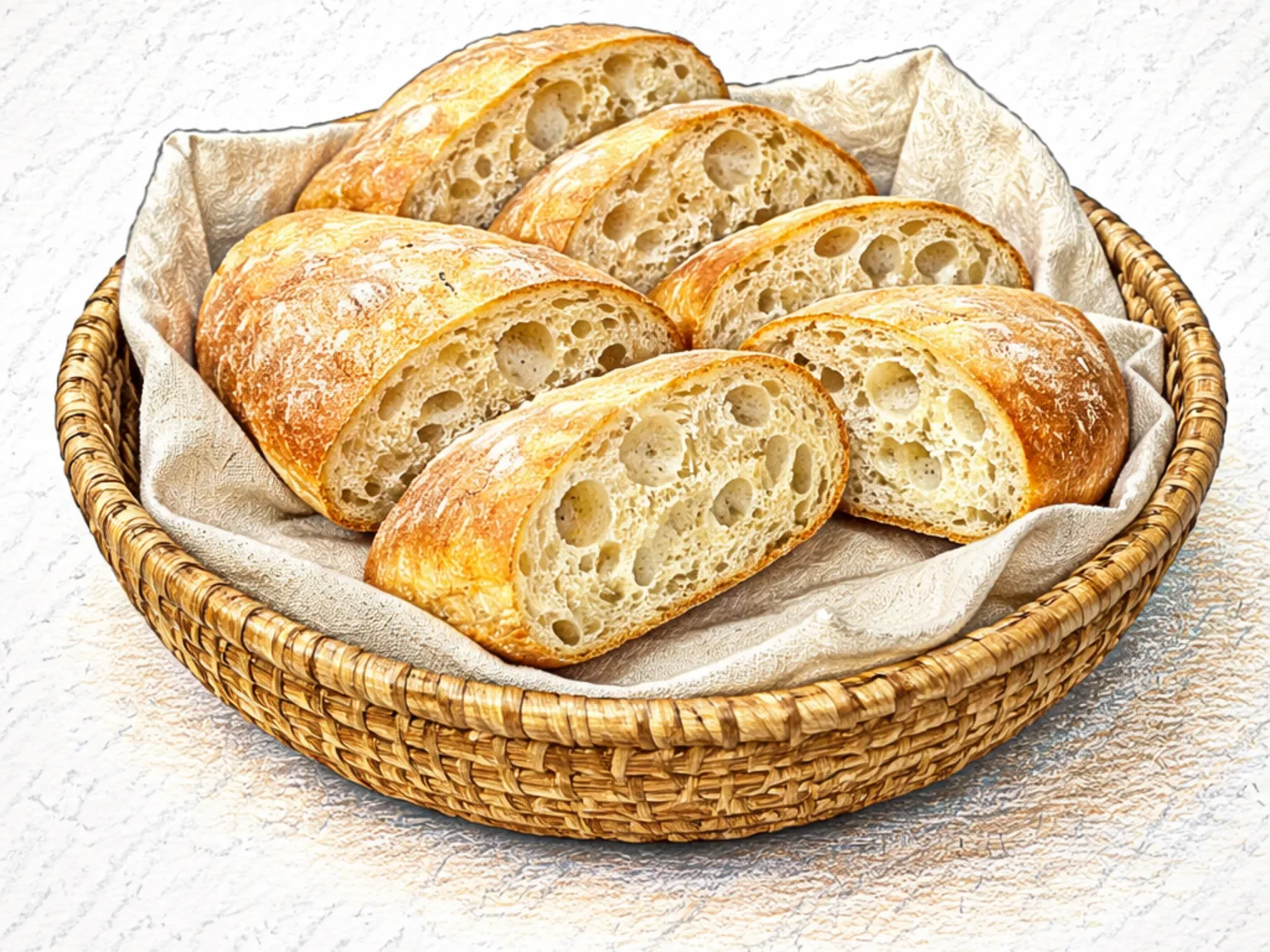
Ciabatta is a flat Italian bread developed in Veneto in 1982 by baker Arnaldo Cavallari, whose name translates to slipper in Italian - a nod to the bread's wide, flat shape. Its defining characteristic is an exceptionally high hydration level, with water making up 70 to 80 percent of the flour's weight. The dough is too slack and sticky to knead by hand in the traditional sense and instead requires a folding technique or stand mixer to develop structure, but this excess moisture is precisely what creates the bread's signature open crumb: large, irregular holes distributed throughout the interior that give the crumb a lacey, almost Swiss-cheese quality. The crust is thin and crackly, shattering lightly when pressed, while the interior crumb is chewy and moist with a mild wheaty sweetness that develops as you chew. A long cold bulk fermentation in the refrigerator builds mild acidity and a more complex flavor than a quick room-temperature proof can produce. Because of its high moisture content, ciabatta stales faster than denser breads and is best eaten the same day it is baked. The contrast between its crackly exterior and open, absorbent interior makes it ideal for panini sandwiches, where the crust crisps further under heat, and for dipping in good olive oil, which pools in the holes of the crumb. It is also an excellent companion to soups, where the open crumb soaks up broth without falling apart.
Orecchiette with Broccoli Rabe
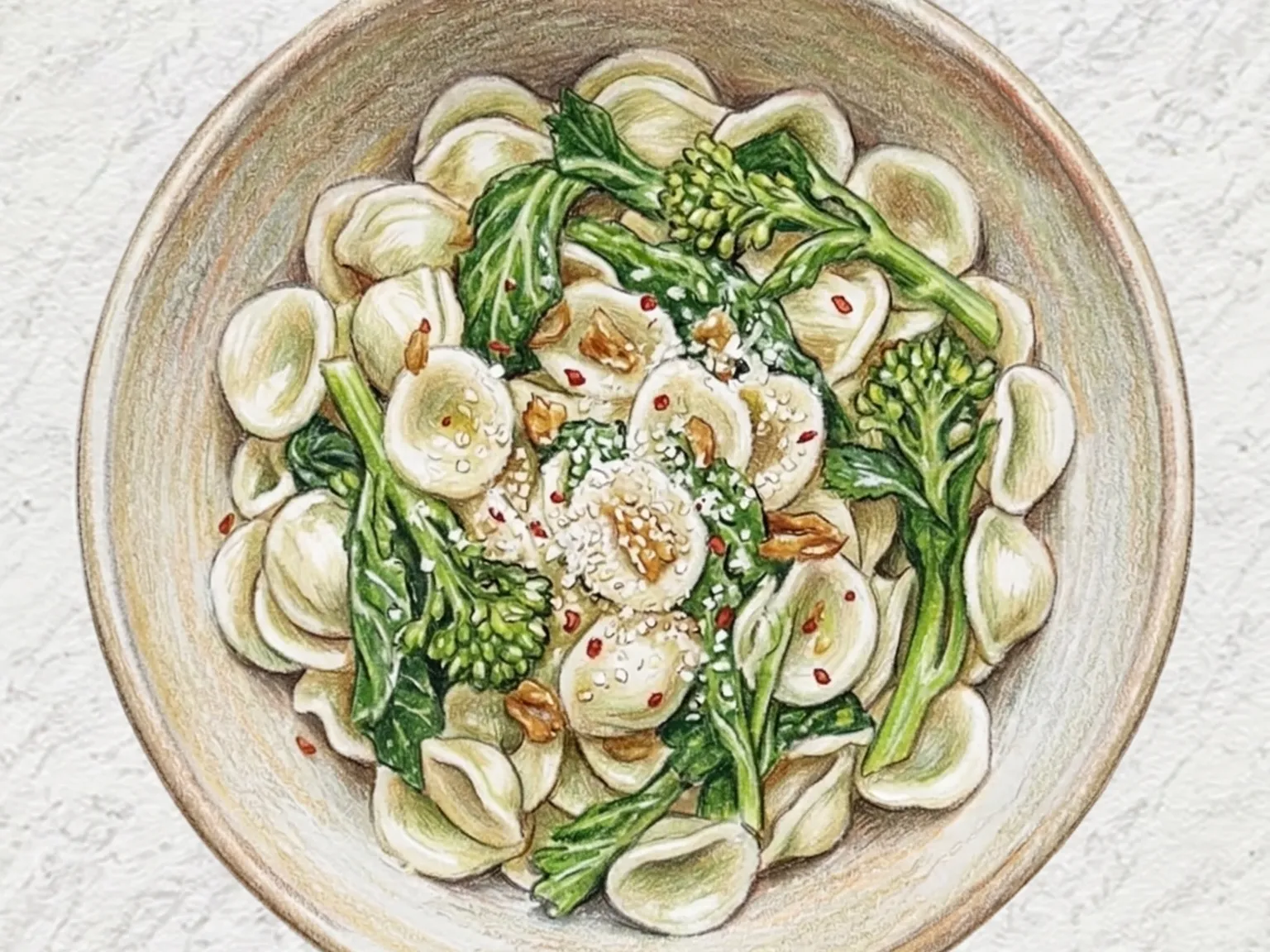
Orecchiette with broccoli rabe is a Southern Italian pasta from Puglia that pairs ear-shaped pasta with blanched broccoli rabe, garlic, anchovy, and dried chili in olive oil. Blanching the broccoli rabe for one to two minutes tames its bitterness, and cooking the pasta in the same water infuses it with the green's flavor. Garlic and anchovy fillets are warmed slowly in olive oil until the anchovy dissolves into a savory paste, providing salt and umami without needing additional seasoning. Dried chili flakes contribute a gentle background heat. Tossing the drained pasta and greens in the pan with a splash of pasta water emulsifies the oil into a light coating on every piece. Grated parmesan scattered on top adds a salty, nutty finish that balances the vegetal bitterness.
Three Bean Salad
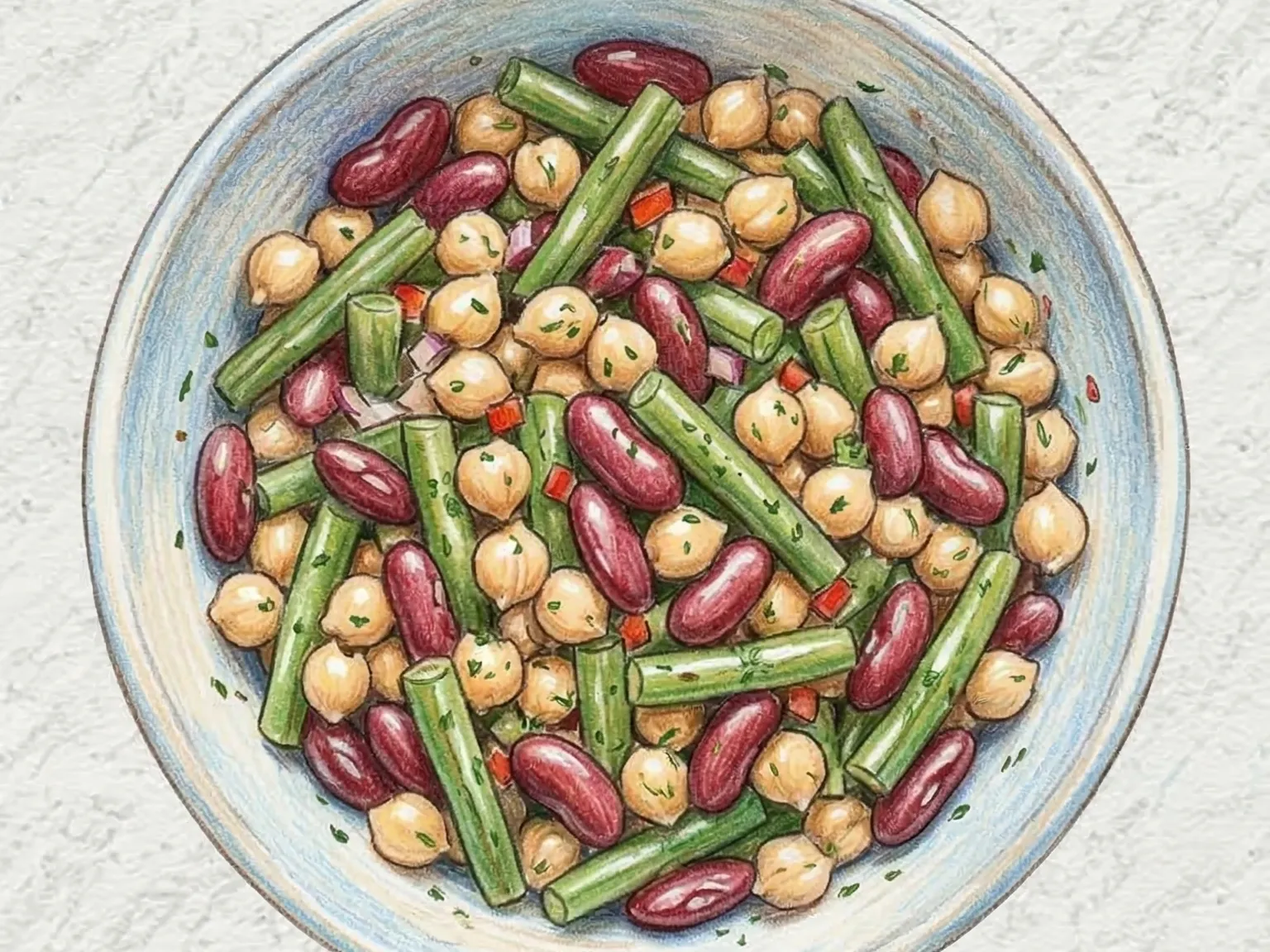
Three bean salad consists of kidney beans, chickpeas, and fresh green beans that are prepared by blanching. The green beans undergo a brief cooking process in boiling water for three minutes, which ensures they retain a bright appearance and a snappy texture. In contrast, the kidney beans and chickpeas used are canned varieties that only require thorough rinsing and draining to remove any excess starch from their surface. The recipe includes red onions that have been thinly sliced and then soaked in cold water. This soaking step is used to remove the sharp, raw bite of the onion, resulting in a mild sweetness that integrates well with the other components. The dressing for this salad is a combination of olive oil, apple cider vinegar, and Dijon mustard. The apple cider vinegar contributes a soft acidity to the mixture, while the mustard introduces a sharp and peppery element that provides flavor to the beans. Storing the assembled salad in the refrigerator overnight is an important step because it allows the dressing to soak into the beans and the green beans. This waiting period makes the dish a suitable option for individuals looking to prepare their meals ahead of time.
Croque Monsieur (Béchamel Ham and Cheese Melt)
Croque monsieur is a Parisian café classic built on a smooth béchamel sauce made from a butter-flour roux whisked with warm milk. One slice of white bread is spread with Dijon mustard before being layered with sliced ham and grated Gruyère cheese. The second slice tops the sandwich, which then gets a generous coat of béchamel and more cheese on the upper surface. Baking at 200 degrees Celsius for ten minutes melts the interior filling, and a brief three-minute broil creates a golden, bubbling crust on top. The mustard's pungent sharpness balances the salty richness of ham and cheese, keeping the overall flavor clean.
Cinnamon Babka (Jewish Twisted Enriched Bread with Cinnamon Swirl)
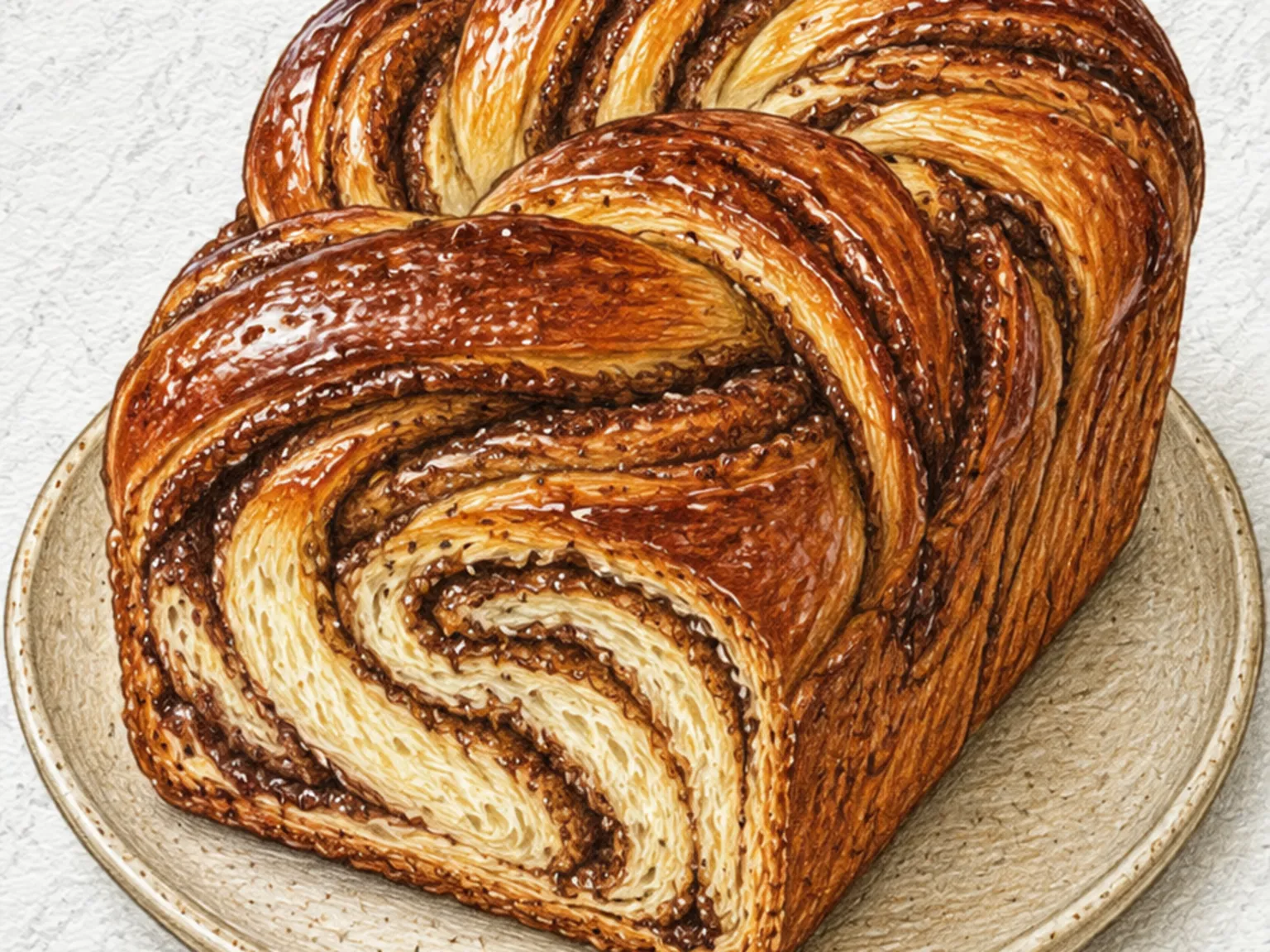
Cinnamon babka is a twisted, enriched yeast bread from the Eastern European Jewish baking tradition, built from a dough loaded with butter and eggs that gives it a crumb closer to brioche than ordinary bread. The dough is rolled into a wide rectangle, spread edge to edge with a thick mixture of cinnamon and brown sugar, then rolled tightly into a log. The log is split lengthwise down the center, exposing the spiral filling on both cut surfaces, and the two halves are twisted around each other before being lowered into the loaf pan. This shaping step is what creates the characteristic layered swirl visible in every slice. During baking, the cinnamon sugar melts into sticky, caramelized threads that run through the crumb and saturate the bread with a warm spice aroma. The soft, pull-apart texture of the enriched dough carries the richness of the butter and eggs in every bite, and the contrast between the pale dough and dark cinnamon filling becomes more defined after the loaf cools. Brushing the surface with simple syrup immediately out of the oven seals in moisture and gives the top a glossy, bakery-counter sheen that holds into the next day. The loaf is sweet enough to serve as dessert yet substantial enough to anchor a breakfast table.
Pasta al Limone (Italian Lemon Butter Cream Pasta)
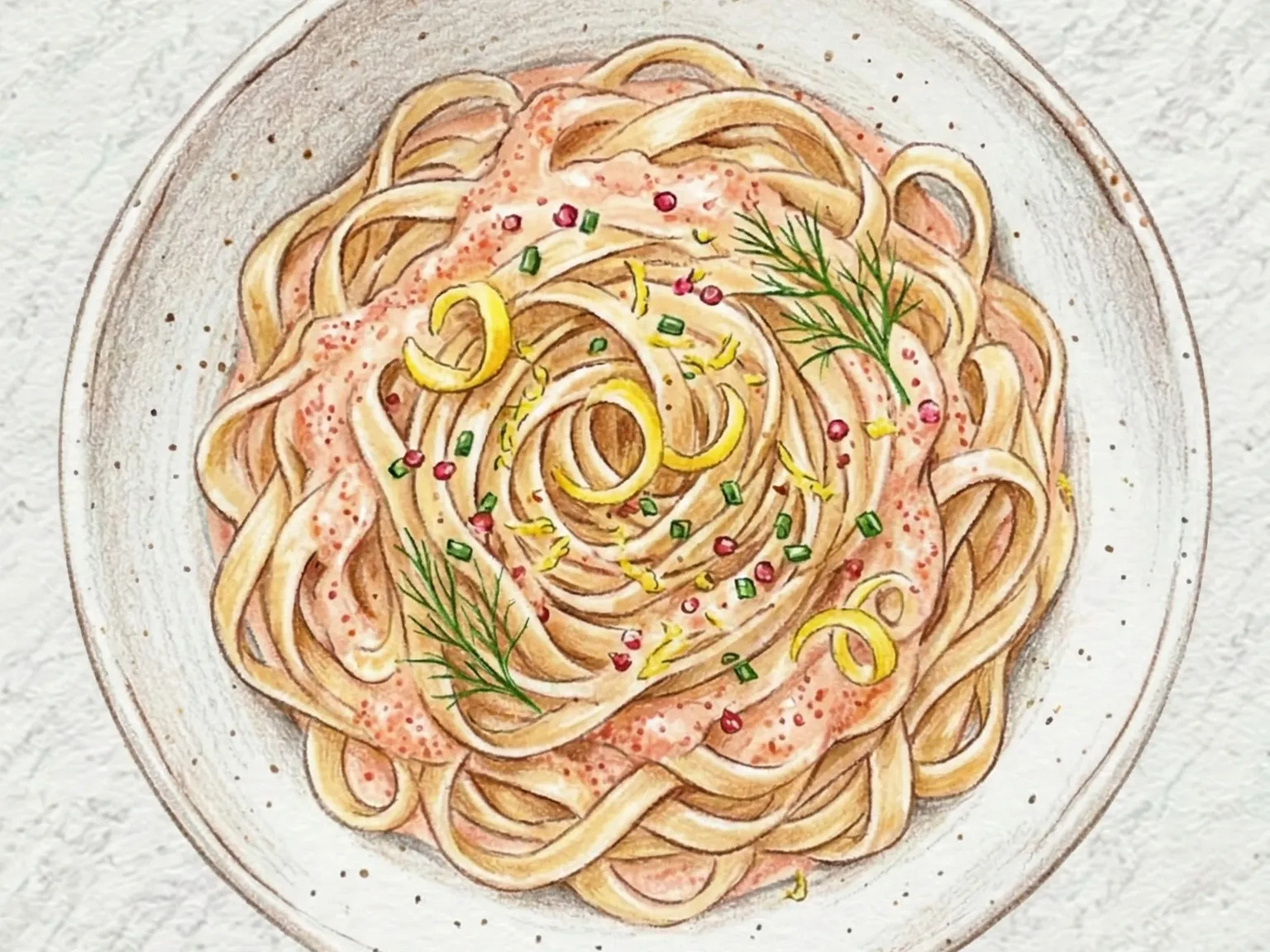
Pasta al limone is a pasta from southern Italy that relies entirely on lemon zest, lemon juice, butter, cream, and Parmesan for its sauce, with no tomato and no meat to complicate the flavor. The citrus oils drawn from the zest dissolve into warm butter and spread their aroma evenly through the fat before any liquid is added, which is what gives the finished sauce its rounded, lingering lemon character rather than a sharp acidic bite. A ladleful of starchy pasta water is then added to emulsify everything into a glossy, clingy coating that holds to each strand of linguine without pooling at the bottom of the plate. Cooking the sauce over low heat throughout is critical: cream added to high heat separates and loses its silky texture. Linguine cooked al dente provides enough resistance to stand up to the light sauce without the combination feeling heavy or cloying. Total preparation from filling a pot with water to plating takes roughly twenty minutes, making it a realistic weeknight option despite its refined result.
Tuna White Bean Salad (Lemon-Dressed Tuna and White Beans)
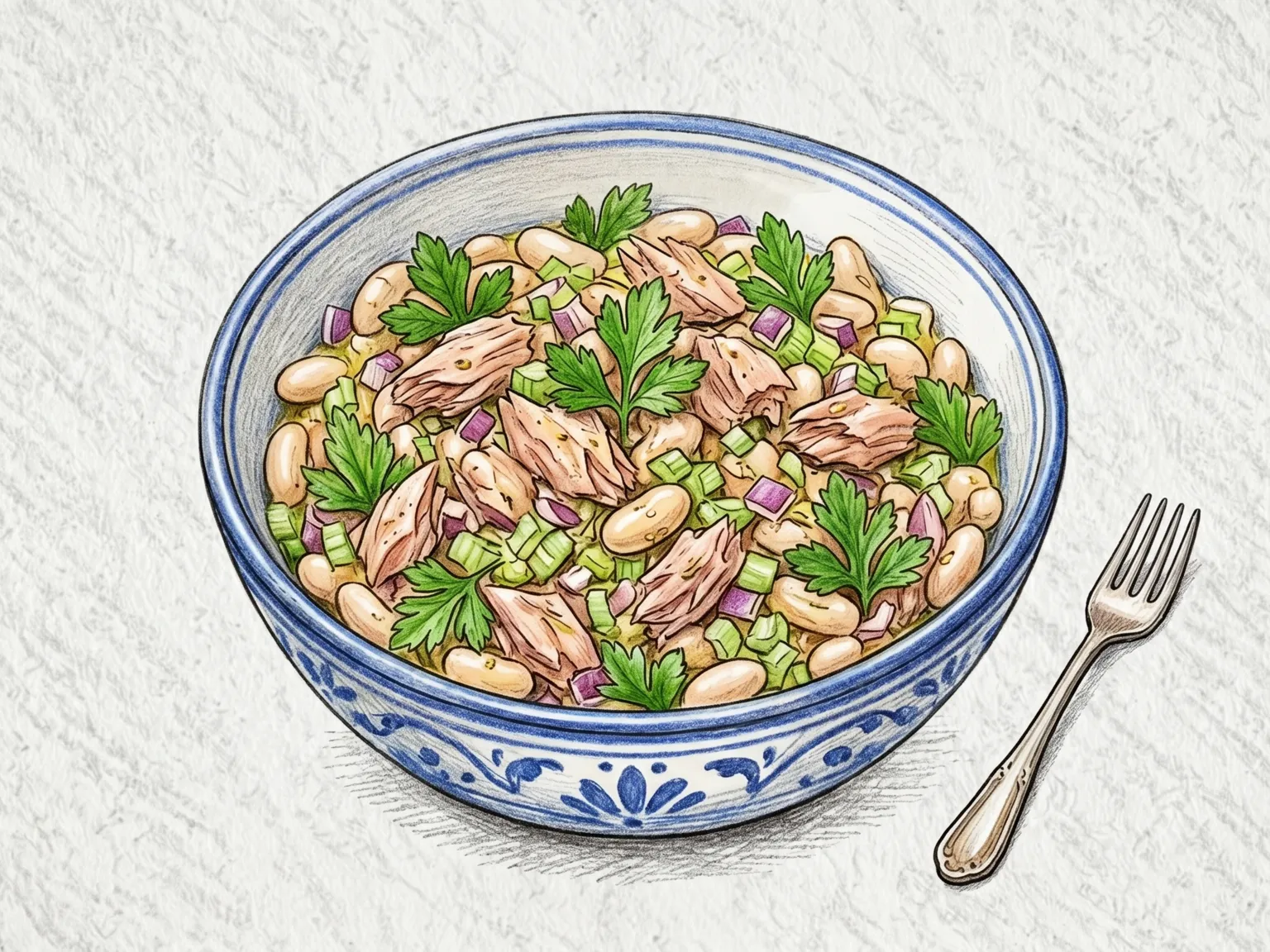
Tuna white bean salad combines canned tuna and cooked white beans with celery, red onion, parsley, olive oil, and lemon juice. Place 160 g canned tuna and 220 g cooked white beans in a sieve for at least 5 minutes. If liquid remains, press only gently enough to drain it without crushing the beans. Finely chop 60 g celery, thinly slice or mince 30 g red onion, and chop 15 g parsley using mostly the leaves. In a large bowl, mix 1.5 tbsp olive oil with 1 tbsp lemon juice for about 20 seconds. Add the drained white beans first and fold them from the bottom for no longer than about 1 minute, until the dressing coats their surfaces. Add the tuna while keeping some larger flakes intact, followed by the celery, red onion, and parsley. Fold the mixture instead of rubbing or stirring hard so the beans and tuna retain their shape. Refrigerate the salad for about 10 minutes. Check the bottom of the bowl before serving, and if the dressing has settled, lift and fold the salad once more before serving it cold. Thorough draining is the main control point because liquid carried by both the tuna and beans would thin the small measured amount of oil and lemon dressing.
Croquetas de Jamon (Crispy Ham Béchamel Bites)
Croquetas de jamon begin with a roux of butter and flour cooked together for two minutes, followed by milk added in stages while whisking continuously to build a thick, smooth bechamel. Finely chopped jamon serrano is folded into the sauce along with seasoning, and the mixture is spread into a shallow dish and refrigerated until firm enough to shape without collapsing. Thorough chilling is the most critical step because soft filling cannot hold its oval form during breading and frying. Each croqueta is coated in beaten egg and rolled in fine breadcrumbs, then coated a second time to reduce the risk of splitting in hot oil. Fried at medium heat until deeply golden on all sides, the exterior shatters crisply while the interior releases a stream of hot, creamy, ham-laced bechamel. The salt and smoke of the jamon permeate the filling completely, making every bite rich and savory. These croquetas are one of the most beloved items in Spanish tapas culture, typically served two or three to a plate alongside a cold drink.
Cinnamon Rolls
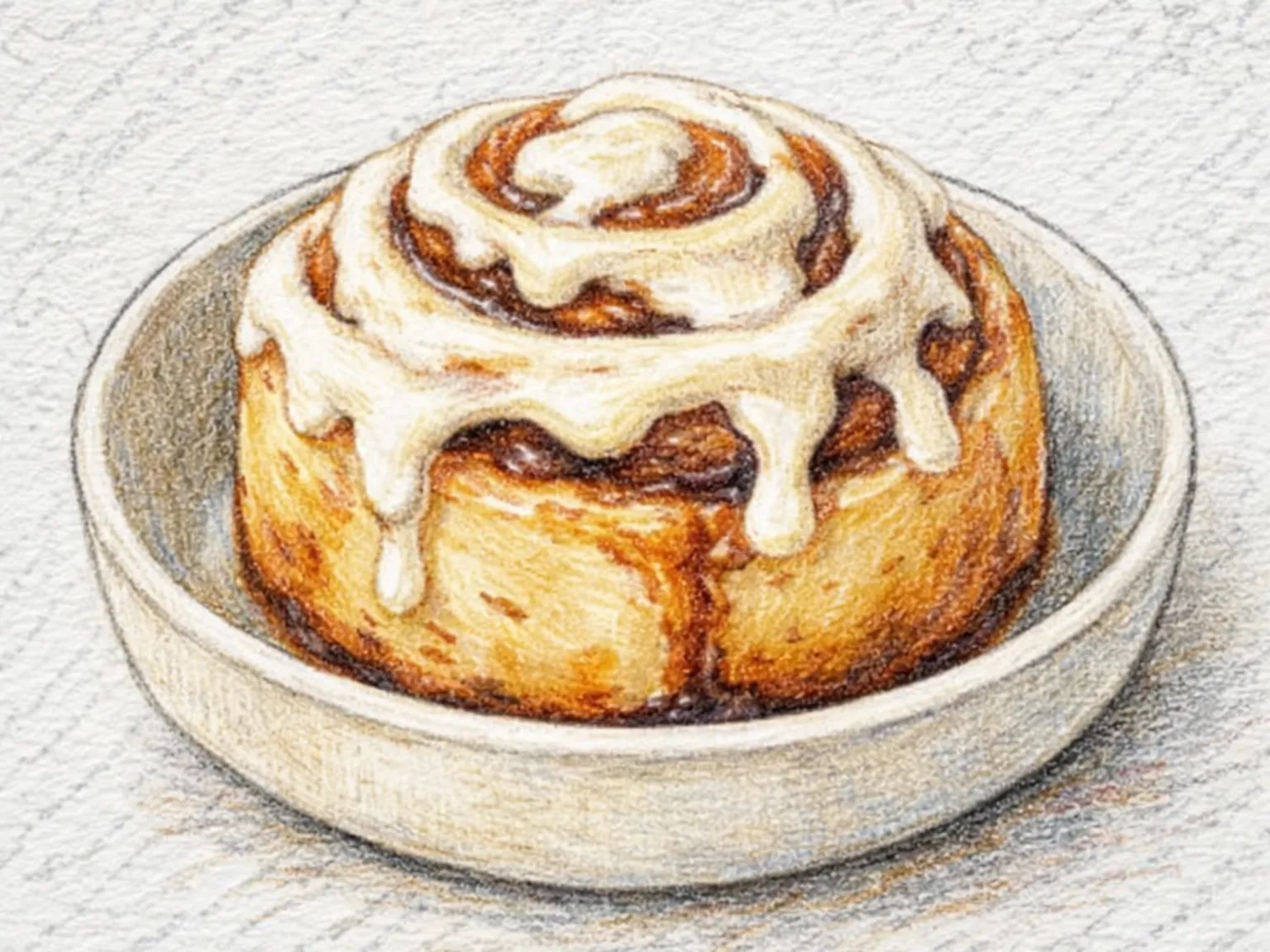
Cinnamon rolls are yeasted enriched dough baked into spirals of butter, cinnamon, and brown sugar, with roots in both Scandinavian and North American baking traditions. The dough, enriched with milk, butter, and eggs, rises into a crumb soft enough to pull apart in layers by hand. A thick layer of softened butter and cinnamon-sugar is spread on the rolled dough before it is coiled tightly and sliced into rounds. During baking, the sugar melts and caramelizes between the coiled layers, and the cinnamon aroma filling the space is one of the most recognizable in all of baking. A cream cheese glaze poured over the hot rolls melts into a tangy coating that balances the sweetness. In Sweden the same concept appears as kanelbulle with less sugar and added cardamom; in the United States the rolls are rolled thicker and buried under a generous glaze.
Pasta alla Genovese (Neapolitan Slow-Braised Onion and Beef Ragu)
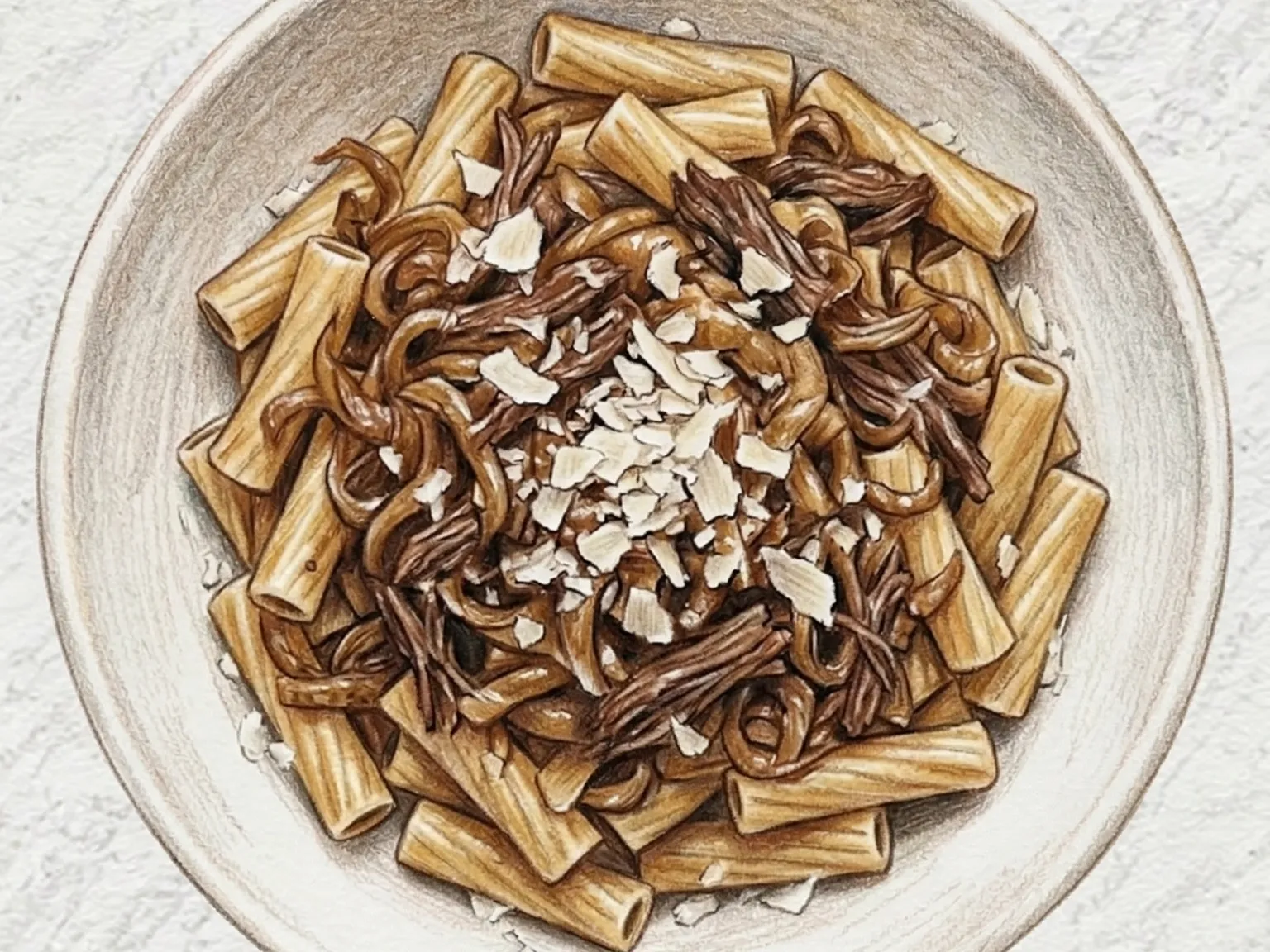
Pasta alla Genovese is a Neapolitan slow-cooked ragu that uses a large volume of onions braised together with beef chuck for at least two hours over low heat. No tomato is involved at any stage; the sauce draws all its sweetness from the onions, which gradually dissolve and caramelize into a thick, deeply savory base, while white wine and the rendered beef fat add richness and acidity. Once the onions have nearly melted into the sauce, the beef is shredded and folded back in, giving the finished ragu a dense, almost jam-like consistency with strands of meat throughout. Despite its name, the dish has no connection to Genoa or Ligurian basil pesto; it is a distinctly Neapolitan preparation, and the name is thought to trace back to Genoese cooks or merchants who settled in Naples. Ziti is the traditional pasta shape, served with a generous dusting of Parmigiano-Reggiano.
Waldorf Salad
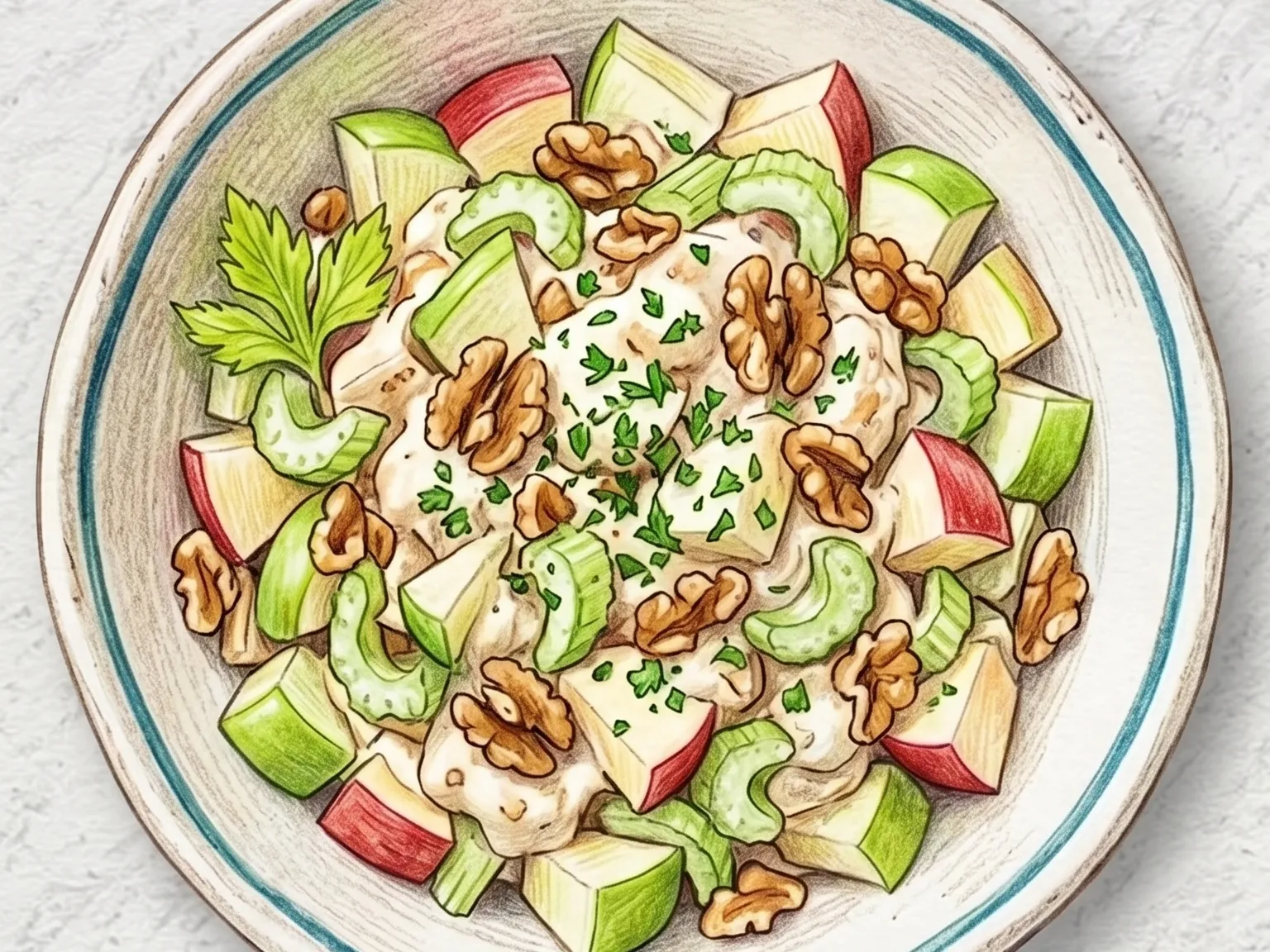
Waldorf salad combines crisp apple, thinly sliced celery, juicy grapes, and fragrant toasted walnuts under a light mayonnaise dressing. For 4 servings, prepare 2 apples, 2 celery stalks, 60 g walnuts, 4 teaspoons mayonnaise, 1 teaspoon lemon juice, 0.5 teaspoon sugar, and 100 g grapes. Rinse and dry the apples, then cut them into even bite-size cubes. Toss the cut surfaces immediately with the lemon juice so they remain bright while the other ingredients are prepared. Trim the celery, remove any noticeable tough strings, and slice it thinly. Halve the grapes and remove any seeds. Break only the largest walnut pieces so the finished salad retains their texture. Warm the walnuts in a dry pan over low heat for about 2 minutes, stopping when they smell fragrant, then let them cool completely before mixing. Stir the mayonnaise and sugar together in a large bowl until the sugar is evenly dispersed. Add any lemon juice left with the apples and mix until the dressing looks smooth. Add the apples, celery, grapes, and cooled walnuts. Fold from the bottom upward with a spatula and avoid pressing the fruit, which would release juice and thin the dressing. Cover the bowl and chill for 30 minutes. Stir once just before serving and check that the dressing still coats the ingredients lightly without pooling at the bottom.
Cuban Sandwich
Cuban sandwich splits a baguette lengthwise and spreads Dijon mustard on both cut sides before layering roast pork, sliced ham, Swiss cheese, and thin pickle slices inside. Butter goes on the outer crust, and the assembled sandwich is pressed in a skillet or sandwich press over medium heat for four to five minutes per side. The sustained pressure flattens the bread into a crisp, golden shell while the Swiss cheese melts and binds the fillings into a cohesive unit. Pickles provide a tart acidity and mustard adds a sharp, pungent bite that cut through the salty richness of the two meats, keeping each mouthful balanced rather than heavy. A heavy cast-iron pan placed on top works as well as a dedicated press when equipment is limited. The traditional pork is lechon, a Cuban-style roast marinated in garlic, cumin, and sour orange juice, though tightly grained pork belly or chashu makes a serviceable substitute. This sandwich was developed by Cuban immigrants in Tampa and Miami, where it became a daily staple rather than an occasional indulgence. Deceptively simple in appearance, it is a study in balance: every ingredient serves a specific purpose and the whole is noticeably better than the sum of its parts.
Clafoutis (French Baked Cherry Custard Dessert)
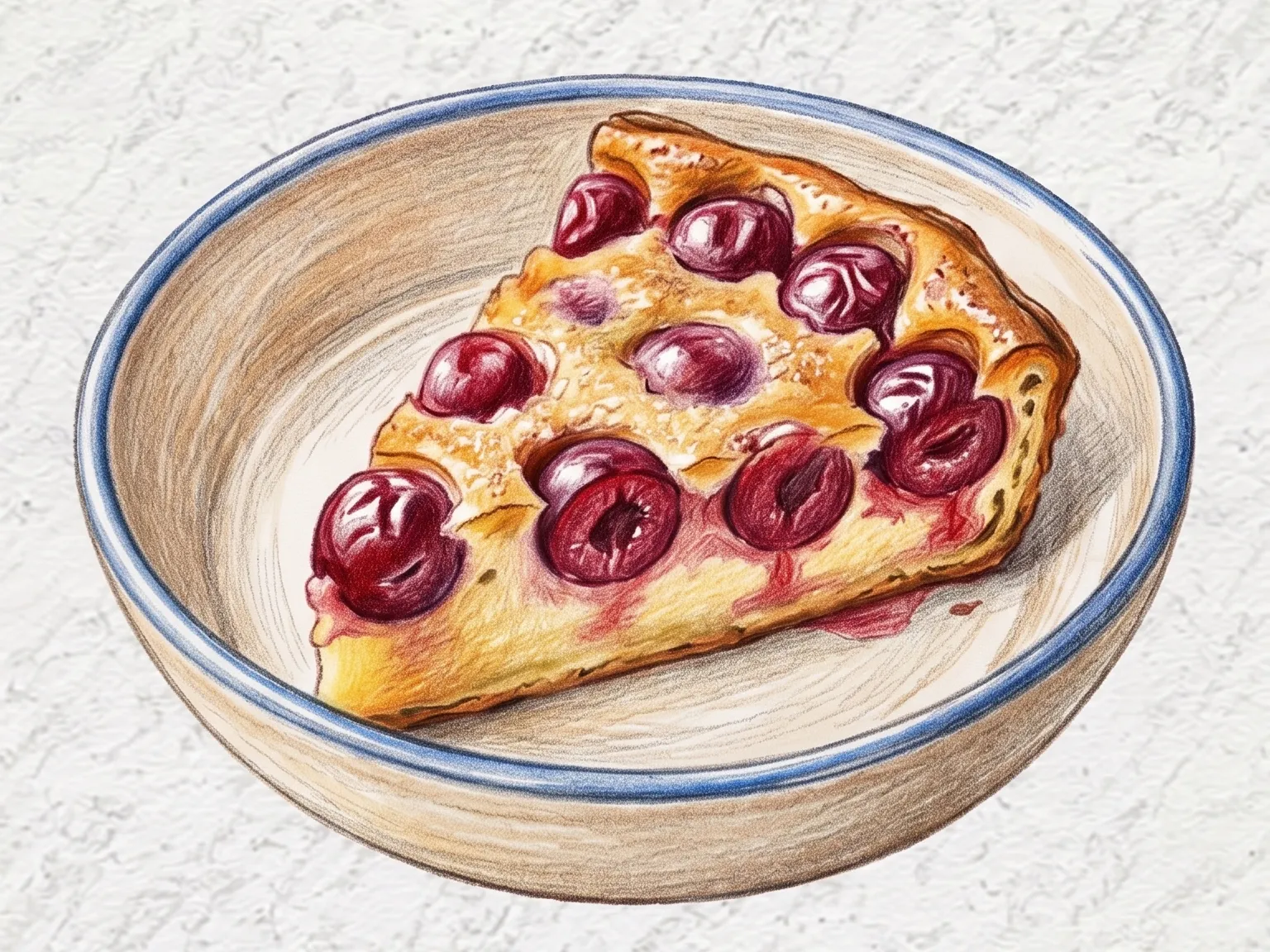
Clafoutis is a traditional French dessert from the Limousin region made by arranging fresh cherries in a buttered baking dish, then pouring over a thin batter of eggs, sugar, milk, and flour and baking at 180 degrees Celsius for thirty to thirty-five minutes. The batter is considerably thinner than pancake batter, and the result when baked is a texture that sits between a creamy custard and a light sponge -- the edges puff and turn golden while the center around the cherries stays moist and yielding. Using unpitted cherries is the traditional method: the pits release a faint almond scent during baking that perfumes the surrounding batter in a way that pitted fruit cannot replicate. The cherries also hold their shape better with the pits in. Vanilla extract deepens the egg-and-milk base, and the cherries' own tart juice seeps into the batter during baking, creating concentrated pockets of fruit flavor that balance the overall sweetness. Clafoutis is served directly from the baking dish, typically dusted with powdered sugar and brought to the table while still warm, because the custard texture softens and loosens slightly as it cools, making the warm version noticeably more appealing. Made with blueberries, plums, or apricots instead of cherries, the dessert takes a different name -- flaugnarde -- though the technique remains identical.
Pasta alla Gricia (Roman Guanciale Pecorino Black Pepper Pasta)
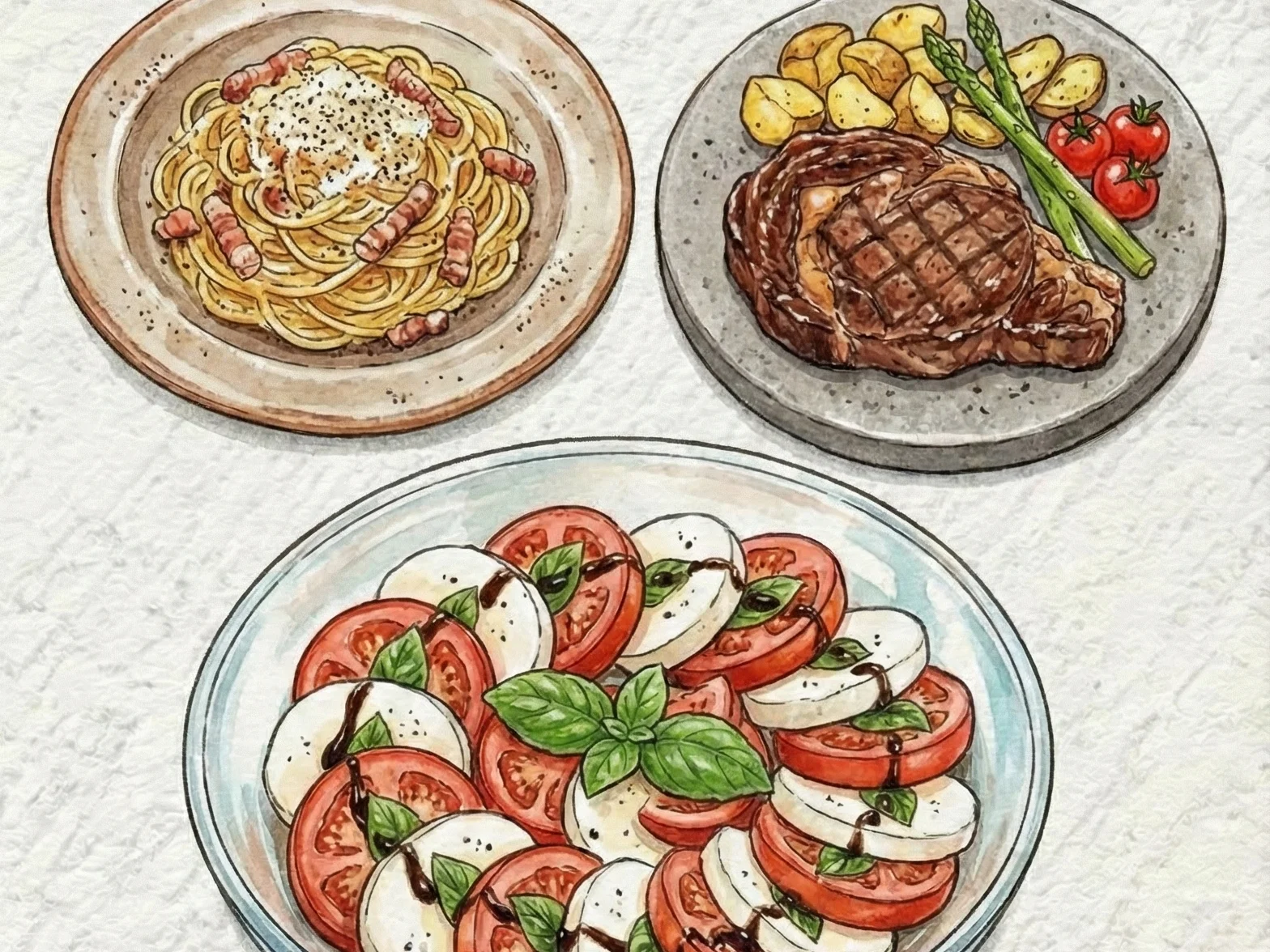
This two-serving pasta uses 200 g spaghetti, 120 g guanciale, 60 g Pecorino Romano, and black pepper. Cut the guanciale into long strips about 5 mm wide and place it in a cold pan over low heat. Cook it slowly for about 8 minutes, lowering the heat if necessary, until the fat looks clear and the edges are crisp without being scorched. Grate the Pecorino very finely before boiling the pasta, because coarse shreds are more likely to seize into lumps. Cook the spaghetti in water seasoned with 1 teaspoon salt until 1 minute short of al dente, and reserve 1 cup of the starchy water before draining. Add the pasta to the guanciale pan with 1/2 cup of that water and toss over medium-low heat for about 1 minute. The liquid is ready for the cheese when the pork fat and water have joined into a glossy coating instead of separating in the pan. Turn off the heat, or reduce it to the lowest setting, and add the grated Pecorino and 1 teaspoon black pepper in several portions while tossing quickly with tongs. If the sauce becomes too tight, loosen it one spoonful at a time with the remaining pasta water. Serve immediately when a thin, smooth cheese emulsion coats the noodles and the guanciale still has crisp edges.
Watermelon Feta Salad
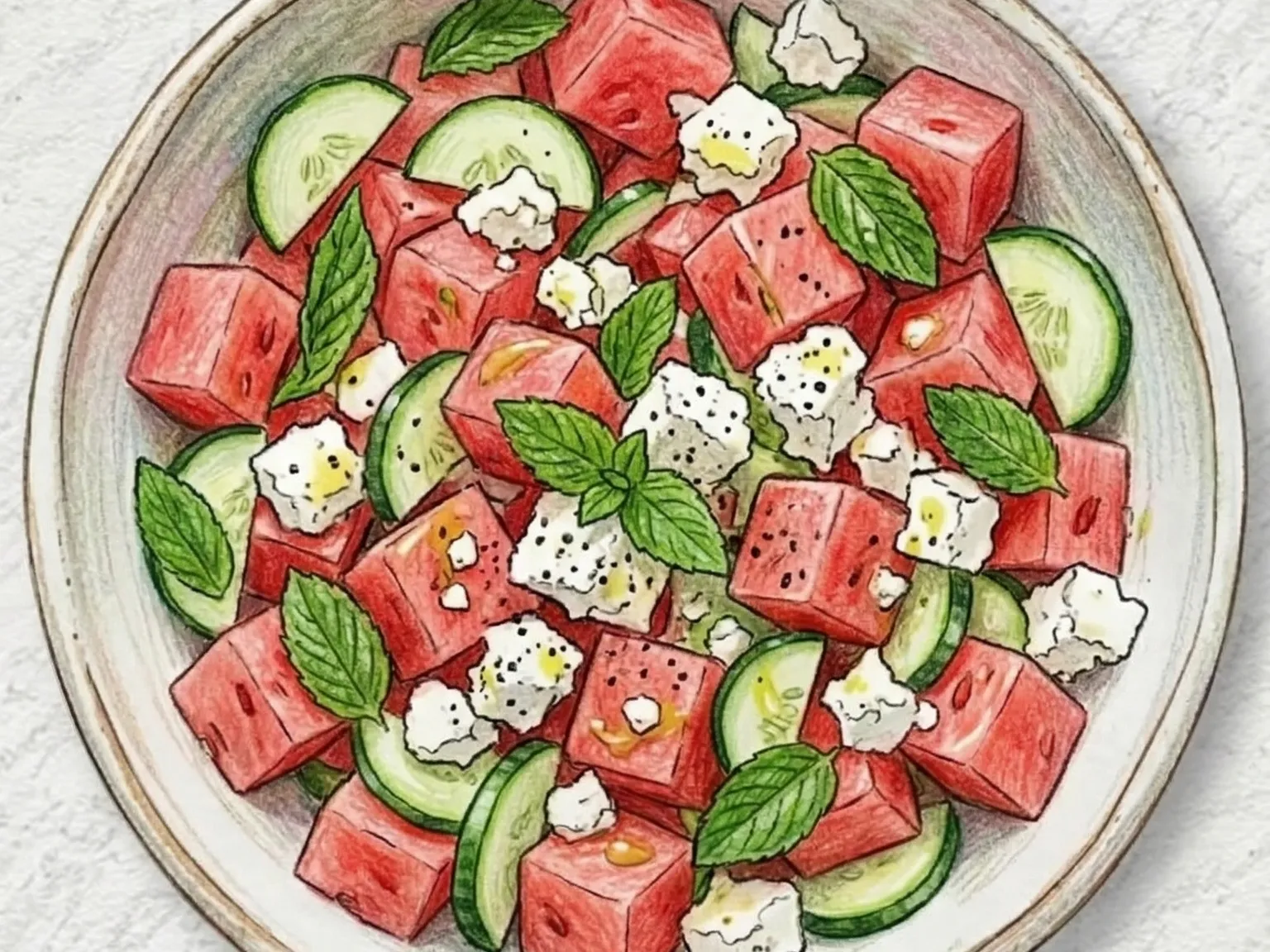
Watermelon feta salad combines chilled watermelon, cucumber, feta cheese, and mint with olive oil and lime juice. Chill 300 g watermelon thoroughly, remove the seeds, and cut the flesh into bite-size cubes. If the cut pieces release a noticeable amount of juice, rest them briefly in a sieve before assembly. Slice 100 g cucumber into thin half-moons. Remove any tough stems from 8 g mint and chop the leaves roughly without crushing them. Place the watermelon and cucumber in a wide bowl, then drizzle 1 tbsp olive oil and 1 tbsp lime juice around the sides. Lift the pieces gently from the bottom instead of pressing them. Crumble 80 g feta by hand into a mix of small and medium pieces and scatter it evenly over the bowl. Add 0.2 tsp black pepper and the prepared mint, then turn the mixture only 3 or 4 times. Stop before the corners of the watermelon cubes begin to break. Serve immediately, or refrigerate for only about 10 minutes if the salad needs to be colder. Draining released watermelon juice and limiting the final mixing reduce the amount of liquid that collects in the bowl. Adding the feta and mint near the end also avoids crushing them while coating the melon and cucumber with the measured dressing.
Currywurst (Sliced Sausage in Curry Ketchup)
Currywurst is a German street food built around a homemade curry-tomato sauce ladled over sliced bratwurst. Finely chopped onion is sautéed until translucent, then tomato paste is cooked for one minute to mellow its raw acidity. Ketchup, curry powder, paprika, sugar, Worcestershire sauce, and apple cider vinegar are stirred in and simmered for eight minutes until the sauce thickens and the spices meld. Bratwurst is browned separately in a pan, rolled to crisp all sides, then sliced into bite-size rounds. A final dusting of curry powder over the sauced sausage intensifies the spice aroma, and the sauce improves noticeably after resting overnight.
Classic Artisan White Sourdough
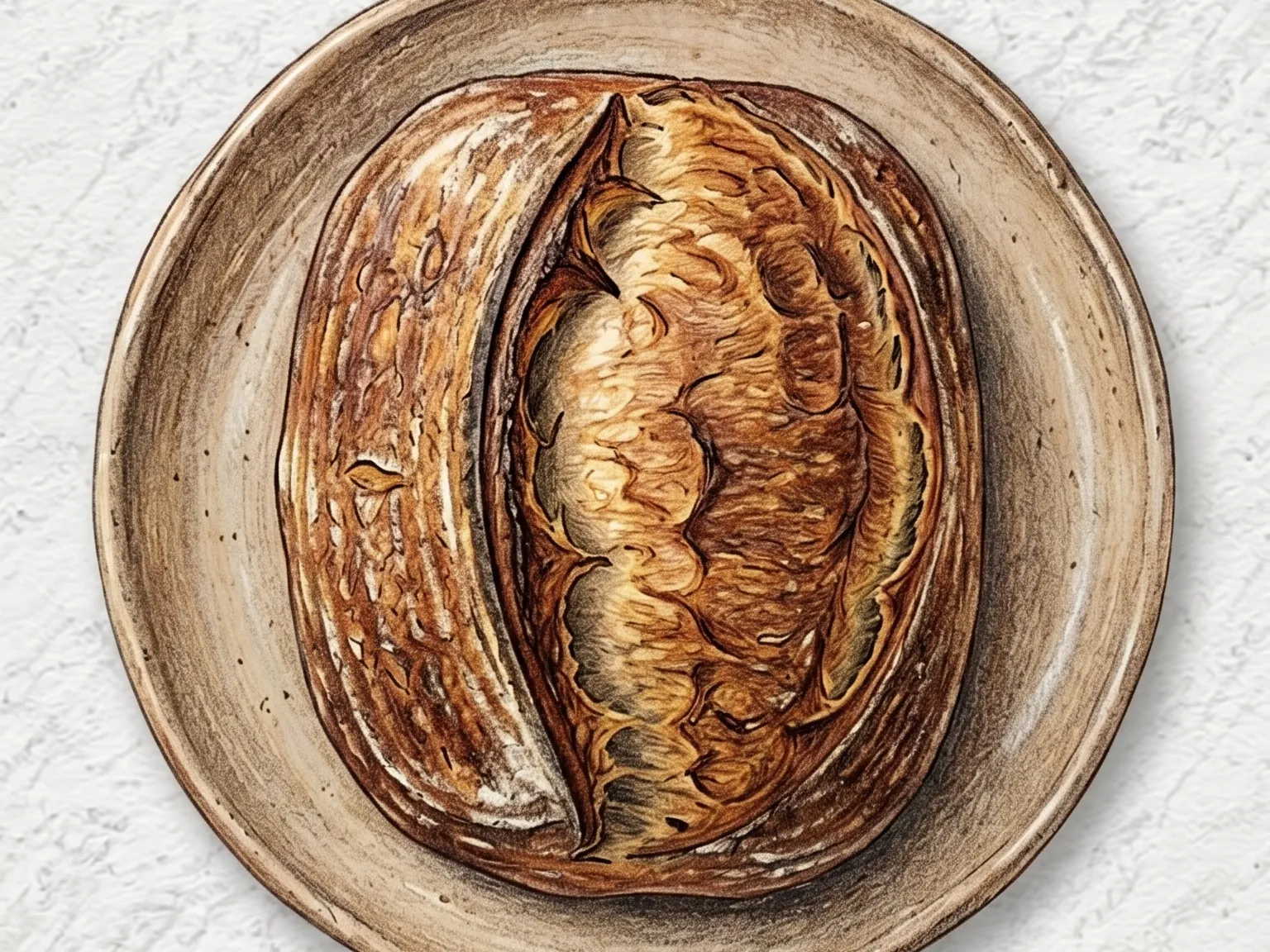
This artisan bread is prepared using a traditional fermentation process to develop a deep, tangy flavor. The recipe begins with a one-hour autolyse step, mixing bread flour, whole wheat flour, and water to hydrate the flour and build the dough structure. Active sourdough starter and salt are then incorporated. The gluten structure is developed through four rounds of stretching and folding at intervals of thirty to forty-five minutes. After a room-temperature bulk fermentation, the dough undergo a cold fermentation in the refrigerator for twelve to fifteen hours to build its complex acidity. Once shaped and proofed in a floured banneton basket, the loaf is baked in a preheated Dutch oven. Baking covered for twenty minutes traps the steam to yield a soft interior, while another twenty minutes uncovered creates a browned, crispy crust.
Pasta alla Norma (Sicilian Fried Eggplant Tomato Pasta)
Pasta alla Norma is a Sicilian eggplant and tomato pasta associated with Catania. Cut 220 g eggplant into 1.5 cm cubes, salt the pieces, and leave them for 10 minutes. Pressing away the beads of moisture helps the eggplant brown instead of steaming and keeps the centers firm enough to hold their shape in the sauce. Spread the cubes in one layer in 2 tablespoons olive oil and turn them for 6 to 8 minutes until several sides are golden. Add 2 minced garlic cloves for only 30 seconds, then pour in 300 ml tomato passata and simmer for 5 to 7 minutes. Cook 220 g spaghetti until just short of al dente, transfer it to the pan 1 minute before the package time, and reserve some pasta water. Maintain medium-low heat and toss the noodles for 1 minute, adding the starchy water in small splashes until the tomato sauce coats them smoothly. Turn off the heat before adding 8 g fresh basil and 30 g parmesan. The finished plate combines browned eggplant with a soft center, a concentrated tomato sauce, fragrant basil, and a salty cheese finish.
Classic Wedge Salad
Wedge salad keeps iceberg lettuce in large sections instead of separating the leaves, pairing its cold, firm texture with blue-cheese dressing and crisp bacon. Lay 120 g bacon in a skillet without overlapping and cook over medium-low heat for 8 to 10 minutes. Let the fat render gradually; once the edges are crisp, move the bacon to paper towels, cool it completely, and crumble it into small pieces. Take half of the 60 g blue cheese and mash it finely. Mix it with 1/2 cup sour cream, 2 tablespoons mayonnaise, and 1 teaspoon lemon juice, leaving a few small cheese pieces rather than blending the dressing perfectly smooth. Cut 1 head of iceberg lettuce into 4 wedges while keeping part of the core attached to each section so the stacked leaves do not fall apart. Rinse the wedges in cold water and shake out the moisture trapped between the cut layers. Careful drying prevents water from thinning the creamy dressing on the plate. Halve 120 g cherry tomatoes, slice enough chives for 1 tablespoon, and keep the bacon cool until assembly. Place each wedge with its cut faces visible and spoon the dressing slowly over the top so some runs between the leaves. Add the bacon, tomatoes, remaining blue cheese, and chives evenly. Dress the wedges only when they are ready to be served, since an early coating softens the lettuce. If the blue cheese tastes too assertive, reduce its amount and replace part of it with Parmesan while keeping the same basic method.
Oven-Roasted Chicken Drumsticks
Dak-dari oven-gui is a Korean oven-roasted chicken drumstick dish where the legs marinate for at least thirty minutes in a mixture of soy sauce, minced garlic, olive oil, and a dried herb blend before going into a 200-degree-Celsius oven. Bringing the drumsticks to room temperature before roasting closes the temperature gap between the surface and the bone, ensuring the meat cooks through evenly rather than having a cooked exterior with an underdone center. Flipping the pieces once at the halfway point promotes uniform browning on both sides and prevents the exposed skin from drying out. Raising the oven temperature to 220 degrees for the final ten minutes drives caramelization in the sugar-containing soy marinade, which produces a thin, lacquered crust on the skin. The salty depth of soy sauce, the mild fat of olive oil, and the fragrance of the herb blend combine with the rendered chicken fat to form a coating that is both deeply savory and aromatic. Marinating overnight in the refrigerator allows the soy and garlic to penetrate further into the meat, resulting in more pronounced flavor all the way to the bone.
Classic Bagel
Classic bagels are defined by a two-stage cooking process that no other mainstream bread undergoes: the shaped rings are boiled before they are baked, and it is that boiling step that creates everything distinctive about the finished product. The dough is made with high-gluten bread flour and deliberately low hydration, then kneaded extensively to build a dense gluten network strong enough to resist expansion in the oven. After shaping into rings and a brief second proof, the bagels are lowered into boiling water -- often sweetened with honey or malt syrup -- and held there for about a minute per side. The heat gelatinizes the starch on the outer surface, forming a thin, tight skin that acts as a physical barrier against the gas trying to expand inside. When the boiled rings go into a hot oven, that skin constrains the rise so the interior stays compressed and dense rather than open and airy. The result is a crust that is firm, slightly shiny, and resilient under pressure, surrounding an interior with a chewiness measured in seconds of resistance rather than the instant softness of most bread. Adding honey or malt to the boiling water contributes a faint sweetness and a deeper color to the finished crust. In New York tradition the bagel is split, toasted, and loaded with cream cheese and smoked salmon, but sliced in half and toasted with butter alone, the structure of a well-made bagel carries the eating experience entirely on its own.
About Western
Olive oil, butter, cream, and cheese create the rich flavors these dishes are known for. From special-occasion dinners to quick weeknight meals, these recipes make Western cooking approachable.